

Founder Tool Chaos: Why Too Many Startup Tools Are Killing Focus
Introduction
Modern founders have access to more startup tools than ever before.
From CRM platforms to financial modeling tools, from task managers to pitch deck software — everything is available at your fingertips.
But instead of making startups easier to run…
These tools are creating a new problem:
Tool chaos.
Founders today aren’t struggling because of lack of tools.
They’re struggling because of too many disconnected tools.
The Illusion of Productivity in Startup Tools
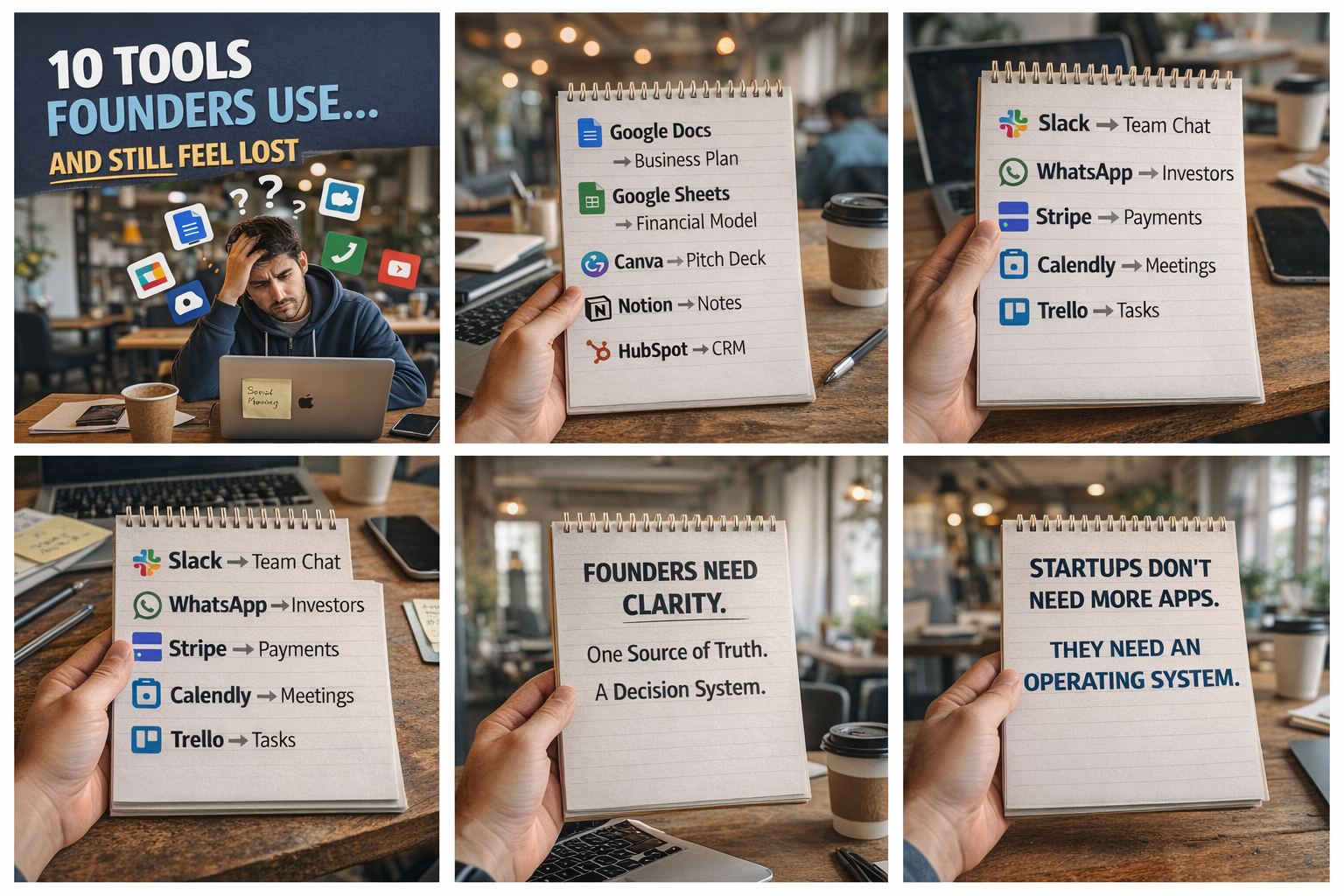
A typical founder stack looks like this:
- Google Docs for planning
- Google Sheets for financial models
- Notion for documentation
- HubSpot for CRM
- Slack or WhatsApp for communication
- Trello or Jira for task management
Individually, these are powerful startup management tools.
But together?
They create fragmentation.
You’re switching tabs all day, responding to notifications, updating dashboards…
And yet, something feels off.
You’re busy — but not clear.
What Is Tool Chaos in Startups?
Tool chaos (also called tool sprawl) happens when startups rely on multiple disconnected tools to manage critical operations.
This leads to:
- No single source of truth
- Repeated data entry
- Context switching
- Misalignment across teams
Your startup ends up living in pieces — scattered across platforms.
The Hidden Cost of Tool Sprawl
1. Cognitive Overload
Every tool has its own system.
Your brain becomes the integration layer.
Instead of thinking strategically, you’re constantly:
- Switching contexts
- Rebuilding mental models
- Searching for information
Over time, this reduces your ability to make high-quality decisions.
2. No Single Source of Truth
Your data is everywhere:
- Financials → Sheets
- Strategy → Docs
- Tasks → Trello
- Leads → CRM
So when you ask:
“Where does my startup actually stand?”
There’s no clear answer.
3. Poor Decision-Making
Startups run on decisions.
But fragmented data leads to:
- Delayed decisions
- Wrong assumptions
- Misaligned execution
And in early-stage startups, bad decisions compound quickly.
4. Founder Burnout
Studies and observations show:
Founders spend 30–40% of their time managing tools instead of building the company.
That means:
- Less time on customers
- Less time on strategy
- More time on operations
This is one of the biggest hidden drivers of founder burnout.
Why Adding More Tools Makes It Worse
When things feel messy, founders often respond by adding another tool.
Better CRM.
Better dashboard.
Better planning software.
But this doesn’t solve the problem.
It amplifies it.
Because the issue isn’t capability —
it’s lack of structure.
The Real Problem: Startups Lack Systems
Startups don’t fail because they lack tools.
They fail because they lack:
- A unified system
- Connected workflows
- Clear decision frameworks
What founders need is not another SaaS tool.
They need a startup operating system.
What Is a Startup Operating System?
A startup operating system is a unified platform where:
- Planning
- Financials
- Execution
- Metrics
…are all connected.
Instead of managing tools, founders manage outcomes.
Instead of searching for data, they see insights.
Instead of reacting, they operate with clarity.
From Tool Stack to System Thinking
We’ve seen this shift before:
- Computers moved from programs → operating systems
- Phones moved from apps → ecosystems
Now startups are evolving from:
Tool stacks → Operating systems
The question is no longer:
“Which startup tools should I use?”
It’s:
“What system should I run my startup on?”
Why This Matters for Early-Stage Founders
In early-stage startups:
- Every decision matters
- Every week counts
- Every mistake is expensive
Without clarity:
- Burn rate drifts
- Teams misalign
- Strategy gets lost
The founders who win are not the busiest ones.
They are the ones with:
The clearest systems and the strongest decision-making frameworks.
Final Thoughts
If you feel overwhelmed as a founder…
It’s not because you’re not working hard enough.
It’s because your system is fragmented.
No amount of hustle can fix a broken system.