How to build a daily AI routine for founders
 Baltej Singh8 min read
A daily AI routine for founders is a fixed day shape with gates, not a pile of chat prompts. Morning, you read what changed. Midday, you clear actions that write outside the company. Standing jobs run on a schedule with stop rules. Evening, you close loops so tomorrow's brief is not yesterday's mess. Without gates, automation becomes a second inbox that sends before you think.
This guide is product education from Nautis help on Chief of Staff and Routines as of October 2026. It is a working template you can run even if you only adopt the calendar habits. Confirm Autonomy settings in your own workspace before you promote anything to auto-run.
A daily AI routine for founders starts as three blocks
Block one is intake: what needs you today. Block two is judgment: approve, reject, or rewrite anything that leaves the building. Block three is standing orders: narrow jobs that run without you reinventing the prompt. Founders who only do block three wake up to surprise sends. Founders who only do block one never ship the boring work AI is good at.
Put the three blocks on the calendar with real times in your timezone. A routine that is "whenever I remember" is not a routine.
Morning: read the brief before you open freeform chat
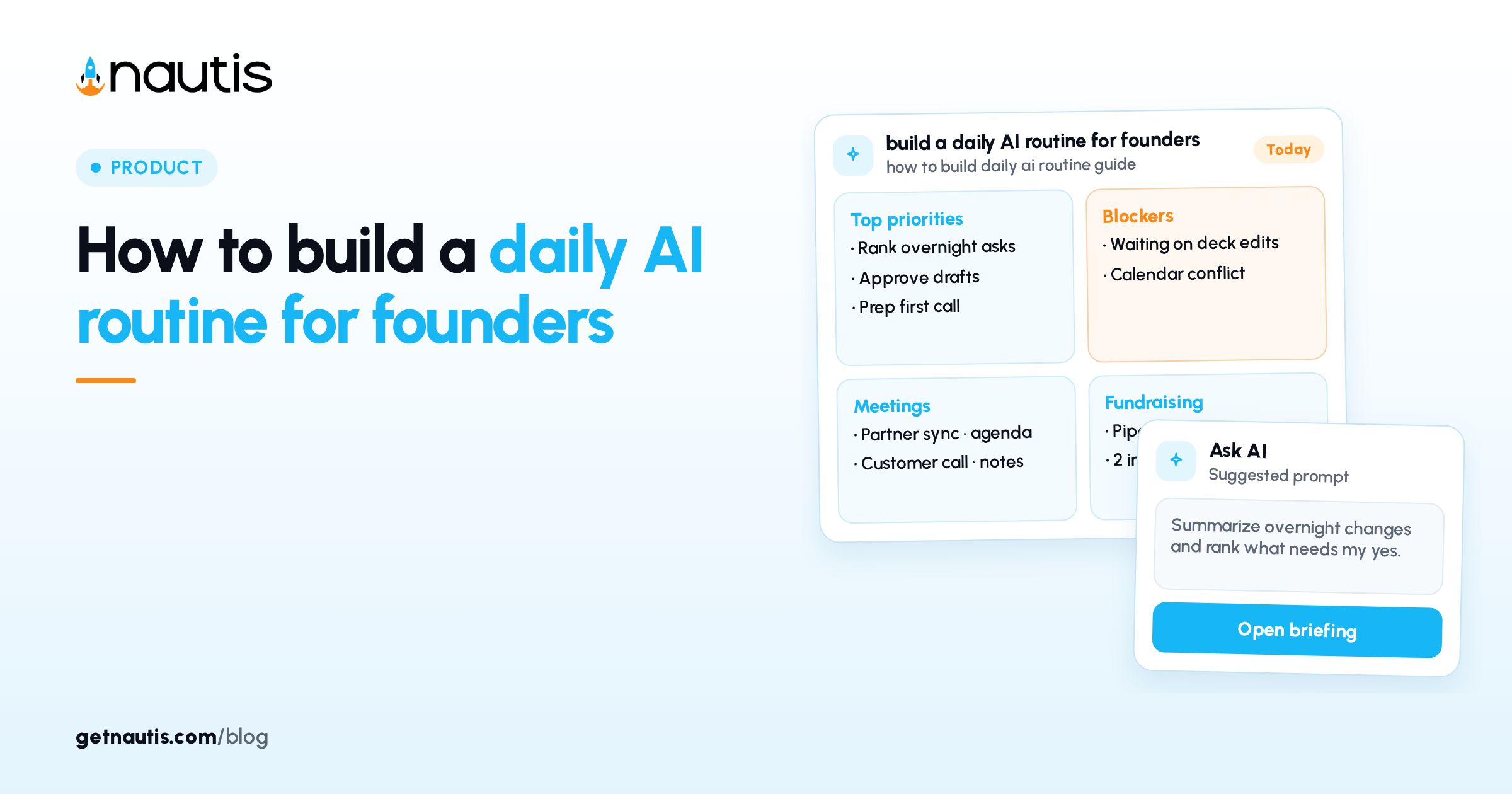
Start with a ranked picture of the company day, not with a blank chat box. In Nautis, the Chief of Staff Briefing is generated each morning at 7:00 am in the organization timezone and groups Priorities, Blockers, Approvals, Pipeline, Today, and Runway. Skim severity, open the source module for anything Critical, and decide what you will personally touch before noon.
Do not ask chat to "catch me up" until you have marked done, snoozed, or dismissed the items that are already ranked. Teaching the brief with those actions is part of the routine. Skipping straight to chat trains you to ignore the queue that already did the ranking work.
Keep morning intake under thirty minutes. If the brief is longer than that, the problem is too many open systems or too many snoozes, not a need for a longer AI monologue.
Midday: clear writes that leave the building
Approvals are the judgment block. Owners and admins review agent actions in the Approval Center. Anything that sends email, changes an external record, or otherwise writes outside should stay on ask-first until you have clean history. A daily AI routine that never opens Approvals is how polite drafts become public mistakes.
Name one human owner for the Approvals tab. Shared "someone will look" ownership produces contradictory tones and late rejects. Clear Waiting for approval the same day the run finished. Overnight piles create Friday panic.
When you reject, write why in one line. That note is how you tighten the next routine instead of arguing with the same bad draft next week.
Standing orders with schedules and stop rules
Routines are standing orders for agents. Pick a catalog job or a narrow custom instruction, set cadence (every day, weekdays, weekly, or monthly) or a trigger, and choose how you hear back. Writes still follow your approval rules. Plan caps apply: 5 routines on Launch, 10 on Voyage, 15 on Fleet as totals, not a monthly allowance. Paused routines still count until removed.
Stop rules belong in the design:
- Read-only first for any new job
- Ask every time for external writes until a month of clean runs
- One owner named on the routine card
- Kill or pause after two bad runs in a week
- No custom "handle my whole company" goals on day one
Triggered routines (new lead, decision logged, and similar events) need the same gates. A trigger is not permission to auto-send.
What belongs in automation versus founder hands
Work type | Put in the daily AI routine | Keep in founder hands |
|---|---|---|
Ranked morning brief | Yes: scan and act on items | Strategy calls that need taste |
Drafts that leave the company | Propose only; approve midday | Final send on money, hiring, legal |
Recurring digests | Catalog routine on a schedule | Narrative investor letters you own |
Meeting cleanup | Summarize and propose tasks | Promises you make in the room |
Destructive deletes | Always ask; do not auto | Confirm before anything irreversible |
If a task needs your voice for a customer promise, keep the human gate. If a task is ranking open blockers from systems you already trust, let the brief do it.
Wire the day in Nautis without turning it into theater
Use Chief of Staff for the morning brief and Approvals. Use Routines for standing orders you will actually clear. Autonomy settings decide ask versus auto-run per capability; only owners and admins change them. The product line is that nothing acts without your approval policy, including auto-run actions that still audit-log.
In Approvals, each card shows which agent asked, when, what the action is, and a plain-language summary. Open Show details before you approve anything that sends text outside the company. Use the Pending / All toggle to review Approved, Rejected, Cancelled, and Expired history; unattended requests expire on their own. Autonomy labels each capability External (touches the outside world) or Internal (stays inside Nautis). Keep External on Ask every time until you have a week of clean Approvals history.
Delivery for routines can be in-app notification, email summary, or Chief of Staff chat. Pick one primary channel so summaries do not scatter. Try a routine once before you schedule it; test runs still ask before writes and use credits.
Weekly digest and evening debrief style jobs belong after the daily loop is stable. Adding seven catalog cards on day one guarantees an Approvals backlog you will ignore.
Two founder day shapes (examples)
Gated day
Priya reads the 7:00 brief at 7:20, clears three Critical items, and leaves chat closed until 11:30. At noon she empties Approvals: two email drafts approved, one rejected with a note. Two weekday routines propose a pipeline summary and a task digest. Nothing auto-sends. Her afternoon deep work stays intact.
Prompt pile
Jon starts in chat every morning with "what should I do." He has twelve routines, half custom, all allowed to draft outward. Approvals sit for three days. A follow-up goes out with last month's pricing. He pauses everything, cuts to three catalog routines, and rebuilds the midday gate before turning anything back on.
Failure modes that look productive
- Opening chat before the brief
- Auto-run on external send because Approvals felt slow
- Custom routines that cannot state a stop condition
- Five people approving with no named owner
- Counting paused routines against the plan cap and wondering why you cannot add a better job
- Measuring success by messages generated instead of decisions closed
If two of those show up together, pause new routines for a week and repair the gates.
Same-week install checklist
- Block morning intake and midday Approvals on the calendar
- Read one full brief and mark done, snooze, or dismiss with intent
- Name the Approvals owner (owner or admin)
- Add at most three catalog routines with weekday or daily cadence
- Keep external writes on ask every time
- Run each new routine once and read the transcript
- Kill any job that cannot state what it must never do
- Review Friday: credits used, rejects, and whether deep work survived
A daily AI routine for founders works when the calendar, the brief, and the approval gate agree.
Treat chat as a surgical tool after intake, not as the operating system. Ask for one artifact at a time: a rewritten rejection note, a shorter brief item, or a draft you will still approve. Broad "run my company" prompts recreate the prompt pile.
When a routine summary arrives on email and in chat, pick one channel and turn the other off for that job. Duplicate delivery trains you to ignore both.
Share the Friday review with co-founders in ten minutes: what ran, what was rejected, what deep work survived. If nobody can answer those three, the routine exists only on paper.
New hires should receive the one-page routine note in week one. Surprise automation is a trust problem inside the team before it ever becomes an external send problem.
If you use Slack delivery for routine summaries, keep Approvals in Chief of Staff so the judgment gate does not move to a noisy channel. Summaries can fan out; writes still need the named owner.
Seasonal spikes (fundraise weeks, launch weeks) are when people disable gates. Instead, pause low-value catalog jobs and keep ask-first on external writes. Stress is the worst time to promote auto-run. AI then handles ranked intake and narrow standing orders while you keep judgment on anything that changes money, hiring, or customer promises.
Revisit Autonomy only on a scheduled Friday, not at midnight after a tedious approval. Late widenings are how stop rules die.
Keep a one-page note of which routines exist, their cadence, and their owner. When a co-founder asks "what is the AI doing," that note is the answer.
If credits run low, protect the brief and the approval path first. Cut research-style catalog jobs before you cut the morning ranking that saves you from scavenger hunts. Routines that only summarize inside the workspace are cheaper mistakes than routines that send; pause senders first when credits are tight.
Frequently asked questions
What is a daily AI routine for founders?
It is a fixed day shape: morning intake from a ranked brief, midday approval of external writes, and a small set of scheduled standing orders with stop rules. Chat is a tool inside that shape, not a replacement for it.
How do Nautis Routines fit a daily routine?
Routines are standing orders that run on a schedule or trigger. Catalog jobs are safer than broad custom goals at first. Writes still follow Autonomy and Approval Center rules, and plan caps limit how many routines you can keep.
Should AI auto-send email in a daily routine?
Keep external sends on ask every time until you have a stretch of clean approvals with no bad recipients or tone rejects. Speed comes from clearing Approvals on a midday block, not from removing the gate.
How many AI routines should a founder start with?
Start with at most three catalog routines you will actually clear. Add more only after Friday reviews show clean runs and protected deep work. Plan limits are totals across the workspace, and paused routines still count until removed.
Sources
- Nautis Routines help. Checked on October 31, 2026.
- Nautis Chief of Staff help. Checked on October 31, 2026.
Baltej Singh is a serial entrepreneur, technology leader, and Founder & CEO of Nautis and DemoVexa, with over 16 years of experience building software products, SaaS platforms, and startups. Previously the Co-Founder & CTO of SanchiConnect, he has worked extensively in the DeepTech startup ecosystem, connecting with 200+ venture capital firms and supporting a network of 4,000+ startups. Passionate about AI, automation, and entrepreneurship, he focuses on building innovative products that solve real-world problems and help businesses grow.