How to run an AI evening debrief as a founder
 Baltej Singh8 min read
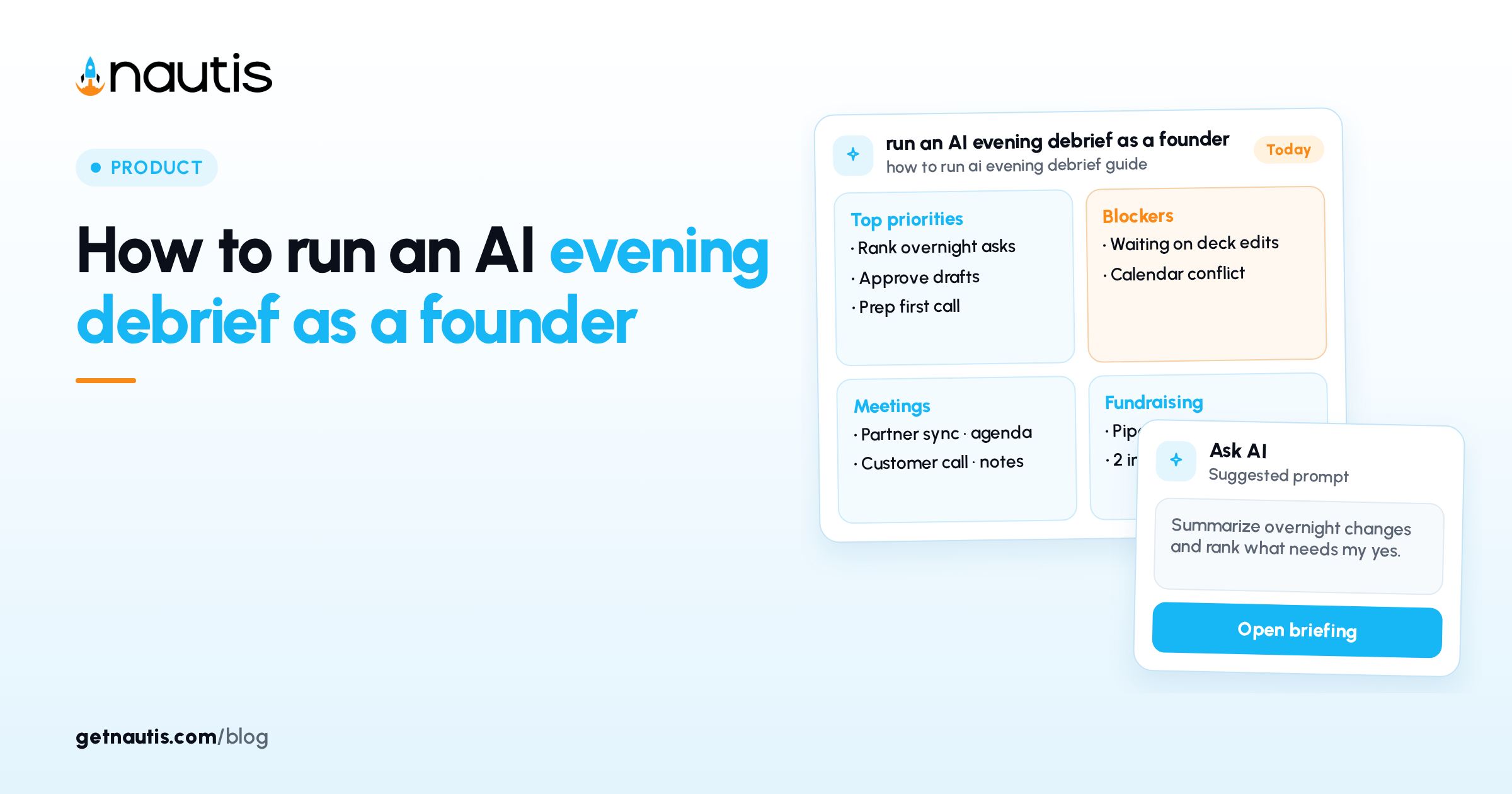
An AI evening debrief for founders is the short close of day that names what moved, what stalled, and what deserves tomorrow before you shut the laptop. Morning briefs start the day. Evening debriefs end it. Without a close, open loops follow you into dinner and reappear as panic in tomorrow's ranking.
This guide is product education from Nautis Chief of Staff and Routines help as of October 2026, plus a founder habit you can run even on paper. In Nautis the evening debrief runs at 5:00 pm in the organization timezone with a "what moved today, what's first tomorrow" framing, and it stays off until a workspace admin enables it.
What a useful evening close contains
Keep the ritual small enough that you will actually do it:
- What moved: shipped work, closed decisions, money or pipeline changes with dates
- What stalled: blockers still open, with an owner
- What is first tomorrow: one to three items, not a fantasy backlog
- Approvals still waiting: anything that writes outside and sat all afternoon
- Personal shutdown: which threads you will not reopen tonight
If the debrief becomes a second status meeting, you will skip it by Thursday.
AI evening debrief for founders versus the morning brief
Moment | Job | Failure mode |
|---|---|---|
Morning briefing | Rank what needs you today | Opening chat before you read the queue |
Midday Approvals | Clear outward writes | Letting Waiting for approval pile overnight |
Evening debrief | Close loops and set tomorrow's first moves | Rewriting the whole roadmap at 9 pm |
Weekly digest | Last week / week ahead on Monday | Treating every night like a board meeting |
Morning asks "what matters now." Evening asks "what is still true after the calendar ended." Do not merge them into one endless scroll.
Turn the product on, then protect the calendar block
In Nautis, ask an owner or admin to enable the evening debrief. Until that flag is on, the built-in Evening Wrap-up routine stays paused. After enablement, History can show Evening entries beside daily briefings and Monday Weekly digests.
Put a fifteen-minute block on your calendar at or just after 5:00 pm local. Read the debrief first. Then act: mark done, snooze with intent, create one task for tomorrow's first move, and open Approvals if anything still waits. Do not start a new strategy chat unless the debrief surfaces a decision that must land tonight.
How to run the human half of the debrief
Write three lines before you negotiate with the model
Even with an AI summary, force your own three lines: moved, stalled, tomorrow. Compare them to the generated debrief. Where they disagree, fix the underlying task or CRM row, not the prose. The point is a shared picture, not a prettier paragraph.
Clear outward work before you leave
If a routine or agent left actions Waiting for approval, decide now. Overnight queues create morning fires. Keep external sends on ask-first; the evening ritual is for judgment, not for flipping Autonomy wider because you are tired.
Park work that is not tomorrow
Move nice-to-haves out of tomorrow's first three. Evening is when ambition tries to sneak back in. A short tomorrow list is a feature.
Standing orders that support the close without spamming you
Routines can deliver an evening wrap on a weekday cadence once the evening brief is enabled. Prefer read-only or ask-first writes. Delivery can be in-app, email summary, or Chief of Staff chat; pick one channel so you do not ignore duplicates.
Do not stack five custom "end of day" jobs. One wrap that summarizes movement plus your manual Approvals pass beats a chorus of digests. Plan caps still apply (5 / 10 / 15 by plan as totals), and paused routines count once changed.
Pair the debrief with decisions you already logged
If you use a decision log or meeting notes habit, skim today's entries during the evening block. Promises made on calls that never became tasks are how mornings feel haunted. Create the missing task with an owner before you close. The debrief can then rank it tomorrow instead of relying on memory.
Founders who skip this step often "remember" work at 11 pm and reopen chat. Put the capture inside the fifteen minutes so night stays closed.
Team norms when more than one person ends the day
Name who owns Approvals after hours. If two admins both half-clear the queue, tone and timing conflict. One primary owner, with a backup for travel weeks, is enough.
Share tomorrow's first moves in a channel that is not the customer inbox. A public dump of internal blockers into email is how evening discipline becomes a new leak. Keep the close inside Chief of Staff, the task board, or a private founder thread.
When a teammate works late in another timezone, do not force their shutdown to your 5:00 pm. Use the organization timezone for the generated debrief, then let remote founders run a personal three-line close at their local end of day. The artifact matters more than synchronized theater.
What not to automate at night
Do not schedule outward customer or investor sends for the evening wrap. Tired approvals are how wrong pricing or wrong names leave the building. Keep night automation on summaries, task proposals, and read-only digests.
Do not let a custom routine rewrite the company brief or the deck after hours. Fact changes need daylight and a second pair of eyes. Evening is for parking work, not for mutating source truth.
If a run fails three times and pauses, fix the cause tomorrow morning. Repeating Run now at midnight usually burns credits without fixing permissions or empty modules.
Where Nautis fits without replacing shutdown discipline
Chief of Staff owns the morning briefing, Approvals, Autonomy settings, History (including Evening when enabled), and the dashboard hero card. The evening debrief is the same family of ranked company signal, timed for close of day.
Use Approvals as the last gate. Owners and admins decide agent actions. A debrief that lists a draft email is not permission to auto-send it.
If credits are tight, protect morning ranking and evening close before research-style catalog jobs. Quiet nights with nothing urgent still teach the system when you mark the day honestly.
Two close-of-day scenes (examples)
Clean shutdown
Maya enables evening debriefs, reads the 5:00 summary at 5:10, clears one approval, writes "tomorrow: finish security questionnaire draft," and closes the laptop. Morning briefing the next day opens on that item instead of a scavenger hunt through Slack.
Fake debrief
Jon asks chat at 10:30 pm to "summarize my life." He has not enabled evening debriefs, Approvals are three days deep, and tomorrow's list has fourteen bullets. He sleeps poorly and spends morning intake re-deriving what an evening pass would have frozen.
Failure modes that keep the day open
- Skipping enablement, then blaming the product for silence at 5 pm
- Using evening time to redesign strategy instead of closing loops
- Leaving Waiting for approval overnight as a habit
- Writing a tomorrow list longer than you can start before lunch
- Running duplicate wrap routines on email and chat until you ignore both
- Measuring success by words generated instead of decisions parked cleanly
If two show up in one week, pause new routines and restore the fifteen-minute block.
Same-week install for the evening close
- Ask an admin to enable the evening debrief for the workspace
- Confirm Evening Wrap-up is active only after that enablement
- Block fifteen minutes after 5:00 pm on weekdays
- Read the debrief before freeform chat
- Write your own three lines: moved, stalled, tomorrow
- Clear Approvals that still wait
- Cap tomorrow at three first moves
- Review Friday: nights you skipped, and whether mornings got quieter
An AI evening debrief for founders works when it ends the day on purpose.
On Fridays, add one extra line: what will wait until Monday on purpose. That single sentence prevents weekend guilt from turning into unfocused Saturday labor that helps nobody. Let the system draft what moved and what is first tomorrow. You still decide what ships outward and what waits until daylight.
Travel days still get a lighter close: three lines and Approvals only. Skipping for a week teaches open loops to become your default.
Share the tomorrow list with a co-founder when work spans both of you. A private debrief that contradicts the shared board creates morning conflict.
If the debrief says you are all caught up and your gut disagrees, refresh once, then fix the missing task or blocker in the source module so tomorrow's morning brief inherits truth. If the generated debrief is empty but your day was full, the gap is usually missing updates in tasks, CRM, or calendar, not a broken summary engine. Fix the source row so tomorrow inherits reality.
Frequently asked questions
What is an AI evening debrief for founders?
It is a short close-of-day summary of what moved, what stalled, and what should come first tomorrow. It complements the morning briefing instead of replacing it, and it pairs with clearing Approvals before you leave.
When does the Nautis evening debrief run?
At 5:00 pm in the organization timezone, framed as what moved today and what is first tomorrow. It is off by default until a workspace admin enables it. History stores Evening entries when enabled.
How is Evening Wrap-up related?
Evening Wrap-up is a built-in routine that stays paused unless the evening brief is enabled for the workspace. After enablement, owners and admins can schedule delivery and keep writes on ask-first.
Should I approve outbound sends during the evening debrief?
Clear waiting Approvals so they do not pile overnight, but be careful with tired sends. Prefer summaries at night and save sensitive customer or investor mail for a clearer head when needed.
Sources
- Nautis Chief of Staff help. Checked on October 31, 2026.
- Nautis Routines help. Checked on October 31, 2026.
Baltej Singh is a serial entrepreneur, technology leader, and Founder & CEO of Nautis and DemoVexa, with over 16 years of experience building software products, SaaS platforms, and startups. Previously the Co-Founder & CTO of SanchiConnect, he has worked extensively in the DeepTech startup ecosystem, connecting with 200+ venture capital firms and supporting a network of 4,000+ startups. Passionate about AI, automation, and entrepreneurship, he focuses on building innovative products that solve real-world problems and help businesses grow.