What belongs in a founder weekly AI digest
 Baltej Singh8 min read
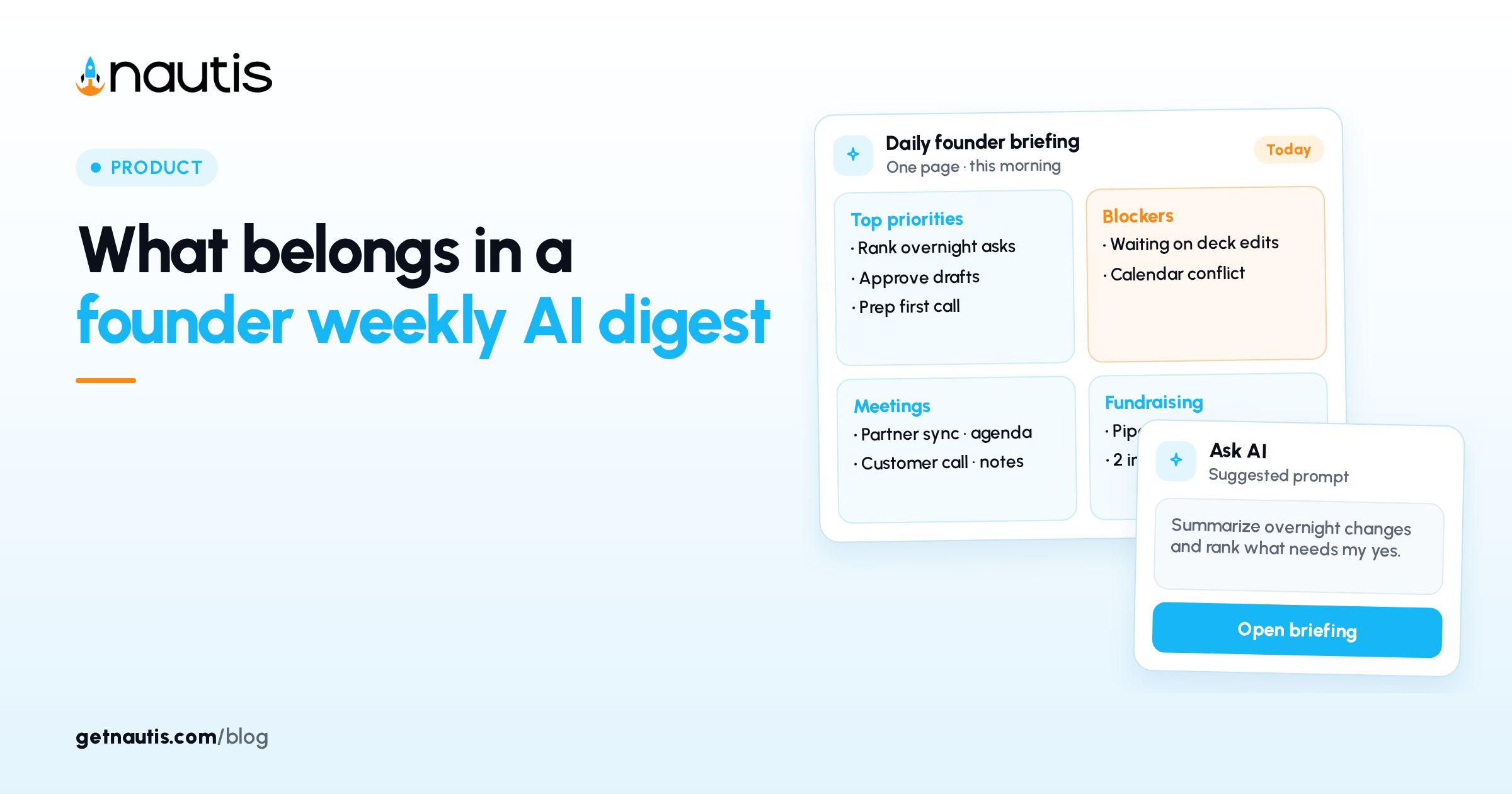
A founder weekly AI digest is the Monday zoom-out: what moved last week, what matters this week, and which numbers or approvals still need a human. Daily briefs rank today. Evening debriefs close today. The weekly digest should be short enough to finish before your first meeting, not a second status theater.
In Nautis, weekly digests generate Monday mornings, archive under History with a Weekly label, and notify owners and admins when ready. This guide is product education from Chief of Staff and Startup Health help as of October 2026, plus a content checklist you can run even on paper.
What belongs in a founder weekly AI digest
Keep a stable skeleton so skimming works:
- One-line company state (shipping, fundraising, or firefighting)
- Runway and cash directional note with the date of the last Startup Health check-in
- Pipeline or revenue movement that changed decisions
- Decisions made and decisions still open
- Approvals or outward writes that waited too long
- Top three priorities for the week ahead
- One ask for co-founders or leads if needed
If a section has nothing real, write "none" rather than inventing drama.
Founder weekly AI digest versus daily and evening loops
Cadence | Job | Keep out |
|---|---|---|
Morning briefing | Rank today | Weekly strategy essays |
Evening debrief | Close today; set tomorrow's first moves | Full runway archaeology |
Weekly digest | Last week / week ahead | Every chat transcript |
Monthly Startup Health | Cash, revenue, burn check-in | Daily task noise |
The weekly read should inherit truth from those systems, not replace them with a new narrative language.
Runway and health without fake precision
Pull runway from the same source you trust for operations. In Nautis, Startup Health is a monthly check-in for cash, recurring revenue, and burn that produces runway and trend views. The digest should cite the check-in month, not a vibe. If the check-in is stale, say so and schedule the update; do not let the AI smooth over missing finance inputs.
Alerts from health tools belong as bullets with owners, not as adjectives.
Pipeline, decisions, and approvals
Pipeline changes that alter hiring or spend belong in the digest. Vanity stage moves do not. Name the metric the same way every Monday.
Decisions need a one-line record: what was decided, by whom, and what it unblocks. Open decisions need a due date. Without that, the digest becomes a museum of maybes.
Open Approvals are a weekly smell test. If outward agent actions sat all week, the operating system is broken even if the prose sounds calm. Clear the queue or pause the routines that create it. In Chief of Staff, that queue lives in Approvals; Owners and Admins are the people who can clear agent actions. A Monday digest that ignores a week-old approval card is theater.
How to keep the digest short enough to use
Cap the whole letter at a few minutes of reading. Use bullets. Ban restated mission statements. Link out to the task board or CRM for detail instead of pasting dumps.
Generate once, edit once. Do not ask chat to "make it inspiring" after the facts are right. Inspiration is optional; identical metric definitions are not.
Metrics that deserve a permanent slot
Pick four to six numbers and refuse to rotate them for novelty. Early B2B teams often reuse: cash, burn, runway months, net new pipeline or MRR, week-four retention or an equivalent product pulse, and open critical bugs or SEV count if that is how you feel reliability. Write definitions once in a footnote only you maintain.
When a metric must change because the business changed, call out the change in the first digest that uses the new definition. Silent swaps look like spin even when you meant clarity.
Fundraising weeks need a thinner public cut
If you are in fundraising mode, keep the internal digest complete and send investors a separate update on your normal cadence. Do not paste approval queues or personnel issues into a forwardable weekly. The weekly AI digest is an operators' document first.
When the raise is active, add one line: fundraising stage, committed vs wired, and whether mode ends this Friday. That single line prevents co-founders from learning status only in hallway rumors.
Editing the model output like a newspaper desk
Read the generated weekly once for facts, once for tone. Cut adjectives that are not attached to a number or owner. Replace "strong progress" with the event that happened. If the model invents a customer or a metric not in Startup Health or the CRM, delete it and fix the source system so next Monday inherits truth.
Keep a rejection log for repeated model errors. After three similar inventions, change the routine instruction or pause it until inputs improve.
Where Nautis assembles the weekly view
Chief of Staff owns morning briefings, evening debriefs when enabled, Approvals, Autonomy, and History including Weekly digests. In product terms, weekly digests generate Monday mornings, archive under History with a Weekly label, and notify owners and admins when ready. The weekly artifact is the Monday "last week / week ahead" summary, not a second daily brief.
Open the History tab to read past daily briefings and the Weekly entries exactly as they were generated that Monday. Evening debriefs (local 5:00 pm style close) stay off unless a workspace admin enables them, so do not assume every org has a night summary feeding the weekly. The daily briefing is generated once each morning and cached for the day unless you hit Refresh; the weekly is a separate Monday artifact, so refreshing today's brief will not rewrite last Monday's digest.
Routines include a Monday Weekly Digest style built-in you can schedule and deliver by notification, email, or chat. Keep writes ask-first. Quiet weeks with little to report should stay quiet; a silent routine run is better than inventing drama for the calendar.
Pick one primary delivery channel for the weekly summary. Parallel email, chat, and notification copies of the same digest train people to ignore all three. History remains the archive either way.
Startup Health is the monthly check-in for cash, recurring revenue, and burn that produces runway and trend views. Cite the check-in month in the digest. If the check-in is stale, say so and schedule the update instead of letting the model invent precision.
Two Monday habits (examples)
Digest as operating cadence
Rae reads the weekly digest at 8:30, updates one stale runway note from last month's check-in, assigns two open decisions, and clears a leftover approval before standup. The team meeting starts from the same three priorities the digest named.
Digest as wallpaper
Omar skims a long AI essay every Monday, never checks whether cash matched Startup Health, and lets Approvals age. By Thursday the morning brief rediscovers the same fires. He cuts the template to seven bullets and bans adjectives without owners.
Mistakes that make weekly digests useless
- Different metric definitions each Monday
- Hiding runway problems behind product storytelling
- Pasting every meeting note instead of decisions
- Celebrating pipeline cosmetics with no next step
- Letting the digest replace the Monday human review
- Running three delivery channels until nobody reads any
If two appear for two weeks, pause custom fluff routines and restore the skeleton.
Who should write versus who should only read
One founder owns the factual spine: runway citation, pipeline number, open decisions. Others can comment, not fork a second digest in Slack. Dual competing Mondays recreate the conflicting-deck problem inside the leadership team.
If you share a shorter investor-facing weekly, derive it from the same spine after you remove internal personnel and approval noise. Do not maintain two unrelated truth documents.
What to do with a quiet week
Quiet is allowed. Write "no material pipeline change" and "no open approvals." A short honest quiet digest beats a padded story that trains readers to skim past real alerts later. The product tip that quiet routine runs can stay silent is a feature; copy that discipline in the human edit.
When the week was only fires, say which fires closed and which remain. Bravery here prevents a polite Monday that surprises the board on Friday.
Team distribution without creating a second inbox
Send the digest to the smallest group that can act on it. Whole-company email turns it into performance. A founders-plus-leads list is usually enough. If someone needs only product or only sales, give them the relevant bullets in the standup rather than forking the source document.
Ask readers to reply with corrections in-thread the same morning. Late Friday corrections belong in next week's digest, not as silent edits that leave people deciding from old numbers.
Same-week digest install for founders
- Confirm Weekly digest generation is on and you know where History stores it
- Paste the seven-section skeleton into a pinned doc
- Align runway language with the latest Startup Health check-in
- Add decision and approval lines with owners
- Cap reading time at five minutes in a co-founder test
- Pick one delivery channel for the routine summary
- Reject any draft that adds claims not in source systems
- Review Friday whether Mondays got faster or noisier
A founder weekly AI digest earns its slot when it makes Monday decisions cheaper.
If Startup Health and the bank balance disagree, stop the digest until finance reconciles. An AI summary cannot paper over a cash mismatch.
Frequently asked questions
What belongs in a founder weekly AI digest?
A short Monday view of company state, dated runway, pipeline movement, decisions made and open, lingering approvals, and the top priorities for the week ahead. Skip empty drama and keep definitions stable.
How is the weekly digest different from the morning briefing?
Morning briefings rank today. Weekly digests summarize last week and set the week ahead. Evening debriefs close a single day. Each cadence fails when you force it to do the others' jobs.
When does Nautis generate the weekly digest?
Monday mornings. It archives in Chief of Staff History with a Weekly label, and owners and admins get notified when it is ready. Built-in weekly routines can deliver by notification, email, or chat.
Should investors get the same weekly AI digest?
Usually no. Keep the operators' digest complete internally, then send investors a separate update on your normal cadence without approval queues or personnel detail.
Sources
- Nautis Chief of Staff help. Checked on October 31, 2026.
- Nautis Startup Health help. Checked on October 31, 2026.
- Nautis Routines help. Checked on October 31, 2026.
Baltej Singh is a serial entrepreneur, technology leader, and Founder & CEO of Nautis and DemoVexa, with over 16 years of experience building software products, SaaS platforms, and startups. Previously the Co-Founder & CTO of SanchiConnect, he has worked extensively in the DeepTech startup ecosystem, connecting with 200+ venture capital firms and supporting a network of 4,000+ startups. Passionate about AI, automation, and entrepreneurship, he focuses on building innovative products that solve real-world problems and help businesses grow.