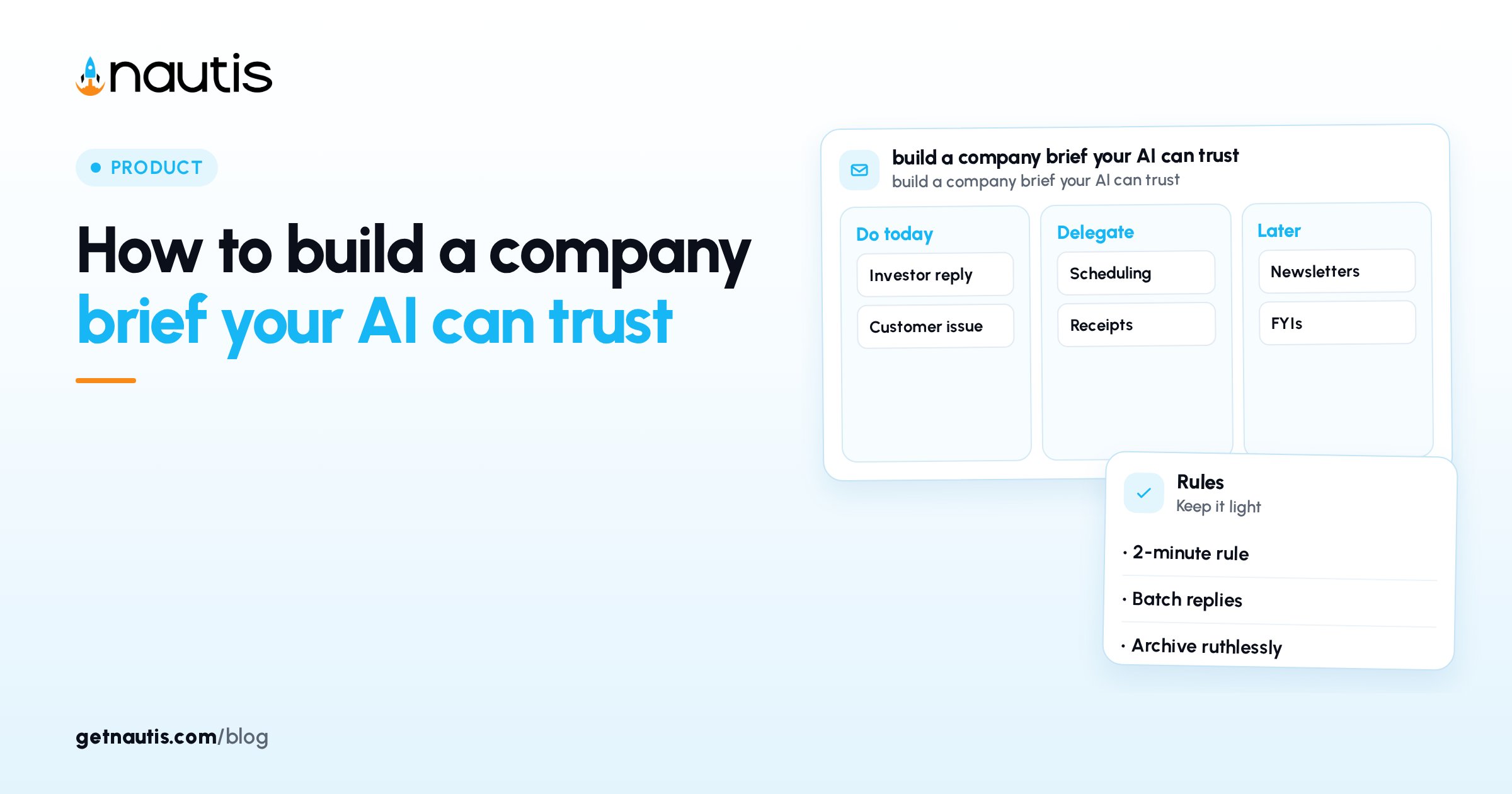
How to build a company brief your AI can trust
 Baltej Singh8 min read
A company brief for AI context is the short, verified story your tools should reuse before they draft, brief, or suggest next steps. Identity, traction, and goals live in one place. When that brief is thin or stale, agents fill gaps with confident guesses that contradict last week's deck.
This guide is for founders who want AI help without training five chats on five different versions of the company. It follows Nautis help on Business Profile and Liftoff setup as of October 2026. You can keep the same discipline in a plain doc if you are not in the product yet.
What a trusted company brief includes
Write for a stranger who must answer for you. The brief should cover:
- Who you serve and the buying scene, in one paragraph
- What you sell and what you explicitly do not sell
- Traction you can defend with a date stamp
- Near-term goals for the next ninety days
- Constraints: regulated claims, pricing rules, words you never want used
- Who is on the founding team and who owns which lane
If any of those six is missing, chat will invent them under pressure. Prefer boring clarity over brand poetry.
Company brief for AI context versus a pitch deck dump
A deck is a narrative arc for humans. A company brief for AI context is a constraint file. Dumping thirty slides into a prompt is not the same as confirming a one-pager of facts the agent may rely on.
Artifact | Good for | Weak for AI context |
|---|---|---|
Pitch deck | Investor meetings | Mixed old and new metrics across versions |
Website copy | Public positioning | Marketing claims you would not defend in diligence |
Chat history | Temporary exploration | Contradictory "we decided" moments with no owner |
Living company brief | Stable facts agents may reuse | Nothing, if you never update dates |
Keep the deck. Add the brief. Point tools at the brief first.
Build it once, then schedule the refresh
Draft from sources you already trust
Start with the one-liner, problem, solution, and team you would put on a public profile. In Nautis, Business Profile holds basic information, mission and vision, company details, funding posture, products, and founding team in structured sections. Fill required fields carefully; optional IP and advisory sections can wait.
Liftoff can seed much of that from a website or deck: Nautis reads what you provide, searches public profiles, drafts profile fields and a Company Brief, then asks you to review sources before anything becomes verified memory. That review step is the job. Untick numbers that came from a demo page. Mark "Not us" on search hits that are not your company.
Verify before you automate
Anything an agent will reuse should survive a co-founder challenge. Put a "last verified" date at the top of the brief. If traction moved, update the brief the same day you update the deck. Silent drift is how two drafts disagree in one afternoon.
Refresh on a calendar, not on vibes
Weekly is enough for early teams: fifteen minutes to confirm one-liner, traction line, open roles, and ninety-day goals. Monthly is too slow if you are raising or launching. Daily rewrites are theater unless a fact actually changed.
Rules that keep AI from improvising your company
Write explicit stop rules into the brief or the adjacent policy note:
- Do not invent customers, revenue, or logos
- Do not promise pricing not on the pricing page
- Do not claim certifications you do not hold
- Do not change the one-liner without a human edit to the brief
- Prefer "unknown / not in brief" over a plausible guess
When you use Chief of Staff setup (Liftoff), the Review step is where those false facts get removed before they harden into memory. Skipping Review to "finish faster" is how a demo metric becomes tomorrow's investor sentence.
What to put in the constraints section
Constraints are the quiet half of the brief. List phrases you never want in outbound copy, markets you are not in yet, and claims that require legal review. Agents are good at fluent filler; they are bad at knowing your counsel's red lines unless you write them down.
Add a short "how we talk about competitors" note. Without it, drafts often overclaim or get petty. A single sentence such as "describe the buyer's alternative workflow, not a named rival's flaws" saves cleanup.
If pricing is negotiated, say so. "List price on /pricing; enterprise quotes need founder approval" stops an agent from inventing a discount ladder in a customer email.
How the brief shows up in daily work
Morning briefs and drafts should quote the same company sentence. Approval queues should reject outward copy that conflicts with the brief. Routines that summarize the business should read the brief before they read last week's chat.
If you keep Brand Kit voice and colors separately, link them: visual identity is not a substitute for factual identity. A perfect tone on a wrong ARR is still wrong.
Where Nautis stores the brief without replacing judgment
Business Profile is the structured public-facing record: who you are, what you do, where you are going, who is on the team. You can keep it private or flip it public when you want a shareable page.
Liftoff is the short setup that teaches Nautis about the startup from website and optional deck, connects calendar and email, and has you confirm what becomes verified memory for the Chief of Staff. Nothing sends or books without your approval in that flow.
Use Chief of Staff afterward for the daily briefing and Approvals. The brief is upstream of those loops. Fix facts there first when answers sound off.
Two brief habits (examples)
Verified brief
Nova spends one Liftoff Review with her co-founder. They remove a website demo "10k users" line, confirm the real pilot count, and lock a ninety-day goal. For two weeks, drafts and morning items repeat the same traction sentence. When a customer asks for a one-pager, the brief and the deck match.
Prompt archaeology
Sam pastes a different company story into each new chat. Monday's agent thinks they are B2B. Wednesday's agent pitches consumers. An investor update draft invents a logo customer from an old case-study template. He stops, writes a one-page brief with dated traction, and pins it as the only source chats may use for company facts.
Failure modes that look like "the AI is dumb"
- Brief never dated, so nobody knows what is current
- Deck metrics updated, brief left stale
- Website marketing claims accepted as verified memory
- Five co-founders editing different prompt pastes instead of one brief
- No stop rules, so the model fills silence with confidence
- Public profile flipped on before Review cleaned false search hits
If two of those appear, pause new agent jobs until the brief passes a co-founder read-through.
Same-week brief install for the founding team
- Open or create the company profile sections for one-liner, problem, solution, team
- Run or reopen Liftoff if you want website or deck seeding, then finish Review carefully
- Write the six-part brief in one page with a last-verified date
- Add stop rules for invented traction, pricing, and certifications
- Align the deck's headline metrics to the same date stamp
- Tell teammates the brief is the only company-fact source for AI drafts
- Schedule a weekly fifteen-minute brief refresh
- Reject any outward draft that conflicts with the brief until the brief is updated on purpose
A company brief for AI context is how you keep automation honest.
When you hire, paste the brief into the onboarding pack on day one. New teammates who only learn the company from Slack folklore will reintroduce conflicting facts into every prompt they try.
If you raise, align the brief with the leave-behind pack before partner meetings. Investors notice when the AI-drafted FAQ and the deck disagree on the same metric.
Reject the urge to keep a "secret real brief" and a "public nice brief" with different traction. Two truths become three by Friday. One dated brief, with a public profile that may show a subset, is enough. Agents can rank work and draft language. They should not be the historians of record for who you are. Keep that history short, dated, and human-owned.
When a goal changes, update the brief before you ask chat for a plan. Plans built on last month's goal waste a day you will not get back.
If Liftoff or search proposes a person or product that is not yours, remove it in Review immediately. Verified memory is sticky by design; cleaning later is harder than cleaning once.
Store the brief where the people who approve outbound work can see it without hunting through chat logs. A fact no approver can find is a fact the company does not really own.
Frequently asked questions
What is a company brief for AI context?
It is a short, verified description of who you serve, what you sell, dated traction, near-term goals, and constraints. Agents should reuse it instead of inventing company facts from scattered chats and old decks.
How does Nautis help build that brief?
Business Profile stores structured company fields. Liftoff can seed profile details and a Company Brief from your website or deck, then asks you to review sources before facts become verified memory for the Chief of Staff.
How often should we update the company brief?
Weekly is enough for most early teams: confirm the one-liner, traction line, goals, and constraints. Update the same day when a metric or positioning decision changes, and align the deck to the same date stamp.
What if the AI invents customers or revenue?
Add explicit stop rules to the brief, remove bad seeded facts in Review, and reject drafts that conflict until the brief is corrected. Prefer "not in brief" over a confident guess.
Sources
- Nautis Business Profile help. Checked on October 31, 2026.
- Nautis: Set up your Chief of Staff (Liftoff). Checked on October 31, 2026.
- Nautis Chief of Staff help. Checked on October 31, 2026.
Baltej Singh is a serial entrepreneur, technology leader, and Founder & CEO of Nautis and DemoVexa, with over 16 years of experience building software products, SaaS platforms, and startups. Previously the Co-Founder & CTO of SanchiConnect, he has worked extensively in the DeepTech startup ecosystem, connecting with 200+ venture capital firms and supporting a network of 4,000+ startups. Passionate about AI, automation, and entrepreneurship, he focuses on building innovative products that solve real-world problems and help businesses grow.