How to write a monthly investor update
 Baltej Singh9 min read
When founders look for an investor update template monthly, they usually need a fixed letter shape, not a new design system. Same sections every month. Same metric definitions. Same send day. Investors skim portfolios between meetings; a predictable shape is how your numbers and asks survive that skim.
Most early teams either go silent for a quarter or send a polished essay when revenue finally moved. Silence teaches investors to stop looking. Essays that change format every time teach them to stop reading. Y Combinator's essential startup advice keeps pushing founders toward clear, repeated contact with reality: talk to users, ship, and skip process theater. A monthly update is that habit pointed at the people who already wrote checks or are still tracking you.
This post is a working template you can run in plain email. Where Nautis appears, it is only a place to pull dated ownership and pipeline facts so the letter matches the books.
What a monthly investor update is not
It is not a fundraising deck attached to a friendly hello. It is not a LinkedIn brag with your investors BCC'd as an afterthought. It is not a quarterly novel you apologize for when cash gets tight.
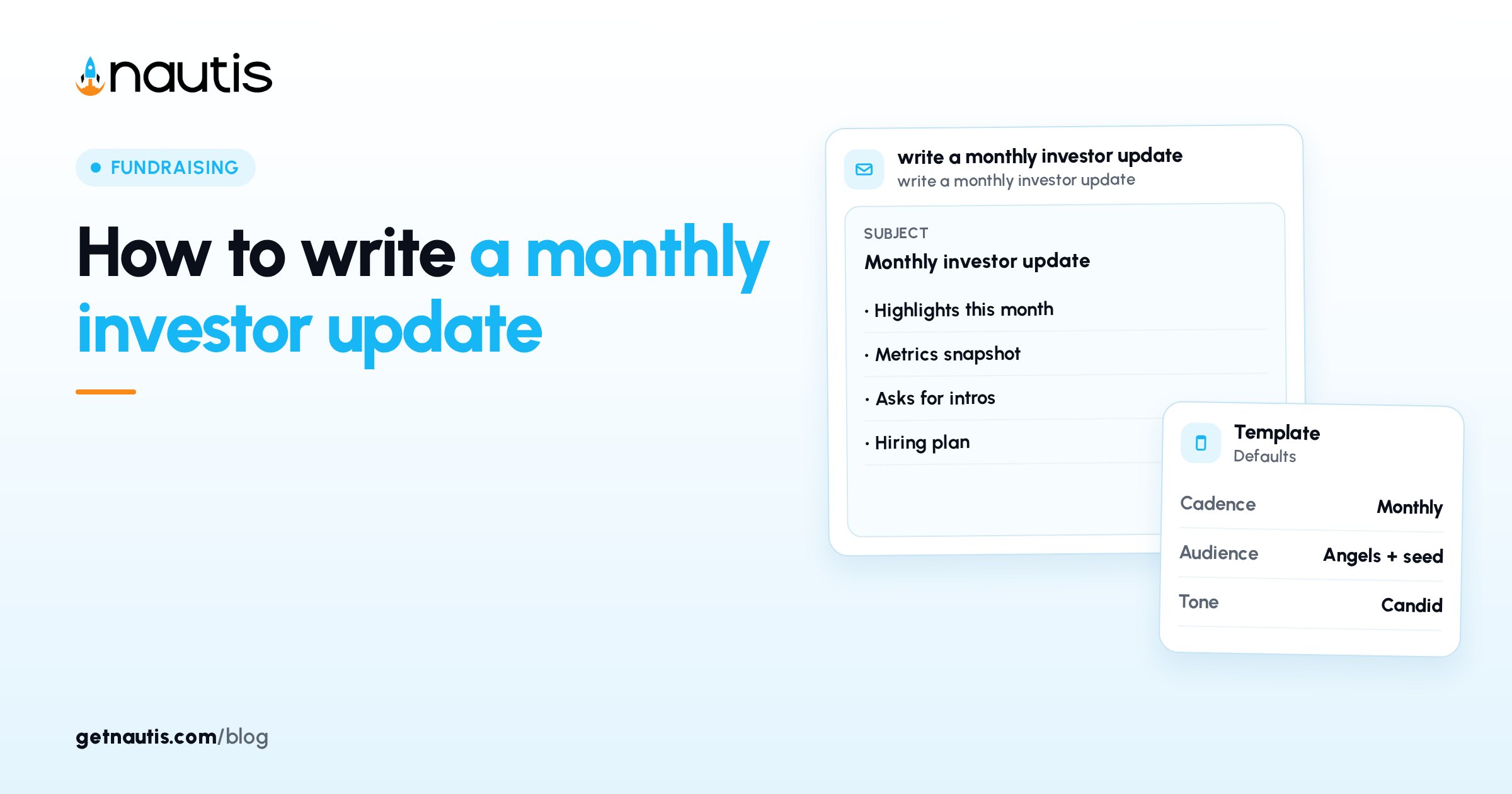
A usable monthly template answers five questions in writing before you draft prose:
- Which four to six metrics will appear every month, with unchanged definitions?
- What is the one-line company reminder for someone forwarding the email?
- What went right that a skeptic can verify?
- What went wrong, named specifically, with the next experiment attached?
- What is the single ask an investor can answer with yes, no, or a name?
If any of those five is missing, you have a newsletter. Fix the skeleton before you chase adjectives.
Freeze the scoreboard before you write a sentence
Spend thirty minutes on inputs on the same day each month. Do not open the draft while MRR still means three different things across three sheets.
Name the recurring metrics
Pick a small set and keep it boring on purpose. Early B2B teams often use: revenue or MRR with month-over-month change, new customers and churned customers, cash on hand, monthly burn, runway months, and one product usage number. Pre-revenue teams swap revenue for a leading indicator they can defend (qualified pilots, weekly active workspaces, paid design partners). Write the definition next to each metric once and paste it into a private footnote for yourself.
Stamp the date on cash
Cash, burn, and runway must come from the same export date. A letter that says "about fourteen months of runway" while the bank balance is three weeks stale is how trust dies quietly. Pull the figure the morning you write, or the morning before if your books close overnight.
Lock the audience lists
Keep three lists: active holders and board, tracking investors who asked to stay in touch, and advisors you want recruiting help from. Same body for active and advisors is fine. Tracking can get a shorter cut if you are careful not to invent two stories. BCC active holders so reply-all chaos does not become the update.
Scoreboard first, story second
Lead with the numbers in the email body. Do not bury them under a mood paragraph or behind a dashboard link. Investors compare you to the rest of their portfolio in one glance; make that glance possible.
Then write a short TL;DR that a partner can forward: what you build, for whom, and the single most important change this month. After that, highlights and lowlights as bullets. Specific beats poetic. "Closed two pilots at $3k each with mid-market ops leads" beats "strong momentum in enterprise." Invented figures in examples here are for shape only; use your real ones.
Keep the whole letter short enough to read in a few minutes. If you need a chart, attach one picture or paste a tiny table. Do not require a login to learn whether cash went up or down.
Lowlights and asks are the sections that earn replies
Lowlights without theater
Name the miss and the response. "Lost a late-stage deal when security review slipped two weeks; we hired a fractional security lead and moved the questionnaire into week one of sales" is usable. "Sales was challenging amid macro headwinds" is not. Investors have read the macro line a thousand times. They have not read your specific miss.
Skipping lowlights is a louder signal than a thin lowlight. People who have sat on both sides of the table can smell a sanitized month.
One ask, sharp enough to act on
Vague asks ("intros to customers") get archived. Named asks get answers: a person, a role, a company shape, a geography. "Anyone who can intro us to a VP Ops at a 200 to 800 person logistics firm already using Salesforce" is a task. "Help with go-to-market" is a shrug.
Put the ask high enough that a skimmer hits it. One primary ask per month beats a grocery list. Extra wishes can wait until next month or a private note to one helpful angel.
Cadence beats cleverness
Send on a fixed day. First Tuesday, last Friday, first business day: pick one and defend it on the calendar like payroll. Monthly fits most seed and Series A companies. Move to quarterly only when the business is stable enough that monthly noise helps nobody; until then, monthly is the forcing function.
Start gathering numbers a few days early so the send day is editing, not archaeology. If the month was quiet, still send a short letter. A 200-word honest quiet month beats a gap that makes people wonder whether you are avoiding the inbox.
Element | Useful monthly update | Weak monthly update |
|---|---|---|
Metrics | Same four to six, defined, dated | New vanity chart every time |
Lowlights | Specific miss plus next experiment | Omitted or blamed on "the market" |
Ask | One actionable request | "Let us know how you can help" |
Format | Stable sections in the email body | New layout, or substance locked in a deck |
Cadence | Same send day each month | Whenever there is good news |
Voice | Founder-written, plain | Marketing adjectives, ghostwritten gloss |
Where Nautis keeps the facts behind the letter
Nautis does not write the update for you and should not auto-send investor email without your approval. It can keep the underlying facts dated.
Fundraising CRM holds who is active, tracking, or advising so your BCC lists match reality instead of a stale spreadsheet tab.
Cap Table should match the ownership story you imply when you say who is on the update list. If the letter and the cap table disagree about who holds, fix the table before you hit send.
Pull runway and burn from the same source you trust for operations, then paste the numbers into the template. Do not retype from memory after a long week.
Two months side by side (examples)
Template with teeth
Amira freezes metrics every first Monday. Her April letter opens with MRR, cash, burn, runway, and weekly actives, then one lowlight about a churned design partner and a concrete ask for a healthcare design partner on Epic. Three investors reply within two days: one intro, one pricing critique, one pass on the ask with a better target persona. The template did the work; the honesty earned the replies.
Format tourism
Chris redesigns the update as a Notion page in March, a PDF in April, and a Loom in May. Metrics shift definitions when the dashboard vendor changes. He skips June because "nothing big happened." In July a tracking investor asks a basic cash question in a thread that should have been unnecessary. Rebuild costs more trust than a short quiet-month email would have.
Mistakes that train investors to ignore you
- Changing metric definitions without calling out the change
- Hiding a down month behind a long product essay
- Asking for five favors so none get done
- Sending only when you are raising
- Letting a teammate ghostwrite a voice investors do not recognize
- Putting the real numbers in an attachment nobody opens
- BCC mistakes that expose the whole list
If two of those appear in one quarter, stop decorating and return to the five-question skeleton.
Reuse the same investor update template monthly
- Create a doc titled with your company and "monthly update template"
- Paste the five questions and the metric definitions
- Build the three audience lists with a last-verified date
- Put the send day on the shared calendar for the next six months
- Write this month's letter in the email body using last month's numbers as a dry run if needed
- Have a co-founder check that lowlights and the ask are specific
- Send on the chosen day from the founder address
- Log replies and intros next to the CRM rows the same day
That reusable monthly template is operating cadence you can see from outside the company. Keep the shape boring, the numbers honest, and the ask sharp. The point is not to sound impressive. The point is to stay readable when your investors are tired and still willing to help.
Protect an hour on the calendar two days before send day for metric freeze only. Writing under that freeze is how you avoid last-minute definition fights.
When a metric must change because the business changed, say so in one plain sentence at the top of the metrics block. Silent redefinition looks like spin even when the intent was clarity.
If you are in an active raise, keep the monthly update separate from the fundraising ask email. Mixing them makes tracking investors feel ambushed and makes holders wonder whether the update exists only to set up a pass-the-hat.
Read the letter once as if you were a partner who already sat through eight updates that morning. Cut anything that does not change what they know or what they can do.
Frequently asked questions
What belongs in an investor update template monthly?
A stable set of metrics with fixed definitions, a one-line company reminder, verifiable highlights, specific lowlights with next experiments, and one actionable ask. Keep the substance in the email body so investors do not need a login to learn the basics.
How often should early-stage startups send investor updates?
Monthly on a fixed day is the usual cadence for seed and early growth companies. Consistency matters more than perfect prose. Move toward quarterly only when monthly updates stop helping either side.
Should I skip a month if nothing big happened?
No. A short honest quiet-month note is better than silence. Skipping trains investors to assume avoidance, and it breaks the forcing function that makes you look at the same metrics every month.
Where should the ask sit in the update?
High enough that a skimmer hits it, after or beside the key metrics. One primary ask beats a list. Vague requests for "help with anything" rarely get replies; named intros and clear roles do.
Sources
- YC: Essential startup advice. Checked on October 31, 2026.
- Nautis: How to write your first investor update. Checked on October 31, 2026.
- Nautis Fundraising CRM help. Checked on October 31, 2026.
Baltej Singh is a serial entrepreneur, technology leader, and Founder & CEO of Nautis and DemoVexa, with over 16 years of experience building software products, SaaS platforms, and startups. Previously the Co-Founder & CTO of SanchiConnect, he has worked extensively in the DeepTech startup ecosystem, connecting with 200+ venture capital firms and supporting a network of 4,000+ startups. Passionate about AI, automation, and entrepreneurship, he focuses on building innovative products that solve real-world problems and help businesses grow.