How to practice a startup pitch before investor meetings
 Baltej Singh9 min read
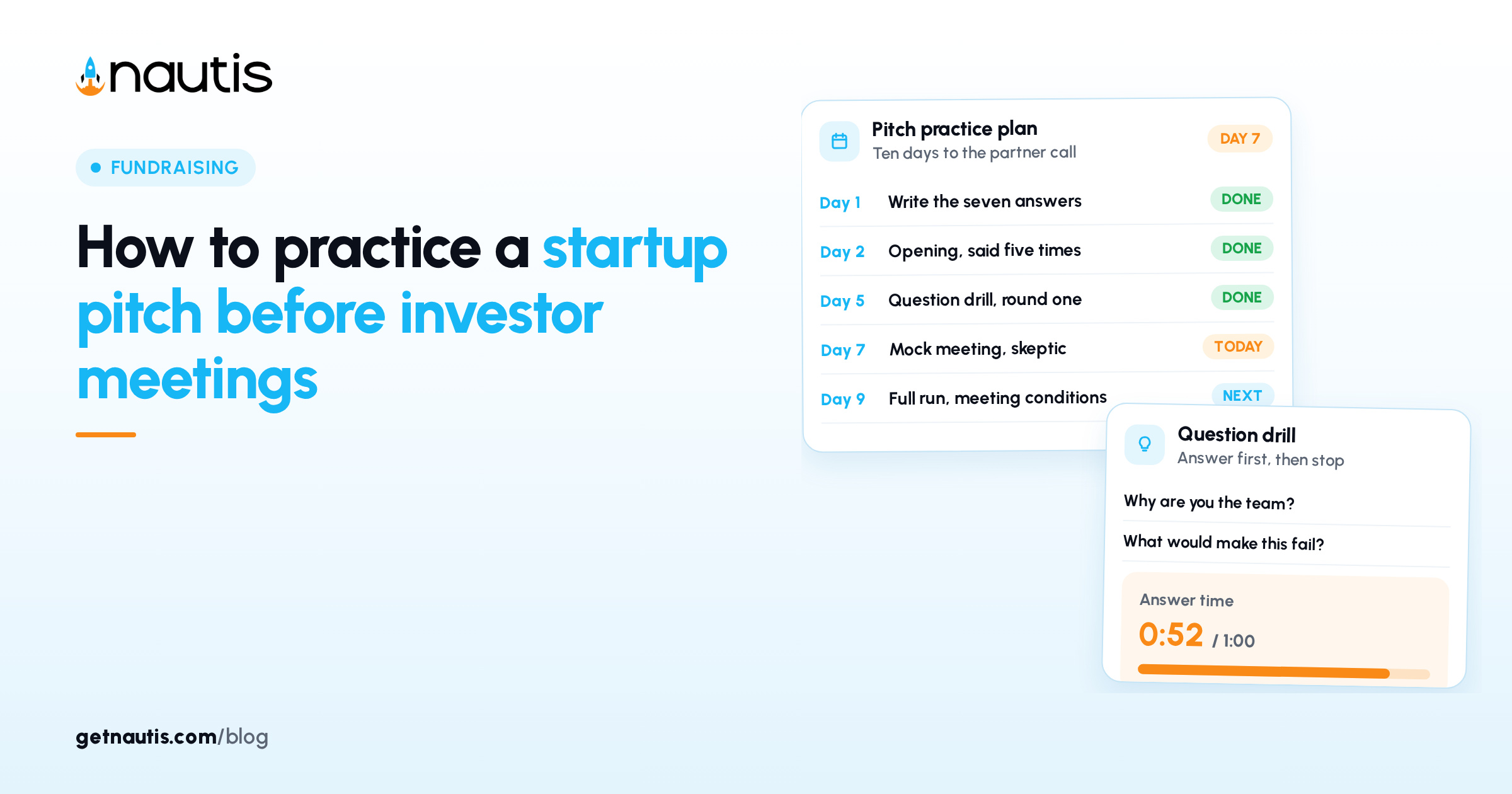
To practice a startup pitch well, rehearse it out loud, on a schedule, with the clock running and someone asking hard questions. Plan about ten days: write the core answers first, say the opening two minutes until the order holds, then spend most of your time on investor questions, because that is where a first meeting is usually won or lost.
Many founders practice by reading their slides silently and tweaking fonts, which changes almost nothing about how the meeting goes. This guide covers how to practice a startup pitch so it holds up in a real partner call: what to write before you rehearse, a day-by-day plan, a question drill, and how to use recordings without obsessing over them.
How to practice a startup pitch in ten days
Ten days is enough to fix the story without burning out on it, and it fits the usual gap between booking a first meeting and taking it. With less time, compress the plan but keep the order.
Each session is short on purpose. Thirty focused minutes of speaking beats three hours of slide editing.
Day | Session | Time | What you produce |
|---|---|---|---|
1 | Write the seven core answers | 45 min | One page of plain sentences |
2 | Say the opening two minutes, five times | 30 min | A spoken version you can repeat without notes |
3 | Full run-through with a timer | 30 min | Your real length, plus a list of stumbles |
4 | Cut and reorder | 30 min | A shorter pitch with fewer slides |
5 | Question drill, round one | 40 min | Answers to the twenty questions you fear most |
6 | Recorded run-through | 30 min | A recording you watch once, with notes |
7 | Mock meeting with a skeptical person | 45 min | Written feedback from someone else |
8 | Question drill, round two | 40 min | Shorter answers to the questions that went badly |
9 | Full run-through in meeting conditions | 30 min | Final timing, final slide order |
10 | Light review only | 15 min | Your numbers sheet, read once |
What should you write down before the first run-through?
Write plain-sentence answers to the questions every investor asks before you rehearse anything. If you can't write an answer clearly, you won't say it clearly.
Michael Seibel's guide on the Y Combinator library reduces a pitch to seven questions. Use them as your one-page script:
- What do you do? One sentence, using the name of the company and what it does for whom.
- How big is the market? Show how you got the number, ideally bottom up from real customers and prices.
- What is your progress? What you've built and who uses it, against how long you've been working.
- What is your unique insight? Something you know about the problem that others don't.
- What is your business model? Who pays, how much, and how often.
- Who is on the team? How many founders, who builds the product, and whether everyone is full time.
- What do you want? Ask directly: the amount you're raising and what it gets you to.
Next to that page, keep a numbers sheet. It holds every figure you might say out loud: monthly revenue, customer count, growth rate, burn, runway, round size and any prior funding. Each number gets a date beside it. When a founder says one revenue figure in the pitch and a different one in the follow-up email, the investor stops trusting the rest. Practicing against a fixed sheet prevents that.
If your deck itself still needs work, fix that first. Our guide to building an investor-ready pitch deck covers the slide order.
Rehearsing the opening two minutes
The first two minutes decide whether the investor leans in or starts checking email. Practice them separately from the rest, until you can say them the same way every time without looking at anything.
A useful opening does three jobs. It says what the company does in words a stranger would understand. It gives one proof point. It says why now. Seibel's advice is to skip the long problem setup and get to the point, and to walk through what a user actually does if the product is hard to explain.
Here is an example with a made-up founder and made-up figures. Priya runs a two-person company that sells shift scheduling software to dental clinics. Her first draft opening spent ninety seconds on staffing shortages in healthcare. Her rewritten version sounds like this:
"We make scheduling software for dental clinics. A clinic manager opens it on Sunday night, sees next week's gaps, and fills them by texting staff from one screen. Eleven clinics pay us today, all from referrals. We're raising to hire a second engineer and sell to small clinic groups."
That takes about twenty seconds and leaves an obvious next question.
Practice drills for the opening:
- Say it five times in a row, standing up. By the fifth pass, the wording settles.
- Say it to someone outside your industry and ask them to repeat what you do. If they can't, rewrite.
- Time it. If the opening runs past two minutes, something in it belongs later.
How do you practice answering investor questions?
You practice answering investor questions by listing the hardest ones, answering each out loud in under a minute, and repeating the ones you fumble. Much of a first meeting is back and forth, and answers you've never said aloud tend to wander.
Build the list from three places: questions you've been asked before, questions about your weakest numbers, and questions you hope nobody asks. Then sort them by what the investor is trying to learn.
Question | What they're really checking | A weak answer sounds like | A stronger answer does this |
|---|---|---|---|
Why hasn't a bigger company built this? | Whether you understand the market | "They're too slow." | Names a specific reason the segment is ignored |
What happens if you don't raise? | Your options and discipline | "We'd figure it out." | Gives months of runway and the plan for each case |
Why are you the team to do this? | Founder and market fit | A list of degrees | Ties one experience to the customer problem |
How do customers find you today? | Whether growth is repeatable | "Word of mouth, mostly." | Gives the actual channel split from your records |
What would make this fail? | Self-awareness | "Nothing, really." | Names the top risk and what you're doing about it |
The rule for every answer: say the answer in the first sentence, then give one reason or one number, then stop. A four-minute answer to a simple question costs more goodwill than a short one. When you don't know something, say so and say when you'll follow up. That reads far better than a guess you have to retract.
Our article on preparing investor frequently asked questions (FAQ) answers goes deeper on writing them down.
Practicing with someone who will push back
Practicing alone makes you fluent. Practicing with another person tells you whether the pitch works. Pick someone who will interrupt you, ideally a founder who has raised before or an angel investor who owes you a favor. Friends who only say "sounds great" are not useful here.
Set the mock meeting up so it resembles the real one:
- Same length as the real meeting, usually thirty minutes.
- Same format, so on video if the real call is on video.
- Ask them to interrupt at least three times, the way partners do.
- Ask them to end with a decision: would they take a second meeting, and why not.
After the session, ask for written answers to four questions. What does the company do, in their words? What was the most convincing moment? Where did they stop believing you? What question did you dodge? Written feedback is easier to act on than a friendly chat afterward, and it stops you from remembering only the compliments.
Change one or two things after each mock. Rewriting the whole pitch after every piece of feedback loses the parts that were working.
Recording yourself and practicing with software
A recording shows habits you can't hear while talking: filler words, rushing through numbers, and trailing off at the end of sentences. Watch each recording once, write down three fixes, and move on. Rewatching the same clip mostly adds nerves.
If you use Nautis, two modules fit this step. One is a practice partner built on artificial intelligence (AI), named AI voice coach. You pitch out loud to an AI venture capitalist persona that asks follow-ups and pushes back, in one of four modes:
Mode | Approximate length | Good for |
|---|---|---|
Full Pitch | About 20 minutes | Delivering the whole pitch and taking follow-ups |
Rapid Q&A | About 10 minutes | Quick question-and-answer drills, matching days 5 and 8 |
Term Sheet Negotiation | About 15 minutes | Practicing talk about valuation and terms |
Mock IC | About 25 minutes | A longer session modeled on an investment committee (IC) |
After a session, the review page gives a score out of 100, suggested rewrites of weak lines, a full transcript, and a Speech tab covering pace, filler words and pauses. If you've already run your deck through the Pitch deck analyzer, you can link it so questions refer to your actual slides. Sessions use AI credits, and the module has to be enabled on your plan.
Video pitches is a separate module for recording a structured pitch topic by topic, with a teleprompter and a time limit per topic. It helps when an investor asks for a recorded overview before a call. A practice tool supports rehearsal with real people; it doesn't replace it.
What to change in the last 48 hours
The last two days are for small fixes. Big changes this late tend to make the pitch worse, because you haven't practiced the new version.
Safe to change in the final 48 hours:
- A number that has been updated since you last practiced, also updated on the numbers sheet.
- The order of two slides, if the mock meeting showed confusion.
- One answer that kept going badly in the question drills.
Leave the opening, the structure and the ask alone. If you're unsure about the round size, settle it with your co-founder and stick with it.
On the morning of the meeting, read the numbers sheet once and say the opening twice. Then stop. Have the deck open, your camera and microphone tested, and a short list of the follow-ups you promise to send. After the call, write down every question you were asked while it's fresh. That list becomes the start of your next question drill, and our guide to running a fundraising process week by week shows where those meetings fit in the wider raise.
Frequently asked questions
How many times should I practice my startup pitch?
Aim for several short spoken sessions across about ten days rather than one long cram. Two or three full run-throughs, two question drills, and at least one mock meeting with a skeptical person cover most of what a first investor meeting tests. Stop adding sessions once your timing and answers stay the same from run to run.
Should I memorize my pitch word for word?
Memorize the opening two minutes and your key numbers, and keep the rest as a clear order of points. A fully memorized pitch tends to break when an investor interrupts. Knowing the structure lets you pick up where you left off after a question.
Who should I practice my investor pitch with?
Practice with someone who will interrupt and push back, such as a founder who has raised before or an angel investor you know. Ask them to treat it like a real meeting and to tell you whether they would take a second meeting. Friends who only offer praise give you little to fix.
How long should answers to investor questions be?
Most answers should fit in under a minute. Give the direct answer first, back it with one reason or one number, and stop so the investor can ask a follow-up. If you do not know the answer, say so and say when you will send it.
Sources
- Y Combinator Startup Library, How to Pitch Your Company. Checked on November 10, 2026.
- Nautis Help Center, AI Voice Coach. Checked on November 10, 2026.
- Nautis Help Center, Video Pitches. Checked on November 10, 2026.
- Nautis Help Center, Pitch Deck Analyzer. Checked on November 10, 2026.
Baltej Singh is a serial entrepreneur, technology leader, and Founder & CEO of Nautis and DemoVexa, with over 16 years of experience building software products, SaaS platforms, and startups. Previously the Co-Founder & CTO of SanchiConnect, he has worked extensively in the DeepTech startup ecosystem, connecting with 200+ venture capital firms and supporting a network of 4,000+ startups. Passionate about AI, automation, and entrepreneurship, he focuses on building innovative products that solve real-world problems and help businesses grow.