How to write a positioning statement for SaaS
 Baltej Singh8 min read
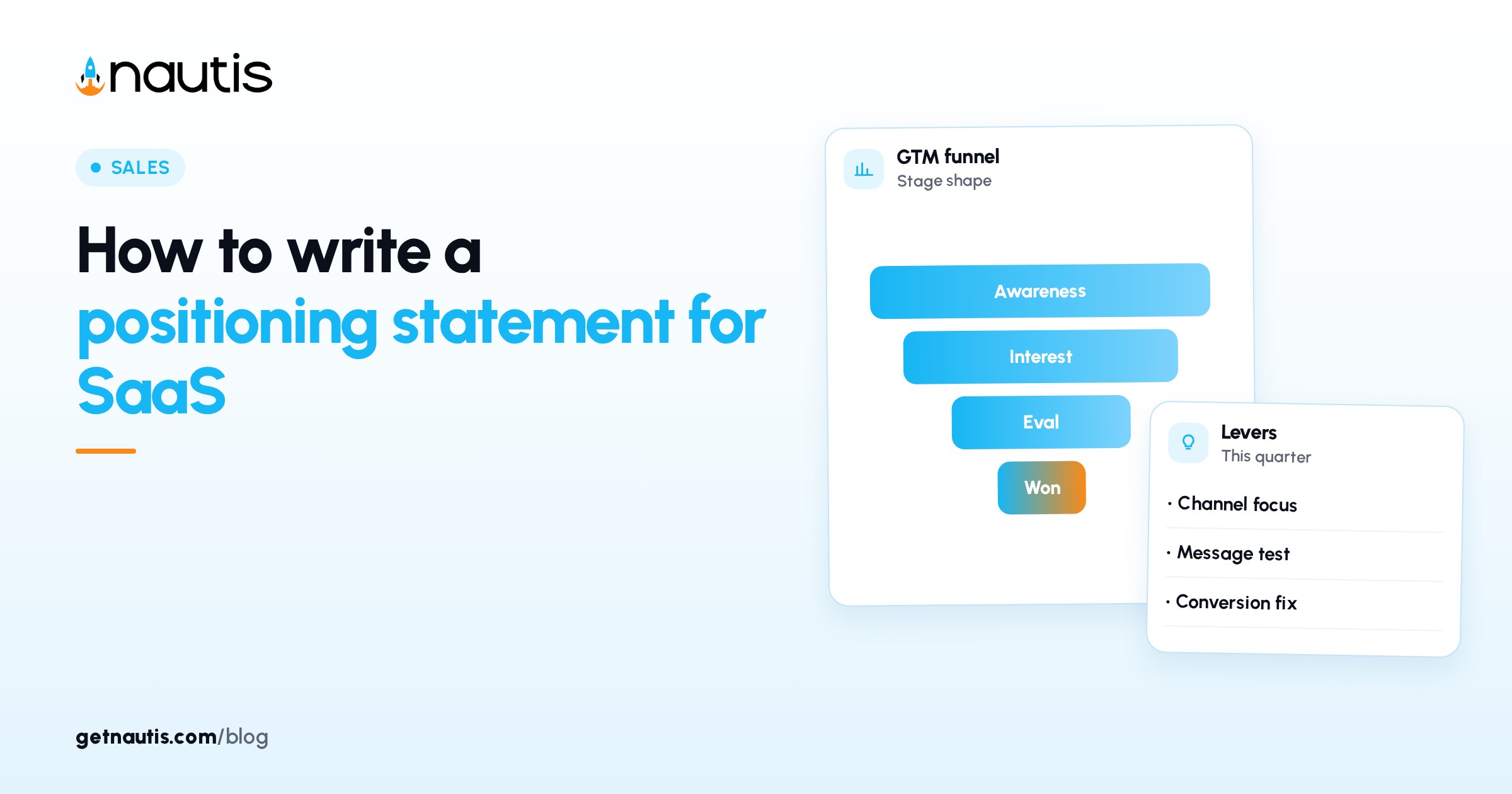
A positioning statement for SaaS is the short claim that names who you serve, what category you play in, and why you win. Without it, homepage copy, sales openers, and ads drift into three different stories. With it, every surface repeats the same bet.
Write the fields first. Polish the sentence second. Change the statement only when the buyer or category truly changes.
What a positioning statement for SaaS has to decide
A positioning statement for SaaS is not a slogan contest. It commits you to a best-fit audience, a market category buyers already understand or will learn, a primary alternative you displace, and a difference they can verify.
Positioning makes focus explicit: who is not for you is as important as who is. Prefer a narrow claim you can repeat over a wide claim you cannot defend (Y Combinator Library, essential startup advice, checkedOn 2026-11-01).
Founders often delay the statement until after a rebrand. That order is backwards. The statement should constrain the rebrand, not the other way around.
Bring one buyer quote that names the category in their words. If buyers never say your invented shelf out loud, reconsider the category field.
Keep a dated snapshot of the owned statement after each update so agencies and contractors work from the same line.
Scene: site headline says platform; outbound says automation; the deck says operating system; none share one written line.
Scene: one sentence naming finance leads at early SaaS companies, shelf "spend controls," stake "approvals before money moves," rereused on site, deck, and email.
If two cofounders cannot recite the same who-category-difference triangle, you do not have positioning yet. You have drafts.
Write the anti-customer in one line too: the segment you will not customize for this year. That sentence protects the statement when a loud prospect asks you to become a different company.
Keep the statement short enough to say aloud in one breath. Detail belongs in proof bullets, not in a paragraph masquerading as a line.
Read the draft aloud to someone outside the company. If they cannot tell who the product is for after one hearing, the audience field is still vague.
Fill the fields before you polish the sentence
Field | What to write | Good enough test |
|---|---|---|
Best-fit audience | Role, company type, and trigger context | Sales can name them without a slide |
Category | Market label buyers already use or will accept | You can point to two known peers in that shelf |
Primary alternative | Status quo or competitor they would otherwise pick | Sales hears that name unprompted |
Difference | The reason you win for that customer | You can show proof without inventing metrics |
One-line statement | Customer + category + difference in one sentence | Team repeats it the same way twice |
Scene: customer "controllers at Series A SaaS"; category "expense management"; alternative "spreadsheets plus card statements"; difference "policy checks before reimbursement"; statement "Expense management for Series A SaaS controllers who need policy checks before money moves."
Share the table with product and sales before you wordsmith. Arguments about adjectives are cheap; arguments about customer and category are the real work.
Time-box the field fill to ninety minutes. If you cannot finish the five rows, the company still disagrees on who the product is for.
Name one editor for the statement. Many reviewers are fine; many editors recreate the miss where every surface tells a different story.
Do not invent a category no buyer searches. Invented shelves force education you may not have budget to fund. Prefer a known shelf with a sharp difference.
Pressure-test the primary alternative with one question: if we disappeared tomorrow, what would this buyer do instead. If the answer is "nothing," you may be describing a vitamin, not a shelf with urgency.
If you must educate, budget for it as a named education program with owners and metrics, not as a hope that the homepage will teach the market alone.
Skip vanity width ("for every team"). Narrow audience language makes the statement usable in outbound and onboarding.
Write the difference as a constraint you accept, not as a pile of adjectives. "Works offline for field teams" beats "powerful, flexible, ."
Scene: "policy checks before payout, even if that means fewer impulse spends." Sales can demo the constraint; engineering can defend it.
Scene: "for modern companies" becomes "for Series A SaaS finance teams running monthly close without a full accounting department."
Tie the statement to proof you already have
Difference without proof becomes branding fog. Attach two or three proof bullets you can defend today: a workflow step, a measurable outcome, a constraint you embrace.
Scene: "approvals before payout," "card and reimbursement in one ledger," "auditor-ready export in one click." Each maps to a shipped capability.
If proof is only aspirational roadmap, narrow the difference to what ships now. Positioning that waits on a future release trains the team to lie politely.
Use the same proof bullets in the sales one-pager and the homepage hero support line. When proof drifts by channel, the statement is already rotting.
Scene: site claims "close in one day"; sales demo still shows a three-day workaround. Fix the product story or the proof bullet before the next campaign.
Revisit proof quarterly. The statement may stay; the bullets should track what is true.
When a proof bullet dies because a feature changed, replace the bullet the same week. Leaving dead proof under a live statement teaches buyers to distrust the whole line.
Keep one owned copy of the live line
Store one owned copy of the statement where the team already looks for company context, not in a lost slide. Name an editor. Derivatives for ads and outbound must point back to that copy.
Scene: statement lives in the company wiki under "Live positioning" with owner Marketing lead and last-updated date; deck and homepage pull from it the same week.
If you keep planning notes in Nautis, paste the finished line where planners already look. Do not turn this post into a product walkthrough; the statement must stand on its own fields and proof.
When agencies or contractors need the line, send the owned copy link, not a rewritten paraphrase in email.
Use the line across surfaces without constant rewrites
Once the statement is stable, paste it into site headline, pitch deck narrative, cold email openers. Surfaces should rhyme, not freestyle.
Scene: homepage H1 mirrors the statement; deck slide 2 restates customer and difference; first email line names category and alternative; support macros avoid contradicting the shelf.
Give marketing and sales a 30-day freeze after publish. Collect objections in a list; change the statement only if the same objection repeats from live deals, not from internal taste.
During the freeze, allow surface-specific length cuts only. A short social version may drop a clause; it may not change the audience or the category.
Reject "also for" clauses that double the audience field after a single conference conversation. Park those requests in a later-statement list with a date to revisit.
When a channel needs shorter copy, cut words from the sentence without changing customer, category, or difference. Compression is allowed; mutation is not.
Keep a single source of the long form statement in the owned copy. Channel cuts are derivatives, not competing originals.
Reject slogan words that hide weak fields
Ban empty intensifiers in the one-liner: powerful, next-generation, end-to-end, all-in-one. If removing them breaks the sentence, the difference field was never specific.
Read the line at standup on a fixed cadence for a month. Drift shows up as jokes and side comments before it shows up in analytics.
Scene: "powerful AI platform for modern teams" becomes "expense controls for Series A SaaS finance leads who need approvals before payout."
Replace feature lists inside the statement with one difference you will defend on a call. Features belong under proof bullets.
Write the stake in present tense. Future-tense promises belong in the roadmap, not in the line buyers hear first.
Update positioning when the audience or category shifts
Change the statement when you permanently change which audience you sell to, which shelf you claim, or what proof you can defend. Do not change it because a single lost deal preferred different adjectives.
Scene: after two quarters selling successfully to mid-market ops, customer field widens from Series A controllers to ops leads at 100-400 person SaaS; category stays; proof bullets add SSO.
Record the old statement and the date you retired it. Teams that overwrite history cannot tell whether messaging churn or product gaps caused a miss.
Store retired lines in a short changelog under the owned copy so new hires do not revive old claims from cached decks.
If product launches a second line of business with a different audience, write a second statement with its own owned copy rather than stuffing two stories into one line.
Scene: core spend-controls statement stays; a new procurement add-on gets its own statement aimed at procurement leads.
Measure success by whether a new seller can read the owned statement and proof bullets and run a first call without inventing a fourth story. Consistency beats cleverness.
Spot-check five recent sales emails against the statement each month. If three invent a new category, you have a coaching problem, not a copy problem.
Before you publish the statement, ask sales to use it on the next five calls without improvising a new category. If they cannot, the fields are still soft.
Say the statement in seller onboarding and ask them to repeat it once. If they add a second audience, the written line is still soft.
Broader product docs sit in the Help Center. See pricing for plan context.
Frequently asked questions
What is a positioning statement for SaaS?
A short claim that names best-fit audience, market category, primary alternative, and why you win, backed by proof you can show.
How long should it be?
One breath aloud. Put detail in proof bullets, not in a paragraph pretending to be a line.
Where should we store it?
In one owned company copy with a named editor. Channel pages and decks should pull from that copy, not invent a second original.
When should we change it?
When the audience, category, or defendable proof permanently changes, not because one lost deal disliked the adjectives.
Sources
- Y Combinator, Essential startup advice. Checked on November 1, 2026.
Baltej Singh is a serial entrepreneur, technology leader, and Founder & CEO of Nautis and DemoVexa, with over 16 years of experience building software products, SaaS platforms, and startups. Previously the Co-Founder & CTO of SanchiConnect, he has worked extensively in the DeepTech startup ecosystem, connecting with 200+ venture capital firms and supporting a network of 4,000+ startups. Passionate about AI, automation, and entrepreneurship, he focuses on building innovative products that solve real-world problems and help businesses grow.