How to pitch a journalist about your startup
 Baltej Singh9 min read
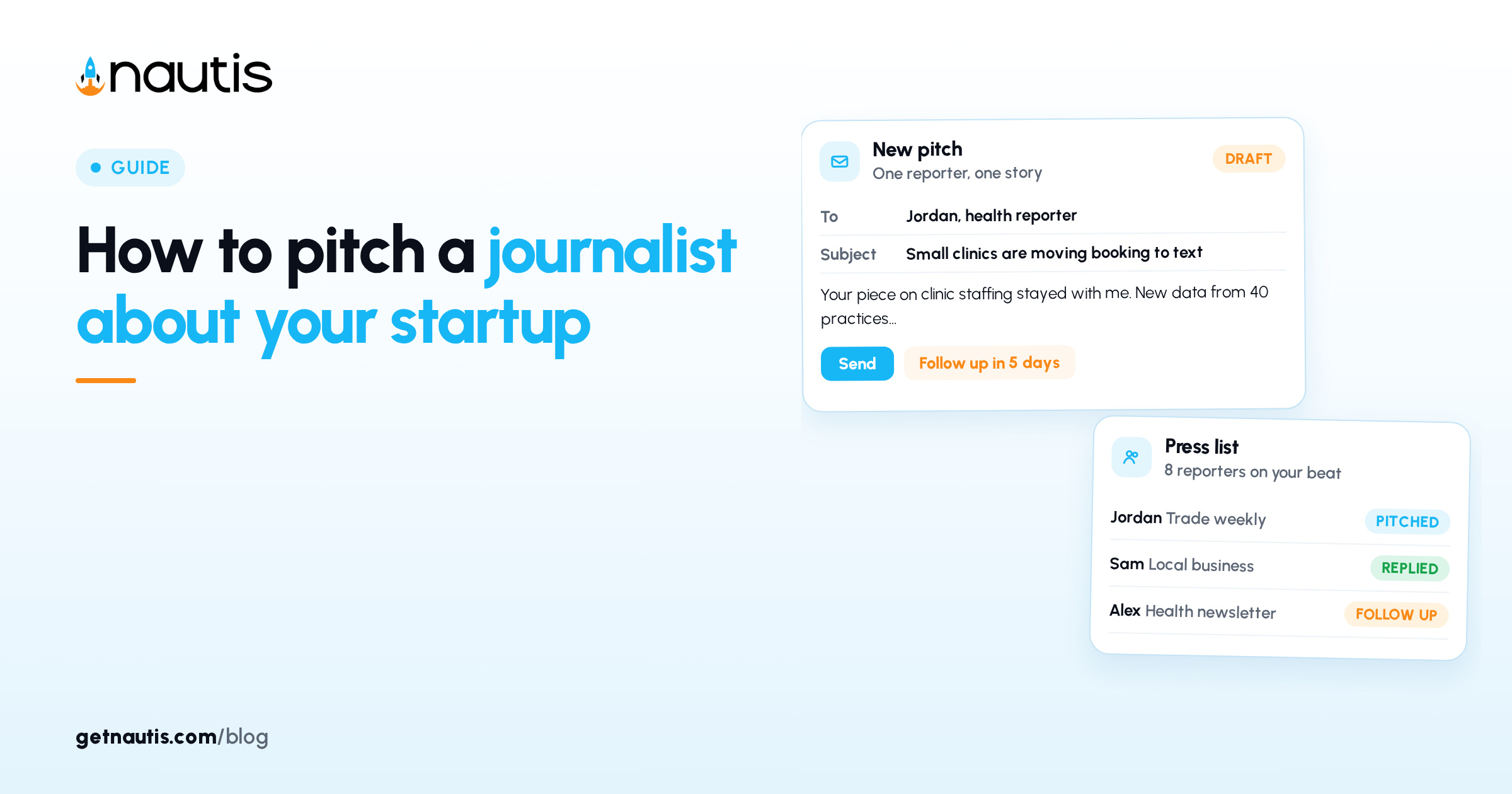
Knowing how to pitch a journalist comes down to one thing: send a specific reporter a short email about something that is new, true and relevant to what they already cover. Most pitches fail before the first line is read because the story is about the company rather than about something readers care about, or because it went to a reporter who never covers that subject.
Early startups rarely have a public relations team, so the founder ends up writing these emails. That is not a disadvantage. A reporter may well prefer hearing from the person who built the thing, as long as that person respects their time and their independence.
This guide covers finding an angle, building a short list of reporters, writing the email, following up, and preparing the materials a reporter will ask for. The example company and email below are invented for illustration.
Find a story angle before you write anything
A reporter is not looking for a company to feature. They are looking for a story their readers will want, and your company might be part of it. So the first job is to work out what the story is.
Ask yourself what a reader would learn that they could not learn yesterday. A launch on its own is usually not enough. A launch that reveals something about an industry, a customer group or a trend can be.
Usually not a story on its own | Can become a story |
|---|---|
"We launched version 2.0" | "Independent clinics are dropping phone booking, and here is the data from our first year" |
"We hired a new head of sales" | "A former hospital administrator explains why small clinics buy software differently" |
"We built a smarter scheduling tool" | "What happens to no-show rates when patients can rebook by text, based on our records" |
"We closed a funding round" | A round can be news for trade or local outlets, especially with a clear reason the money matters |
The right column has three things in common. It names a group of people, it offers something the reporter cannot easily get elsewhere, and it does not depend on the reader caring about your brand. Original data, a clear customer story you have permission to share, or a founder with real expertise on a live topic all give a reporter something to work with.
If you have no angle yet, wait. A weak pitch sent today can make a reporter less likely to open your next one.
Which reporters should you pitch first?
Pitch the reporters who have written about your subject in the last few months. A short list of five to ten people who cover your exact area is more useful than a long list of anyone with "technology" in their bio.
To build that list:
- Search the outlets your customers read, including trade publications and newsletters, for recent articles on your topic.
- Note the byline on each relevant piece, the date and one line on what it argued.
- Check how each reporter prefers to be contacted. Some list this on their author page or social profile.
- Drop anyone who covers the subject only in passing.
Trade and local outlets are often a better first target than national ones. Their readers are closer to your customers, and a story there gives you something real to point to later.
Keep the list somewhere you can update. In Nautis, Contacts lets you create a folder, for example "Press", and store each reporter's email, company, job title, LinkedIn and notes. The notes field is a good place for the article you read and the date you last wrote to them.
How to pitch a journalist by email, with an example
The email should be short enough to read on a phone in under a minute. Each part has one job.
Part | Its job |
|---|---|
Subject line | Say the story plainly, the way a headline would |
First line | Show you read their work, with a specific article |
The story | Two or three sentences on what is new and why it matters to their readers |
The proof | The fact, data or person that makes it credible |
The offer | What you can give them: data, an interview, a customer contact |
Sign-off | Name, role, phone number, one link |
Here is an example. The company, names and figures are invented.
Subject: Small dental clinics are moving booking to text, new data from 40 practices
Hi Jordan,
Your piece last month on staffing shortages at independent clinics stayed with me, especially the point about front desks spending half the day on the phone.
We make scheduling software for small dental practices. Across the 40 clinics using it this year, about a third of all appointments were booked or moved by text rather than by phone. Clinics that switched also saw fewer empty chairs from last-minute cancellations, because patients rebooked on their own.
I can share the anonymized numbers by month, and two clinic managers have agreed to talk about what changed for their staff.
Would that be useful for anything you are working on?
Dana Ruiz, cofounder (555) 010-0199
A few things make this work. The subject line could be the headline. The first line proves Dana read Jordan's work without flattery. The data is specific, and the offer gives Jordan something to report rather than something to repeat.
What the email leaves out matters too. There is no attachment, no long company history, and no request for a call before Jordan has shown interest.
When should you follow up, and when should you stop?
Follow up once, about four or five working days after the first email, and then stop. Reporters are busy, and silence usually means no rather than "remind me."
The follow-up should add something rather than repeat the pitch. Reply in the same thread so the context is there, and keep it to two or three lines: a new data point, a timely link to news on the topic, or a narrower version of the offer.
Some practical rules:
- Do not send the same pitch to two reporters at one outlet at the same time.
- Do not call a reporter's phone to ask whether they got your email.
- If someone says no, thank them and move on. Note it in their contact record so you do not pitch them the same story again.
- If you offer the story to one reporter first, say so, and give them a clear date before you go to others.
If your story has a release date, you can offer it under embargo. That means the reporter gets the details early and agrees not to publish before a set date and time. Only offer this to people you trust, and only for news that really has a date attached, such as a product release or a report you are publishing.
If nobody on your list replies after the follow-up, look at the story before you look at the list. Ask a friend outside your industry to read the first three lines and tell you what the news is. If they cannot say it back in one sentence, the angle needs work. Rewrite it around a clearer finding or a more specific group of readers, then try a different set of reporters a few weeks later. Sending the same email to more people rarely fixes a pitch that did not land the first time.
In Nautis, the Email inbox, listed as MailBox in the sidebar, includes Scheduled send, so you can write the follow-up when you send the first email and set it for later. Keep an eye on the Scheduled folder so a reminder does not go out after the reporter has already replied.
Have your press materials ready before you send
If a reporter says yes, they will often need things quickly. Prepare these before you send the first pitch:
- A one-paragraph description of the company, written plainly
- A short founder bio and a recent photo
- Logos in a few formats and two or three product screenshots
- The data behind your claim, with a note on how it was collected
- Contact details for any customer who agreed to speak, with their permission confirmed
A Brand Kit in Nautis holds logos, colors, fonts and imagery in one place. Its Share Brand Kit option creates a read-only link that can be set to expire, which works as a simple press kit. Send the link only after a reporter shows interest, rather than attaching files to the first email.
Check every number you plan to share. If a reporter publishes a figure from you and it turns out to be wrong, the correction carries your company's name.
Working with a reporter once they say yes
Once a reporter is interested, your job is to make their work easier without trying to control it.
Answer questions quickly and plainly. If you do not know something, say so and follow up with the answer. Agree on ground rules before you say something you do not want quoted, since "off the record" only applies if both sides agree to it first.
Do not ask to approve the article before it runs, and never offer gifts, payment or other favors in exchange for coverage. The Society of Professional Journalists' Code of Ethics asks journalists to refuse presents, favors, fees or special treatment aimed at influencing coverage, and to distinguish news from advertising. If you want guaranteed placement, that is advertising, and it should be bought and labeled as advertising.
After the story runs, thank the reporter and share it with your customers. Then add a note to their contact record with the date, the outlet and the story, so the next pitch starts from what they already know about you. For ways to reuse coverage alongside your own posts, see the content marketing plan for early startups.
Frequently asked questions
How do you pitch a journalist for the first time?
Find a reporter who has written about your subject in the last few months, read their recent work, and send a short email that names one of their articles. Explain in two or three sentences what is new and why their readers would care. Offer something concrete, such as data or an interview.
How long should a pitch email to a journalist be?
Keep it short enough to read on a phone in under a minute, which usually means a subject line and four or five short paragraphs at most. Leave out attachments and long company history. Share press materials only after the reporter shows interest.
How many times should you follow up with a journalist?
Once is usually enough. Reply in the same thread about four or five working days after the first email and add something new, such as a fresh data point. If there is still no reply, treat it as a no and move on.
What does embargo mean when pitching the press?
An embargo means you share news with a reporter early, and they agree not to publish before a set date and time. It suits news with a real release date, such as a product release or a report. Offer it only to reporters you trust, and agree to it before you share the details.
Sources
- Society of Professional Journalists, SPJ Code of Ethics. Checked on November 12, 2026.
- Nautis Help Center, Contacts. Checked on November 12, 2026.
- Nautis Help Center, MailBox (unified email inbox). Checked on November 12, 2026.
- Nautis Help Center, Brand Kit. Checked on November 12, 2026.
Baltej Singh is a serial entrepreneur, technology leader, and Founder & CEO of Nautis and DemoVexa, with over 16 years of experience building software products, SaaS platforms, and startups. Previously the Co-Founder & CTO of SanchiConnect, he has worked extensively in the DeepTech startup ecosystem, connecting with 200+ venture capital firms and supporting a network of 4,000+ startups. Passionate about AI, automation, and entrepreneurship, he focuses on building innovative products that solve real-world problems and help businesses grow.