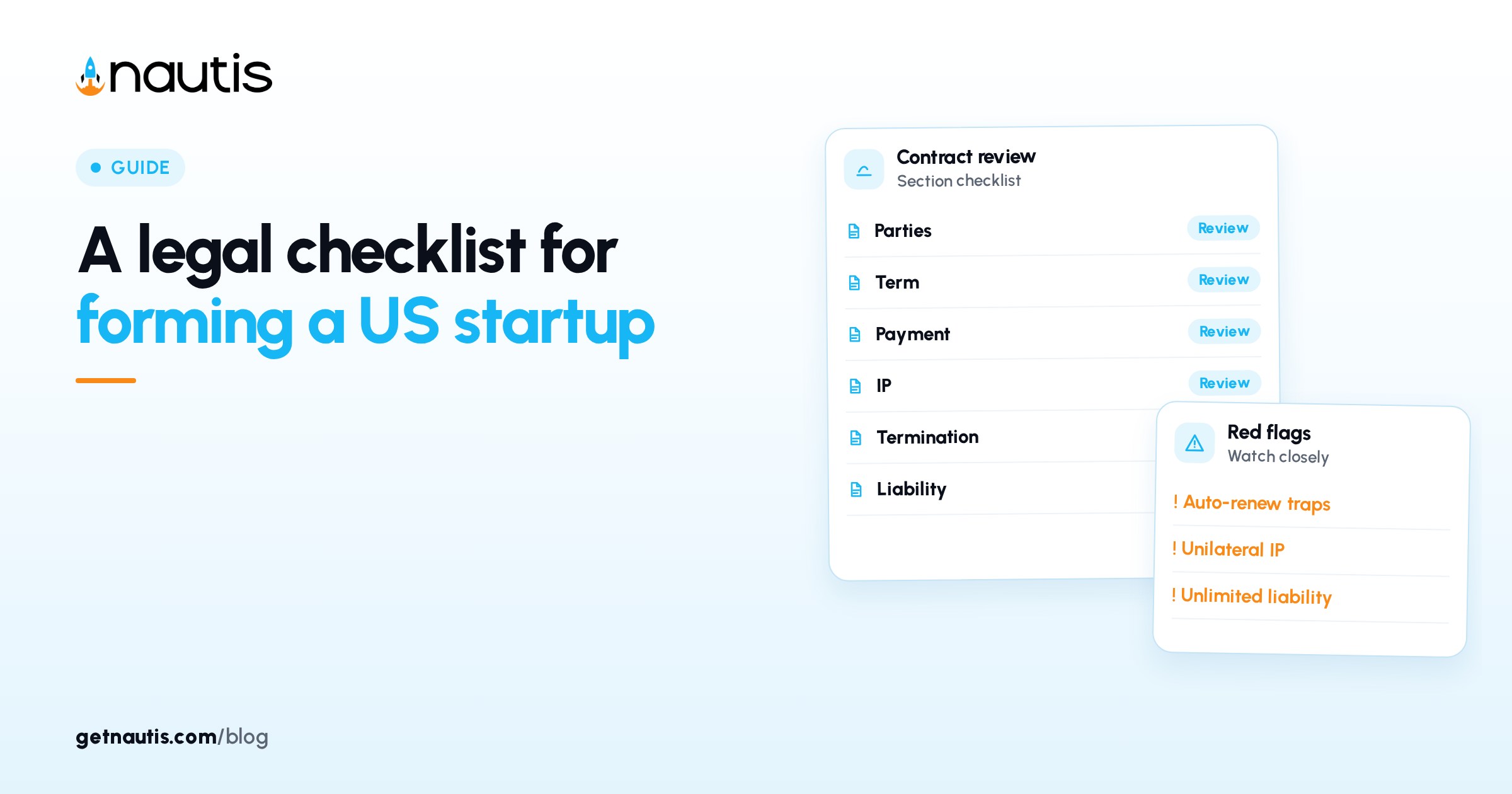
A legal checklist for forming a US startup
 Baltej Singh9 min read
A legal checklist for forming a US startup is a dated folder of filings and signatures that proves the company exists, who owns it, who can sign, and which tax IDs are live. Without that folder, bank onboarding and later document review stall.
This article is not legal advice. Check every step with a qualified attorney and tax advisor for your facts prior to filing or signing.
Run the folder like operations work: owners, due dates, and proof. Leave structure debates to a separate memo.
What a legal checklist for forming a US startup includes
Stage | Outcome | Proof in the folder |
|---|---|---|
Structure memo | One written sentence on the company form | Dated note among cofounders |
Charter | State record shows the company | Stamped certificate |
Governance pack | People authorized to act | Signed governing rules plus initial consent |
Who-owns-what pack | Founders hold shares or units on signed forms | Purchase agreements and who-owns-what list |
Tax pack | EIN live; elections filed when required | IRS letter; dated election proof |
Money and presence | Company account open; extra-jurisdiction filings if required | Bank confirmation; qualification receipts |
Packet: refuse vendor contracts in the company name until the stamped certificate and EIN letter sit in the same folder.
Assign one owner per row. Shared ownership of every row is how day-30 elections miss.
Label every PDF YYYY-MM-DD-description prior to entering the folder. Unlabeled scans become duplicate hunts.
For the full LLC versus C corporation comparison, read LLC vs C corp for a US startup (separate draft on this blog). Keep that debate out of this folder after the one-sentence memo exists.
Charter filing and the registered agent
Delaware describes the filing path as choosing a name and type, selecting a registered agent, and filing a Certificate of Incorporation with the Division of Corporations (Delaware Corporate Law, forming a Delaware corporation, checkedOn 2026-11-01).
Delaware requires every company to maintain a registered agent with a Delaware street address who can receive legal papers and state communications during business hours (same Delaware source, checkedOn 2026-11-01).
The certificate includes the name, registered agent details, incorporator information, and for stock companies the authorized share count and par value. The company exists only after the Division accepts the filing.
Save the stamped confirmation the same day. Banks and later reviewers will ask for it.
A Delaware filing is not a license to operate everywhere you sit. Local permits stay separate.
Rename public pages only after confirmation is in hand. Premature corporate designators create cleanup.
Keep a reachable communications contact for the agent if founders change cities or numbers. Returned agent mail is how standing problems start quietly.
Build a courier log for physical filings: who mailed what, tracking number, and expected arrival. The log sits next to digital scans so nobody re-mails a finished job.
Name availability screenshot: save a dated screenshot of the name search result next to the charter. Reviewers sometimes ask how you knew the name was free.
Incorporator checklist: confirm the incorporator name on the certificate matches the person who will sign the initial consent. Mismatched names create a cleanup consent.
Governance pack, then founder share paper
Adopt the governing rules and pass the initial consent that seats the people who can sign and that authorizes grants of shares or units. Without those papers, signature authority is unclear.
Issue founder share paper with signed purchase agreements that state price, amount, and restriction language your lawyer drafted. File the signed copies the same day.
Collect written assignments for inventions built prior to the filing date. Document review readers look for those early.
If you need countersignatures, DocSign stores an exportable audit trail (DocSign help).
Build a one-page signature map: document, people, wet or electronic, date done. Missing rows on that map are the usual delay ahead of a bank appointment.
Record the consideration each founder paid, even if the amount is small. Folklore without a receipt frustrates later reviews.
Store wet-ink originals in a fire-safe place and keep scans in the shared folder. Do not leave the only copy in a backpack.
Refuse to start the who-owns-what pack before the governance pack is signed. Out-of-order signatures create rewrite work.
Bank appointment kit
Item | Why the bank asks |
|---|---|
Stamped certificate | Proves the company exists |
EIN letter | Ties the account to the IRS ID |
Governing rules and consent | Shows who may open accounts |
Government ID for each signer | KYC on the humans |
Who-owns-what list | Explains control of the company |
Pack the kit the prior night. Missing one row usually means a second trip.
Folder hygiene rules
Keep drafts in a sibling folder named _working. Only signed or stamped files live in the live packet. Mixing drafts with finals is how reviewers open the wrong bylaws.
Delete download duplicates weekly. certificate (1).pdf next to certificate.pdf is a false comfort.
When two cofounders both "own" the folder, pick a single librarian. Dual librarians create divergent copies.
Section 83(b) for restricted stock grants
When founders receive substantially nonvested stock tied to services, a Section 83(b) election can measure tax at transfer rather than as shares later become transferable. The IRS requires the election no later than 30 days after the property is transferred. If day 30 falls on a Saturday, Sunday, or legal holiday, the election is timely if postmarked by the next business day (IRS Form 15620 instructions, checkedOn 2026-11-01).
Each founder files for themselves with Form 15620 or a regulation-compliant written statement, sends it to the IRS office where that founder files returns, gives a copy to the company, and keeps mailing or delivery proof forever.
As of November 2026, Form 15620 is the IRS form many filers use. Read the current instructions prior to mailing.
Write the transfer date and day-30 deadline on a shared list the hour the purchase agreements are signed. Returned mail with a wrong address burns days inside that window.
Photograph or scan the proof of mailing into the folder prior to the envelope leaves the building. Memory is not proof.
Pre-address the envelope and verify the founder tax address the day prior to signing. Weekend signing without a Monday mailing plan is a common miss.
Certified mail habit
Use a method that produces a receipt you can scan. Drop the receipt image into the packet under 83b-proof/ with the founder initials in the filename. Slack photos of receipts that never reach the folder do not count.
EIN, company account, extra-jurisdiction filings, and Delaware franchise dues
Form the company on the home filing record prior to requesting an Employer Identification Number. The IRS tells applicants creating a company to register with the state first, then apply for the EIN (IRS EIN page, checkedOn 2026-11-01).
Open a company bank account with the EIN and the filed charter. Keep personal spending off that account.
Bring the stamped certificate, EIN letter, and government ID for the signers to the bank appointment. Incomplete KYC stacks are a common second-trip cause.
If the company is active in another jurisdiction, you may need to register as out-of-state there. The U.S. Small Business Administration explains home filing plus a Certificate of Authority in other jurisdictions where the company is active, and notes that many jurisdictions also ask for a Certificate of Good Standing from the home filing state (SBA, register your business, checkedOn 2026-11-01).
Confirm each jurisdiction's definition of doing business, fees, and annual reports with that office. Do not assume one filing covers every location.
Hold industry and city licenses your work requires. The charter never replaces those permits.
Delaware corporations must file an annual report and pay the franchise tax. Taxes and annual reports are to be received no later than March 1 each year. The Division publishes minimums by calculation method and requires electronic filing for domestic corporation annual reports (Delaware Division of Corporations, annual report and tax information, checkedOn 2026-11-01).
Ask your lawyer which calculation method fits your numbers so the first March invoice is expected. Put the deadline in company systems, not only in one inbox.
Out-of-state corporations registered in Delaware follow separate annual report timing on the same Division page. Confirm which category applies prior to paying.
Create a recurring task titled "Delaware March filing" with the login for the electronic system stored in the company password vault, not in a personal browser.
Evidence packet buyers and banks can open
Name one folder "Startup paperwork packet" and keep it current:
- Filed charter and amendments
- Governing rules document
- Initial consents and officer or manager appointments
- Founder purchase agreements and who-owns-what list
- Founder invention assignments
- EIN letter
- 83(b) proof per founder after filing
- Bank confirmation
- Extra-jurisdiction qualification receipts if any
- Latest annual report and franchise tax receipt once filed
- Courier log for any physical mailings
Packet: a seed lead asks for startup paperwork on a Friday; you send one link, not twelve chat files.
Review after any who-owns-what change or board change. Stale officer lists are a common document review finding.
Mirror signed files to company storage the same day signatures land. A single laptop is not a packet.
If templates change, replace the live copies and archive old versions with dates. Two unlabeled governing-rule versions create false confidence.
Run a five-minute cold open twice a month until the first outside raise: can you answer who owns what, who can sign, and whether the EIN letter is present. If not, fix the folder ahead of anyone else opening it.
Add a cover sheet with the company legal name, home filing jurisdiction, file number if issued, and the path to the live folder. Cover sheets save search time during document review calls.
Standing letter drill
Once a quarter, request a good-standing letter or equivalent printout and drop it in the packet with the request date. If the request fails, you learn about a filing gap ahead of a buyer ask.
Librarian handoff
If the paperwork librarian rotates, run a 15-minute handoff: open every required file, confirm links work, and update the cover sheet path. Silent handoffs are how packets go missing after a cofounder leaves ops.
Track open asks to the lawyer in a three-column list: question, date sent, date answered. Untracked questions reappear as emergency calls the week of a bank appointment.
Point teammates to the Help Center for product workflows. Open pricing if you need plan limits for shared docs and signatures.
Again: this is not legal advice. Check with a lawyer before you rely on any step for your company.
Frequently asked questions
What is a legal checklist for forming a US startup?
A dated folder that proves the company exists, who owns it, who can sign, and which tax IDs are live. It is an operations packet for founders, not a substitute for a lawyer.
Is this legal advice?
No. Formation and tax rules depend on your facts and jurisdictions. Check every step with a qualified attorney and tax advisor before you file or sign.
Where do the 83(b) and EIN rules come from?
The IRS Form 15620 instructions set the 30-day Section 83(b) window. The IRS EIN page tells you to form the company with the state before you apply for an EIN.
Where should I compare LLC and C corporation?
Keep the structure memo to one sentence here. Read LLC vs C corp for a US startup for the full comparison draft on this blog.
Sources
- Delaware Corporate Law, Forming a Delaware Corporation. Checked on November 1, 2026.
- Delaware Division of Corporations, Annual Report and Tax Information. Checked on November 1, 2026.
- IRS, Employer identification number. Checked on November 1, 2026.
- IRS, Form 15620 Section 83(b) Election. Checked on November 1, 2026.
- SBA, Register your business. Checked on November 1, 2026.
Baltej Singh is a serial entrepreneur, technology leader, and Founder & CEO of Nautis and DemoVexa, with over 16 years of experience building software products, SaaS platforms, and startups. Previously the Co-Founder & CTO of SanchiConnect, he has worked extensively in the DeepTech startup ecosystem, connecting with 200+ venture capital firms and supporting a network of 4,000+ startups. Passionate about AI, automation, and entrepreneurship, he focuses on building innovative products that solve real-world problems and help businesses grow.