How Delaware franchise tax works for startups
 Baltej Singh9 min read
Delaware franchise tax is an annual tax every Delaware corporation owes for the right to exist, whether or not it earned anything that year. For a startup with millions of authorized shares, the bill shown on the first notice can be far higher than what it actually owes, because the state lets you pay the lower of two methods, and the lower one usually needs only your issued share count and total gross assets.
That gap surprises first-time founders. A company with 10 million authorized shares can open its notice, see a figure in the tens of thousands of dollars, and assume something has gone wrong. Nothing has. The notice uses the simplest method, and the founder has not yet run the second one.
This guide walks through both methods with example numbers, then covers the deadlines, fees and records you need before you file. It is general information, not legal or tax advice. Rules and rates can change, so confirm your figures with a certified public accountant (CPA) or your corporate lawyer before you pay.
What Delaware franchise tax is and who has to pay it
The Delaware Division of Corporations says every corporation incorporated in the state must file an annual report and pay a franchise tax. The tax applies if the corporation was active in the state's records at any time between January 1 and December 31 of the tax year. You owe it even if you have not started doing business. The Division's tax questions page answers that question directly and points to Title 8, Chapter 5 of the Delaware Code.
A few groups are treated differently:
- Exempt domestic corporations do not pay the tax but still file the annual report, with a $25 filing fee.
- Limited liability companies (LLCs), limited partnerships and general partnerships formed in Delaware do not file an annual report. They pay a flat annual tax due on or before June 1. Check the current amount on the Division's site before you budget for it.
- Foreign corporations, meaning companies formed elsewhere and registered in Delaware, file an annual report by June 30 with a $250 fee.
The rest of this post is about the most common startup case: a Delaware C corporation that issued stock to founders and maybe a few investors.
Why does the first franchise tax notice look so high?
The notice is high because it is usually calculated with the Authorized Shares Method, which only looks at how many shares your charter allows. A charter that authorizes millions of shares, to leave room for founders, an option pool and future rounds, gets a large number under this method. More authorized shares means a bigger bill.
The Division publishes the scale:
Authorized shares | Tax under the Authorized Shares Method |
|---|---|
5,000 or fewer | $175 (the minimum) |
5,001 to 10,000 | $250 |
Each additional 10,000 shares or part of 10,000 | Add $85 |
Any amount | Capped at $200,000 |
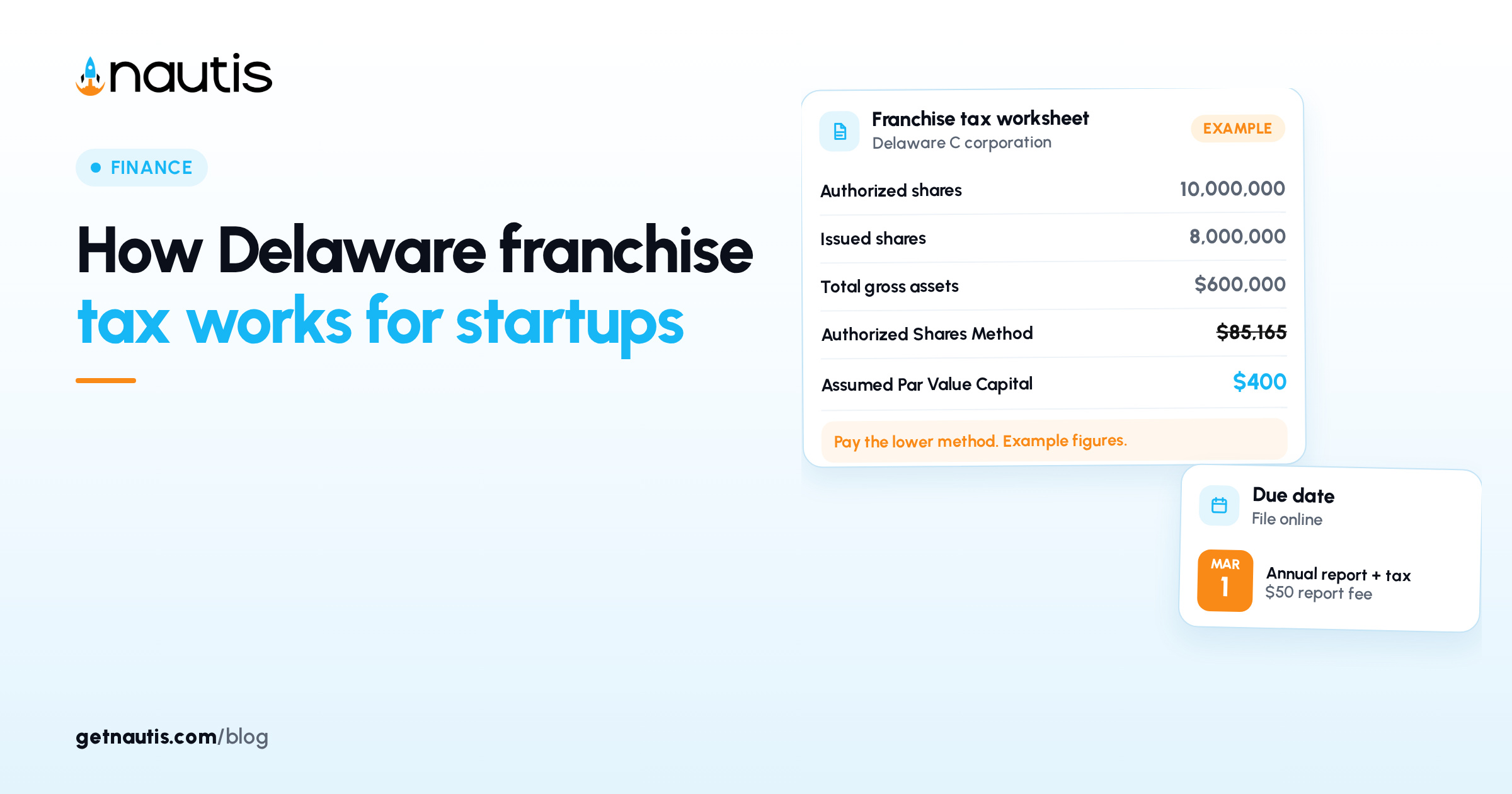
Run that for an example company with 10,000,000 authorized shares. The first 10,000 shares cost $250. The remaining 9,990,000 shares are 999 blocks of 10,000, and 999 times $85 is $84,915. The total is $85,165.
That number is correct for that method. It is often not the number an early company has to pay. The Division's own calculation page says to use the method that results in the lesser tax. It also notes that for companies with no par value stock, the Authorized Shares Method will always come out lower, so the second method only helps if your shares have a par value. Your certificate of incorporation states whether they do.
How to calculate Delaware franchise tax with the assumed par value method
The second option is the Assumed Par Value Capital Method. It looks at what your company owns compared with how many shares you have actually issued. For a young company with few assets and many issued shares, the result is often the $400 minimum.
You need three numbers:
- Total gross assets. The Division says this is the "total assets" figure reported on United States Form 1120, Schedule L, for the fiscal year ending in the calendar year before you file.
- Total issued shares, including treasury shares.
- Authorized shares and their par value, from your certificate of incorporation.
Then follow the Division's steps:
Step 1: Find your assumed par
Divide total gross assets by total issued shares, carried to six decimal places.
Step 2: Find your assumed par value capital
For each class of authorized shares whose par value is lower than the assumed par, multiply the number of shares by the assumed par. For any class whose par value is higher than the assumed par, multiply the shares by their own par value instead. Add the results together.
Step 3: Turn capital into tax
If assumed par value capital is under $1,000,000, divide it by $1,000,000 and multiply by $400. If it is over $1,000,000, round it up to the next million first, then divide by $1,000,000 and multiply by $400. The minimum under this method is $400, and the maximum is $200,000.
If you changed your authorized shares or par value during the year with an amendment, the Division asks for figures for each part of the year and prorates the tax by days. That case is worth handing to your accountant.
A worked example for one seed-stage company
Here is one example company, with invented figures for illustration. It has 10,000,000 authorized shares of common stock at a par value of $0.0001. The table shows three versions of its filing year so you can see which input moves the result.
Example scenario | Issued shares | Total gross assets | Assumed par | Assumed par value capital | Tax |
|---|---|---|---|---|---|
Year one, founders only | 8,000,000 | $600,000 | $0.075000 | $750,000 | $400 (minimum applies) |
After a seed round | 9,500,000 | $2,400,000 | $0.252632 | $2,526,320 | $1,200 |
Few shares issued | 1,000,000 | $600,000 | $0.600000 | $6,000,000 | $2,400 |
Walk through the first row. $600,000 divided by 8,000,000 issued shares gives an assumed par of $0.075. That is higher than the $0.0001 par value, so all 10,000,000 authorized shares are multiplied by $0.075, which gives $750,000. Because that is under $1,000,000, the tax is $750,000 divided by $1,000,000, times $400, which is $300. The method has a $400 minimum, so the company owes $400 in tax.
In the second row, assumed par value capital of $2,526,320 rounds up to $3,000,000, and three times $400 is $1,200.
The third row shows why the issued share count matters. With the same assets but only 1,000,000 shares issued, the assumed par jumps and the tax rises to $2,400. If your cap table is out of date and you report too few issued shares, you could pay more than you need to.
In every row, the result is far below the $85,165 from the Authorized Shares Method. Add the $50 annual report fee for a non-exempt domestic corporation, and the first-year example company pays $450 in total.
Deadlines, fees and penalties to put on the calendar
The annual report and franchise tax for the prior year are due on or before March 1. Delaware requires domestic corporations to file online. The Division sends notices to each company's registered agent in December, so make sure your agent has a current email for you.
Item | Amount or date, per the Division of Corporations |
|---|---|
Annual report and tax due | On or before March 1 |
Annual report fee, non-exempt domestic corporation | $50 |
Late filing penalty | $200 |
Interest on unpaid tax | 1.5% per month |
Estimated payments if you owe $5,000 or more | 40% by June 1, 20% by September 1, 20% by December 1, remainder by March 1 |
Payments over $5,000 | Electronic bank debit required |
Two more details from the Division are easy to miss. The annual report must list the names and addresses of all directors and the officer who signs it, and domestic reports now require a nature of business line describing how the company earns revenue. The Division also warns about mail and email that look official but do not come from the state or your registered agent. Pay only through the state's own filing site or your agent.
If you are winding the company down, taxes keep accruing until a document ending the company's existence, such as a certificate of dissolution, is filed with the state. Shutting down operations alone does not stop the bill.
For the federal and state dates that sit around this one, the startup tax calendar basics post lays out a full year.
What to gather before you file, and where Nautis helps
Most of the work is collecting numbers you already have in different places. Before you open the filing site, have these ready:
- Authorized shares and par value for each class, from the certificate of incorporation
- Total issued shares as of year end, including treasury shares
- Total gross assets for the year, from the figure your accountant uses for Form 1120, Schedule L
- Names and addresses of current directors
- The name and title of the officer who will sign
- A one-line description of what the company does to earn revenue
The share numbers are where a tidy cap table pays off. In Nautis, the Cap Table setup asks for Total Authorized Shares and Par Value Per Share, and the Overview tab shows totals for issued shares and authorized shares. Check those totals against your signed stock records before using them, since the filing should match your legal documents. If you are unsure how to read the totals, how to read a startup cap table explains each column.
For the deadlines, a board in Task Boards can hold one task per date with an owner and a due date. A simple version has three tasks: confirm share and asset figures in early February, file and pay by March 1, and save the acknowledgment copy. If your tax is $5,000 or more, add the June, September and December estimated payments as their own tasks.
Nautis does not file the report or pay the tax for you. It keeps the numbers and the dates in one place so the person filing is not hunting through email in late February. Before you submit, ask your CPA or lawyer to check the method and the figures, especially in a year when you raised money or amended your charter.
Frequently asked questions
Why is my Delaware franchise tax bill so high?
The figure on the notice is usually based on authorized shares, and a company with 10,000,000 authorized shares gets $85,165 under that method. Delaware lets you pay the lower of two methods. Recalculating with the Assumed Par Value Capital Method, using total gross assets and issued shares, often gives a much smaller amount for an early company.
When is Delaware franchise tax due?
For domestic corporations, the annual report and franchise tax are due on or before March 1 for the prior year. Companies that owe $5,000 or more make estimated payments of 40% by June 1, 20% by September 1 and 20% by December 1, with the rest due March 1.
Do I have to pay Delaware franchise tax if my startup made no money?
Yes. The Delaware Division of Corporations says corporations owe the tax even if they have not started doing business. The tax is assessed if the corporation was active in the state records at any time during the tax year.
What is the minimum Delaware franchise tax for a corporation?
The minimum is $175 under the Authorized Shares Method and $400 under the Assumed Par Value Capital Method. Non-exempt domestic corporations also pay a $50 annual report filing fee. Confirm current amounts on the Division of Corporations site before you pay.
Sources
- Delaware Division of Corporations, How to Calculate Franchise Taxes. Checked on November 12, 2026.
- Delaware Division of Corporations, Annual Report and Tax Information. Checked on November 12, 2026.
- Delaware Division of Corporations, Annual Report and Tax Instructions. Checked on November 12, 2026.
- Delaware Division of Corporations, Frequently Asked Tax Questions. Checked on November 12, 2026.
- Nautis Help Center, Cap Table. Checked on November 12, 2026.
- Nautis Help Center, Task Boards. Checked on November 12, 2026.
Baltej Singh is a serial entrepreneur, technology leader, and Founder & CEO of Nautis and DemoVexa, with over 16 years of experience building software products, SaaS platforms, and startups. Previously the Co-Founder & CTO of SanchiConnect, he has worked extensively in the DeepTech startup ecosystem, connecting with 200+ venture capital firms and supporting a network of 4,000+ startups. Passionate about AI, automation, and entrepreneurship, he focuses on building innovative products that solve real-world problems and help businesses grow.