How to manage a startup without using 15 different tools
 Baltej Singh5 min read
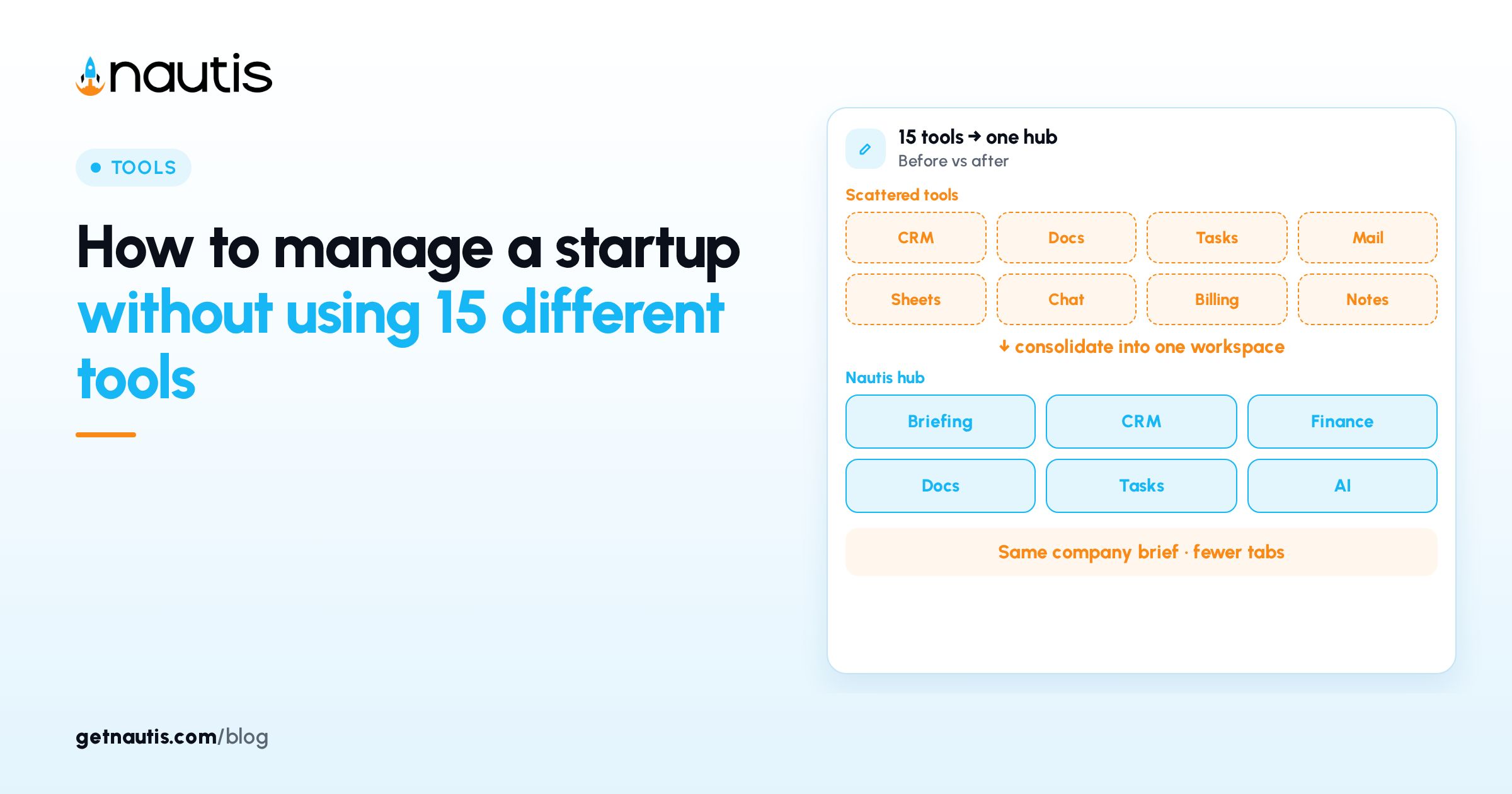
How to manage a startup without using 15 different tools starts with one rule: every fact the company needs should live in one system of record, and every other app must justify itself each month. Founders usually collect SaaS the way they collect browser tabs.
This post is a consolidation playbook, not a vendor tour. Where Nautis appears, it is one optional example of an AI business operating system that keeps briefing, tasks, and approvals together. You can follow the same structure with a disciplined stack of your own.
How to manage a startup without using 15 different tools when sprawl hurts
Tool sprawl is the usual failure mode. Cut it on purpose.
Why tool sprawl hurts early teams
Each new tool adds login friction, another export, and another place a decision can hide. Weekly reviews stall because nobody trusts which board is current. Investor updates take a day because pipeline lives in one app and burn lives in a spreadsheet. Hiring feedback sits in email threads that never reach the scorecard.
Y Combinator's essential startup advice emphasizes focus and talking to users over building process theater. The same focus applies to software: fewer surfaces, clearer owners, faster loops.
A simple stack map
Write five columns on one page: Source of truth, Daily work, Communication, Money, and Experiments. For each column allow at most one primary tool.
- Source of truth: company goals, decisions, and the living brief.
- Daily work: tasks and projects.
- Communication: chat and email.
- Money: bank, bookkeeping, and invoices.
- Experiments: anything temporary (ads, survey forms, landing-page builders).
Experiments may multiply. The other four columns should not. If two tools claim the same column, pick one within a week or delete both and start over.
Step-by-step consolidation
1. Inventory what you pay for
Export last month's card charges. List every SaaS line with owner, job, and last login. Anything unused for 30 days is a cut candidate.
2. Name the system of record for each object
People, companies, deals, tasks, documents, and cash each need one home. If deals live in both a spreadsheet and a CRM, freeze the spreadsheet for reporting and move edits to the CRM.
3. Move the morning read to one page
Your daily founder briefing should show blockers, pipeline, cash, and approvals without opening five apps. In Nautis that page is the Chief of Staff Briefing; if you stay tool-agnostic, build the same sections in a single doc updated every morning.
4. Gate outbound sends
Whatever drafts email for you, require a human preview of subject, body, and recipients. That rule matters more than which assistant you use. See the human-in-the-loop AI agents guide for a policy table by action type. Standing jobs can live under Routines once the stack is thin.
5. Schedule the weekly prune
Every Friday, delete or pause one tool. Stop when you can describe the stack in under a minute.
What good looks like after 30 days
- One CRM, one task board, one file tree, one finance system.
- Chat is for conversation, not for storing commitments.
- Approvals for money, equity, and external email are written down.
- New tool requests need a one-page brief: job, owner, kill criteria.
How Nautis can fit without becoming the pitch
If you want the briefing, Approval Center, and routines in one workspace, start from the Chief of Staff help center. Liftoff connects calendar and email so the morning page has real signals. You do not need fifteen adjacent products to get a ranked day.
Common failure modes
- Keeping a "temporary" spreadsheet that becomes the real CRM.
- Adding an AI chat for every department without shared memory.
- Measuring productivity by number of integrations instead of cycle time.
- Refusing to delete a tool because someone might need it someday.
A one-week cut plan
Day 1: inventory and owners. Day 2: pick system of record per object. Day 3: migrate open deals and tasks. Day 4: turn off duplicate notifications. Day 5: ship the one-page morning briefing. Day 6: write approval rules. Day 7: cancel two unused subscriptions.
Manage a startup without many tools by subtraction first. Add software only when a human process is already clear.
How to pick the system of record
Choose the tool where edits happen, not where reports are screenshotted. If the CRM is the system of record for deals, disable spreadsheet edits except as a weekly export. If the task board owns commitments, stop accepting "I'll Slack you" as a substitute for a dated card.
Write ownership in public: name, backup, and review day. Without an owner, consolidation fails quietly.
Communication rules that replace three apps
- Decisions go into a decision log with date, options, and owner.
- Files live in one tree with a naming convention people can guess.
- Status updates happen on a fixed cadence so chat stays conversational.
These habits matter more than which chat product you buy. They also make an AI briefing safer because the model reads fewer contradictory sources. For autonomy and approval patterns when agents write back into tools, read AI Governance.
When a second tool is allowed
Allow a second tool only when it is read-only analytics on top of the system of record, a legal or tax system your counsel requires, or a time-boxed experiment with a kill date on the calendar. No kill date means it is not an experiment.
Closing standard
If a new hire cannot draw your stack on a whiteboard in five boxes, you are not done consolidating. Manage startup without many tools until that whiteboard test passes.
Frequently asked questions
How many tools should an early startup keep?
Keep one primary tool for source of truth, daily work, communication, and money. Experiments can multiply if they have a kill date. If two tools share a column, pick one within a week.
Where should deals live if we also use spreadsheets?
Pick the CRM as the system of record for edits. Use the spreadsheet only as a weekly export for reporting so numbers do not fork.
Do we need an AI product to consolidate?
No. Consolidation is an ownership and subtraction problem first. An AI briefing helps only after facts live in fewer places.
Sources
- Chief of Staff help center. Checked on October 31, 2026.
- YC essential startup advice. Checked on October 31, 2026.
Baltej Singh is a serial entrepreneur, technology leader, and Founder & CEO of Nautis and DemoVexa, with over 16 years of experience building software products, SaaS platforms, and startups. Previously the Co-Founder & CTO of SanchiConnect, he has worked extensively in the DeepTech startup ecosystem, connecting with 200+ venture capital firms and supporting a network of 4,000+ startups. Passionate about AI, automation, and entrepreneurship, he focuses on building innovative products that solve real-world problems and help businesses grow.