Best startup financial planning tools for founders
 Baltej Singh8 min read
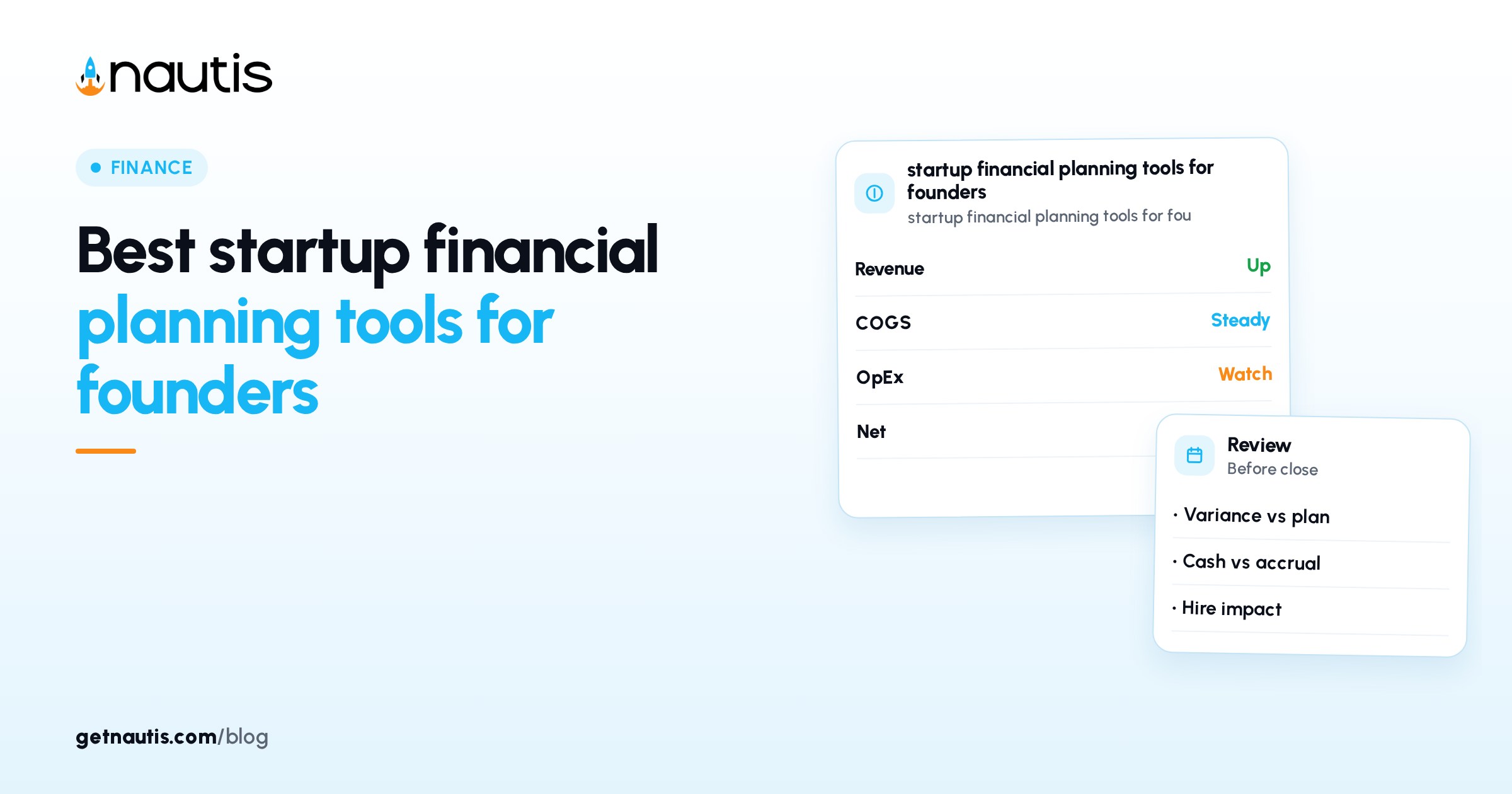
The phrase best startup financial planning tools should mean fit for your stage, not a trophy score. Founders need a model they can defend: revenue and cost assumptions, cash, burn, runway, and a way to stress a delayed raise or a hiring spike. Anything that cannot produce those views is the wrong category, no matter how pretty the dashboard.
This guide compares options using what each vendor published as of October 2026, plus redirects we followed the same day. There are no invented star ratings and no affiliate picks. Prices change; re-check the linked pages before you buy. For the arithmetic behind burn and runway, keep how to calculate startup burn rate and runway beside any tool.
The U.S. Small Business Administration's manage-your-finances guidance still starts with bookkeeping, knowing cash position, and separating concerns so money-in and money-out stay visible. Planning software sits on top of that habit. It does not replace a bookkeeper or tax filing.
What "best" should mean for an early team
Score candidates against jobs you will actually do this quarter:
- Build a multi-year projection from explicit assumptions
- Show cash, burn, and runway without a twelve-tab scavenger hunt
- Run at least a base case and a stressed case
- Export something an investor or accountant can open
- Stay within a budget you can explain to a co-founder
If a product is quote-only enterprise FP&A, it can still be excellent and still be the wrong buy at pre-seed.
Snapshot table (vendor sites, October 2026)
Tool | What the vendor publishes | Self-serve list price seen today | Notes from live pages / redirects |
|---|---|---|---|
Spreadsheets (Sheets / Excel) | Models you build yourself | Google Workspace plans listed on Google's pricing page; Excel sold via Microsoft 365 (check current list prices) | Maximum control; easy to fork into conflicting files |
cfo.ai (formerly Runway Financial) | AI CFO product with integrations and scenarios | Startup $375/mo billed annually ($500 monthly); Growth $1,125/mo billed annually ($1,500 monthly); Enterprise custom; 14-day trial | Pricing page checked Oct 31, 2026 |
Forecastr | Software plus a dedicated finance expert | Essentials $5,000/year; Growth $10,000/year; CFO Services custom | Analyst-included plans on forecastr.com/pricing |
Jirav | Planning for accounting and CFO advisory firms | Controller Essentials from $50/mo; CFO Enterprise from $150/mo (wholesale framing) | Aimed at firms serving clients, not only a single startup |
Cube | Spreadsheet-native FP&A | Quote-only Bronze / Silver / Gold by entity count | No public dollar amount on the pricing page |
Nautis Financial Planner | Multi-year projection inside the Nautis workspace | Included with Nautis plans: Launch $49, Voyage $99, Fleet $129 per month; 14-day trial with no card on Launch | Module must be enabled on your plan |
Former standalone names now redirect elsewhere as of this check: causal.app to Lucanet xP&A, finmark.com to BILL, pry.co to Brex, mosaic.tech to HiBob finance. Treat those as platform moves, not as current self-serve startup SKUs under the old brands.
Spreadsheets first when the model is still simple
Google Sheets and Excel remain the default for many seed teams because every investor already opens them. You own the formulas. You also own the failure modes: silent version forks, broken links, and a runway cell nobody trusts.
Use a sheet when one founder can explain every driver in a single meeting. Graduate when monthly actuals entry becomes a weekend job or when two people edit conflicting copies. The SBA material's emphasis on knowing cash and keeping books current still applies: a pretty model on top of unreconciled bank data is fiction.
cfo.ai when you want live actuals and published startup pricing
On cfo.ai/pricing (checked October 31, 2026), Startup is $375 per month billed annually or $500 on monthly billing, with up to five standard integrations and a 14-day trial. Growth is $1,125 per month billed annually ($1,500 monthly) with higher AI usage and more integrations. Enterprise is custom.
The same page states Ari reads ledger, banking, and payroll and does not write back to those systems; outbound actions need approval. That matters if you are comparing "AI CFO" claims. It is still not your auditor. Keep closed books with your accountant.
Pick this lane when you will pay hundreds per month to keep a driver-based model tied to connected systems and you want a vendor that still publishes self-serve startup tiers.
Forecastr when you want an analyst in the plan
Forecastr prices Essentials at $5,000 per year and Growth at $10,000 per year, with CFO Services above that. Every plan on the pricing page includes a dedicated finance expert, a custom model, variance analysis, and monthly forecast updates on Essentials, with deeper scenario and departmental work on Growth.
That is a services-shaped product. Compare total cost to a fractional CFO hour rate in your market, not only to a pure software seat. It can be the right "best" answer when the bottleneck is human modeling time, not missing charts.
Jirav and Cube when finance already looks like a firm
Jirav's public pricing is framed for accounting and CFO advisory wholesale: Controller Essentials starting at $50 per month and CFO Enterprise starting at $150 per month, with plan counts, forecast durations, and department limits listed on the page. If you are a single startup buying directly, confirm the commercial motion with them; the page you read today is written for firms.
Cube lists Bronze, Silver, and Gold by legal-entity bands and asks you to get a quote. Unlimited users are called out; dollars are not. That pattern fits Series B+ finance teams that already live in Excel or Sheets and need governed FP&A, not a first founder model.
Best startup financial planning tools inside an operating system: Nautis
If you already want briefing, CRM, and fundraising beside the model, Nautis Financial Planner builds a multi-year financial projection for your startup: revenue, costs, profit and loss, balance sheet, cash flow, and loan schedules. You enter assumptions once; Nautis renders the statements, ratios, and a dashboard with burn rate and runway. Export to Excel or PDF when you are ready to share.
Create a blank project or an industry template (for example SaaS, E-commerce, Restaurant, Services, Mobile App), choose a 3-year or 5-year period, then work Revenue Items, Model Inputs, and starting balances. Profit and Loss and Cash Flow are calculated. Clone a project to run scenarios and use Compare to lay two projections side by side. Runway is current cash divided by monthly net burn from the Cash Flow tab.
The module must be enabled on your plan. Nautis plan prices on /pricing are Launch $49, Voyage $99, and Fleet $129 a month, with a 14-day trial with no card starting on Launch. Nautis is not an accounting or payroll system; keep books elsewhere and treat the planner as forward-looking. Details live in the Financial Planner help center.
How to choose without a fake ranking
Your situation | Stronger fit from today's public pages | Why |
|---|---|---|
Pre-revenue, one founder model | Spreadsheet | Lowest cost; full formula ownership |
Want published self-serve AI CFO pricing and integrations | cfo.ai Startup or Growth | Clear list prices and trial on the vendor site |
Want a human analyst bundled | Forecastr Essentials or Growth | Expert included in the plan copy |
Accounting firm serving many clients | Jirav wholesale tiers | Pricing page written for CAS / CFO advisory |
Multi-entity FP&A, spreadsheet-native, quote OK | Cube | Entity-based plans, quote flow |
Want the model next to startup ops modules | Nautis Financial Planner | Projection plus export inside the workspace |
Revisit the table when a vendor page changes. Acquisition redirects (Causal, Finmark, Pry, Mosaic brands) are a reminder that "best of 2024" lists age badly.
Bookkeeping versus planning (keep the line bright)
Planning tools forecast. Bookkeeping records what already happened. The SBA manage-your-finances pages stress balance sheets, knowing available cash, reconciling banks, and getting help with receivables and payables. None of the products above should be treated as a substitute for that work.
A practical split:
- Books and payroll: your accountant stack
- Forward model and scenarios: one planning home
- Published runway number for the company: one figure everyone may quote
When the planning tool and the books disagree, stop debating the chart. Reconcile cash first, then update assumptions. Investor updates that mix accrual theater with cash runway create diligence questions you do not need.
Two founder paths (examples)
Example: sheet long enough
Aria keeps a single Google Sheet with revenue drivers, hiring plan, and cash. She updates it every Monday after bank export. At $0 revenue the sheet is enough. When a second co-founder starts editing a private copy, they freeze the fork and pick one file as the system of record. Software comes later.
Example: services beat seats
Ben can afford software seats but cannot finish a board pack alone. He buys Forecastr Essentials at the published $5,000 per year because the dedicated analyst owns monthly updates. The "best" tool for him is the one that removes weekend modeling, not the one with the flashiest AI label.
A one-hour evaluation script
- Write the three decisions the model must support this quarter
- Open each shortlisted pricing page and record price, trial, and who the page is sold to
- Build the same simple scenario in each tool or sheet: hiring two people next month
- Export or share the output with a co-founder who did not build it
- Keep the tool whose export a stranger can explain in five minutes
If two tools tie, pick the one your accountant will actually open. Best startup financial planning tools are the ones that survive contact with the bank balance and the board pack, not the ones that win a blog trophy.
Frequently asked questions
What should founders look for in financial planning software?
Explicit assumptions, cash and runway views, at least two scenarios, and an export an outsider can open. Fancy charts without trusted cash inputs create diligence risk. Match the tool to your stage and budget.
How much does cfo.ai cost?
As of October 31, 2026 on cfo.ai/pricing, Startup is $375 per month billed annually or $500 monthly, Growth is $1,125 per month billed annually or $1,500 monthly, and Enterprise is custom. A 14-day trial is offered on that page.
Is Nautis a replacement for QuickBooks or payroll?
No. Nautis is not an accounting or payroll system. Financial Planner builds forward-looking projections and exports; keep books and payroll in the systems your accountant uses.
Why do older blog posts still recommend Causal, Finmark, Pry, or Mosaic?
Those brands redirected or changed packaging by late 2026 when checked: Causal to Lucanet, Finmark to BILL, Pry to Brex, Mosaic to HiBob finance. Prefer live vendor pages over undated listicles.
Sources
- cfo.ai pricing. Checked on October 31, 2026.
- Forecastr pricing. Checked on October 31, 2026.
- Jirav pricing. Checked on October 31, 2026.
- Cube pricing. Checked on October 31, 2026.
- Nautis pricing. Checked on October 31, 2026.
- Nautis Financial Planner help center. Checked on October 31, 2026.
- SBA manage your finances. Checked on October 31, 2026.
Baltej Singh is a serial entrepreneur, technology leader, and Founder & CEO of Nautis and DemoVexa, with over 16 years of experience building software products, SaaS platforms, and startups. Previously the Co-Founder & CTO of SanchiConnect, he has worked extensively in the DeepTech startup ecosystem, connecting with 200+ venture capital firms and supporting a network of 4,000+ startups. Passionate about AI, automation, and entrepreneurship, he focuses on building innovative products that solve real-world problems and help businesses grow.