

How to think about pricing a seed round
 Baltej Singh8 min read
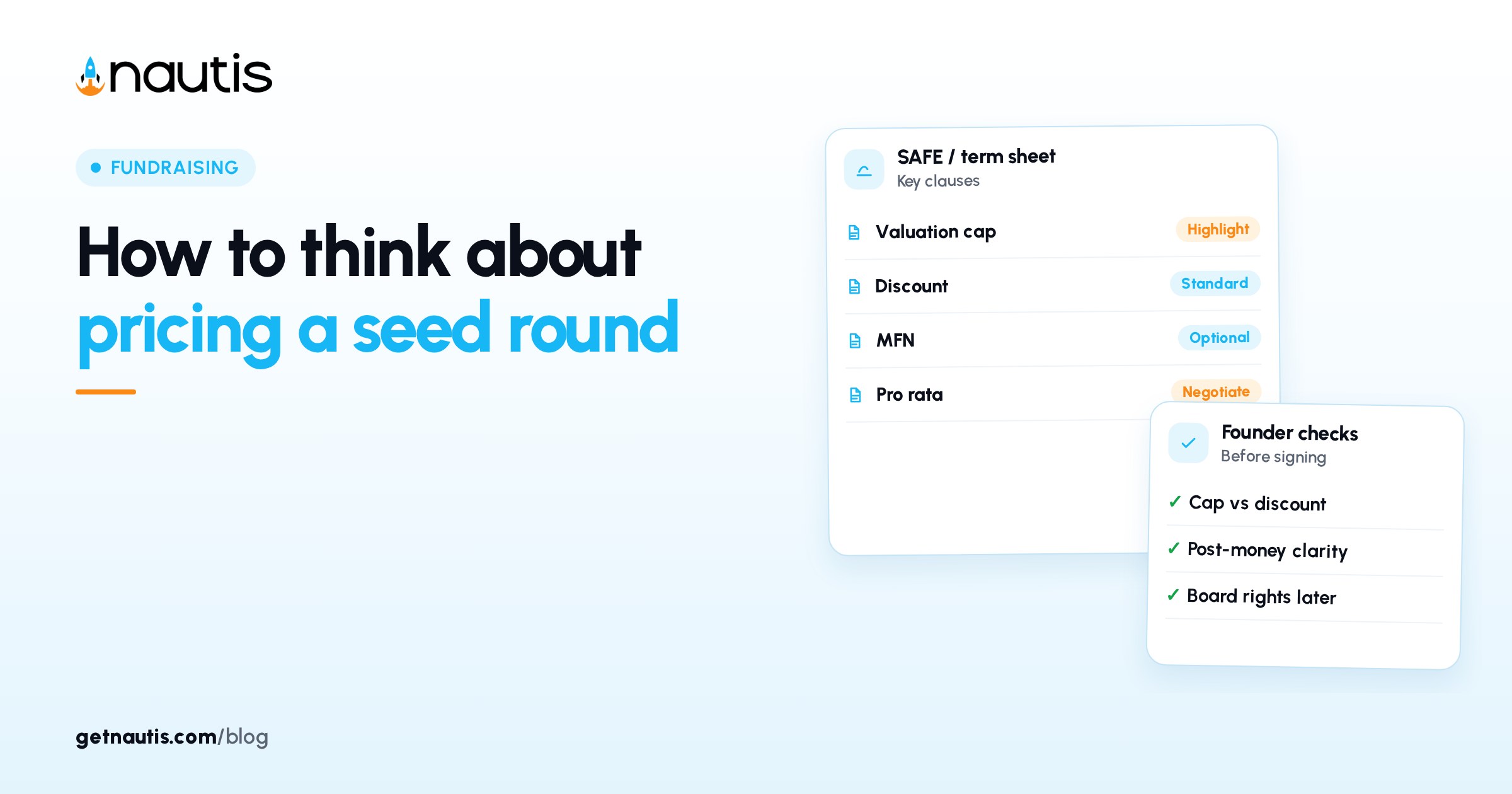
How to price a seed round starts with ownership math, not a gut number on a whiteboard. Y Combinator's SAFE materials (checked 31 Oct 2026) tell founders to pick the fundraise amount and the ownership they are willing to sell, then let the post-money valuation cap follow: ownership sold equals investment divided by the post-money cap. YC's Guide to Seed Fundraising by Geoff Ralston (checked 31 Oct 2026) states that no formula makes an early company "worth" a precise figure, that the market sets price when interest is real, and that the objective is a valuation that funds the plan with acceptable dilution rather than the highest sticker. This post is educational orientation. It is not legal, tax, or investment advice. Ask counsel before you issue SAFEs or priced stock.
How to price a seed round when the instrument is still open
Price means different things on different paper. On a post-money SAFE, the headline number is usually a valuation cap (and sometimes a discount). On a convertible note, you also negotiate interest and maturity. On a priced equity round, you set a pre-money valuation, a share price, and you sell new shares now. YC's seed guide notes that most Silicon Valley seed rounds shifted toward convertibles or SAFEs, with priced equity the exception at that stage because it is more complicated, expensive, and time consuming. Pick the instrument with counsel first. Quoting a "valuation" before you know whether you are talking SAFE cap or priced pre-money is how founders talk past investors. YC's SAFE FAQ also says SAFE investors should be accredited and that the board must approve issuing SAFEs. Side rights such as pro rata belong in separate side letters rather than inside a modified SAFE. Those process rules sit beside the math: a clean cap with messy issuance still fails diligence.
Decision | SAFE (post-money) | Priced equity seed |
|---|---|---|
Headline number | Valuation cap (ownership = dollars / cap) | Pre-money valuation and price per share |
When ownership finalizes | Clear at SAFE issue for post-money caps; converts later | Clear when shares issue |
Typical seed complexity | Short form; board approval required per YC FAQ | Longer docs; option pool and prefs negotiated |
What "price high" does | Higher cap sells less ownership per dollar | Higher pre-money sells fewer shares per dollar |
Main risk of over-optimizing | Cap the next round cannot clear; awkward conversion | Hard close; longer process; more legal cost |
Start from raise size and ownership sold
YC's SAFE page walks the arithmetic with a clear illustrative pattern: target $1M raised and 15% ownership sold, and the post-money valuation cap is about $6.7M ($1M / 15%), often spoken as "$1M at $6.7M post / $5.7M pre." Raise $500k on that same cap and you sell about 7.5%; raise $800k and you sell about 12%. You can also split across caps: YC shows $500k at a $5.5M cap (~9%) plus $500k at an $8.3M cap (~6%) still totaling about 15% sold. Those figures are YC's teaching examples, not a promise for your company. YC's SAFE calculator FAQ adds two pricing discipline points founders miss. Post-money SAFEs at the same cap do not dilute each other: ownership for each is investment divided by the cap with other SAFEs already in the capitalization picture, so five $100k SAFEs at a $5M cap sell 10% total, not 2%. You should raise well under the cap; raising the full cap would imply selling 100% of the company. Decide the total raise before you start issuing SAFEs so the ownership stack stays intentional.
YC's seed guide frames dilution targets in plain language: giving up as little as 10% in seed is wonderful, most rounds will require up to 20%, and founders should try to avoid more than 25%. Tie the ask to a believable plan for months of runway. The guide's engineer rule of thumb (about $15k all-in per month per engineer in that Silicon Valley framing) is a planning aid for building a range, not a universal payroll model. Decide how many months you need (often 12 to 18 in that guide) and what progress that cash must buy, then work backward to ownership you can accept.
Let interest set the band, then stop optimizing
The seed guide's valuation section says early price is notional: investors write checks when they believe the team and opportunity, and values move with interest. When no one will set a number, founders may look at comparable raises, still aiming for a figure that clears the round with acceptable dilution. The guide notes seed valuations tended to range from about $2M to $10M in that discussion, and warns that the goal is not the best valuation and that a high valuation does not increase the odds of success. Do not treat that band as a 2026 market report. Treat it as a reminder to clear the round instead of maximizing a sticker.
Over-pricing creates two failure modes. On SAFEs, a sky-high cap that no later priced round can sit above can force conversion at the new-money price and surprise everyone on ownership. YC's SAFE calculator FAQ explains that if the priced round is below the cap, the cap does not bind and SAFE holders convert at the new money price. On priced rounds, a number the market will not pay simply delays close while legal meters run.
YC's seed guide also walks a priced-round illustrative path: raise $1,000,000 on a $5,000,000 pre-money with 10,000,000 shares outstanding, so price is $0.50 per share, 2,000,000 new shares issue, post-money is $6,000,000, and dilution is about 16.7% of the new total, not 20% of the old base. Founders who only divide new money by pre-money misstate dilution. Cap Table Scenarios exist so you see that math before you shake hands.
Keep every quote identical in CRM and Cap Table
Once you pick a working cap or pre-money, write it the same way in every investor note. In Fundraising CRM, create the round with Round Name and Funding Round Type, set Fundraise Target to the cash you are raising, and set Pre-Money Valuation to the valuation or the valuation cap when you are using SAFEs or convertible notes (the help page states that explicitly). Add each investor with Investor / firm name, Source, Investor Type, and Check Size. Store signed SAFEs or stock docs under Files. Move stage when money is committed. On Raise HQ, drafted follow-ups stay unsent until you approve. The Closing checklist covers Terms and paperwork and Money and records and is labeled guidance, not legal advice.
On Cap Table, add investor stakeholders and record SAFE or preferred instruments on the Equity tab. Overview shows issued, authorized, and fully diluted totals. Use Scenarios before you agree to a number: create a scenario for the proposed raise, compare current ownership to post-event ownership, and only then record the live round. Scenarios are sandbox-only until you record the real instrument. Export All Data (JSON) when the seed cluster closes. For SAFE conversion detail without reteaching pricing, see SAFE note explained for startups.
Illustrative bad quote versus a cleaner one
Both stories below are composite illustrative examples, not real companies or investor sets.
Bad quote: A founder told Angel A "$8M post SAFE," told Angel B "$10M post," and told a small fund "$6M pre priced." Check sizes were similar. When the fund asked for the cap table math, three stories appeared. Fundraising CRM had one Fundraise Target and three conflicting Notes. Cap Table had no SAFE rows yet. The illustrative failure was not ambition. It was inconsistent pricing language across channels.
Cleaner quote: A founder decides with counsel to raise about $1.0M selling about 15% on post-money SAFEs, so the working cap is about $6.7M post, matching YC's teaching arithmetic. They set Fundraise Target to $1.0M and Pre-Money Valuation to the matching pre figure in Fundraising CRM, put the same sentence in every outreach note, add deals with Check Size as conversations progress, and model the 15% case in Cap Table Scenarios before the first SAFE is signed. Board approval is obtained before issue, as YC's SAFE FAQ requires. Later seed diligence sees one math story.
A short sequencing checklist before you name a number
Confirm the instrument with counsel (SAFE, note, or priced). If you use a note, price the cap or discount with the same ownership discipline and remember interest and maturity create different cash and conversion dynamics than a SAFE. Set months of runway and the milestone that cash must buy. Pick an ownership range you can accept (seed guide: aim near 10% to 20%, try not to exceed 25%). Derive the SAFE post-money cap as raise divided by ownership sold, or derive share price from pre-money and fully diluted shares for a priced round. Pressure-test with Cap Table Scenarios. Put Fundraise Target and Pre-Money Valuation in Fundraising CRM. Use one sentence in every investor note. How to price a seed round, in practice, is that sequence repeated until the book fills, not a single clever valuation slide.
Frequently asked questions
How do I price a seed round on a post-money SAFE?
Choose how much cash you need and how much ownership you are willing to sell. Divide raise by ownership to get the post-money valuation cap. YC’s materials use about $1M for 15% ownership as roughly a $6.7M post-money cap. Ask counsel before you issue.
Is a SAFE cap the same as a priced pre-money valuation?
No. A post-money SAFE cap is a conversion ceiling that makes ownership transparent at issue. A priced round sets a share price and issues stock now under a pre-money valuation. Mixing the words in investor notes creates conflicting stories.
How much dilution is typical in a seed round?
YC’s Guide to Seed Fundraising says giving up as little as 10% is wonderful, most rounds will require up to 20%, and founders should try to avoid more than 25%. Tie dilution to a believable runway plan, not to a vanity sticker.
Where should I record the seed price in Nautis?
In Fundraising CRM, set Fundraise Target and Pre-Money Valuation (the help page notes that field can hold a valuation cap for SAFEs or notes). Record instruments on Cap Table Equity and test the deal in Scenarios before you sign.
Sources
- Y Combinator SAFE. Checked on October 31, 2026.
- Y Combinator SAFE conversion calculator FAQ. Checked on October 31, 2026.
- Y Combinator Guide to Seed Fundraising. Checked on October 31, 2026.
- Nautis Fundraising CRM help. Checked on October 31, 2026.
- Nautis Cap Table help. Checked on October 31, 2026.
Baltej Singh is a serial entrepreneur, technology leader, and Founder & CEO of Nautis and DemoVexa, with over 16 years of experience building software products, SaaS platforms, and startups. Previously the Co-Founder & CTO of SanchiConnect, he has worked extensively in the DeepTech startup ecosystem, connecting with 200+ venture capital firms and supporting a network of 4,000+ startups. Passionate about AI, automation, and entrepreneurship, he focuses on building innovative products that solve real-world problems and help businesses grow.


