A win-loss interview guide for founders
 Baltej Singh9 min read
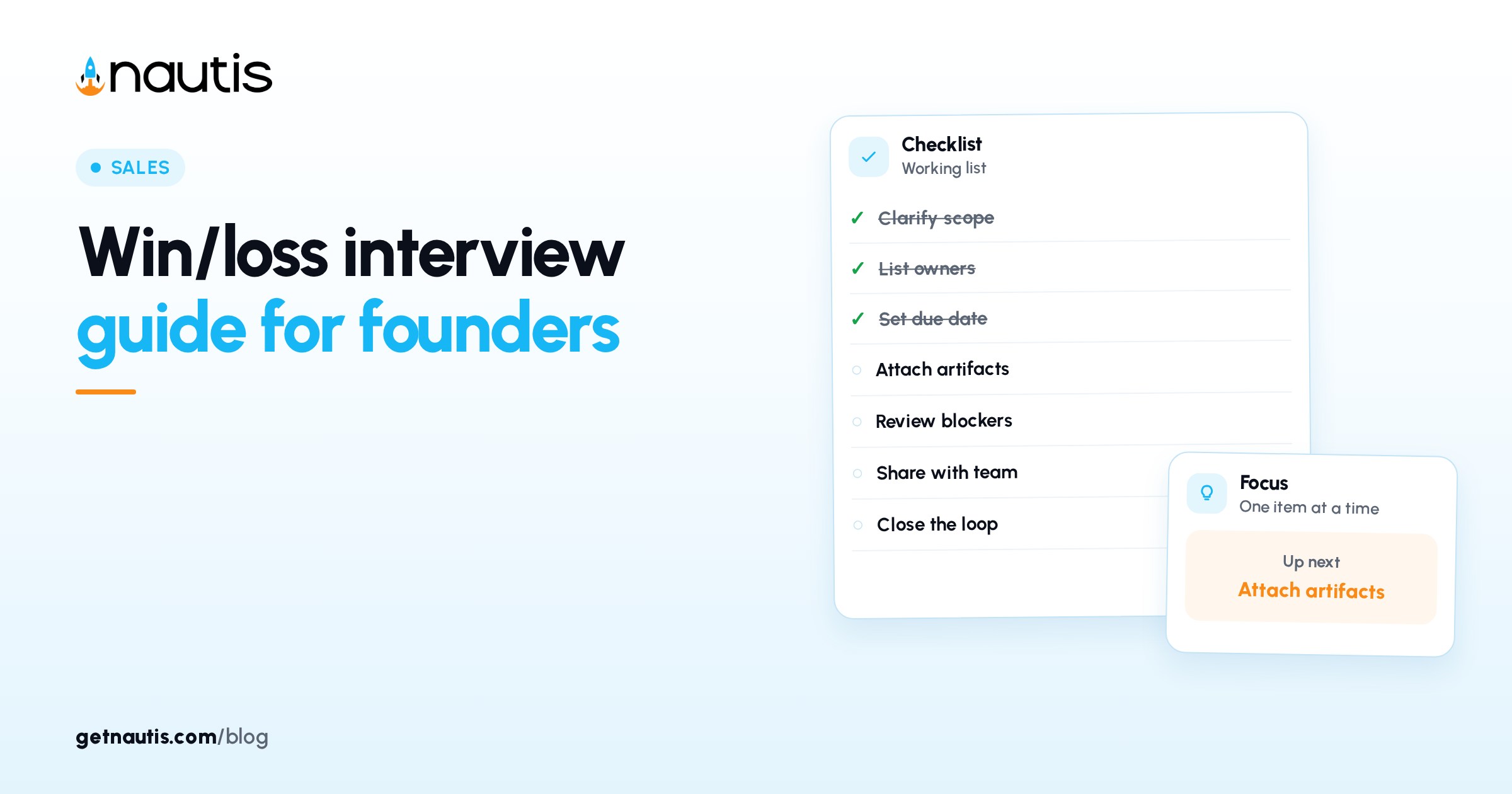
A win-loss interview guide is the short script and coding sheet you use after a deal closes or dies so the team learns why, not the CRM close-reason guess. CRM close reasons are often written by the person who lost. Interviews correct that bias.
Run the same core questions for wins and losses. Change only the prompts that ask the factor that tipped the choice.
Pieces every win-loss interview guide needs
Piece | Purpose |
|---|---|
Invite script | Sets time, purpose, and "not a reopen pitch" |
Interviewer rule | Person who was not the seller on the deal |
Timed agenda | Keeps the interview near 25 to 30 minutes |
Core questions | Trigger, committee, shortlist, comparison, decision, counterfactual |
Coding sheet | One primary reason plus up to two contributing tags |
Verbatim bank | Verbatim lines the build and GTM teams can reuse |
Case: a founder interviews three losses in two weeks using the same core questions; the primary tag "proof gap" appears twice with verbatim lines. Roadmap debate shifts from opinions to those verbatim lines.
Weight the sample toward losses, keep some wins, and include at least occasional no-decision outcomes. No-decision is often the real competitor. Public B2B win/loss guides commonly recommend a loss-heavy mix, a non-seller interviewer, and a call near 25 to 30 minutes (SaaS Marketing win/loss guide; Kalungi win/loss interview format, checkedOn 2026-11-01).
ICP filter before invite
Skip interviews outside the ICP unless the goal is qualification research. Off-ICP losses pollute fit tags with fit noise.
Loss-first calendar
Block two interview slots on the same weekday each month before the month starts. Fill losses first, then wins. Empty slots that week mean you invite older decisions, not that you skip learning.
Closed-won vs closed-lost invite lines
Won invite: "We want to copy what worked in your evaluation." Lost invite: "We want to understand the decision so the next team you meet from us is better." Never use the same first line for both.
Seller exclusion card
Print the rule on the invite template: the account owner may introduce you, then leaves. If the seller stays, mark the file "contaminated" and do not use it for primary tags.
Invite without sounding like a reopen
Send within about two weeks of the decision while memory is fresh. State the length in the first sentence. Say you are not trying to revive the deal.
Offer a small thank-you if your budget allows, or a charity donation option. Keep the ask light.
Gift vs access thank-you
Some evaluators prefer a donation receipt over a gift card. State both options in the invite. Never make the thank-you conditional on "useful" answers; that trains flattery.
Name a non-seller as interviewer when you can. Evaluators speak more freely to someone who was not pushing the close.
Ask permission to record. If they refuse, take near-verbatim notes and mark the file as notes-only.
Timed agenda that follows the decision in order
Block | Minutes | Job |
|---|---|---|
Frame | 2 | Role, consent, reminder this is learning |
Trigger | 4 | What made looking urgent |
Committee | 5 | Who cared about what |
Shortlist | 5 | Who else was evaluated and how they appeared |
Comparison | 6 | What separated finalists |
Decision and counterfactual | 5 | Name the decider; name the condition that would have changed it |
Close | 2 | What you failed to ask |
Do not name your product until they do. Top with your brand teaches them to perform politeness.
Keep drill-downs ready for vague praise or blame. "Integrations" becomes which systems, which data, who owned the ask.
Core questions you can read aloud
Keep volunteered competitor names separate from prompted ones on the coding sheet. Volunteered names reveal the real shortlist; prompted names reveal memory once you speak.
Trigger: Name the event that made a purchase feel necessary.
Committee: List the people who had to agree, and the metric each optimized for.
Shortlist: List other options you seriously considered, and how each name appeared.
Comparison: At what moment did one option feel safer than the others.
Our part: Where did we gain or lose ground in the process.
Price check: If price were identical, would the choice have been the same.
Counterfactual: Name the condition that would have had to be true for you to pick us (or, on a win, for you to pick someone else).
Open close: Name any prompt you expected that I skipped.
On wins, spend more time on the moment confidence flipped. On losses, spend more time on the overruling argument and the counterfactual.
Coding sheet that forces a single primary reason
Tag | Use when |
|---|---|
Fit | Wrong segment, use case, or must-have constraint from day one |
Product gap | A named capability missing |
Value proof | They believed the promise but not the evidence |
Price pack | Price or packaging relative to perceived value |
Process | Demo, trial, responsiveness, or multithreading gaps |
Timing | Budget freeze, reorg, or unrelated delay |
Trust | Risk, references, security review, or stability worries |
Status quo | Decided to do nothing |
Pick a single primary tag. Allow at most two contributing tags. Three co-primary tags erase the lesson.
Score signal strength from 1 to 3. A 3 needs a clear verbatim crumb and a pattern you have heard before or expect to retest.
Example coded rows
Outcome | Primary | Contributing | Verbatim line crumb |
|---|---|---|---|
Loss | Value proof | Process | "Loved the demo; never saw the ROI math on our numbers." |
Loss | Fit | Timing | "We needed warehouse connectors you do not ship." |
Win | Process | Trust | "Your trial mirrored our workflow in week one." |
No-decision | Status quo | Timing | "Budget freeze; revisit if Q3 opens." |
Rows without verbatim crumbs do not enter the monthly histogram.
Histogram hygiene
Rebuild the histogram from the coding sheet, not from memory. If a tag appears once, park it under watchlist. Act only when a tag clears a threshold you set in advance, such as three strong signals in a month.
Log a verbatim verbatim line beside every tag. Percentages without verbatim lines die in leadership review.
Tag conflict rule
If two listeners disagree on the primary tag, replay the verbatim line aloud and pick the tag the evaluator spent the most time on. Do not average tags. Averaging hides the decision.
Primary tag veto list
Do not allow primary tags of "bad fit vibes," "competitor is better," or "timing" without a dated fact. Vague tags are how digests stay useless.
Price vs proof split
When the evaluator says price, ask the identical-price prompt before you code. Many "price" losses become value proof or process once price is held constant in the counterfactual.
After the interview: same-day summary
Write a half-page summary before the day ends: primary tag, contributing tags, three verbatim lines, and one implied change owner (build, GTM, or founder).
File the recording or notes in a single folder named by month. Scattered Drive links kill patterns.
Recording naming scheme
Use YYYY-MM-DD-win|loss|nodeal-company-slug. Consistent names make histogram rebuilds boring in a good way.
Share a monthly digest of tags and verbatim lines, not a stack of raw transcripts. Owners need frequency and language, not homework.
Artifact map
If verbatim lines mention a missing artifact (ROI sheet, security packet, reference call), log the artifact name in a third column. Product and GTM then argue about named files, not moods.
Digest format
Single page: tag histogram, three verbatim lines, one change the company will fund this month, and the owner of that decision. If the digest cannot name a change, the interviews did not finish.
Case: histogram shows value proof on top; verbatim lines mention missing ROI worksheet; owner is GTM writing; decision is to ship a single-page ROI sheet before demos.
Change a single major GTM or product variable per phase when you act on findings so learning stays attributable. If you ship five fixes in the same release train, you cannot tell which verbatim line mattered.
Keep the win-loss interview guide alive
Aim for a steady trickle rather than a heroic binge. A handful of solid interviews each month beats twenty rushed ones after a bad quarter.
Prioritize core ICP losses over random logos. A loss outside ICP teaches qualification more than offer design.
Re-interview wins if the team disagrees about why you win. Internal myths about "we always win on price" die quickly against evaluator verbatim lines.
Retire prompts that never produce usable tags. Add drill-downs where answers stay mushy for three interviews in a row.
Review the guide each quarter: which prompts produced tags, which invites converted, which tags moved a roadmap or talk track.
Store the live guide next to the coding sheet template so new interviewers do not invent a private script.
No-decision protocol
Treat no-decision as a first-class outcome. Ask what would restart a search and who would reopen it. Code status quo when they truly stopped; code timing when a freeze is dated.
Interviewer rotation
Rotate who runs the win-loss interview guide so no single founder becomes the only listener. Fresh listeners catch patterns the deal-weary miss.
Win myth busting
If internal lore says you win on relationship, check win interviews for proof moments. If wins cite a specific artifact or demo moment, fund that artifact. Lore without verbatim lines is expensive.
Point teammates to notes workflows in the Help Center. Plan limits are on pricing.
Deal-size floor
Set a minimum deal size for automatic loss interviews. Below the floor, sample randomly. Above the floor, attempt every loss. This stops the team from only interviewing comfortable small misses.
Champion vs economic buyer split
On the coding sheet, note whether your main contact was the champion or the economic buyer. Losses where you never reached the economic buyer often code as process, not product gap.
Quarterly kill criteria for the guide
Retire the program for a quarter if digests produce zero shipped changes. Restart only with a named owner and a pre-committed change slot on the build or GTM agenda.
Anti-patterns to ban in the room
Ban selling during the interview. Ban arguing with the evaluator. Ban promising a feature on the spot. Ban coding tags while the evaluator is still talking; code after hangup.
Library of banned first prompts
Do not open with "Why did you pick the competitor." Do not open with "Was price the issue." Those frames collapse nuance into a single socially safe answer.
A win-loss interview guide earns its keep when primary tags and verbatim lines change what you ship or how you sell. Without coding and owners, interviews become polite therapy.
Frequently asked questions
What is a win-loss interview guide?
A short script, invite language, timed agenda, and coding sheet used after deals are won, lost, or end in no-decision so the company learns why from evaluators, not from CRM guesses.
Who should run the interview?
Someone who was not the seller on that deal. Founders, product marketing, or a peer from another segment work. The account owner can introduce, then leave.
How do we code answers?
Pick a single primary tag such as fit, product gap, value proof, price pack, process, timing, trust, or status quo. Add at most two contributing tags and store a verbatim crumb for each.
What are the core questions?
Cover trigger, buying committee, shortlist, comparison, your part in the process, a price-held-constant check, the counterfactual, and an open close about prompts you skipped.
Sources
- SaaS Marketing, Win Loss Analysis for B2B SaaS. Checked on November 1, 2026.
- Kalungi, How to Conduct B2B SaaS Win, Loss, and Churn Interviews. Checked on November 1, 2026.
- Clozd, How to Conduct Win-Loss Interviews. Checked on November 1, 2026.
Baltej Singh is a serial entrepreneur, technology leader, and Founder & CEO of Nautis and DemoVexa, with over 16 years of experience building software products, SaaS platforms, and startups. Previously the Co-Founder & CTO of SanchiConnect, he has worked extensively in the DeepTech startup ecosystem, connecting with 200+ venture capital firms and supporting a network of 4,000+ startups. Passionate about AI, automation, and entrepreneurship, he focuses on building innovative products that solve real-world problems and help businesses grow.