Advisory board vs board of directors for startups
 Baltej Singh9 min read
Advisory board vs board of directors for startups is a governance-label question with real consequences. An advisory board is a group you ask for counsel. A board of directors is the corporate body that, under statutes such as the Delaware General Corporation Law, manages or directs the business and affairs of a Delaware corporation. Mixing the labels creates false comfort in decks and diligence.
This post is educational orientation for founders. It is not legal advice. Ask counsel licensed for your jurisdiction before you appoint directors, grant board seats, draft advisory agreements, or describe either role in financing documents.
Nautis does not replace corporate counsel or a human board. Product tools do not create director appointments.
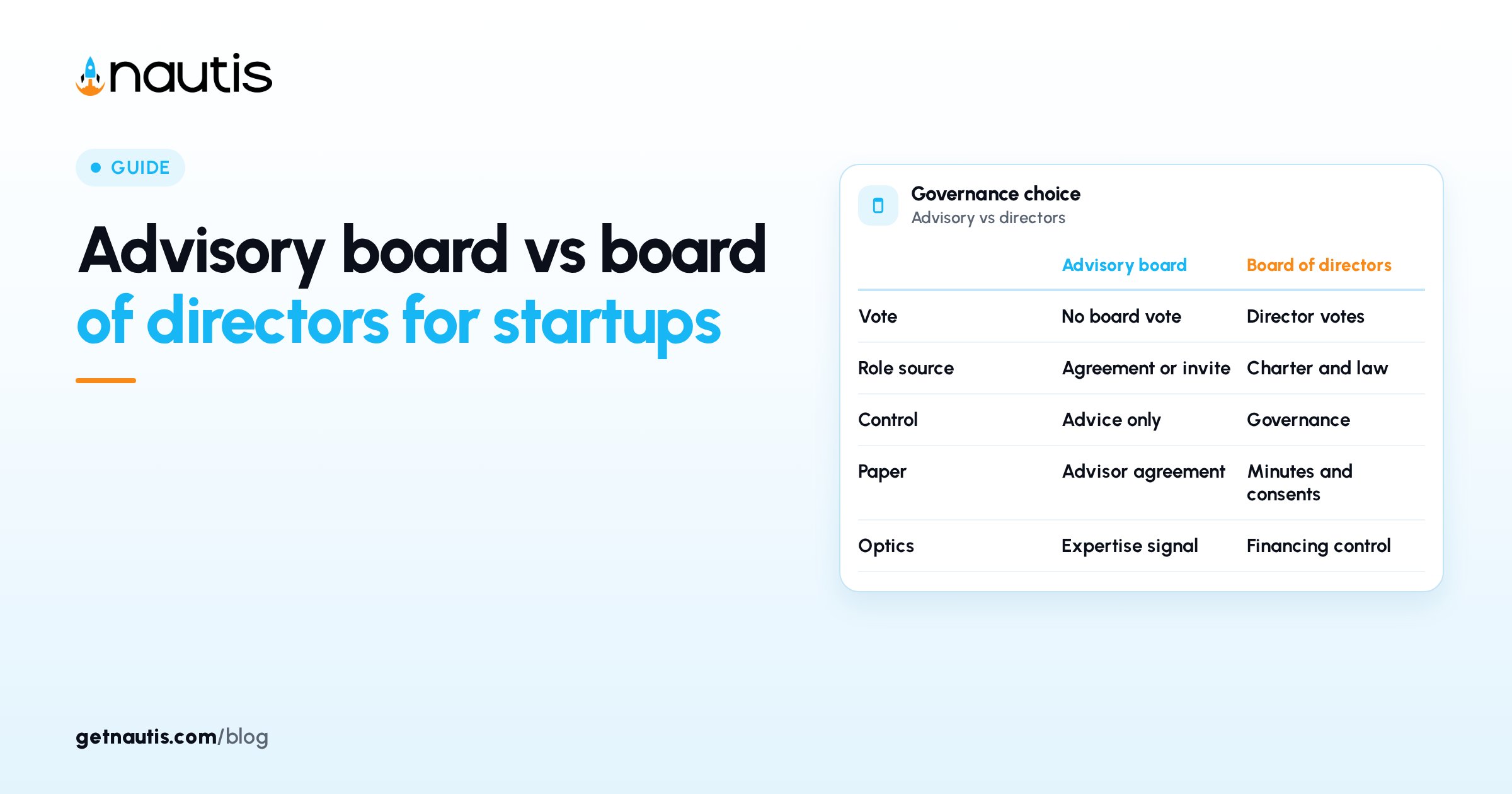
Advisory board vs board of directors for startups in one view
Dimension | Advisory board | Board of directors |
|---|---|---|
Primary job | Advise founders on product, GTM, hiring, or domain expertise | For a Delaware corporation, manage or direct the business and affairs of the corporation (DGCL § 141(a)) |
How people get there | Invitation or advisory agreement (contract practice; ask counsel) | For many corporations, directors are selected by the shareholders; Cornell LII notes the board is selected by the shareholders and responsibilities are governed by the articles of incorporation |
Formal board action | No corporate board vote as directors | Directors act as the board; under DGCL § 141(b), a majority of the total number of directors is a quorum for board business unless the certificate or bylaws require a greater number |
Duties language | Do not assume director fiduciary duties apply; ask counsel what your advisory agreement and jurisdiction require | Cornell LII states that directors of corporations are charged with fiduciary duties, including the duty of care and the duty of loyalty |
Paper trail | Advisory agreement, vesting, confidentiality | Board minutes, consents, and governing documents; financing packages often assume a real board process |
Sources for the director column: Delaware Code title 8, § 141 (Directors and Officers); Cornell LII Wex entries on board of directors, fiduciary duty, duty of care, and duty of loyalty (all checkedOn 2026-11-01). The advisory column is practical product and contracting language, not a statutory definition. Advisory boards are not the board described in DGCL § 141.
The National Venture Capital Association publishes model legal documents used across venture financings (NVCA Model Legal Documents, checkedOn 2026-11-01). Those packages assume a real corporate board process around preferred stock and related rights. They are not a substitute for an informal advisory channel renamed as a "board."
What a board of directors actually is
Cornell LII defines a corporate board of directors as a group of people, selected by the shareholders, who make the major decisions for the company, with exact responsibilities governed by the company's articles of incorporation. LII notes that the board is generally responsible for choosing corporate officers, among other major actions, and that the board has a fiduciary duty to act in the best interest of the shareholders (Cornell LII, board of directors, checkedOn 2026-11-01).
For Delaware corporations, DGCL § 141(a) states that the business and affairs of every corporation organized under the chapter shall be managed by or under the direction of a board of directors, except as otherwise provided in the chapter or the certificate of incorporation (Delaware Code title 8, § 141(a), checkedOn 2026-11-01).
Director elections for Delaware corporations are addressed in DGCL § 211(b): unless directors are elected by written consent in lieu of an annual meeting as that subsection permits, an annual meeting of stockholders shall be held for the election of directors on a date and at a time designated by or in the manner provided in the bylaws (Delaware Code title 8, § 211(b), checkedOn 2026-11-01).
Illustrative miss (composite only): three friends call themselves "the board" in a shared doc; no stockholder election or appointment record; a seed term sheet asks for an investor director and nobody can show current board composition.
Illustrative win (composite only): founder directors documented under the company's governing documents; board consent templates ready; advisory circle kept on a separate roster with clear non-director language drafted by counsel.
When financing documents discuss protective provisions, voting agreements, or director appointment rights, they refer to the corporate board, not to advisors. Mislabeling advisors as directors in a deck trains investors to ask for voting seats you did not intend to sell.
What an advisory board is good for
An advisory board gathers people with experience in your market, channel, or function. You set the agenda. You decide whether to take the advice. Compensation is often equity under an advisor agreement, sometimes cash, sometimes neither. Confidentiality and IP assignment still matter; goodwill is not a contract. Ask counsel to draft the agreement for your jurisdiction.
Use advisors when you need pattern recognition without treating them as the statutory board. Product positioning reviews, enterprise buying maps, and hiring bar calibration fit. Do not use an advisory board to replace board consents when counsel says a board action is required.
Illustrative advisory use (composite only): two go-to-market advisors meet monthly for sixty minutes; notes stay in a shared folder; no one is described as a director; equity vests on an advisor schedule drafted by counsel.
YC's essential startup advice emphasizes focus and talking to users over process theater (Y Combinator Library, checkedOn 2026-11-01). Give each advisor a written scope of one or two themes so the group does not become a second unbound executive meeting.
How to keep the two roles separate
Keep two rosters. Roster A: directors with appointment or election dates from your governing documents. Roster B: advisors with agreement dates and scope. Never merge the lists in investor updates.
Use different verbs in public materials: directors "serve on the board"; advisors "advise on X." If a sentence would be false with "director" substituted for "advisor," rewrite it.
Keep meeting templates separate. Board meetings need notice, agendas, and minutes consistent with your governing documents and counsel's process. Advisory sessions can be lighter, but still written. Shared formatting is how people later swear a brainstorming call was a board meeting.
Keep equity paperwork separate. Advisor grants should not quietly copy director information rights or appointment language. Ask counsel for clear non-director acknowledgments where appropriate.
Name a single founder owner for advisor relationships and a single owner for board administration. Split ownership prevents duplicate invites and conflicting promises about seats.
Illustrative separation (composite only): website lists "Board of directors" and "Advisors" as different sections; deck matches; Cap Table narrative never calls advisors directors.
Board observer rights, when they appear in financing documents, are a separate topic from both advisors and voting directors. Do not paper over that distinction with casual titles.
What changes when new directors join the board
Once investor directors or independent directors join, board composition becomes part of how control works in practice: who sits as a director, what quorum is under DGCL § 141(b) and your documents, and which actions need board approval under your charter, bylaws, and financing agreements. Advisory goodwill does not change those mechanics.
DGCL § 141(b) provides that a majority of the total number of directors shall constitute a quorum for the transaction of business unless the certificate of incorporation or the bylaws require a greater number (Delaware Code title 8, § 141(b), checkedOn 2026-11-01). Your financing documents may add voting agreements or appointment rights on top of that baseline. Read those with counsel before you celebrate a valuation.
Advisory boards do not fix a painful board composition. They also do not replace the need for clean minutes and consents when the corporation takes major actions. If your counsel asks for a board consent, an advisory email chain is not the same artifact.
Illustrative composition (composite only): seed round adds one investor director under a written appointment; advisory circle stays at four people; investor updates list directors and advisors in separate bullets.
When you log consequential choices after a board or advisory session, write the decision, owner, and date in a durable place such as Decision Loop so oral summaries do not fork. Decision Loop does not appoint directors; it only stores decisions you choose to record. If the decision requires a board consent, create that consent with counsel.
How this differs from an AI advisory board in software
Some products, including Nautis, offer an AI Advisory Board: software advisors you query before hard calls. That is a product feature for stress-testing decisions. It is not a corporate board of directors and it is not a human advisory board with equity agreements.
Keep the three layers separate in speech:
- Corporate board of directors: legal governance under corporate law and your governing documents.
- Human advisory board: contracted or invited experts.
- AI advisory board: in-product advisors with instructions and limits.
Illustrative mix-up (composite only): founder tells a diligence contact they "have a board" because they use AI advisors; the follow-up asks for director names and minutes that do not exist.
Use AI advisors for reversible stress-tests. Use human advisors for lived experience. Use directors for governance. Crossing the wires wastes trust.
How to choose which structure you need now
Choose a board of directors process when you are incorporated as a corporation, raising institutional capital that expects governance, or taking actions that counsel says require board approval. For Delaware corporations, start from DGCL § 141 and your certificate and bylaws, then layer financing documents.
Choose an advisory board when you need expertise, introductions, or stress-tests without treating people as directors under your governing documents.
Choose both when you already have a formal board and still want domain advisors on a separate track. Keep invitations, equity, and meeting invites on the advisory track unless counsel is drafting director appointments.
Do not staff the advisory board with people who already serve as directors unless counsel designs dual roles on purpose. Dual titles multiply conflict questions.
Illustrative choice (composite only): early corporation with founder directors only; five advisors on quarterly calls; later financing introduces an investor director seat as a separate workstream with counsel.
Independent directors are still directors under corporate law and your documents, not "advisors with a nicer title." Write appointment or election dates next to every director name the same day counsel confirms the change.
Broader product docs sit in the Help Center. For plan context on the workspace, see pricing.
Frequently asked questions
Is an advisory board the same as a board of directors for startups?
No. An advisory board advises. A board of directors governs the corporation. Votes, duties, and appointment mechanics differ. Ask counsel before you grant either role.
Can I have both an advisory board and a board of directors?
Yes. Many startups keep a formal board for governance and a separate advisory circle for expertise. Keep invites, equity, and minutes on separate tracks.
Does an AI advisory board count as a corporate board?
No. An AI advisory board in software is a product feature for stress-testing decisions. It does not appoint directors or satisfy corporate board formalities.
Where should we record decisions after advisor or board conversations?
Write the decision, owner, and date in a durable log such as Decision Loop for memory. If the action needs a board consent, create that consent with counsel; a log entry is not the consent.
Sources
- Delaware Code title 8, § 141 (Board of directors). Checked on November 1, 2026.
- Delaware Code title 8, § 211 (Meetings of stockholders). Checked on November 1, 2026.
- Cornell LII Wex, board of directors. Checked on November 1, 2026.
- Cornell LII Wex, fiduciary duty. Checked on November 1, 2026.
- Cornell LII Wex, duty of care. Checked on November 1, 2026.
- Cornell LII Wex, duty of loyalty. Checked on November 1, 2026.
- NVCA Model Legal Documents. Checked on November 1, 2026.
- Y Combinator, Essential startup advice. Checked on November 1, 2026.
- Nautis Help Center, Decision Loop. Checked on November 1, 2026.
Baltej Singh is a serial entrepreneur, technology leader, and Founder & CEO of Nautis and DemoVexa, with over 16 years of experience building software products, SaaS platforms, and startups. Previously the Co-Founder & CTO of SanchiConnect, he has worked extensively in the DeepTech startup ecosystem, connecting with 200+ venture capital firms and supporting a network of 4,000+ startups. Passionate about AI, automation, and entrepreneurship, he focuses on building innovative products that solve real-world problems and help businesses grow.