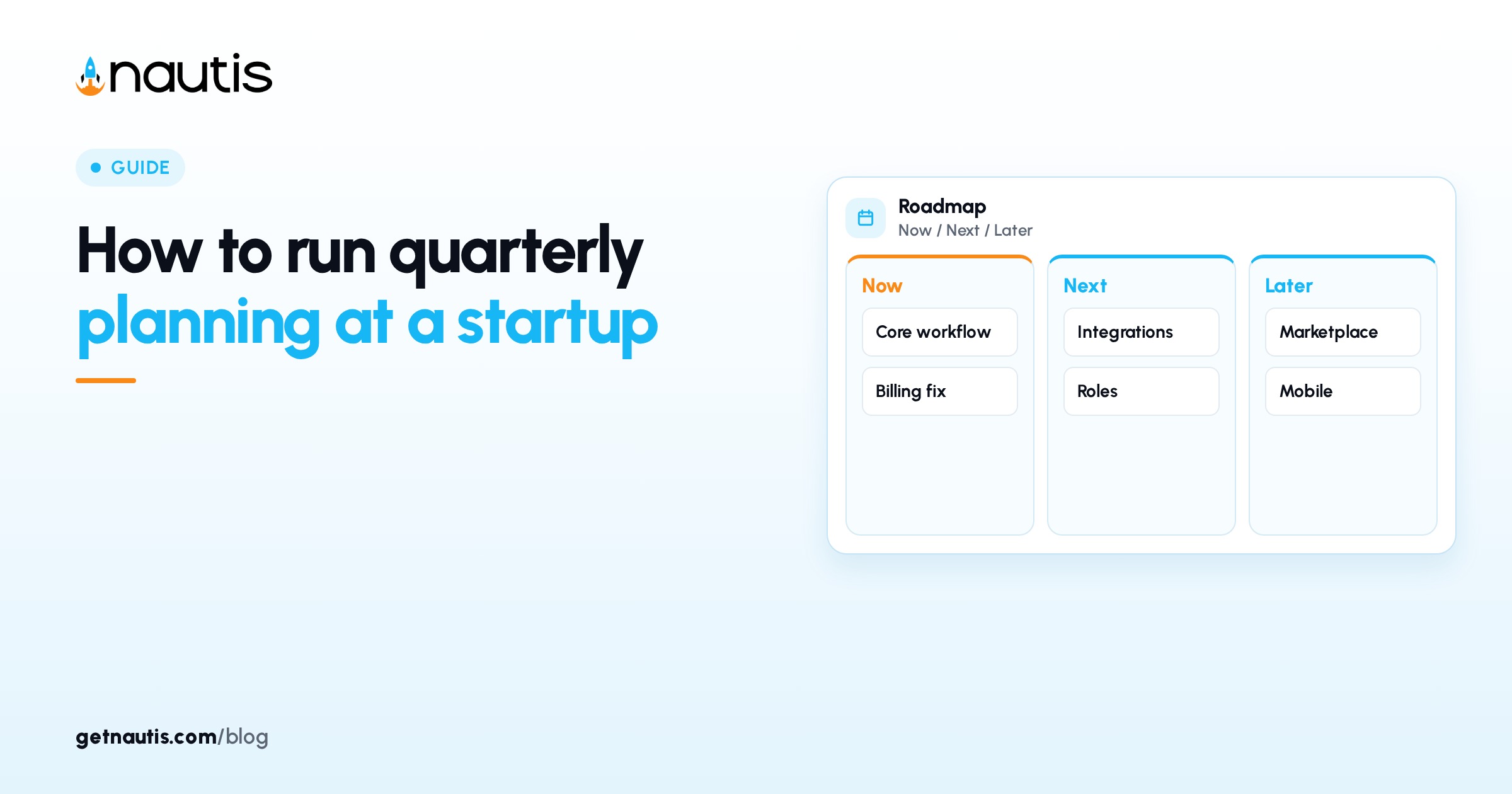
How to run quarterly planning at a startup
 Baltej Singh8 min read
Quarterly planning for startups works when you leave the room with a short list of bets, named owners, dates, and kill criteria, not a deck of ambitions. The quarter is ninety days long. Treat it as a capacity contract, not a wish list. This post shows a one-day planning shape you can run with two founders or a ten-person team, using tools you already have.
Most early companies skip the contract. They paste last quarter's slides, add three new themes, and hope the calendar will stretch. It will not. Y Combinator's essential startup advice keeps pushing founders back to talking with users and doing work that does not scale before they invent process theater. A quarterly plan that ignores capacity is theater with nicer fonts.
What quarterly planning for startups should include
A usable quarterly plan answers five questions in writing before anyone books a kickoff lunch:
- What three outcomes would make this a good quarter if almost everything else slipped?
- What work will we refuse so those outcomes have room?
- Who owns each outcome end to end?
- Which numbers prove progress every two weeks?
- What evidence would make us cut or rewrite a bet mid-quarter?
If any of those five is missing, you still have a brainstorm. Finish the page before you open project tools.
Keep the document short enough to read in ten minutes. One page of outcomes, one page of bets with owners, one page of metrics and kills. Longer binders become unread binders.
How long should a quarterly planning session last?
A half day is enough for a seed-stage team if prep is done the day before. A full day fits when you have more than one function in the room and need time to argue capacity out loud. Multi-day offsites rarely improve the plan; they inflate the slide count.
Prep the day before
- Pull the last quarter's outcome list and mark each item shipped, slipped, or dropped.
- Write current cash, burn, and runway from your books or from a monthly check-in habit such as Startup Health.
- List open customer promises and hard external dates (pilots, renewals, filings).
- Ask each function lead for a one-page capacity note: people available, known vacations, and already committed work.
Live session shape (example)
Use this as an example agenda for a six-hour day with a one-hour lunch. Adjust times to your team size.
Block | Minutes | Job |
|---|---|---|
Look back | 45 | Score last quarter without rewriting history |
Capacity | 45 | Agree how many big bets fit |
Draft outcomes | 60 | Write three outcomes max |
Bet design | 90 | Break outcomes into owned bets |
Metrics and kills | 45 | Attach numbers and stop rules |
Calendar lock | 45 | Put reviews and deep-work blocks on the calendar |
Do not invent numbers in the room. If a metric is unknown, write "unknown, owner will baseline by Friday" instead of guessing a target that nobody believes.
Build the scoreboard before the agenda
People argue themes all morning when the scoreboard is blank. Flip the order. Start with the few numbers that already decide whether the company is healthy.
For most early B2B teams that set is small:
- Cash and runway (update monthly; see how to calculate startup burn rate and runway)
- One product usage or delivery metric that matches how customers get value
- One pipeline or revenue metric you can count without a data hire
- One customer risk metric (churn signals, unpaid invoices, open severity bugs)
Write last quarter's actuals next to this quarter's targets. If a target needs a new tracking habit, name the owner of that habit. A target without a feed is decoration.
Nautis Startup Health is one place to record monthly cash, monthly recurring revenue, and burn so runway is not trapped in a private spreadsheet. You can run the same three-number habit in any sheet you already trust. The point is a shared feed, not a brand of dashboard.
Turn themes into owned bets
Themes such as "improve activation" or "tighten enterprise readiness" are labels. Bets are commitments.
A bet has:
- A one-sentence outcome
- A named owner (one person, not a committee)
- A definition of done that a stranger could check
- A time box inside the quarter
- Dependencies called out in plain words
- A kill or reshape rule
Cap the number of concurrent big bets. For a five-person company, two company-level bets plus ordinary keep-the-lights-on work is often the real limit. For a fifteen-person company, three may fit if functions are staffed. When leaders insist on six, they are scheduling failure and calling it ambition.
Example bet card (illustrative)
Outcome: "Ten design partners complete the new onboarding checklist without founder help."
Owner: Priya (example name).
Done when: checklist completion is visible in the product analytics you already use, and a short note lists remaining friction.
Time box: weeks 1 to 8 of the quarter.
Kill if: fewer than four design partners reach the midpoint checkpoint by week 4 (example threshold you replace with your own).
Put bets on Task Boards or any board your team already opens daily. In Nautis, Task Boards hold themed boards with due dates, assignees, and discussion on the board itself. Mirror the same shape in whichever tracker your team will actually update.
If a bet is really a strategic decision with long effects, log it in Decision Loop as well: title, category, confidence, expected outcome, and a 30, 60, or 90 day review date. That keeps the "why we chose this" searchable after the Slack thread dies. The same habit works as a startup decision journal even outside Nautis.
Review mid-quarter without rewriting the plan
Pick two mid-quarter checkpoints when you book the kickoff. Ninety minutes each is enough. The job is not to invent a new strategy. The job is to score bets against the kill rules you already wrote.
Agenda for a mid-quarter checkpoint:
- Scoreboard: actuals vs targets for the few metrics on the plan
- Bet by bet: on track, at risk, or kill
- Capacity changes: illness, hiring slips, surprise customer work
- One page of edits: only the bets and dates that change
- Calendar: confirm the next checkpoint and the weekly review cadence
Refuse brand-new themes unless a kill rule fired or an external deadline appeared. New themes mid-quarter are how quiet quarters turn into loud, unfinished ones.
Tie the weekly rhythm to a short weekly review for founders so the quarter plan stays connected to Monday choices. The weekly review executes the quarter. It should not reinvent it.
Where to keep the plan so people find it
Pick one home for the living plan. Candidates that work:
- A short Business Plans document with a clear status (Draft, In Review, or Approved) if you want section progress and export
- A Notes page or shared doc linked from the company home
- A GTM Planner workspace when the quarter is mostly go-to-market work (strategy, roadmap, tasks, experiments, and metrics in one place)
Nautis Business Plans can hold a named plan with shared access, section completion, and PDF or Word export when you need a durable copy for a board pack. GTM Planner fits when the quarter bets are mostly customer, channel, and experiment work. Task Boards fit the execution layer either way. Use one planning home and one execution home. Duplicating the same text in three tools guarantees drift.
Whatever you pick, link it from the place people already open on Monday. A brilliant plan in a folder nobody bookmarks might as well be a draft email.
A one-page quarterly planning template
Copy this skeleton into your planning home before the session. Replace bracketed prompts with your words. The sample figures are examples only.
Quarter: [Q1 2027]
Planning date: [date]
Facilitator: [name]
Outcomes (max 3)
- [Outcome] - owner [name] - done when [checkable result]
- ...
- ...
Refusals this quarter
- [Work we will not start]
- [Work we will pause]
Bets
Bet | Owner | Done when | Checkpoint | Kill if |
|---|---|---|---|---|
[Bet A] | [Name] | [Evidence] | [Week 4 / Week 8] | [Clear stop rule] |
[Bet B] | [Name] | [Evidence] | [Week 4 / Week 8] | [Clear stop rule] |
Scoreboard
Metric | Last quarter actual | This quarter target | Source owner |
|---|---|---|---|
Cash / runway | [example] | [example] | [Name] |
Product value metric | [example] | [example] | [Name] |
Pipeline or revenue metric | [example] | [example] | [Name] |
Cadence
- Weekly review: [day, time, owner]
- Mid-quarter checkpoints: [two dates]
- Decision log location: [link]
Close the day with calendar holds
Before people leave, put the weekly review, both checkpoints, and any deep-work blocks the bets require onto real calendars. A plan without holds is a PDF.
Founders who want a lighter goal system than nested OKRs can keep this bet-and-scoreboard shape and skip enterprise goal trees. Nautis does not ship a built-in OKR method, which is fine for early teams that need focus more than cascading scorecards.
Run the planning day once. Protect the checkpoints. Rewrite only when a kill rule fires or capacity truly changes. That is quarterly planning that fits a startup instead of a binder built for a company you do not run yet.
Frequently asked questions
How many goals should a startup set each quarter?
Most seed-stage teams can protect two or three company-level outcomes plus keep-the-lights-on work. More than that usually means nobody has spare capacity. Write refusals beside the outcomes so the limit is visible.
How long should quarterly planning take?
A half day works for a small founding team if numbers and capacity notes are prepped the day before. A full day fits when several functions must negotiate the same capacity pool. Multi-day offsites rarely improve the plan.
What belongs on the quarterly scoreboard?
Cash and runway, one product value metric, one pipeline or revenue metric you can count, and one customer risk metric. Skip vanity totals you cannot refresh every two weeks. Name an owner for each feed.
Do startups need OKRs for quarterly planning?
Not necessarily. A short list of outcomes, owned bets, and kill criteria creates focus without nested scorecards. Nautis does not include a built-in OKR method, and many early teams do better with bets than with cascading goals.
Sources
- Y Combinator, YC's Essential Startup Advice. Checked on November 2, 2026.
- Nautis Help Center, GTM Planner. Checked on November 2, 2026.
- Nautis Help Center, Task Boards. Checked on November 2, 2026.
- Nautis Help Center, Startup Health. Checked on November 2, 2026.
Baltej Singh is a serial entrepreneur, technology leader, and Founder & CEO of Nautis and DemoVexa, with over 16 years of experience building software products, SaaS platforms, and startups. Previously the Co-Founder & CTO of SanchiConnect, he has worked extensively in the DeepTech startup ecosystem, connecting with 200+ venture capital firms and supporting a network of 4,000+ startups. Passionate about AI, automation, and entrepreneurship, he focuses on building innovative products that solve real-world problems and help businesses grow.