AI Chief of Staff vs AI Executive Assistant: What's the difference?
 Baltej Singh9 min read
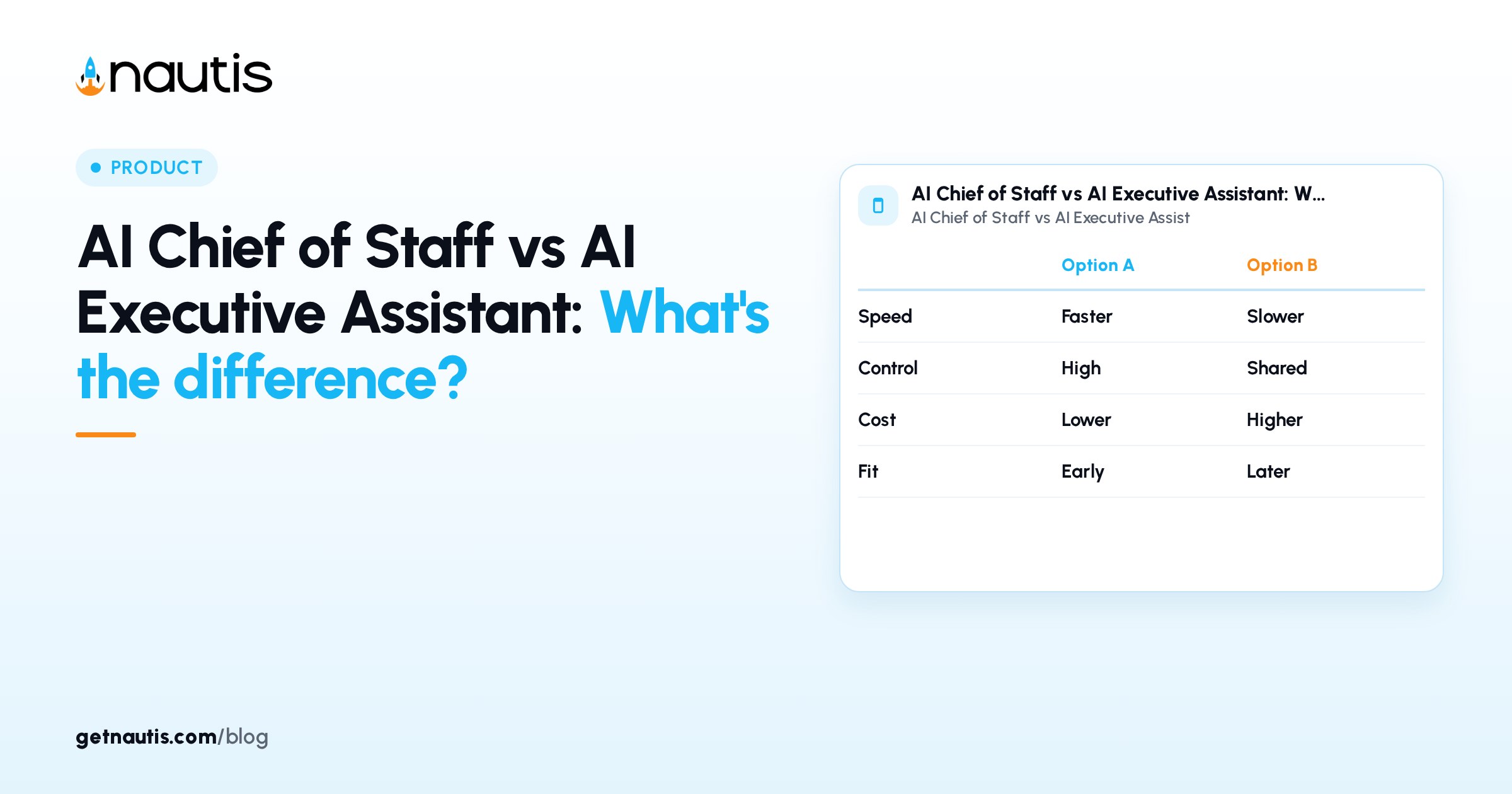
AI Chief of Staff vs AI Executive Assistant is a scope test, not a branding fight. An executive assistant pattern protects one person's calendar, travel, and inbox logistics. A chief of staff pattern runs company rhythm: what needs attention across teams, what is blocked, and what waits on an approval. Mix the two and you get a bot that books lunch while the fundraising diligence thread dies unread.
Human roles already split this way. Bridgespan and a16z style guides (summarized in Nautis's own chief of staff guide) put scheduling with an assistant and operating cadence with a chief of staff. Software copies of those jobs should respect the same line. This post compares the patterns so you can hire, buy, or configure without pretending one tool is both.
Side-by-side: assistant, human CoS, company briefing
Use this table as a hiring and product filter. Cells are role patterns, not a claim that every vendor matches them.
Job | Executive assistant pattern | Human startup chief of staff | Nautis Chief of Staff pattern |
|---|---|---|---|
Primary customer | One executive | The company and the founder | The organization (shared briefing) |
Core output | Calendar, travel, inbox triage | Meeting rhythm, cross-team follow-through, gap projects | Morning Briefing ranked from workspace signals |
Typical success metric | Founder time protected | Actions closed; fewer surprises | Blockers and approvals cleared same day |
Authority | Logistics and access | Influence across teams; rarely line management | Asks before external writes by default |
Failure mode | Becomes a shadow COO without mandate | Becomes a personal assistant in disguise | Treated like a private chatbot for one person |
If a product only rewrites email tone and proposes meeting times, it is closer to an assistant. If it ranks company blockers, pipeline, runway, and pending approvals on one page, it is closer to a chief of staff loop.
What an AI executive assistant is good for
Assistants shine when the unit of work is personal logistics.
- Propose times across calendars
- Draft short replies in your voice after you set the point
- Remind you about travel, visas, or a dinner reservation
- Summarize a long thread you already own
That work matters. Founders without it drown in coordination tax. It is still not company operating rhythm. An assistant that never sees the shared task board, the raise pipeline, or the runway figure cannot tell you that three diligence items and an overdue invoice are the real morning.
Keep assistant tools on a short leash for outbound sends. A polite draft that goes to the wrong distribution list is still a send.
What a startup chief of staff actually does
Nautis's guide, What does a startup chief of staff do?, groups the human job into four kinds of work: running the rhythm, guarding founder attention, closing gaps between teams, and owning projects with no natural home. Scheduling itself usually sits with an assistant. Admin should stay a small slice; if the role is mostly booking, hire an assistant instead of renaming one.
A realistic week in that guide is full of leadership agendas, owners and dates, board prep, and careful escalations. Very little of it is "find me a flight." When people say they want an AI chief of staff, they usually want help with the rhythm and the gap-closing, not a louder calendar bot.
Where AI Chief of Staff vs AI Executive Assistant products diverge
Shared company day vs private to-do list
A chief of staff briefing should be the company's day. In Nautis, the Briefing is per-organization: two people see the same prioritized list, and done, snooze, and dismiss update it for everyone. That is the opposite of a personal assistant inbox that only one founder reads.
Ranked blockers vs chronological mail
Assistants sort messages. A chief of staff surface ranks Priorities, Blockers, Approvals, Pipeline, Today, and Runway from workspace data. Mail volume is not the scoreboard.
Approvals vs silent sends
Company-affecting actions need a review step. In Nautis, the Approval Center is where you review any action your AI agents want to take. Do it never means the action already ran; for a change it creates a card you still approve, unless Agent Autonomy explicitly allows that action to run without asking. Drafts always open a card you can edit first.
Memory of the company vs memory of preferences
Assistants remember that you prefer aisle seats. A chief of staff loop needs company facts: who owns the raise, what the ICP is, which metric is the north star. Different memory, different trust model.
Decision guide: hire, buy, or combine
Situation | Lean assistant | Lean chief of staff | Often both |
|---|---|---|---|
Solo founder drowning in calendar and travel | Yes | Later | When a second executive appears |
Team of ten with missed follow-through on leadership actions | No | Yes | Assistant still helps the founder personally |
Active raise with diligence and follow-ups | Light help on scheduling | Yes for pipeline visibility and approvals | Keep investor email behind review |
You want "an AI that runs the company" as a slogan | Risk | Risk | Start with briefing + ask-first writes only |
Buy software for the first pass: reading updates, surfacing missing data, drafting a note. Keep humans for trust conversations, hard prioritization, and anything that needs line authority. The Nautis guide is explicit that software does not replace a human chief of staff.
How Nautis draws the line in product terms
Chief of Staff is the module that builds your daily Founder Briefing: what changed, what is blocked, and what needs you today. Every morning it scans the workspace, ranks what matters, and presents one prioritized list with a one-sentence headline. The same home includes the Approval Center and the Agent Autonomy settings that decide what agents may do without asking.
Owners and Admins set each capability to Ask every time or Run without asking. Ask every time means you see the action first and nothing happens until you approve. Deletes in Nautis stay on Always asks. External capabilities that touch the outside world deserve extra care; start them on Ask every time until a narrow, repeated template earns trust.
Setup starts with Liftoff, which connects the signals the Briefing needs. For a product walkthrough of the morning page itself, see What is an AI chief of staff for startups? and the Chief of Staff help center. For the human role the software is named after, read What does a startup chief of staff do?.
Founder scenarios (examples)
Scenario A: assistant-only stack
Jordan uses a calendar AI and an email rewriter. Mornings feel lighter. The seed raise still slips because nobody owns a single view of which funds are in diligence, which approvals wait, and what runway number is current. The fix is not a smarter tone model. It is a company briefing and an investor follow-up board.
Scenario B: CoS loop without personal support
Samir turns on a company briefing and clears blockers daily. He still burns evenings on travel bookings and personal inbox triage. A part-time human assistant (or a narrow assistant tool) returns hours without pretending to rank the company's day.
Scenario C: mixed with clear swim lanes
A two-founder team assigns personal logistics to an assistant pattern and company ranking to Chief of Staff. Investor and customer sends stay on Ask every time. Weekly, they review AI Activity for anything that ran without asking. The slogan stays boring on purpose.
Mistakes that collapse the distinction
- Calling any chatbot a chief of staff because it can draft email
- Letting an assistant tool send external mail with no approval card
- Expecting a company briefing to manage one person's grocery list and travel
- Hiring a human chief of staff and then filling their week with calendar admin
- Measuring success by messages sent instead of blockers cleared and decisions owned
- Flipping Agent Autonomy to Run without asking across External capabilities on day one
Questions to ask a vendor before you buy either pattern
Bring these to a demo. Vague answers usually mean the product is an assistant wearing a CoS label.
- Is the daily view per person or per company?
- Which systems does it read by default: tasks, CRM, runway, approvals, calendar?
- What happens when it wants to send email or update a record: silent send, draft only, or an approval card?
- Who can change autonomy settings, and is there an audit log?
- Can two co-founders share one ranked morning list without forwarding screenshots?
If the demo only shows a chat box with memory of your preferences, you are evaluating an assistant. That can still be worth buying. Just do not staff it as the operating rhythm.
How this choice shows up in a real Monday
Imagine a ten-person SaaS team with a seed raise open. Monday at 8:15am should not start in three private chats.
A chief of staff style surface should already show: two diligence blockers, one overdue approval for an investor follow-up draft, a pipeline slip on a design partner, and today's customer calls. An assistant style surface might instead remind the CEO about a dentist appointment and offer to decline a low-value invite. Both reminders can be true. Only one of them moves the company.
The founder who clears the company list before personal logistics usually ships a cleaner week. The founder who only clears personal logistics often discovers the diligence hole on Thursday when a partner asks why materials never arrived.
Pairing the patterns without double work
Write a one-page RACI even if you hate the acronym:
- Personal calendar and travel: assistant human or assistant tool
- Company briefing and approvals: chief of staff module or human CoS
- Investor relationship log: fundraising CRM with a named owner
- Final say on external sends: founder or delegated Owner/Admin review
Review the page every month. Roles drift. Tools drift faster. When something hurts, check whether you asked an assistant pattern to do company work, or asked a company briefing to behave like a concierge.
A one-hour clarity checklist
- Write two columns on a page: Personal logistics vs Company rhythm
- List the tools and humans that own each column today
- Move any company blocker tracking out of private chat into a shared surface
- Put outbound email, CRM edits, and money moves behind an explicit approve step
- If you use Nautis, confirm Agent Autonomy defaults and clear the Approval Center before noon
- Agree which founder owns the Monday ops review so the briefing has a human closer
AI Chief of Staff vs AI Executive Assistant stops being confusing when you name the customer of the work. One person or the company. Pick that first, then pick the software.
Frequently asked questions
Is an AI chief of staff the same as an AI executive assistant?
No. Assistant patterns stay personal to calendar, travel, and inbox logistics. Chief of staff patterns rank company blockers, pipeline, cash signals, and approvals for the whole team. One product rarely does both well without clear settings.
Does Nautis replace a human chief of staff?
No. Nautis is framed as an AI business operating system that asks before it acts. It can draft and surface work; trust conversations, hard prioritization, and line authority stay human.
Why do two people see the same Nautis briefing?
The briefing is per-organization. It is the company's day, not a personal to-do list. Done, snooze, and dismiss update it for everyone with access.
Can Nautis agents send email without asking?
Only if Owners or Admins set that capability to Run without asking under Agent Autonomy. Everything starts on Ask every time except Quick capture inbox notes. Drafts always open a card you can edit first.
Sources
- Chief of Staff help center. Checked on October 31, 2026.
- What does a startup chief of staff do?. Checked on October 31, 2026.
Baltej Singh is a serial entrepreneur, technology leader, and Founder & CEO of Nautis and DemoVexa, with over 16 years of experience building software products, SaaS platforms, and startups. Previously the Co-Founder & CTO of SanchiConnect, he has worked extensively in the DeepTech startup ecosystem, connecting with 200+ venture capital firms and supporting a network of 4,000+ startups. Passionate about AI, automation, and entrepreneurship, he focuses on building innovative products that solve real-world problems and help businesses grow.