How to calculate startup burn rate and runway
 Baltej Singh5 min read
How to calculate startup burn rate and runway is a two-step cash habit: measure net cash leaving each month, then divide cash on hand by that number. Founders who skip the definitions argue about runway while the bank balance tells a quieter story.
This is general finance practice drawn from small-business cash management guidance, not tax advice. Confirm edge cases with your bookkeeper. If you keep runway on a morning briefing later, the math still starts here.
Definitions you can defend in a board meeting
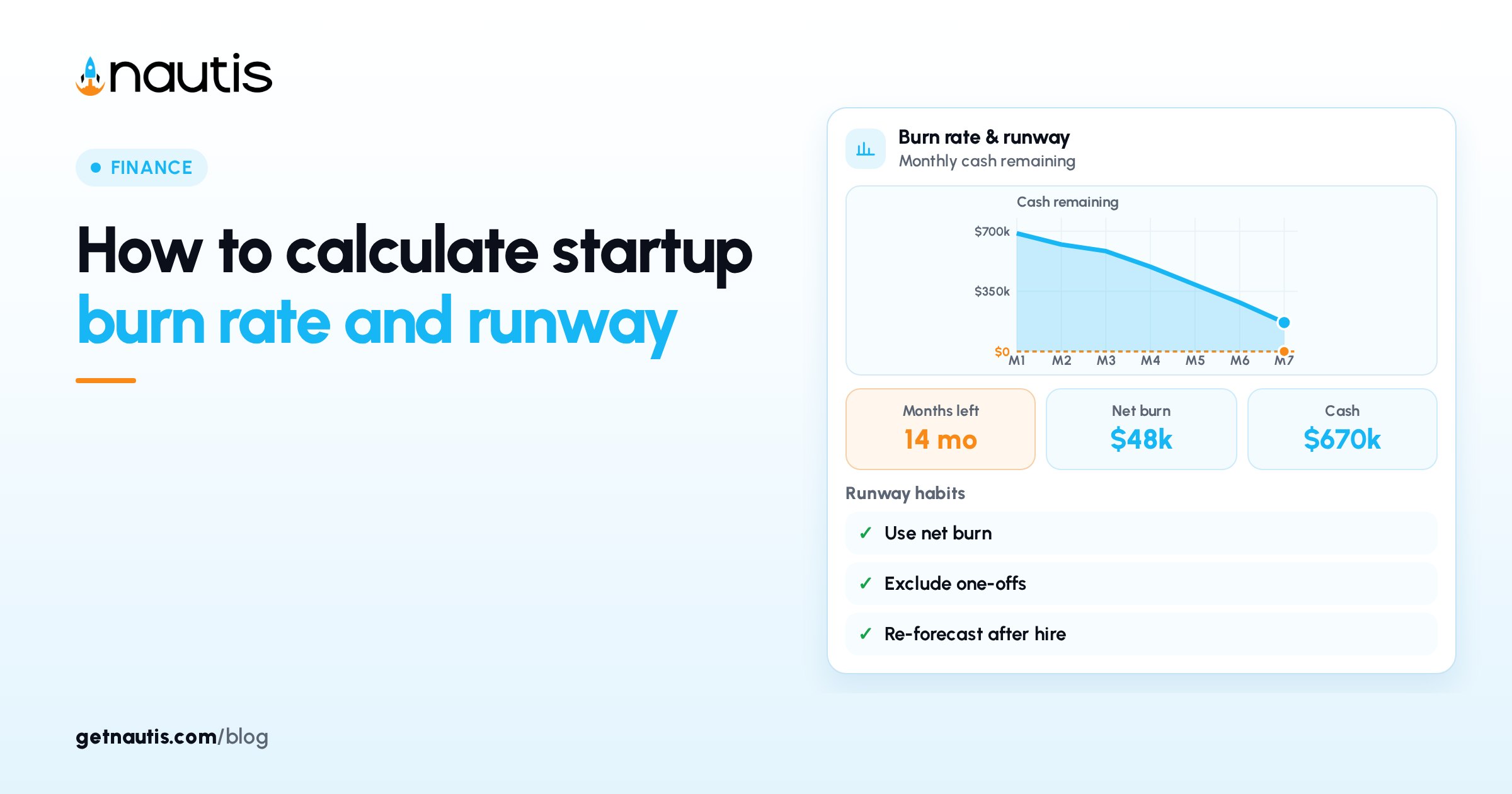
Burn rate is the net amount of cash your company spends in a period, usually a month. Gross burn is cash out before counting cash in. Net burn is cash out minus cash in. Runway is how many months you can operate at the current net burn before cash hits zero, assuming no new financing and no sudden change in spend.
The U.S. Small Business Administration's manage-your-finances guidance stresses knowing cash position, tracking expenses, and keeping books current so decisions rest on numbers you can explain. Burn and runway are that habit applied to an early company.
How to calculate burn rate
Pick a clean window
Use the last full calendar month, or a trailing three-month average if last month was noisy (annual insurance, a one-time legal bill).
Pull cash, not accrual theater
From your bank and cards, sum cash that left. From deposits, sum cash that arrived. Exclude owner capital injections if you want operating burn; include them if you want total cash change. Say which definition you used.
Compute
- Gross burn = cash out
- Net burn = cash out − cash in from customers and other operating receipts
Example: $180,000 out and $40,000 in → net burn $140,000 for the month.
How to calculate runway
Runway months = cash on hand ÷ net burn per month.
Example: $1,400,000 cash and $140,000 net burn → 10 months.
If net burn is zero or negative (cash-flow positive), runway talk shifts to how long you can fund growth plans without a raise, not survival months. State that clearly so investors do not hear "infinite runway" when you mean "not dying."
Sensitivities worth running every month
- Hiring plan: add fully loaded monthly cost of committed roles.
- Churn or delayed receivables: cut cash-in by a sober percentage.
- One-time costs: keep them out of the baseline or call them out.
- Raise timing: model close date slips of 30, 60, and 90 days.
Write the assumptions under the number. A runway figure without assumptions is a slogan.
Operating rules that keep the math honest
- Separate business and personal accounts.
- Reconcile weekly so burn is not a surprise.
- Update runway the same day you change headcount plans.
- Share one definition with co-founders and anyone who speaks to investors.
- When you cut burn, change the budget in the system of record the same week.
Where this shows up in a startup operating rhythm
Put runway and burn next to pipeline and blockers on your weekly review. Some teams surface runway on a daily founder briefing so the number is hard to ignore. In Nautis, runway appears in the Chief of Staff Briefing when Startup Health has data; the calculation above still belongs to you. Pair it with the Set up your Chief of Staff (Liftoff) inputs so calendar and mail signals exist beside cash.
Mistakes that inflate runway
- Counting committed but undrawn venture debt as cash.
- Using accrual revenue as cash in.
- Ignoring credit-card float that will hit next month.
- Averaging in a giant one-time customer prepayment as normal inflow.
How to calculate startup burn rate and runway in one sitting
Block thirty minutes: export, tag, divide, write assumptions, share. Do not wait for the perfect model.
A monthly checklist
- Export transactions.
- Tag operating vs financing cash.
- Compute gross and net burn.
- Divide cash by net burn.
- Recompute with hiring and delay scenarios.
- Record the figure and assumptions in your decision log.
Calculate startup burn rate and runway the same way every month. Consistency beats cleverness when the bank is the scoreboard.
Worked example with a hiring spike
Suppose cash is $900,000. Last month net burn was $90,000 (10 months runway). You sign two engineers at $15,000 all-in each per month starting next month. Baseline net burn becomes $120,000 if revenue is flat. Runway falls to 7.5 months before any other change. Write both numbers in the update: current and forward.
If a customer prepay of $60,000 landed last month, exclude it from the "steady" cash-in assumption or you will advertise fake runway.
Reporting format investors can scan
Use four lines only:
- Cash on hand (date)
- Gross burn / net burn (month or 3-month average)
- Runway months at current net burn
- Runway months under the hiring plan
Attach the assumption list as bullets. Resist a twelve-tab model in the first seed conversation unless someone asks.
Tie-in to weekly ops
Put calculate startup burn rate and runway on the same agenda as pipeline coverage. Teams that separate finance review from sales review invent two truths. A single weekly ops review keeps one scoreboard. For a productized morning view later, the Chief of Staff briefing can surface runway when Startup Health is populated; the arithmetic stays yours.
Cash hygiene checklist from public guidance
The SBA manage-your-finances material emphasizes bookkeeping, knowing obligations, and separating concerns so you can see money-in and money-out. Translate that into startup practice:
- Reconcile bank feeds weekly
- Tag financing vs operating cash
- Keep a forecast that matches the burn definition you publish
- Assign one owner for the monthly number
What not to claim
Do not present runway as a promise of solvency through a named date if collections are uncertain. Do not mix personal runway with company runway. Do not use "about a year" when you have not divided the figures that week.
Frequently asked questions
What is the difference between gross burn and net burn?
Gross burn is cash leaving. Net burn subtracts operating cash coming in. Say which one you use when you quote runway so investors are not comparing different definitions.
How often should we recalculate runway?
At least monthly, and the same day you change headcount or major spend. Weekly reconciliation keeps the inputs trustworthy.
What if net burn is negative?
You are cash-flow positive on that definition. Talk about how long you can fund the growth plan without a raise instead of survival months.
Sources
- SBA manage your finances. Checked on October 31, 2026.
- Chief of Staff help center. Checked on October 31, 2026.
Baltej Singh is a serial entrepreneur, technology leader, and Founder & CEO of Nautis and DemoVexa, with over 16 years of experience building software products, SaaS platforms, and startups. Previously the Co-Founder & CTO of SanchiConnect, he has worked extensively in the DeepTech startup ecosystem, connecting with 200+ venture capital firms and supporting a network of 4,000+ startups. Passionate about AI, automation, and entrepreneurship, he focuses on building innovative products that solve real-world problems and help businesses grow.