Channel partner basics for early startups
 Baltej Singh8 min read
Channel partner basics for early startups are simple on paper and messy in practice: pick one partner type, write what you sell together, tag every shared lead, and review margin and support load on a fixed cadence. Start with a small pilot. A signed logo on a slide is not a channel.
Channel partner basics begin with one partner type
Choose a single motion for the first quarter. Mixing reseller, affiliate, and co-sell in the same pilot hides what actually works.
Type | Partner does | You still own | Early fit |
|---|---|---|---|
Referral / affiliate | Warm intro for a fee or credit | Full sale and delivery | Few partners, thin ops |
Co-sell | Joint meetings into their accounts | Product expertise and pricing | Overlapping ICP, trusted brand |
Reseller | Quotes and closes under their paper | Enablement, deal desk rules | Later, when packaging is stable |
Tech integration partner | Ships a joint workflow | Roadmap honesty and support | Product already embeds cleanly |
Write the choice in one sentence on a shared note. Example: "Q1 pilot is co-sell only with two agencies that already implement tools next to us." If you cannot finish that sentence, you are not ready to recruit.
Recruiting criteria for the pilot:
- They already sell to your ICP without you inventing a new segment for them.
- They have a named person who will own joint deals, not a generic partnerships@ inbox.
- They accept non-exclusivity for ninety days.
- They will join at least one live deal review with you each month.
Decline "logo exchange" partners who only want a website badge. Badges do not create tagged opportunities.
Skip partners who want exclusivity, custom builds, or your roadmap under their brand during the pilot. Those terms belong after you have proof.
Write a joint value brief before the first intro
Partners need a brief they can reuse without you on the call. Keep it to one page:
- Who you help, in buyer language.
- What problem you remove that the partner does not.
- Proof a skeptical buyer can check (dated metric, named use case, or public case).
- What the partner earns and when.
- How an intro should reach your team.
Store the brief where sales can find it. Notes or a linked doc on the partner Contact works. Update the proof line when numbers change; stale proof is how partners go quiet.
Do not hand partners a forty-slide deck as the brief. They will not learn it. They will improvise, and you will inherit messy expectations.
YC's published essential startup advice stresses talking to users and doing things that do not scale. Early partner work is the same idea with a second company in the room: few partners, real deals, written learning.
Agree handoffs, pricing rules, and support edges
Ambiguity here creates angry buyers. Decide in writing:
- Who speaks first after an intro.
- Who owns pricing exceptions.
- Who answers product support for joint deals.
- What happens if the partner promises a feature you have not shipped.
Put those rules in the same brief or a one-page addendum both sides can quote. If a partner refuses to write handoffs down, treat that as a signal, not a personality quirk.
Keep public plan language aligned with pricing so partners do not invent discounts you must unwind later.
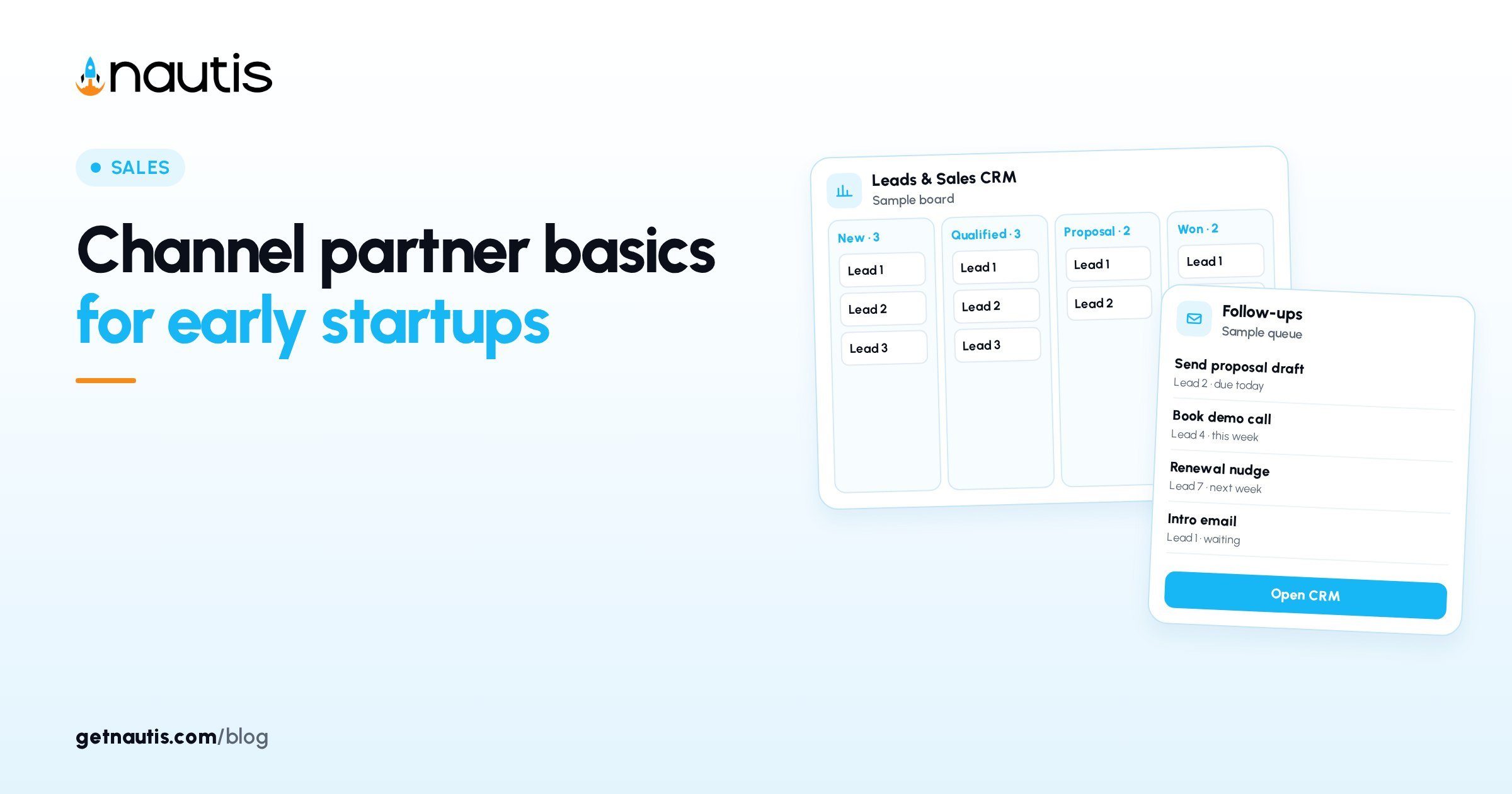
Keep partner deals labeled in your CRM
Without a clear source label, partner-sourced revenue disappears into generic inbound. Treat this as ordinary CRM hygiene in whatever system you use. On every shared opportunity, record at least:
Practice | Example |
|---|---|
Source / channel | Partner, or the partner firm name if your tool allows |
Partner link | Record or contact for Riverline Agency |
Motion | Co-sell, referral, or reseller |
Intro date | 2026-11-01 |
Owner on your side | Named person who replies first |
Filter and report from those labels weekly. List open partner-sourced opportunities with no next step older than fourteen days. Partners notice silence faster than cold inbound does.
Share a thin weekly snapshot with each pilot partner: open partner-sourced opportunities, next steps, and blockers. Five lines in email is enough. Partners who never receive updates invent stories about your pipeline.
Monthly, compare win rate and sales-cycle length for partner-sourced deals versus your direct motion. If partner deals close worse, read five notes before signing more logos.
Where you keep people records, store the prospect and the partner as separate contacts (in Nautis, that is Contacts) and connect them to the opportunity when the deal closes or dies so the outcome is not only in email.
Pilot with two partners, not twenty
Recruit two partners who already serve your ICP. Run ninety days with a cap on active joint opportunities so your team can respond fast.
Measures that matter in the pilot:
- Qualified opportunities created with the partner tag.
- Meetings held with both parties present when co-selling.
- Closed-won count and gross margin after partner cost.
- Support tickets per joint account.
Kill or pause a partner who generates noise without qualified opportunities, or who creates support load you cannot staff. Expand only after one partner produces repeatable wins with clean handoffs.
Enablement during the pilot should be light: the one-page brief, a recorded product walkthrough, and a scheduled office hour. Heavy certification programs can wait until the motion pays.
Protect response time during the pilot. If your average first reply on partner intros slips past one business day, freeze new partner recruiting until the queue is healthy. Speed is part of the offer you make to partners.
Review economics before you scale recruiting
A channel that wins logos at thin margin and high support is a hobby. Each month, put three numbers next to each active partner:
- Revenue closed that carries their tag.
- Partner cost (fee, credit, or margin share).
- Support hours on those accounts.
If cost plus support erodes the deal below your direct-sale floor, change the offer or exit. Do not fix a bad partner motion by hiring more partner managers first.
When you are ready to add partners, change one variable at a time: either a new partner type, a new segment, or a new reward shape. Changing all three hides the lesson.
Retire the pilot in writing if ninety days produce no qualified opportunities despite honest effort. A clean no protects both brands. Channel partner basics stay useful only when you are willing to stop.
Document exits the same way you document entries. A short note to the partner, a CRM status of paused or ended, and a stop date on payouts prevents zombie obligations. Channel partner basics include endings, not only kickoffs.
Founders often confuse a friendly integration tweet for a channel. An integration without tagged deals and a handoff rule is marketing, not distribution. Keep the distinction visible in the CRM.
If legal needs a paper form, bring counsel a short summary: partner type, payout trigger, non-exclusivity, and brand rules. Do not let a fifteen-page draft block a two-partner pilot that could have used a lighter referral letter while you learn.
Train your own team to refuse off-brief promises. The fastest way to burn a partner is to contradict them on a joint call about price, timeline, or scope. Align privately for ten minutes prior to every co-sell meeting until the motion is muscle memory.
After the first closed-won partner deal, write a five-line retrospective: what the buyer thought the partner was for, where handoff slowed, what proof landed, what you will change next time. That note is worth more than a new slide theme.
A note on tooling: use the same pipeline stages you already trust for direct sales, plus the partner labels above. Inventing a second shadow spreadsheet for "partner only" deals is how forecasts diverge. Keep partner people beside other contacts and partner-sourced deals beside your other commercial opportunities so forecasts do not diverge.
Founders sometimes wait for a perfect partner contract before the first intro. Learn with a narrow pilot and counsel-reviewed essentials, then harden paper as volume appears. Perfect contracts around zero deals teach nothing.
Finally, keep founder time honest. If you personally must attend every partner meeting for ninety days, the motion is still founder-led sales with company. That can be fine as a learning phase. Label it correctly so you do not mistake busyness for a scalable channel.
Example pilot scoreboard you can copy:
Partner | Tagged opps | Meetings | Won | Partner cost | Support hours | Decision |
|---|---|---|---|---|---|---|
Riverline | 6 | 4 | 1 | $800 credit | 3 | Continue |
Northpine | 2 | 0 | 0 | $0 | 1 | Pause |
Lakeview | 5 | 5 | 0 | $1,200 fee | 9 | Renegotiate |
Fill it from CRM and calendar evidence, not optimism. The Decision column forces an action: continue, pause, renegotiate, or exit.
When a partner brings a deal outside your ICP, thank them and decline politely with the ICP sentence from the brief. Accepting misfit logos to "keep the relationship warm" trains them to ignore your targeting.
If you later add resellers, revisit packaging first: clear SKUs, discount floors, and a deal-registration rule. Reseller motion on top of fuzzy packaging multiplies exceptions. Channel partner basics say earn co-sell proof before you outsource the close.
Keep the partner brief and the scoreboard in places a substitute can find without asking you. Channels break when knowledge sits in one founder's head during travel week.
If a partner asks for a custom integration as the price of distribution, separate that request from the channel pilot. Integrations are product work with their own cost. Channels are distribution work with tagged deals. Mixing the two without dates and owners creates silent roadmap debt.
Frequently asked questions
What partner type should an early startup start with?
Most early teams start with referral or co-sell because you still own pricing and delivery. Reseller motion usually waits until packaging and discount floors are stable.
How many partners should we recruit in a pilot?
Two is enough. Twenty logos with no tagged deals teach nothing. Cap active joint opportunities so your team can reply within a business day.
How do we know if a channel is working?
Track tagged opportunities, win rate versus direct sales, gross margin after partner cost, and support hours on joint accounts. Pause partners that create noise without qualified opportunities.
What belongs in a joint value brief?
Who you help, what problem you remove that the partner does not, dated proof, what the partner earns and when, and how an intro should reach your team. Keep it to one page.
Sources
- YC essential startup advice. Checked on November 1, 2026.
- Nautis Leads CRM help. Checked on November 1, 2026.
- Nautis Contacts help. Checked on November 1, 2026.
- Nautis Notes help. Checked on November 1, 2026.
Baltej Singh is a serial entrepreneur, technology leader, and Founder & CEO of Nautis and DemoVexa, with over 16 years of experience building software products, SaaS platforms, and startups. Previously the Co-Founder & CTO of SanchiConnect, he has worked extensively in the DeepTech startup ecosystem, connecting with 200+ venture capital firms and supporting a network of 4,000+ startups. Passionate about AI, automation, and entrepreneurship, he focuses on building innovative products that solve real-world problems and help businesses grow.