Closing a seed round: founder checklist
 Baltej Singh9 min read
Closing a seed round checklist work is the difference between a verbal "we're in" and money that counsel, the bank, and the next lead will all recognize. A close is not a vibe. It is signed instruments, board approval where required, wires to the company account, and ownership rows that match the PDFs. Y Combinator's SAFE FAQ (checked 31 Oct 2026) still requires board approval to issue SAFEs and says SAFE investors should be accredited. This post is an operator checklist for founders. It is not legal advice. Ask counsel before you take cash.
Closing a seed round checklist: what counts as closed
Treat a deal as closed only when all of the following are true for that investor: the instrument is signed, board consent is filed if the instrument needs it, funds cleared into a company-controlled account, and Cap Table (or your equivalent ledger) shows the matching instrument or shares. Soft circles, "handshake ownership," and personal-account Venmo do not count. Write that bar once so nobody on the team can redefine closed under pressure from a demo-day high.
Paste the definition into every partner update until the round is Locked. When a friend of a friend asks whether they are "in," answer with the same four bullets instead of improvising. Consistency beats charm when money and ownership are on the line. If two co-founders disagree about whether a dinner counts, the written bar settles the argument before Cap Table gets a fake row.
Phase map from soft yes to money in
Phase | Founder job | Exit criteria |
|---|---|---|
Soft circle | Log interest without calling it closed | Deal stage is not Won; Notes record date and amount discussed |
Docs out | Send the exact instrument counsel approved | PDF version pinned; no side terms in chat only |
Docs signed | Collect signatures; store the fully executed file | Files tab has the signed PDF; board consent attached if required |
Money moving | Wire instructions to company account only | Bank shows cleared funds matching the instrument amount |
Books match | Update CRM stage and Cap Table the same day | Raised totals and Equity instruments agree with the PDF |
Round hygiene | Close or pause the round when the book is done | No new deals if you Lock the round; export a dated backup |
Move left to right. Skip no column because a dinner felt decisive. If you are tempted to mark Won after Soft circle, reread the exit criteria for Money moving and Books match first. The phase names can live as CRM stage labels or as a sticky note above your monitor. What matters is that every name in the round has a current phase and a dated next action.
Run Raise HQ like a close cockpit
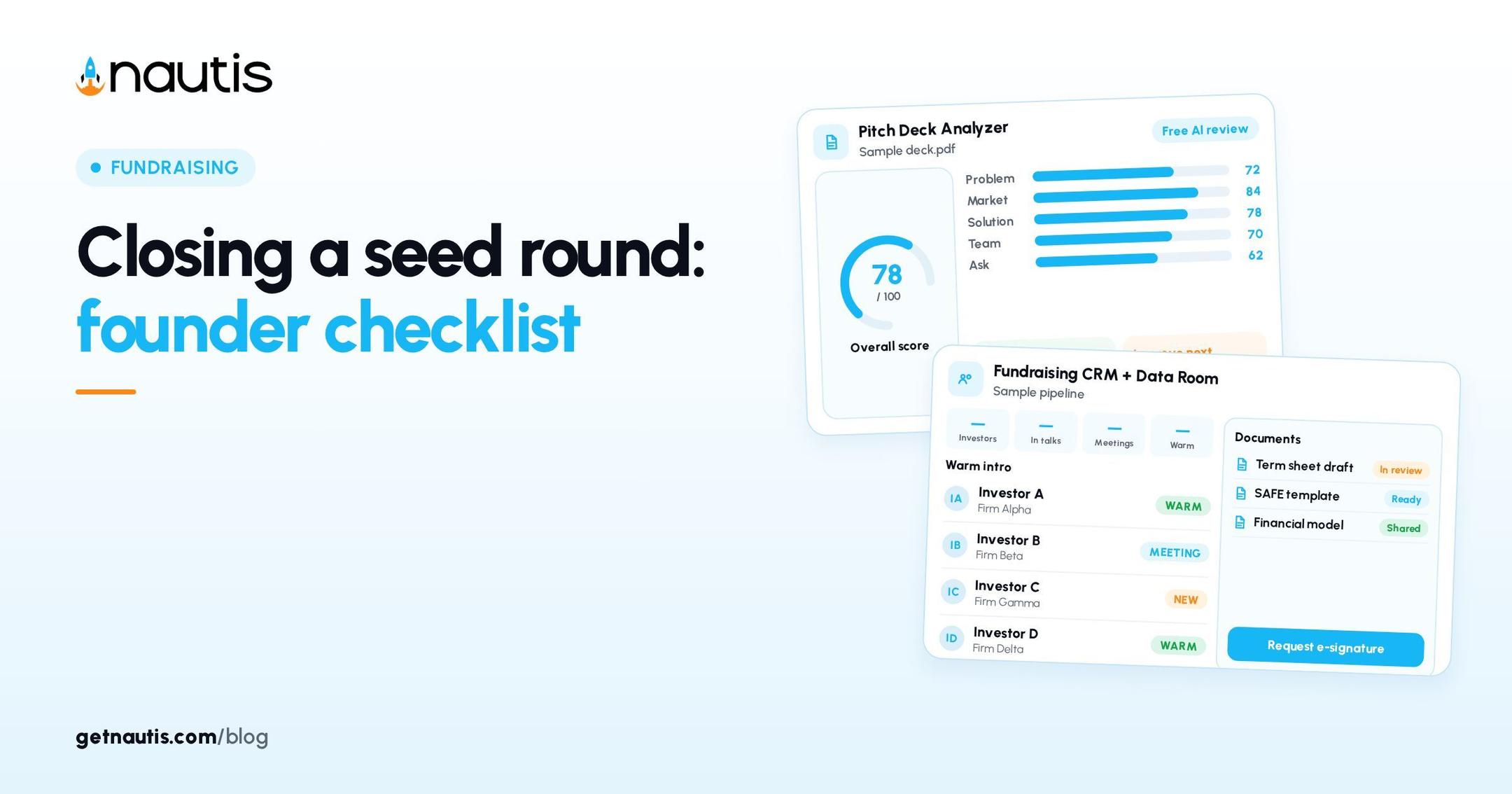
In Fundraising CRM (checked 31 Oct 2026), each round opens on Raise HQ. The Closing checklist there covers Terms and paperwork and Money and records, adapted to your instrument, and the product labels it as guidance, not legal advice. Use it as the on-screen twin of this article, not as a substitute for counsel.
Keep Fundraise Target honest. Mark stages Won only when money is committed under your definition above so Raised and the progress bar do not lie. On Follow up today, nothing goes to investors until you Approve & send. Attach signed SAFEs, notes, consents, and wire receipts under each deal's Files tab. If you need a holding pen for almost-done investors, keep them in a late stage rather than marking Won early.
When the book is complete, the Lock icon on the round card Closes the round so no new deals can be added. Reopen later with the same control if you reopen the book for a clean follow-on check. Closed rounds keep their data. That Lock step belongs on this closing a seed round checklist so a stray Add Investor does not reopen chaos after you told the company the round was done.
For investors who stall after Docs signed, use Notes with a dated chase plan rather than a second verbal celebration. Soft pressure with a clear ask ("signed SAFE by Friday, wire Monday") beats vague optimism in the pipeline. Sort Follow up today by who is blocking Books match, not by who replied last with emoji.
Same-day Cap Table and readiness truth
Mirror every closed instrument on Cap Table (checked 31 Oct 2026): add the investor stakeholder, record the SAFE or equity on the Equity tab, keep board consents on Documents, and glance at Overview for issued, authorized, and fully diluted totals. Use Scenarios before you accept a last-minute check that would blow past the ownership you already sold on prior SAFEs. Export All Data (JSON) when the seed cluster finishes so diligence next round is not inbox archaeology.
Investor Readiness will not wire money for you. It will show whether The Ask & Round Terms, Data Room, and Pipeline still look unfinished while you claim you are closing. If Overview still says Not yet because the data room or round terms are empty, fix those gaps before you announce a close externally. Ready to raise is a preparedness verdict for fundraising fundamentals, not a close certificate.
For SAFE conversion and cap mechanics without reteaching the whole instrument, see SAFE note explained for startups. Keep signature chases on a dated list so they do not vanish under product noise the week wires are supposed to land.
Paper, money, and records without drama
Counsel owns instrument language. Founders own the filing habit. Before Docs out leaves your inbox, confirm the PDF filename, version date, and that side letters live as attachments rather than Slack lore. After Docs signed, name the stored file with investor, instrument type, and date so a future Series A data room can find it in seconds.
Money and records means company account only. Publish wire instructions once, from a company domain, and refuse personal accounts even when a relative insists it is faster. Match every cleared amount to the instrument. If the wire is short or long, pause Won until counsel and the investor agree on a corrected schedule or an amended instrument. Do not invent a verbal fix that Cap Table cannot store.
Board consent belongs next to the signed SAFE or stock purchase agreement. YC's SAFE materials assume board approval for issuance. If your board is just founders today, still document the consent in writing and store it. Future counsel will thank you for the paper trail more than for the story.
When you mix SAFEs and priced equity in one seed cluster, keep separate folders and Cap Table instrument types. Do not collapse everything into a single "seed investors" row. Next-round diligence will ask for the individual PDFs anyway, and Cap Table Overview only stays honest if Equity matches those files one for one.
Refuse last-minute side deals that live only in a text thread. If an angel wants a unique discount or a different post-money figure, route it through counsel, update the instrument, and only then move Docs out. Your closing a seed round checklist fails the moment Cap Table and the signed PDF disagree.
Who owns each close task on a tiny team
On a two-founder seed, split the work by system of record rather than by investor personality. One founder owns Raise HQ stages, Follow up today approvals, and Files. The other owns Cap Table Equity rows, Documents, and the bank confirmation screenshot. Both must sign off before anyone says closed aloud.
If you are solo, still keep the split as two calendar blocks on the same day: morning for CRM and signatures, afternoon for Cap Table and wires. Mixing both into one exhausted evening is how PDFs land in Downloads and never reach Documents. Put the split on the closing a seed round checklist itself so a contractor or future hire can pick up mid-stream without a verbal handover.
Counsel remains outside that split. They draft and negotiate. You file what they approve. Do not ask counsel to babysit Cap Table rows or CRM stages; that is founder ops, and it is the work this checklist exists to make boring.
An illustrative fake close (composite only)
The story below is a composite illustrative example, not a real raise.
A founder marked three CRM deals Won after a demo-day dinner, tweeted "seed closed," and still had zero signed SAFEs and zero Cap Table rows. Two weeks later one "investor" ghosted and another wired a different amount to a personal account. The illustrative failure was celebrating Phase Soft circle as if it were Phase Books match. The checklist in this post exists to prevent that leap.
A cleaner illustrative pattern looks dull on purpose: soft yes logged as Interest, Docs out with a pinned SAFE PDF, Docs signed with Files filled, wire cleared to the company account, Cap Table Equity row added the same afternoon, round Locked when the book stopped growing. Nobody clapped on social media until Books match was true for every name in Raised. The dull pattern is the one that survives a bank audit and a Series A data room request.
The final 48 hours before you say closed
- Diff every signed PDF against the terms in Notes and Raise HQ.
- Confirm board approval docs sit in Files and Cap Table Documents.
- Confirm each wire amount, date, and company account destination.
- Move only cleared deals to Won; move ghosts to Lost with a reason.
- Recompute Investor Readiness if you closed documentation gaps; do not fake Ready to raise.
- Export Cap Table JSON and store a dated copy offline.
- Lock the round if you are done adding names.
- Send one consistent close note to the internal team: amount raised, instrument, and that books match.
Run the eight steps as a single sitting when possible. Split ownership only if one founder owns bank confirmation and another owns Cap Table, and still end the day with a joint "books match" message in the same channel. Closing a seed round checklist discipline is repetitive on purpose. Soft yes, signed paper, cleared wire, matching ledger. Repeat until the progress bar and the bank tell the same story. When they do, celebrate once, then protect the archive so the next raise starts from facts instead of folklore.
Frequently asked questions
When is a seed investor actually closed?
When the signed instrument, required board consent, cleared company-account wire, and matching Cap Table row all exist for that name. Soft circles and personal-account transfers do not count. Keep that bar written and shared so the team cannot redefine closed mid-round.
What does Nautis Closing checklist cover?
On Raise HQ, Closing checklist covers Terms and paperwork and Money and records, adapted to your instrument. The product labels it as guidance, not legal advice. Use it beside counsel, not instead of counsel.
Should I Lock the round when the last wire clears?
Yes, if you are done adding investors. Lock on the round card Closes the round so no new deals can be added, while closed rounds keep their data. Reopen later with the same control if a clean follow-on check belongs in the book.
Does Investor Readiness prove the seed closed?
No. Ready to raise judges fundraising fundamentals such as The Ask & Round Terms, Data Room, and Pipeline. It does not replace signed PDFs, cleared wires, or Cap Table rows. Fix Not yet gaps before you announce a close externally.
Sources
- Nautis Fundraising CRM. Checked on October 31, 2026.
- Nautis Cap Table. Checked on October 31, 2026.
- Nautis Investor Readiness. Checked on October 31, 2026.
- Y Combinator SAFE documents. Checked on October 31, 2026.
Baltej Singh is a serial entrepreneur, technology leader, and Founder & CEO of Nautis and DemoVexa, with over 16 years of experience building software products, SaaS platforms, and startups. Previously the Co-Founder & CTO of SanchiConnect, he has worked extensively in the DeepTech startup ecosystem, connecting with 200+ venture capital firms and supporting a network of 4,000+ startups. Passionate about AI, automation, and entrepreneurship, he focuses on building innovative products that solve real-world problems and help businesses grow.