How to run a fundraising process week by week
 Baltej Singh8 min read
How to run a fundraising process is less about charm and more about a calendar with gates. You either enter fundraising mode or you do not. While you are in it, you run parallel investor conversations, treat soft interest as a no until money is committed in writing, and close wires before you celebrate. Paul Graham's fundraising advice for YC companies (the essay founders still circulate as the phase-two map) puts the same spine under different words: be in mode or not, search breadth-first by expected value, hear no until you hear yes, and get back to the product when the straw fills with air.
This post is a week-by-week operating map for an early raise. It is education based on that public YC-era advice and related seed practice as of October 2026, not a promise any firm will behave. Confirm securities and docs with counsel.
How to run a fundraising process without living in maybe
Investors sit between fear of missing a hit and fear of funding a flop. That tension produces delays, soft yeses, and silence that feels like progress. Your job is to impose external rules so wishful thinking does not run the company.
Rules that keep the process honest:
- Fundraising mode is on or off; do not half-raise while pretending to ship
- Talk to investors in parallel, prioritized by expected value
- Treat anything short of a clear commit as a no
- Know the next step after every meeting
- Close committed money into the bank
- Stop when you have enough or when the straw fills with air
If a rule feels optional, that is usually the moment it is doing the most work.
Week 0: lock the ask and the owner
Before week one intros, write one line: amount range, instrument, and decision window. Name the founder who owns fundraising so others keep building. Build the leave-behind you can send the same day: short summary, deck or memo if you use one, and a dated cap table export.
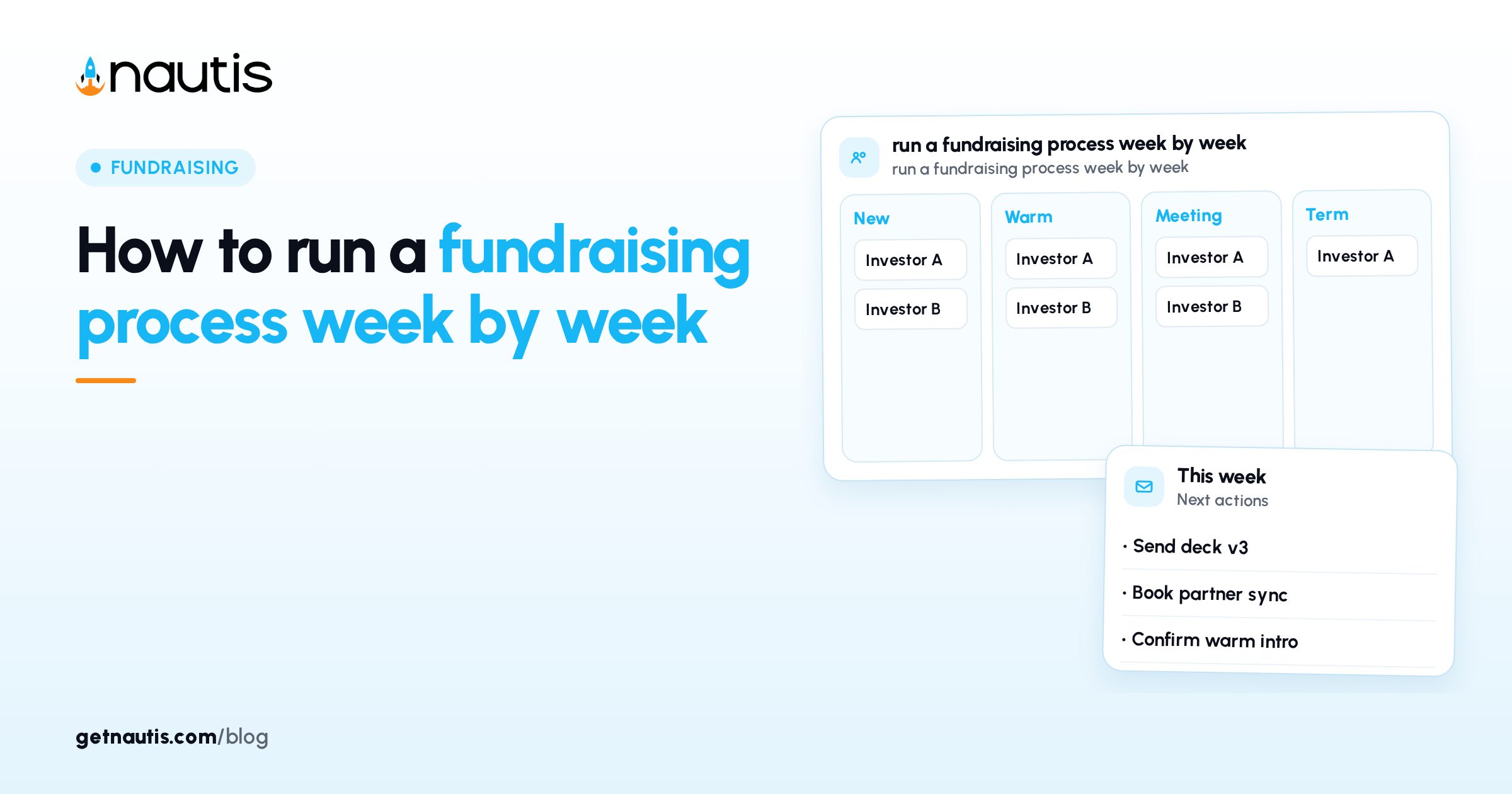
Create the CRM round with stages you will actually update. Empty stages are theater. You need Lead, Contacted, Meeting, Diligence, Committed, Wired, Passed.
Weeks 1 to 2: open the graph in parallel
Week | Primary job | Volume target (example) | Exit criteria |
|---|---|---|---|
1 | Warm intros live; first meetings booked | 15 to 25 qualified intros requested | Calendar has real meetings, not hope |
2 | Run meetings; rank by expected value | 8 to 12 first meetings | Clear next steps on every live thread |
3 | Push deciding investors; start closes | First written commits in motion | At least one serious path to wire |
4+ | Roll commits; raise or stop | Wires clearing; weak leads dropped | Enough cash or deliberate stop |
Examples are illustrations, not quotas. Adjust to your network size. The shape matters: parallel outreach weighted toward people who can say yes without waiting for a mythical lead.
Do not serialize one investor for three weeks. You cannot afford the calendar, and they feel no pressure from a market that does not exist yet.
Weeks 2 to 3: meetings that end with a next step
Never leave a meeting vague. Ask what has to happen before they can decide, who else must see it, and when they expect to know. Write the answer the same day in the CRM. Actions beat adjectives.
If someone speaks like a yes but will not confirm a commit, keep them as a no in your head. Get written confirmation when you believe they are in. Wishful founders and optional investors create explosions when those two meet.
Ignore "we do not lead" prospects early. Their expected value is near zero until you already have momentum. Talk to them last if at all.
Weeks 3 to 4: close the first money, then roll
The first real commit is often half the difficulty. Once it lands, ask that investor for intros to people they respect. Roll additional commits greedily: accept acceptable offers, give parallel investors a short window when needed, and babysit wires until cash hits the account.
"We've raised" means money in the bank, not lunch compliments. Buyer's remorse is common; delay invites it.
Have multiple plans for different raise sizes so you can tell a coherent story whether you raise a smaller or larger bag. Underestimate the public target early if you want momentum signals; you can expand if interest remains.
Intros, associates, and who gets your calendar
Warm intros beat cold inbound. Prioritize introductions from investors who already committed, then from founders they backed, then from trusted operators. Treat associate cold email as low expected value unless a partner is already engaged through a real intro. Time is the scarce input; spend it where a yes can happen without a scavenger hunt through the firm.
When an investor asks you to meet "just to learn," and you are not in mode, decline politely and offer to reconnect when fundraising is on. Casual chats that become negotiation are how mode gets declared by accident.
Materials that survive a forward
Keep the executive summary to one page of plain facts: what you build, for whom, traction with dates, and the ask. If you use a deck, make it a leave-behind that matches the verbal story, not a second company. Assume anything you send will be forwarded. Do not refuse to share with serious investors out of paranoia; treat leaks as a cost of the process and keep sensitive customer detail out of the first pack.
Update numbers on a fixed cadence during the raise so two partners do not receive two different ARR figures in the same week.
After the wire: exit mode cleanly
Send a short note to active threads you are pausing. Log passes with reasons. Archive the CRM stages you will need for the next raise. Then remove fundraising from the top of the mental stack on purpose. The point of a timed process is to return attention to users and product while the new runway still means something.
Monday review while the process runs
Every Monday during fundraising mode, spend thirty minutes on five lines only:
- Cash committed vs wired vs target
- Active threads by stage
- Next steps due this week with owners
- Highest expected-value conversations
- Decision: continue, expand ask, or stop
Share that page with co-founders. Chat threads are not a scoreboard.
Where Nautis holds the week without owning the raise
Nautis does not convince investors for you. It can keep the process from forking across inboxes.
Fundraising CRM is the round, deals, stages, notes, and activity log. Update it the same day as the meeting.
Find Investors can refill the shortlist by stage and check size when enabled, after warm paths are working.
Cap Table should reflect new instruments the day wires clear so ownership talk stays true.
Two process shapes (examples)
Mode with a stop date
Asha blocked six weeks, ran parallel intros, and Monday-reviewed ruthlessly. Soft maybes got less time each week. Two commits wired in week four. She stopped outreach, thanked the rest, and returned to product with runway bought on purpose.
Eternal soft yes
Ben stayed "almost fundraising" for four months, taking casual chats that became negotiation without a mode switch. Product growth flattened. Investors sensed drift. He reset, declared mode for four weeks only, and either closed or stopped by a dated Friday.
Mistakes that stretch the process into a second job
- Serializing investors because it feels polite
- Believing contingent language is a commit
- Optimizing valuation while the wire is still imaginary
- Letting fundraising become the top idea for the whole company
- Refusing to stop when you are only getting air
- Updating the CRM once a week from memory
If two appear together, pause new intros for forty-eight hours and repair the operating rules.
Same-week kickoff checklist
- Write the ask line and fundraising owner
- Declare mode on with an end date on the calendar
- Build or clean the CRM stages
- Request the first batch of warm intros
- Schedule Monday reviews for the next six weeks
- Agree what counts as a written commit
- Agree what "enough" looks like for a stop
- Protect builder calendar for the non-fundraising founder
How to run a fundraising process week by week is imposing a map on an alien market. If growth goes flat during the raise, say so in the next meeting with a cause and a fix. Hiding a stall until the wire is a trust tax you will pay twice. Parallelize, prioritize, confirm commits in writing, close cash, and exit mode so the company can grow again. Fundraising is a means. Shipping and talking to users remain the test that matters after the last wire clears.
Keep the ask line identical in every note until the board changes it on purpose.
Frequently asked questions
How do you run a fundraising process week by week?
Lock the ask and owner, open warm intros in parallel, run meetings to clear next steps, push commits and wires, and review the pipeline every Monday until you stop. Keep the company in fundraising mode only for a dated window.
Why talk to investors in parallel?
Serial conversations burn calendar and remove market pressure. Breadth-first outreach weighted by expected value is the practical map from YC-style fundraising advice for getting through phase-two raises without living in maybes.
When should we stop fundraising?
Stop when you have raised enough for the plan you sold, or when options run out and you are only getting air. Continuing a dead process distracts founders from the growth that makes the next raise possible.
What counts as raised money?
Cash in the bank. Verbal excitement and contingent language are not commits. Confirm commitments in writing and track wires until they clear.
Sources
- Paul Graham: How to Raise Money. Checked on October 31, 2026.
- YC: A Guide to Seed Fundraising. Checked on October 31, 2026.
- Nautis Fundraising CRM help. Checked on October 31, 2026.
Baltej Singh is a serial entrepreneur, technology leader, and Founder & CEO of Nautis and DemoVexa, with over 16 years of experience building software products, SaaS platforms, and startups. Previously the Co-Founder & CTO of SanchiConnect, he has worked extensively in the DeepTech startup ecosystem, connecting with 200+ venture capital firms and supporting a network of 4,000+ startups. Passionate about AI, automation, and entrepreneurship, he focuses on building innovative products that solve real-world problems and help businesses grow.