How founders weigh data against customer stories
 Baltej Singh8 min read
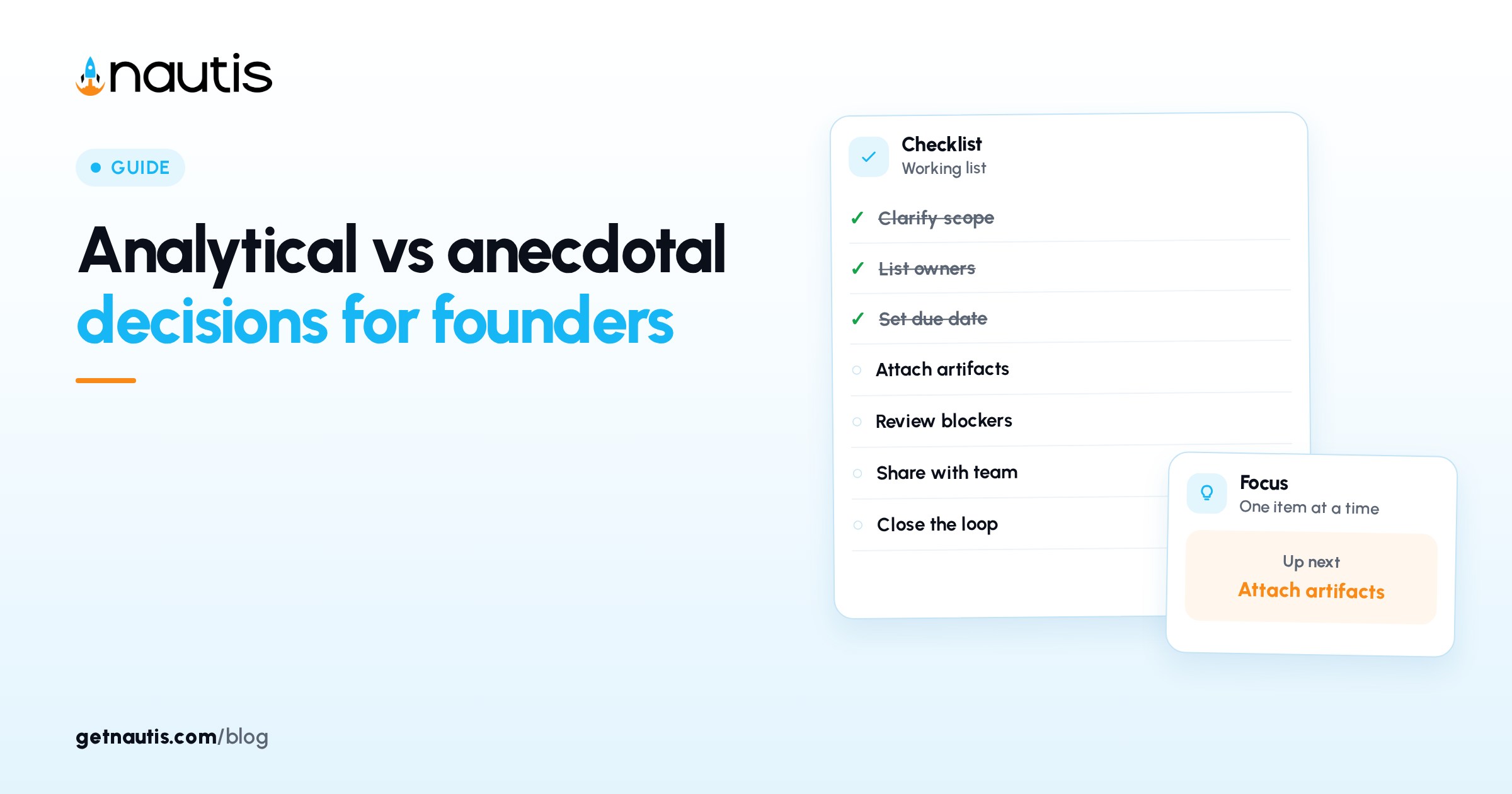
How founders can weigh data against customer stories is a practical filter: checkable evidence on one side, vivid single stories on the other. Founders need both story sense and evidence habits. Trouble starts when a single anecdote silently outranks the better data in the room.
This guide is a working filter, not a lecture against listening to customers or teammates.
How founders weigh data against customer stories day to day
An anecdote is one experience, often memorable, rarely verified across cases. Analytical evidence is information you can inspect, compare, and revisit: counts, rates, controlled tests, or documented patterns from more than one source.
Evidence-based practice asks leaders to use strong available evidence from multiple sources, appraise how trustworthy it is, and assess outcomes after the decision (Center for Evidence-Based Management, Evidence-Based Practice: The Basic Principles, checkedOn 2026-11-01).
Signal | Anecdotal lane | Analytical lane |
|---|---|---|
Source | One call, one demo, one Slack rant | Multiple cases, logged metrics, repeated tests |
Strength | High emotion, low sample | Lower drama, higher checkability |
Risk if overweighted | Scaling a one-off | Ignoring a real edge case that needs a patch |
Good use | Hypothesis generator | Decision load-bearing input |
Case: a loud churn story claims "pricing killed us." Analytical review of twenty exits shows support tickets clustering on onboarding, not price. The anecdote still earns a pricing FAQ; it does not set the roadmap alone.
Grade the evidence before you pick an option
Write the decision question in a single sentence. If you cannot, you are still brainstorming.
List every claim on the table. Label each claim as story, metric, test, outside research, or judgment.
Refuse to let five story labels outvote one clean metric without saying so out loud. Silence is how anecdotes win by default.
Claim-type card example
Claim | Type | Note |
|---|---|---|
"Enterprise hates annual prepaid" | Story | One failed close last month |
Prepaid share of new ARR last 90 days | Metric | 62% prepaid in segment |
Two-week checkout test on annual default | Test | Planned, not run |
The card makes the mismatch visible before anyone raises their voice.
Center for Evidence-Based Management lists asking, acquiring, appraising, aggregating, applying, and assessing as the loop for better decisions (same CEBMa primer, checkedOn 2026-11-01). Your claim-type sheet is a lightweight appraisal step.
Minimum evidence bar by stakes
Stakes | Minimum bar before you commit |
|---|---|
Reversible, cheap | Clear anecdote plus a planned check within two weeks |
Costly but reversible | Metric trend or small test, not only stories |
Hard to reverse | Multiple analytical signals or a pre-registered test |
Hard-to-reverse examples: multi-year contracts, public pricing pages, equity grants. Raise the bar on purpose.
If speed is real
Sometimes you must move before the pack is perfect. Take the decision, mark it Provisional, and schedule the assessment date in the same breath. Provisional without a follow-up date is just an anecdote with authority.
Use anecdotes as sparks, not as proof
Invite the story. Then ask three plain questions: How many times has this happened. Who else saw it. What would disprove it.
Park the anecdote as a hypothesis card with an owner and a follow-up date. Hypothesis cards die if nobody owns the follow-up.
Story intake script
If someone brings a vivid case, reply with: thanks, tagged as anecdote, follow-up owner is X, follow-up date is Y. That script is kindness with structure. Without it, every story feels like a demand for immediate roadmap change.
Sample size honesty
If the story is n=1, say n=1 in the notes. Inflating one case into "customers are saying" is how weighing data against customer stories get corrupted in the #general channel.
Brown University's overview of evidence-based management stresses that anecdotes are not systematically verifiable the way objective evidence is, and that leaders must separate story from evidence (Brown SPS evidence-based management note, checkedOn 2026-11-01).
Do not shame people for bringing stories. Shame the habit of closing the decision on story alone.
Build a light analytical pack for recurring choices
For decisions you make often (pricing tweaks, channel spend, hiring pace), keep a a short pack: definition of the metric, current window, comparison window, and known data gaps.
Update the pack on a fixed cadence you already run. Do not invent a new ceremony.
If the pack and the loudest anecdote disagree, read both aloud. Either the pack is wrong (fix the instrumentation) or the anecdote is a special case (patch the edge).
Pack freshness rule
If the pack is older than your review window, mark it Stale ahead of deciding. Stale analytical packs are anecdotes wearing a spreadsheet costume.
Metric definition fights
If two founders quote different churn numbers, stop the decision and align the definition first. Weighing data against customer stories cannot proceed while the metric claims disagree on meaning.
Disconfirming search
Assign a designated skeptic to argue the opposite for five minutes. Weighing data against customer stories improves when someone is paid, socially, to find the counterexample.
If nobody can name a disconfirming check, you are fundraising for a belief, not deciding.
Run a small test when the analytical lane is thin
Thin data is common early. Thin data is not permission to pretend a story is a study.
Design the smallest test that could change your mind: a two-week channel split, a pricing page variant, a sales script change with logged outcomes.
Pre-write the kill or keep rule. Without a rule, every test becomes a success story.
Test card fields
Write: hypothesis, primary metric, window, sample rule, kill/keep threshold, owner. Missing threshold means you will negotiate the result after you see it.
Stopping early
If early results already clear the kill threshold with enough volume to care, stop. Stretching a dead test to "give it a full month" is another anecdote machine.
Log the result next to the original anecdote. That pairing teaches the team faster than either alone.
Keep judgment visible instead of smuggling it
Judgment is allowed. Hide it and it masquerades as data.
If you choose against the analytical pack, write why in a single line: time pressure, strategic bet, data known broken. That line is accountability, not weakness.
Review those override lines monthly. A pile of "data broken" overrides means fix instrumentation ahead of the next strategy offsite.
Override taxonomy
Label overrides as time-box, strategic bet, or broken instrumentation. That vocabulary makes the monthly lookback faster than rereading prose.
Public override log
Keep overrides in a shared note, not in private memory. Patterns across overrides (always sales exceptions, always founder taste) are analytical evidence about how you actually decide.
Choice card fields
Field | Purpose |
|---|---|
Question | A single sentence |
Claim tags | claim types counts |
Analytical summary | Three bullets max |
Anecdote summary | One bullet, named source |
Choice and owner | Who decided |
Follow-up date | When you will assess |
Store choice cards where the team already looks. Orphan docs do not change behavior.
How cofounders weigh data against customer stories together
Agree that either cofounder may call "evidence pause" when a meeting is about to close on one story. The pause lasts ten minutes to pull the pack or schedule the test.
Rotate who brings the analytical pack so the "numbers person" is not always the brake.
Celebrate corrected beliefs. If a story loses to better evidence, thank the storyteller for the spark and the analyst for the follow-up. Culture beats a laminated framework.
Meeting end check
Before you leave the room, ask: did we close on tags M/T/E, or only on story and judgment. If only A and J on a high-stakes item, schedule the follow-up ahead of spending.
Onboarding the filter
New hires see a worked decision card in week one. Weighing data against customer stories is a team habit, not a founder personality trait.
Claim ledger
Keep a running ledger of claim types counts per major choice for a quarter. The ledger is pattern evidence about whether the company runs on stories or on inspectable inputs.
Anecdote half-life
Vivid stories fade slower than spreadsheet cells in human memory. Write the analytical summary into the same note as the story within a day so the pair travels together.
Channel-specific noise
Sales anecdotes skew to the last lost deal. Support anecdotes skew to the loudest ticket. Product anecdotes skew to the last demos. Require the lane label (sales, support, product) on every story claim so you see which microphone is hot.
Board and investor storytelling
Investors love a crisp founder story. Still separate fundraising narrative from operating decisions. A Series pitch anecdote is not a substitute for the analytical pack when you set pricing for real customers.
Tooling without theater
A spreadsheet of decision cards beats a unused "decision OS." If the team will not open it, print the tag legend on a wiki page they already use. Weighing data against customer stories fails when the filter lives in a tool nobody opens.
Point teammates to decision and ops docs in the Help Center. Plan limits are on pricing.
Weighing data against customer stories stays healthy when stories open questions and evidence closes them, with judgment labeled when it overrules the pack.
Frequently asked questions
How can founders weigh data against customer stories?
Treat stories as sparks and metrics or tests as load-bearing inputs. Label every claim in plain words, then match the evidence bar to how hard the choice is to reverse.
Should founders ignore customer stories?
No. Use stories to form hypotheses, then check them. Ignoring stories blinds you; closing on stories alone biases you.
What labels should we use instead of letter codes?
Story, metric, test, outside research, and judgment. Count those types in the room so five stories cannot silently beat one clear metric.
What if we must move fast?
Decide, mark the choice Provisional, and set a follow-up date in the same meeting. Speed without a follow-up is just a story with authority.
Sources
- Center for Evidence-Based Management, Evidence-Based Practice: The Basic Principles. Checked on November 1, 2026.
- Brown University SPS, Evidence-based management overview. Checked on November 1, 2026.
Baltej Singh is a serial entrepreneur, technology leader, and Founder & CEO of Nautis and DemoVexa, with over 16 years of experience building software products, SaaS platforms, and startups. Previously the Co-Founder & CTO of SanchiConnect, he has worked extensively in the DeepTech startup ecosystem, connecting with 200+ venture capital firms and supporting a network of 4,000+ startups. Passionate about AI, automation, and entrepreneurship, he focuses on building innovative products that solve real-world problems and help businesses grow.