A customer kickoff agenda for B2B startups
 Baltej Singh9 min read
The first working meeting after a business-to-business (B2B) deal closes should follow a written plan. A customer kickoff agenda for B2B startups is a timed session you run once the contract is signed: confirm why they bought, name owners on both sides, lock success metrics, list the access you need, and leave with dated next steps. You send the agenda before the call, keep the meeting to about fifty minutes, and write the decisions the same day.
Many early teams treat that first post-sale call as a victory lap. They replay the demo, skip the economic buyer, and hang up without a written definition of success. Weeks later the champion is busy, an integration never starts, and nobody can say what "live" meant. Gainsight's guide to etiquette in customer interactions, as of November 2026, still tells teams to propose an agenda, send it ahead of time, ask the customer what to add, and close with owners and deadlines in a same-day note.
This post gives you a dated agenda you can run even if you never open a customer success product. Where Nautis appears, it is one place to keep the agenda in Notes, store stakeholders in Contacts, and turn next steps into tasks on a Task Board.
What should a customer kickoff agenda for B2B startups cover?
A finished agenda answers six questions in writing:
- Why did this company buy, in their words?
- Who owns the relationship on each side, including a backup?
- What does success look like in thirty, sixty, and ninety days?
- Which systems must connect, and who grants access?
- What will we train, and who attends?
- What are the dated next steps when we hang up?
If any of those six is blank, you are hosting a conversation, not a kickoff. Fill the blanks before you send the invite. Pair this session with a named post-sale owner and a thirty-day path in customer success basics for early SaaS.
Founder scenario (example): Priya sold a workflow tool to a ten-person operations team at a regional logistics firm. Her first call after signature was a second demo, and nobody wrote a success metric. Six weeks later the champion had not invited teammates. She reran a fifty-minute session with the agenda below and left with a written first-value date.
Who should attend the first kickoff
Keep the room small enough to decide things.
On your side:
- The person who will own the account after sales, often the founder at this stage
- Someone who can answer setup and integration questions, if that is not the same person
- The closer, for a short handoff at the start. They can leave after that block.
On their side:
- The executive sponsor, meaning the person who cared enough to buy
- The champion or primary admin
- One end user who will do the work in the first month
- A technical owner if an integration blocks first value
Gainsight's customer onboarding template, as of November 2026, lists your team as a customer success manager (CSM), an implementation specialist, and technical support, and their side as an executive sponsor, an admin user, and end-user representatives. A three-person startup will collapse those titles into two seats. Write the jobs, not the org chart.
Do not invite the whole buying committee just in case. Too many spectators turn the hour into status updates. If a critical person cannot join in the first five minutes, the same Gainsight etiquette guide says to ask the group whether you should reschedule. Use that rule when the buyer or technical owner is the person who can grant access.
Send names and roles with the agenda so introductions take a sentence, not ten minutes. Store those people in Contacts so the champion, sponsor, and technical owner live in the shared address book.
A 50-minute agenda with owners
Gainsight's etiquette guide asks teams to budget fifty minutes rather than a full hour so people can reach their next meeting on time. Use the leftover minutes as buffer, not as permission to ramble.
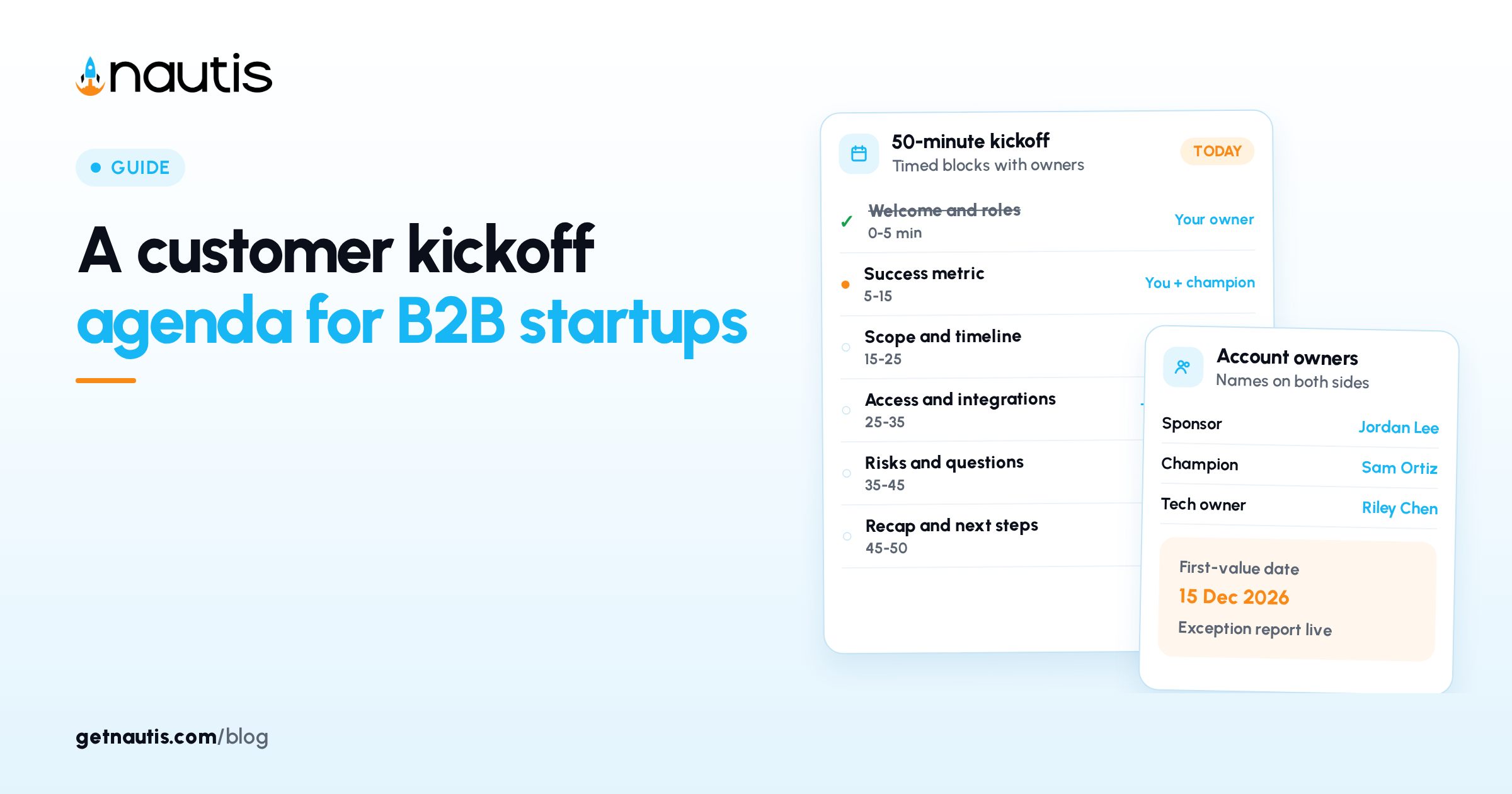
Example 50-minute customer kickoff agenda (illustrative times; adjust if your product needs a longer technical block):
Minutes | Topic | Owner | Done when |
|---|---|---|---|
0 to 5 | Welcome, roles, and why we are here | Your account owner | Everyone can name the buyer goal in one sentence |
5 to 15 | Success metrics and first-value date | Your owner and their champion | One written definition of success |
15 to 25 | Scope, timeline, and out-of-scope items | Implementer | Dated milestones for month one |
25 to 35 | Access, users, and integrations | Technical owner | A list of logins and systems to connect |
35 to 45 | Risks, constraints, and open questions | Their champion | Named blockers with owners |
45 to 50 | Recap, actions, and the next check-in | Your account owner | Written actions, owners, and dates |
Put the owner column on the invite. If a block has no owner, it will become a group discussion that overruns.
Send this table in the calendar description and again the day before. Propose the agenda, then ask what they want to add or edit. That is the Gainsight rule: never open with a request that they invent the plan live.
If you need slides, use them only to recap this table and to show a blank success line you will fill together. A long welcome deck is a different meeting, and it usually fails as onboarding.
How do you set success metrics on day one?
You set them by writing one buyer outcome, one product behavior that proves it, and one date. Do that in the room, in their words, not in your roadmap language.
Strong examples (illustrative only):
- By 15 December 2026, two dispatchers complete the Friday exception report in the tool without a spreadsheet export.
- By the fifth week, the admin has invited the full operations pod and each person has finished one live workflow.
Weak examples:
- Adopt the platform
- See value
- Roll out company-wide
Company-wide rollout is a later milestone. The kickoff should pick the smallest success that would make the champion comfortable telling the sponsor the purchase was right.
Write three horizons if they help: first value, often inside the first month; habit, meaning the workflow happens without you on the call; and an expansion note that records what would justify more seats, kept as a reminder rather than today's ask.
Capture the metric where both sides can find it. In Nautis, put the success line in a shared Notes document for the account. Notes is a rich-text workspace with folders, tags, sharing, and export to Portable Document Format (PDF) or Word.
Access, integrations, and the first month of work
Most delayed accounts stall here, not in the welcome.
Before or during the access block, list:
- Who will be invited in week one, including any email domain rules
- Which admin permissions you need, and who at the customer can grant them
- Which integration, if any, blocks first value, and the backup path if that work slips
- What data you will migrate, and what you will leave alone
- Security or procurement steps that still sit with their information technology (IT) team
- Training: who attends, when, and whether it is a live session or a short guide
Gainsight's onboarding template treats the kickoff as the week-one alignment call, then setup, training, and a first-value check as later steps. Your first-month plan can follow that shape without copying their product:
Week | Customer finishes | You own | Check |
|---|---|---|---|
Week 1 | Kickoff held; admins named; access requested | Send the agenda, record decisions, file access asks | Access tickets opened |
Week 2 | Core setup started; required integration requested | Unblock configuration and schedule training | Champion can log in |
Week 3 | Named users complete training or a guided workflow | Run the training and collect blockers | First real workflow attempted |
Week 4 | First-value metric reviewed | Host a short check-in and write what changed | Metric hit, slipped, or rewritten |
These rows are examples. Rewrite them around the job they bought, not around your feature list.
If value depends on an integration, say so out loud in the kickoff. A backup path, such as a manual import or a narrower workflow, keeps the first-value date honest when an IT review takes longer than anyone hoped.
Turn each row into owned work. In Nautis, create a Task Board for the account, add outcome tasks with assignees and due dates, and keep the living plan in Notes. You can also book the kickoff as a one-off meeting in Meetings and add attendees from Contacts.
What should you send after the kickoff?
Send a same-day follow-up to everyone who attended, plus anyone who was invited and missed it. Gainsight's etiquette guide asks for that note the same day, with decisions, action items in short bullets, owners, and deadlines. Repeat what you already said on the call.
A usable follow-up has five parts:
- One sentence on why they bought, in their words
- The success metric and the first-value date
- Decisions, including scope in, scope out, training format, and how you will communicate
- Actions with owners and dates
- The next check-in, already on a calendar
Do not paste a transcript and call it a recap. Convert talk into owned work the same day, the way you would turn meeting notes into owned tasks. If you recorded the call, you asked permission first, which is another Gainsight rule.
Store the recap where the next teammate can find it without asking you. A Notes page shared with the people who cover accounts beats a thread that lives only in one inbox. Export to PDF if their sponsor wants a file they can forward.
How a kickoff stays a working session
Protect the fifty minutes.
- Start the conference a few minutes early and greet people as they join.
- If you plan to share a screen, close unrelated files and notification pop-ups first.
- Ask before you record.
- Mirror their pace. If they are rushed, skip history they already know.
- Write names next to statements in your notes so later readers know who promised what.
- Leave the last five minutes for recap even if earlier blocks ran long. If you are still in the weeds at minute forty-five, pause and schedule a technical follow-up rather than taking their next meeting.
- End early if the work is done.
Do not reopen the sales process. They already bought. Questions about extra modules or more seats can wait until first value is real.
If the champion asks for a feature, write the job in their words and promise only what you will ship inside a stated window. A kickoff that turns into a roadmap negotiation delays access and training, which is how first value slips.
Frequently asked questions
What should a customer kickoff agenda for B2B startups include?
Include why they bought, owners on both sides, a written success metric, access and integration needs, the training plan, and dated next steps. Send that agenda before the call and ask the customer what to add. Leave with a name on every action so the first month has a plan instead of a transcript.
How long should a B2B customer kickoff last?
Fifty minutes is a practical default, which matches Gainsight's advice to budget fifty minutes rather than a full hour so people can reach their next meeting. Use a longer technical follow-up if integrations need more time, rather than stretching the kickoff past a hard stop. End early if the work is done.
Who should attend a customer kickoff at a small startup?
On your side, bring the person who will own the account and anyone who can answer setup questions. On their side, bring the executive sponsor, the champion or admin, one end user, and a technical owner if an integration blocks first value. Keep the room small enough to make decisions.
What should we send after a customer kickoff?
Send a same-day note to everyone who was invited, including people who missed the call. Recap the buyer goal, the success metric, decisions, actions with owners and dates, and the next check-in. Store that recap where the next teammate can find it.
Do we need a customer success hire before we run kickoffs?
No. An early team can run the same agenda with a founder as the account owner. Hire later if that rhythm is overloaded for weeks and accounts still stall. The written agenda matters more than the job title.
Sources
- Gainsight, The Guide to Etiquette in Customer Interactions. Checked on November 8, 2026.
- Gainsight, Customer Onboarding Template: Proven Resources for Success. Checked on November 8, 2026.
- Nautis Help Center, Notes. Checked on November 8, 2026.
- Nautis Help Center, Task Boards. Checked on November 8, 2026.
Baltej Singh is a serial entrepreneur, technology leader, and Founder & CEO of Nautis and DemoVexa, with over 16 years of experience building software products, SaaS platforms, and startups. Previously the Co-Founder & CTO of SanchiConnect, he has worked extensively in the DeepTech startup ecosystem, connecting with 200+ venture capital firms and supporting a network of 4,000+ startups. Passionate about AI, automation, and entrepreneurship, he focuses on building innovative products that solve real-world problems and help businesses grow.