How to prepare for a startup board meeting
 Baltej Singh9 min read
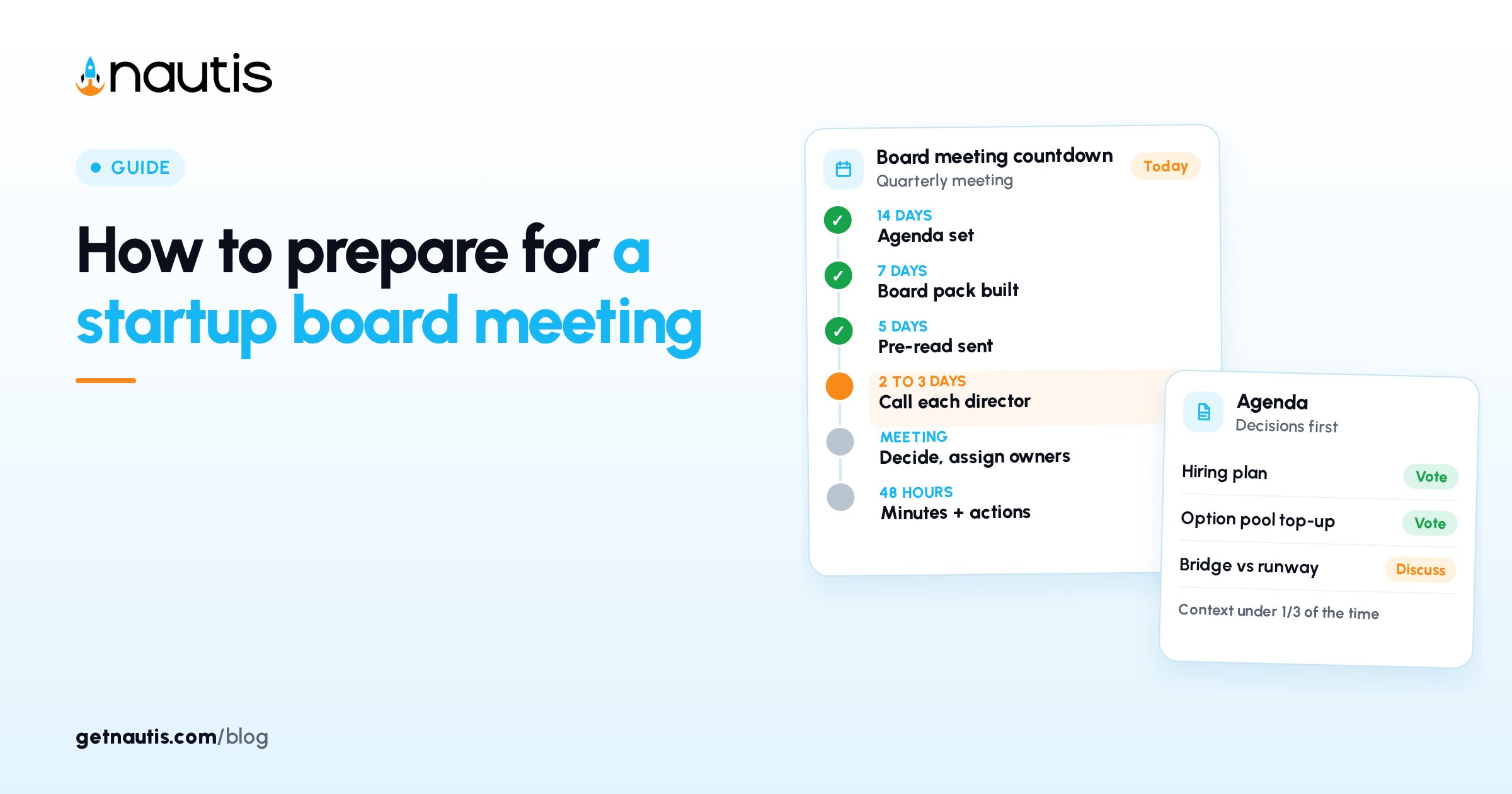
Board meeting preparation for an early startup takes about two weeks of light work, not one frantic night. Pick the two or three decisions you need from the board, send a short pre-read at least five days ahead, talk to each director before the meeting, and write the minutes within 48 hours. If directors arrive already knowing the numbers and the bad news, the meeting can be spent on the decisions instead of a slide-by-slide recital.
This guide follows one quarterly meeting from fourteen days out to the day after. The example company is fictional. Dev is the chief executive officer (CEO) of a seed-stage logistics software company with a three-person board: Dev, his cofounder Ana, and the partner from the fund that led their seed round. Swap in your own board and calendar.
What board meeting preparation should cover
Most first-time founders prepare a deck. Experienced ones prepare a decision. The deck exists to make that decision easy to reach.
Here is the full countdown on one page.
When | Main job | What you produce |
|---|---|---|
14 days out | Pick the decisions and set the agenda | One-page agenda with time per item |
7 days out | Build the pre-read | Board pack: metrics, narrative, asks |
5 days out | Send it | Pre-read in directors' inboxes |
2 to 3 days out | Talk to each director alone | Notes on concerns and likely votes |
Meeting day | Run the room | Decisions, owners, dates |
Within 48 hours | Close the loop | Draft minutes, action list, follow-up email |
If your board is still forming and you are not sure which seats carry votes, sort that out first. Advisory board vs board of directors covers the difference.
Fourteen days out: set the agenda around decisions
Start with a blank page and one question: what do I need this board to decide, approve or push back on?
For Dev, the list this quarter looks like this (an example):
- Approve the plan to hire two engineers next quarter.
- Approve a new stock option pool top-up for those hires.
- Get input on whether to raise a bridge round or extend runway with cuts.
Everything else is context. Build the agenda backwards from those items and put a time on each one.
Agenda item | Example time | Type |
|---|---|---|
Opening and approval of last meeting's minutes | 5 min | Formal |
CEO summary: what changed since last time | 10 min | Context |
Metrics review, questions only | 15 min | Context |
Hiring plan | 20 min | Decision |
Option pool top-up | 10 min | Decision |
Bridge round vs runway extension | 25 min | Discussion |
Closed session without management, if requested | 10 min | Formal |
Notice that context gets less than a third of the time. If metrics take 45 minutes, the decisions get rushed at the end, and rushed decisions come back next quarter.
Send the agenda and calendar hold now, even before the pack exists. Directors with several portfolio companies block their weeks early.
Seven days out: build the board pack
The board pack is the pre-read. It should stand on its own for a director who reads it on a plane with no context.
Keep it to roughly ten pages and use the same structure every quarter so directors learn where to look.
- CEO letter. One page in plain prose. What went well, what went badly, what you are worried about, and what you need from the board.
- Metrics. The same small set every time, with the last few periods side by side. For a seed-stage software company that is often cash, monthly burn, runway in months, monthly recurring revenue (MRR) and one product usage number. If you have not settled on a set yet, startup metrics dashboard basics is a good place to start.
- One page per decision. State the question, your recommendation, the options you rejected and why, and the cost.
- Appendix. Detail that supports the decisions but would bloat the main pages, such as the full hiring plan or a cap table summary.
Pull numbers from one place and freeze them on a date. Dev freezes his on the last day of the month so the pack, the minutes and his monthly update all match. If you already write a monthly update, much of the pack is a longer version of that letter. See how to write a monthly investor update for a structure that carries over.
How early should you send the board deck?
Send it at least five days before the meeting. That gives directors a weekend or two quiet evenings to read it. A pack that lands the night before turns the meeting into a reading session.
Put the bad news on page one. Directors who find a missed target buried on slide nine start reading everything else with suspicion. Dev's example letter this quarter opens with "We missed our new-revenue target by about a third, and here is why," then moves to the good news.
Two habits help the pack get read:
- Send one file, not five attachments. A single shared folder with a link works if the appendix is large.
- Ask a direct question in the email body, such as "Please come ready to vote on items 4 and 5, and to give a view on item 6."
If you use a shared folder, control who can open it and for how long. In Nautis, Data Rooms lets you create a share link with a passcode and an expiration date, choose whether downloads are allowed, and see on the Analytics tab who opened which files. That last part tells you whether a director has read the pack before you call them.
Two to three days out: talk to each director and check the formalities
The meeting should rarely be the first time a director hears your recommendation. Call each one for fifteen minutes. Ask what worried them in the pack and whether they can support the decisions as written. If the lead investor has a concern about the option pool size, it is better to learn that on Tuesday than live in front of the full board.
Use these calls to adjust, not to lobby. If two directors raise the same issue, change the recommendation or add the missing analysis to the pack.
Then check the formal side. For a Delaware corporation, these rules from Title 8 of the Delaware Code are the ones founders most often meet:
- Quorum. A majority of the total number of directors is a quorum unless the certificate of incorporation or bylaws require more. Unless the certificate says otherwise, the bylaws can set a lower number, but never less than one third of the total.
- Voting. Once a quorum is present, a majority vote of the directors present is the act of the board, unless the certificate or bylaws require more.
- Joining remotely. Unless the certificate or bylaws restrict it, directors can take part by phone or video as long as everyone can hear each other, and that counts as being present.
- Acting without a meeting. Unless restricted, the board can act by written consent if every director consents, and the consent is filed with the minutes.
- Minutes. One of the officers has the duty to record the proceedings of directors' meetings.
Ask your lawyer to draft the resolutions for any formal approval, such as the option pool increase, and send them with the pack. This section is general information, not legal advice. Your certificate of incorporation, bylaws and investor agreements may add rules, so confirm the requirements for your company with your counsel.
On the day: run the room
Start on time and follow the agenda you sent. A few rules keep a two-hour meeting useful:
- Do not present the pack. Assume it has been read. Open each section with "Questions on this?" and move on when there are none.
- Name the decision out loud. Before discussion, say the exact question, then after discussion, call the vote or the conclusion.
- Park side topics. Keep a visible list of topics that come up but do not belong on today's agenda. Assign each one an owner before the meeting ends.
- Let someone else take notes. Running the meeting and capturing it at the same time means both are done badly. A cofounder, a company secretary or outside counsel can record decisions while you lead.
Give the board time without management if a director asks for it. It is normal, and treating it as an insult sends the wrong signal.
In Dev's example meeting, the hiring plan passes as written, the option pool top-up passes with a smaller increase than he proposed, and the bridge discussion ends with a request for two runway scenarios by the next meeting. Three items, three clear outcomes.
Within 48 hours: minutes, actions and follow-up
The meeting is not finished until the record exists. Draft the minutes while memory is fresh and keep them short. Short minutes usually record who attended, that a quorum was present, what was approved and how the votes went. They are not a transcript of the debate. Your counsel can review the wording on formal approvals.
Then send directors one follow-up email with three parts:
- The decisions made, in one line each.
- The action list, with an owner and a date for every item.
- Anything you promised to send, attached or linked.
Dev's example action list after this meeting:
Action | Owner | Due |
|---|---|---|
Open two engineering roles | Ana | Within 2 weeks |
Board consent for revised pool size | Counsel | Within 1 week |
Base and stressed runway scenarios | Dev | Before next meeting |
For the runway scenarios, a copy-and-compare approach works well. Nautis Financial Planner lets you copy a projection, change its assumptions and compare the two side by side, and Startup Health turns a monthly check-in of cash, recurring revenue and burn into runway and a shareable investor snapshot. Notes can hold the draft minutes, with a Draft or Published status so the approved version is easy to find later.
Put the date of the next meeting on the action list too. Fourteen days before it, the countdown starts again.
Frequently asked questions
How long before a board meeting should I send the deck?
Send the board pack at least five days before the meeting. That gives directors a weekend or a couple of quiet evenings to read it. A pack sent the night before turns the meeting into a reading session.
What should a startup board pack include?
A one-page CEO letter, the same small set of metrics every quarter, one page per decision with your recommendation and the options you rejected, and an appendix for supporting detail. Keeping the structure fixed helps directors find things quickly.
How many directors need to attend for a board vote to count?
For a Delaware corporation, a majority of the total number of directors is a quorum unless the certificate of incorporation or bylaws require more, and the bylaws may set a lower number but never below one third. Check your own documents with counsel, since investor agreements can add rules.
Who should take notes in a startup board meeting?
Someone other than the person running the meeting. A cofounder, company secretary or outside counsel can record decisions while the CEO leads. Draft minutes within 48 hours while memory is fresh.
Sources
- Delaware Code, Title 8, Chapter 1, Subchapter IV (Directors and Officers), sections 141 and 142. Checked on November 3, 2026.
- Nautis Help Center, Data Rooms. Checked on November 3, 2026.
- Nautis Help Center, Startup Health. Checked on November 3, 2026.
- Nautis Help Center, Financial Planner. Checked on November 3, 2026.
- Nautis Help Center, Notes. Checked on November 3, 2026.
Baltej Singh is a serial entrepreneur, technology leader, and Founder & CEO of Nautis and DemoVexa, with over 16 years of experience building software products, SaaS platforms, and startups. Previously the Co-Founder & CTO of SanchiConnect, he has worked extensively in the DeepTech startup ecosystem, connecting with 200+ venture capital firms and supporting a network of 4,000+ startups. Passionate about AI, automation, and entrepreneurship, he focuses on building innovative products that solve real-world problems and help businesses grow.