How to protect founder deep work blocks
 Baltej Singh9 min read
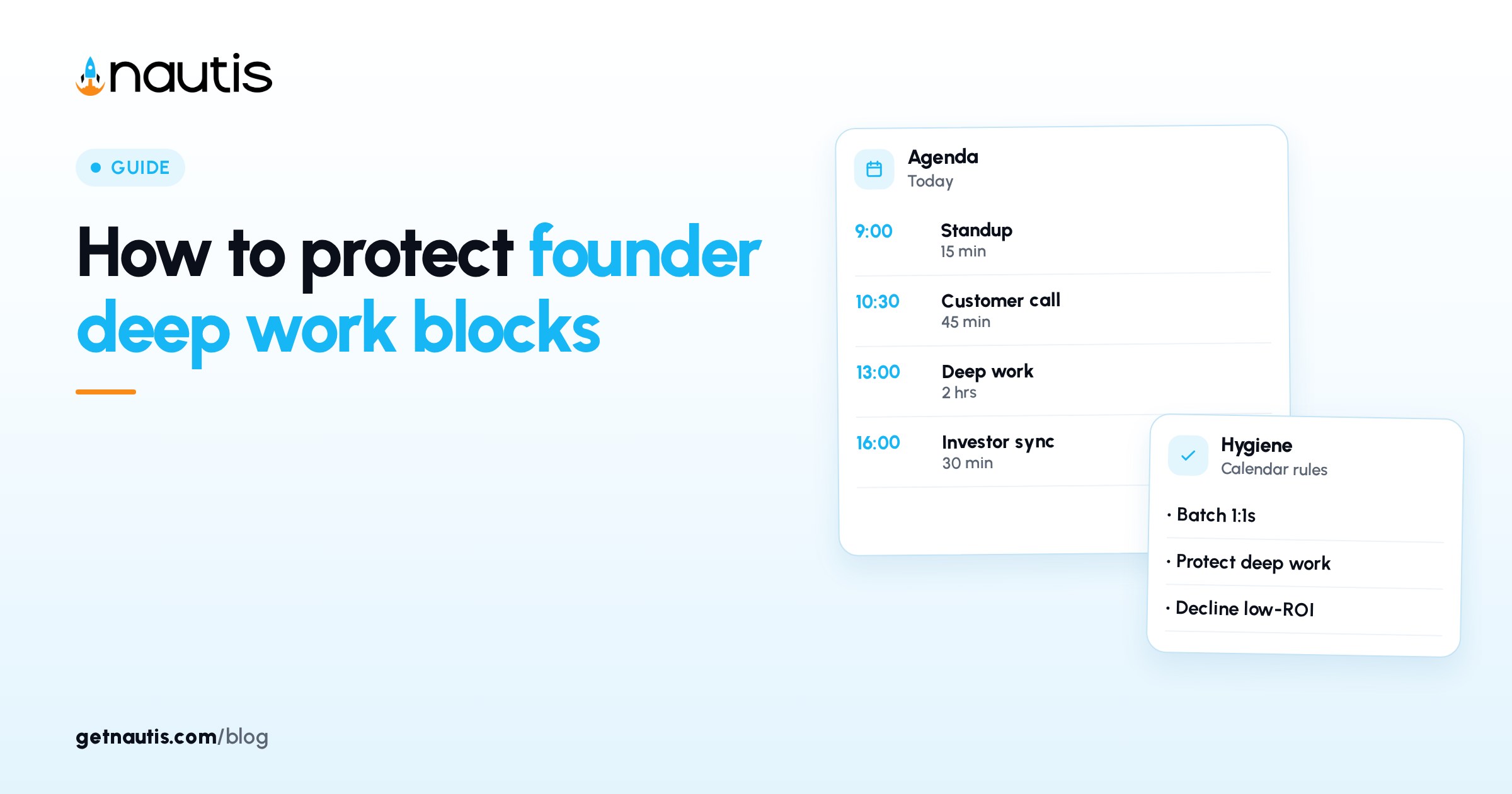
Founder deep work blocks are protected output sessions where you finish one hard file without chat, email, or drop-ins. Without them, days fill with reactions and important writing slips to night hours. Protect the sessions the way you protect payroll: named, visible, and hard to steal.
Name the file first. Reserve the time second. Publish the interrupt rules.
Founder deep work blocks start with a file title, not a blank hold
The habit fails when the reservation has no output title. Spec, memo, narrative draft, architecture note, or decision record: choose one before the busy status exists.
If you cannot say the title aloud, you are not ready. Spend two minutes naming it, then reserve. Keep a short queue of candidate titles for the next fortnight so booking never starts empty.
Build a tiny title grammar and reuse it: Verb + object + version. Examples: "Choose pricing default v1", "Cut API error budget v2", "Draft partner one-pager v1". Titles without a verb usually produce essays that never decide.
Refuse titles that begin with Think about or Review stuff. Those are invitations to wander.
Chat, admin, and quick checks belong in a light ops window, not inside the reservation.
Case: title "Pricing default: annual vs monthly"; one and a half hours later the file holds a choice and three risks, not a stack of unread tabs.
Define done as an output contract: something another person can act on that needs no interpretation from you. "Ship pricing memo" fails; "Recommend annual default, list three risks, name the owner for the change" passes.
Guard the first reservation of the cycle even when the inbox is loud. It sets the tone for every later one.
Match session length to the kind of output
Output kind | Length | File to finish | Interrupt rule |
|---|---|---|---|
Strategy writing | 1.5 hours | Memo or plan section with a recommendation | Busy status; chat off; no attendees |
Invent / design | 1.5 to 2 hours | Spec or note someone else can build from | Phone away; one file only |
Decide / triage | 1 hour | Written yes/no on a short prepared list | Zero attendees until after |
Light ops | 45 minutes | Cleared message batch or scheduling pile | Separate slot; never merges into output sessions |
Case: two writing reservations and one light ops slot on the map; invites negotiate around them.
Share the table with anyone who schedules you. Invisible rules get broken.
When your job mix shifts, swap output kinds and keep going the practice. A raise-heavy month may need more narrative writing and less invent time.
Prefer earlier hours for writing and inventing when you can. Night-only sessions collapse when you travel.
Match invent sessions to your sharpest hours and decide sessions to lower-energy hours. Inventing while depleted creates fake options; deciding while depleted creates avoidant delays.
Two output sessions beat four stacked ones. Leave a buffer before a heavy meeting run so you are not yanked mid-sentence into a pitch.
Refuse hybrid reservations that claim to be deep while leaving chat open in case. Half-open attention turns strategy memos into reaction logs.
Mark the reservation busy so invites bounce
A sticky note is not protection. Create a busy reservation on the shared schedule people already check so tools and teammates stop offering the slot.
Title it with the file name, not a vague Focus label. Vague titles invite got-a-minute taps.
Color the reservations if the schedule allows. A cycle with no focus color means you have not booked yet; book before accepting new invites.
Keep public booking links from selling those hours. Intro slots can be bookable; writing reservations stay personal and busy.
Rename the reservation the morning of if the file changed. Keep busy status either way.
Focus over process theater remains the bar (Y Combinator Library, essential startup advice, checkedOn 2026-11-01).
Start locked, end with a file someone else can use
Close chat, silence notifications, open only the target file. Write one done sentence at the top before you draft.
Use a visible timer. Open-ended until-lunch stretches leak without an output.
Stay inside a single file. Park side ideas on a short parking list for light ops. Collect research links before the timer; mid-session research becomes browsing.
Use a dedicated browser profile stripped of chat extensions during writing reservations. Extensions that badge unread counts recreate the inbox in your peripheral vision.
Pair each output kind with a maximum new-tab count after start. Strategy writing: zero. Invent: at most two tabs gathered beforehand. Decide: only the list under review. Crossing the max ends the reservation early; rebook with a cleaner setup.
Case: done sentence "Pick annual vs monthly default and list three risks"; timer ends with both present.
When the timer ends, save the file where teammates already look for company docs, with a title that matches the reservation. Share it with whoever must act next. Do not leave the only copy in a private scratchpad.
Write a one-line reader for every file: who must understand it tomorrow. If that person is only you, widen the share list or the file is still private theater.
If the session fails, write one line why (interrupt, fuzzy title, wrong energy) and adjust the next reservation. Skip the autopsy and the same miss returns.
Never open email for a second mid-session. That second is how one and a half hours becomes twenty. Batch messages for light ops so the company learns to respect busy status.
Separate inventing from deciding
Inventing creates options. Deciding kills options. Mixing both in one reservation usually produces neither a sharp draft nor a clear call.
Book invent and decide as different kinds on the table. If a decide slot lacks a short list prepared in advance, cancel it and return the time to writing instead of inventing criteria live.
Pre-load the decide list the day before. A decide reservation without a prepared list becomes another invent session in disguise and usually ends without a call.
Handle interrupts with a written yes/no list
Pressure will arrive: a customer call, a bank request, a teammate who only can meet during your writing slot. Default offer the light ops window or another day.
Reject "quick sync" invitations that land on a writing reservation unless they pass the demo-postpone test. Syncs that cannot wait two hours are rare; most can move to the light ops window.
Publish your writing hours in the team handbook or status channel. Visible norms cut private negotiations.
Agree with cofounders which rare events may break a reservation (for example, a security incident) and which must wait. Write that list once.
Carry a pocket rule for your own exceptions: you may break a reservation only if you would also postpone a customer demo already confirmed. If the ask fails that test, it waits.
If the same person or channel invades three times in a fortnight, fix intake instead of relying on willpower.
Track invasion sources in a tiny tally: customer, finance, cofounder, random. After ten invasions, the tallest bar tells you which intake path to redesign first.
Case: teammates know Tuesday 9:00-10:30 is writing time; requests move to the afternoon light ops window.
Recover the practice after travel and launches
Travel and launches will smash a stretch. As soon as you are back at the desk, place two writing reservations again instead of declaring the practice dead for months.
After a smashed stretch, keep one shorter decide slot rather than deleting everything. Continuity beats perfect length.
Teach newcomers the writing hours in their first days. People cannot respect a norm they never heard.
Review on a fixed cadence: which titles shipped, which reservations were invaded, which titles were vague. Lengthen stubborn memo work or split outline and draft across two sittings when the usual length is not enough.
Measure success by finished files, not by hours reserved. Empty reservations with no files are theater.
Score each finished file: shipped, needs peer read, or still draft. Only shipped counts toward the streak. When three shipped files in a row share fuzzy scope, tighten titles before the next reservation.
Run a five-minute peer check on shipped files twice a fortnight: can a teammate restate the decision without you in the room. If they cannot, the file was still a private draft.
Keep recent outputs in one folder or tag so the streak is visible. A visible streak makes the next invasion easier to refuse.
Photograph or export the finished file list once every fortnight and drop it beside the title queue. The contrast shows whether titles are turning into shipped files or stalling as ambitions.
Earn a third writing reservation only after two already survive interruption across twenty-one days of real load.
Never revise a shipped file inside a new reservation to polish adjectives. Create a fresh titled version instead so invent and decide stay separated from vanity edits.
Print or pin the output-kind table where your scheduler sits. Paper next to the keyboard beats a buried doc when invites arrive fast.
If you split attention across two companies or a heavy advisory load, run separate queues of artifact titles so contexts do not bleed inside a single reservation.
When advisory or second-company work appears, give it a separate title queue and separate reservations. Mixing contexts inside one session is how files ship with the wrong audience in mind.
The practice compounds when the company treats writing reservations as infrastructure. Announce them once, defend them calmly, and let the files prove the point. Keep the phrase founder deep work blocks on the public table so people know what the busy holds mean.
This practice is calendar-and-file discipline first. If you need plan limits later, open pricing; general product docs sit in the Help Center.
Frequently asked questions
What are founder deep work blocks?
Protected output sessions where a founder finishes one hard file without chat or email. Treat them like other critical company commitments.
How long should a session be?
Usually 60 to 120 minutes. Two strong writing reservations beat four weak ones stacked in a single day.
How do I stop invites from landing on them?
Create a busy reservation titled with the file name on the shared schedule people already check, and keep public booking links off those hours.
Where should the finished file go?
Save it where teammates already look for company docs, with a title that matches the reservation, and share it with whoever must act next.
Sources
- Y Combinator, Essential startup advice. Checked on November 1, 2026.
Baltej Singh is a serial entrepreneur, technology leader, and Founder & CEO of Nautis and DemoVexa, with over 16 years of experience building software products, SaaS platforms, and startups. Previously the Co-Founder & CTO of SanchiConnect, he has worked extensively in the DeepTech startup ecosystem, connecting with 200+ venture capital firms and supporting a network of 4,000+ startups. Passionate about AI, automation, and entrepreneurship, he focuses on building innovative products that solve real-world problems and help businesses grow.