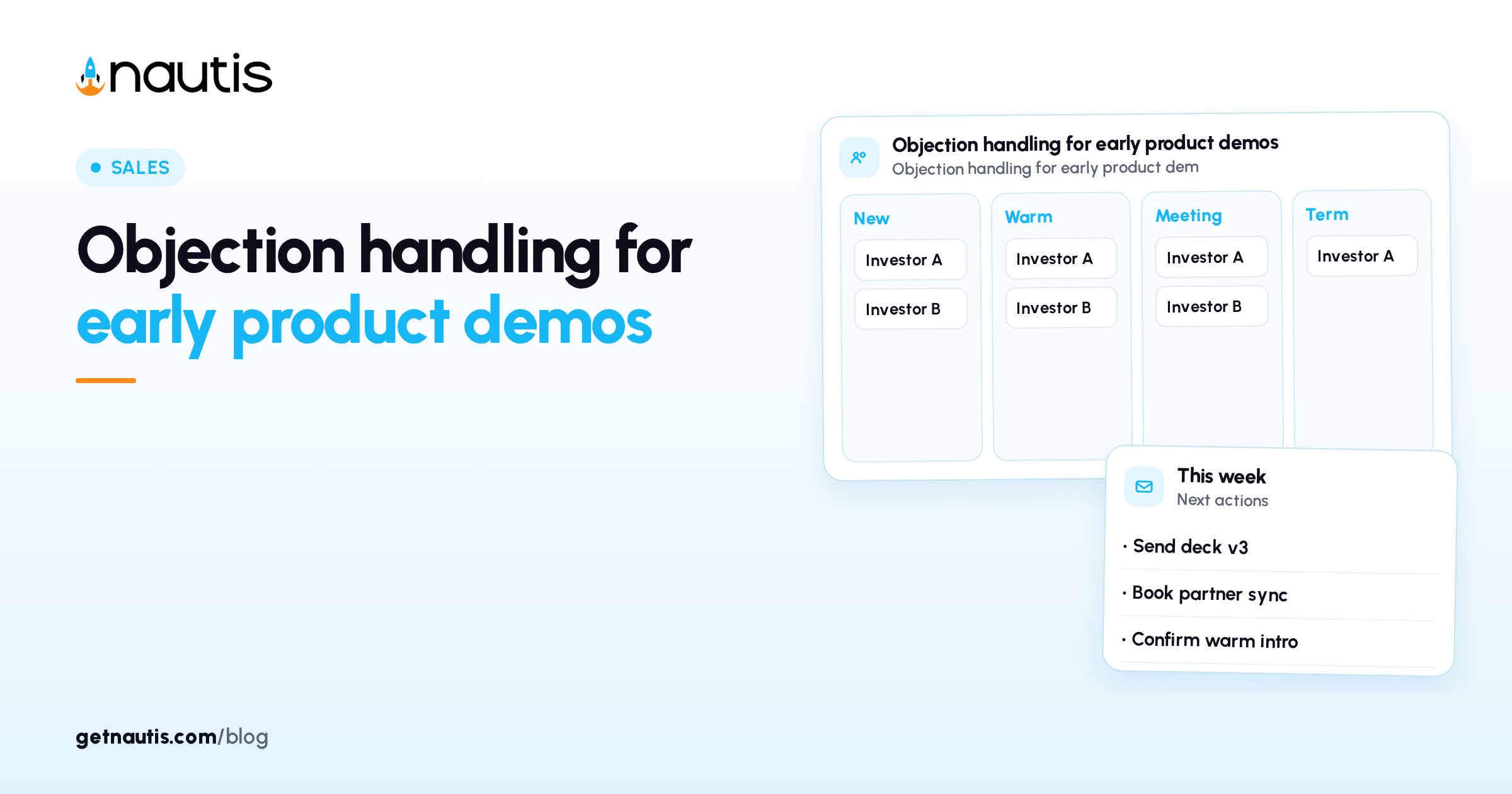
Objection handling for early product demos
 Baltej Singh9 min read
Objection handling for demos is the skill of hearing a pushback mid-session, naming the real block in plain words, answering in a short beat, and confirming what happens next. Early product demos invite skepticism about match, timing, security, price, and whether the company will still exist next year. Treat objections as information under a clock. Avoid treating them as a debate to win on the slide deck.
Objection handling for demos starts by naming the block
Most weak replies fail before the first sentence of the answer. The presenter guesses what the buyer meant and talks past the buyer.
Before you answer, sort the pushback into these four buckets:
Bucket | What you heard | Clarifying probe |
|---|---|---|
Clarity | They do not understand a claim | Which phrase confused them |
Match | Mismatched workflow or ICP | Which job they actually need done |
Risk | Fear of failure, lock-in, or compliance | Whose approval is required |
Priority | Interest without urgency | What else is competing for budget and calendar |
Say the bucket back in plain words: "It sounds like the risk is less about features and more about who has to approve a new vendor. Is that fair?" If the buyer corrects you, thank them and re-sort. Naming the block simply prevents the wrong speech.
That habit is the whole method: name the block, then answer in a short beat. You do not need a binder of clever comebacks. You need an accurate label and a single honest reply.
Keep a living log of real pushbacks
Keep a short log of the objections you actually hear on demos. Update it once the session ends. Skip inventing twenty clever comebacks for pushbacks nobody raises.
Objection (exact wording) | Bucket | One-beat reply | Proof to show | Who maintains |
|---|---|---|---|---|
"We already built something internal" | Match / risk | Find what breaks when the builder leaves | Migration path, time-to-first-value | Presenter |
"Come back when you have SOC" | Risk | Name what you do have and the review path | Security one-pager, counsel process | Presenter |
"This feels expensive for an early tool" | Priority / match | Tie list amount to the job and the alternative cost | ROI sketch with their numbers | Presenter |
Store the log in Notes or a shared table. For each demo, add a row if you heard something new. Retire rows that never recur.
Log the opportunity and follow-up in Leads CRM so objection patterns sit beside stage, not only in memory.
Answer in a short beat, then confirm
A strong reply has three parts and then a confirming question:
- Acknowledge without surrendering the meeting
- Answer with a concrete claim
- Offer proof or a follow-up artifact
- Finish with a confirming question
Example on list amount:
- Acknowledge: "Fair. Budget is real."
- Answer: "Teams replace a mix of sheets and contractor hours that usually costs more than this tier within a quarter."
- Proof: "If you share rough hours spent on the workflow today, we can sketch that with your numbers."
- Confirm: "Does that framing help, or is the blocker a hard cap this half?"
Avoid stacking five proof points. Listeners get lost and feel sold.
Phrases that make demos worse
- "No one else worries about that."
- "Our competitors are worse."
- "Just trust us."
- "We can be anything you need."
If you do not know, say so and date the follow-up. Invented compliance claims create legal and trust debt.
Map common early-product objections to moves
Objection theme | Sort for | Move |
|---|---|---|
"Not sure it fits our stack" | Clarity vs match | Diagram the integration surface; offer a thin pilot on a single system of record |
"We need a longer trial" | Risk vs priority | Learn what evidence would end the trial early; propose a dated success test |
"Founder-sold tools scare us" | Risk | Introduce the second operator, support path, and roadmap discipline |
"Can you discount?" | Priority | Trade scope or term for list amount; avoid silent endless discounts |
"Talk again next quarter" | Priority | Learn what changes next quarter; book a short checkpoint or release the deal |
Write your own third column. Generic SaaS rebuttals sound pasted.
Security and procurement pushbacks
If they raise certifications you do not have, never bluff. Share the current controls you can stand behind, the review process, and when you expect the milestone. Offer a security questionnaire slot with a named responder. Point people at public plan facts only when they are true; for plan and trial basics you can send them to pricing rather than improvising numbers live.
Timing pushbacks
"Next quarter" often means "not prioritized." Learn what initiative would have to slip for them to buy now. If nothing slips, you are in a nurture lane. Agree a lightweight stay-in-touch plan and stop over-demoing the same deck.
List-amount pushbacks without racing to zero
Separate ability to pay from willingness to pay. Ability problems need a smaller scope, a later start, or a polite no. Willingness problems need a sharper tie to outcomes and alternatives. Discounting before you know which one you face trains people to push again.
If you discount, trade for something: yearly prepay, a case study right, a tighter success definition, or removal of a custom request. Record the trade on the deal record.
Champion vs economic buyer pushbacks
Champions often raise match and clarity issues. Economic buyers raise risk and priority issues. If only the champion is on the demo, schedule a shorter second session for the buyer instead of pretending one reply serves both. Bring a brief summary, not a second full feature tour.
Competitive mentions
If they name another tool, learn which job that tool already covers well. Position against the job gap, not against the logo. Skip trashing rivals. Learn what switching cost they fear. Often the real bucket is risk, not feature envy.
Several stakeholders, several blocks
If three people each raise a different objection, write a tiny matrix: person, bucket, open question, artifact owed. Answer in parallel with dated follow-ups. A single epic email that tries to close every thread usually closes none.
Practice the awkward ones out loud
Objection handling for demos improves with reps, not with longer decks. Pick the three pushbacks that scare you. Rehearse naming the block and the short-beat reply until they sound like normal speech.
Useful drill:
- Partner throws one exact objection from last week's demos
- You name the bucket in a single sentence
- You deliver the reply beat in in less than a minute
- Partner flags hedges and overclaims
- You rewrite that log row before the day ends
If you use a voice practice tool, keep the goal as clarity and honesty, not theatrical polish. Nautis includes an AI voice coach for spoken reps when you want structured practice.
Close the loop after the demo
Write four lines before the day ends:
- Objection that mattered most
- Bucket you used
- Commitment you made
- Follow-up with date
If you promised a security note, send it when you said you would. Broken follow-ups teach buyers that your answers are unreliable; keep promises boring and on time.
Each week, skim several recent demos for repeated objections. If the same match issue appears four times, change the homework you do ahead of screen share. Packaging and positioning may be the fix, not a cleverer sentence.
When to stop the demo
If naming the block shows clear non-match, end politely. "It sounds like you need X, and we are built for Y. I would rather not waste your time." Pushing a bad-fit deal through objection handling for demos creates churn and ugly references.
Role of the second voice
On important demos, a second teammate can watch for missed buckets and capture exact phrases. The primary speaker stays with the buyer. Debrief briefly once the session ends. Avoid arguing with the buyer in a two-on-one pile-on.
Metrics that help without vanity
Track:
- Win rate when a risk objection appeared vs when none did
- Median time from first objection to follow-up confirmation
- How often promised artifacts ship inside the promised window
Ignore "number of objections crushed." That metric rewards talking.
Homework that prevents half the drama
Many demo objections are prep failures. If you walk in without stack, economic buyer, and success metric already clear, you will face match and clarity pushbacks that homework would have caught.
Demo length and objection density
A forty-minute demo that surfaces twelve objections is usually a discovery gap, not a reply skill gap. Cut the tour. Spend the first third proving you understand their job, then show the workflow that matches. Fewer random pushbacks leave room to handle the real ones well.
Screen-share mechanics under pressure
If a hard objection lands, stop clicking through the product for a moment. Face the camera, name the block, answer, then return to the workflow only if the confirming question says you should. Rapid clicking while talking signals anxiety and buries the reply.
Mute, chat, and late joiners
If a stakeholder joins late and raises an objection you already closed, avoid restarting the full tour. Restate the closed decision in a single sentence, then offer a two-minute recap after the main session. Chat-sidebar objections deserve a spoken summary so the room hears the answer once.
Hiring help later
If you hire a first seller, hand them the objection log, not an empty playbook. Have them add exact phrases for two weeks before they rewrite tone. Founders who skip that handoff watch new hires invent soft answers that reopen closed risk topics.
Whiteboard vs deck during a live objection
If the pushback is about process or architecture, a quick whiteboard (physical or digital) often works better than hunting for a buried architecture slide. Draw the two systems and the data flow. Invite them to correct the drawing. People soften when they co-author the picture.
Slide discipline during pushback
If an objection lands, resist jumping fifteen slides ahead to a buried appendix. Stay on a simple visual or a blank page and talk. Slide thrashing signals panic. Return to the agenda only after the confirming question.
Honest limits
You will lose deals on list amount, timing, and trust. Objection handling for demos raises the quality of the conversation and the clarity of the no. It never guarantees a yes. Keep the log, keep the practice, and keep the follow-ups.
YC's essential startup advice keeps returning to talking with users and learning quickly. Demo objections are user talk under commercial pressure. Treat them as data with a clock attached.
Frequently asked questions
What is the first step in objection handling for demos?
Name the block before you answer. Sort it as clarity, match, risk, or priority, say that label back to the buyer, and let them correct you if needed.
Should I prepare a script for every possible objection?
No. Keep a short log of objections you actually hear. Update it after demos and retire rows that never recur. Invented binders sound fake on the call.
How do I handle security certification objections if we are early?
Never bluff. Share the controls you have today, the review process, and a dated path. Offer a questionnaire slot with a named responder.
When should I end the demo after an objection?
End politely when naming the block shows clear non-fit. Pushing a bad-fit deal through clever replies creates churn and weak references.
Sources
- YC essential startup advice. Checked on November 1, 2026.
- Nautis Leads CRM help. Checked on November 1, 2026.
- Nautis Notes help. Checked on November 1, 2026.
- Nautis AI voice coach help. Checked on November 1, 2026.
Baltej Singh is a serial entrepreneur, technology leader, and Founder & CEO of Nautis and DemoVexa, with over 16 years of experience building software products, SaaS platforms, and startups. Previously the Co-Founder & CTO of SanchiConnect, he has worked extensively in the DeepTech startup ecosystem, connecting with 200+ venture capital firms and supporting a network of 4,000+ startups. Passionate about AI, automation, and entrepreneurship, he focuses on building innovative products that solve real-world problems and help businesses grow.