

Pre-seed vs seed funding: what changes
 Baltej Singh8 min read
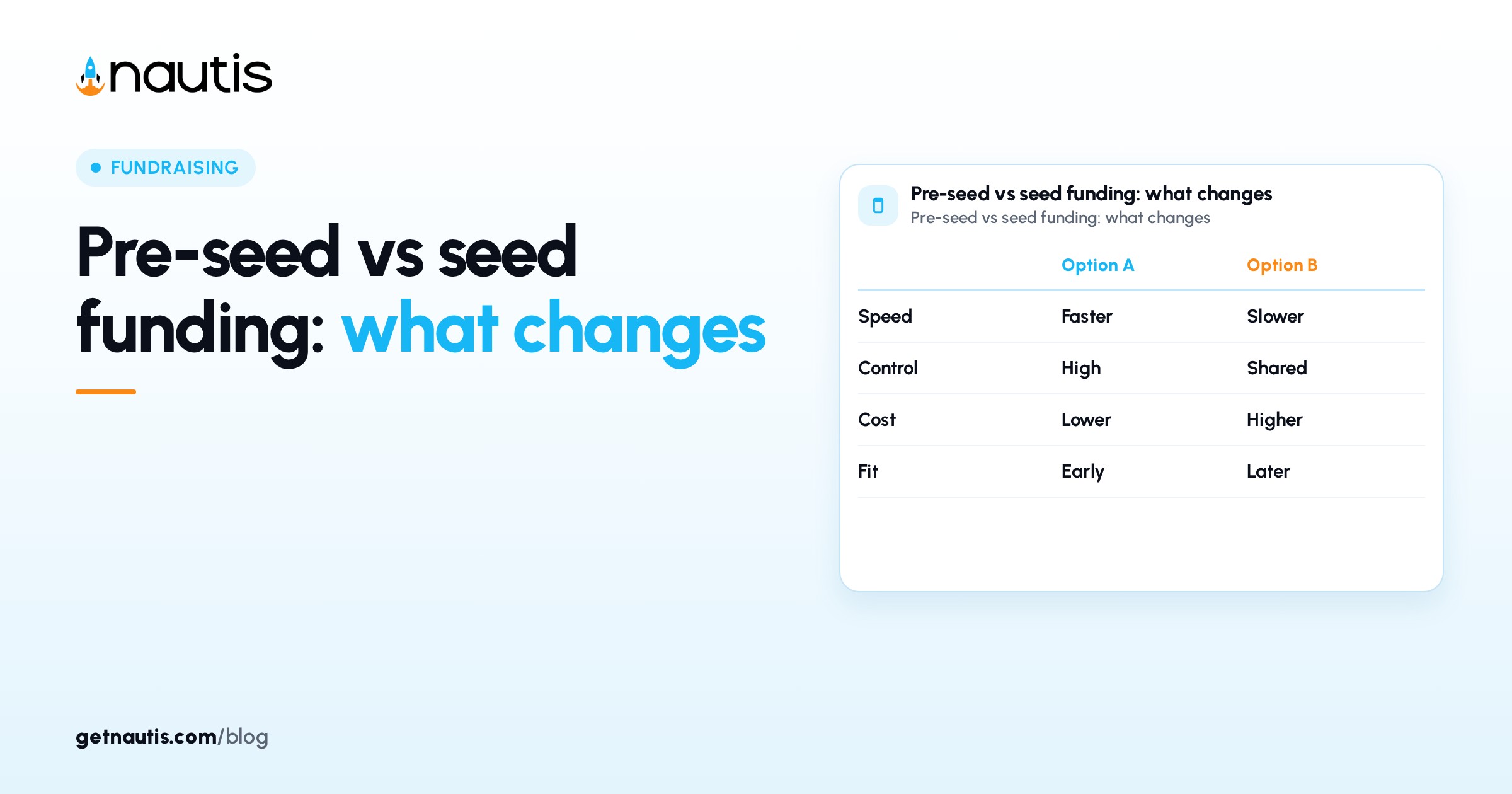
Pre-seed vs seed funding is less about the label on the email subject line and more about what you can prove. Pre-seed usually buys discovery: problem clarity, an early product, and enough runway to learn. Seed usually buys evidence: a working product, early adoption, and a plan to reach the next fundable milestone. Markets blur the names, so founders who only argue vocabulary waste weeks.
Y Combinator's seed fundraising guide still frames the first venture round as seed capital: raise enough to reach a major milestone (often twelve to eighteen months out), prefer clean instruments such as SAFEs or convertibles early on, and treat fundraising as a finite campaign so you can return to the product. This post uses that grounding, plus how practitioners now split an earlier "pre-seed" sleeve when the story is still mostly discovery. It is education, not a promise that any firm uses the words the same way.
Pre-seed vs seed funding: what actually changes
Three things move when you graduate the label.
- Proof bar. Pre-seed investors underwrite team, insight, and a believable learning plan. Seed investors still care about those, but they want adoption they can touch: users, revenue, retention shape, or design-partner intensity that looks like pull.
- Investor set. Friends and family, angels, and specialized pre-seed funds dominate the earlier sleeve. Seed adds more seed-focused funds and some traditional VCs who write early checks. Warm intros matter in both; cold spray works worse as the check size rises.
- Runway job. Pre-seed cash should buy experiments that create seed-ready proof. Seed cash should buy the milestone that makes Series A diligence possible. If the plan cannot name that milestone, the round name will not save you.
Amounts vary by market and year. Treat any "typical" range as a conversation starter with counsel and comparable founders, not as a law.
A comparison you can put beside the deck
Dimension | Pre-seed (common pattern) | Seed (common pattern) |
|---|---|---|
Primary job | Validate problem and early product | Show early traction toward product-market fit |
Proof investors expect | Insight, prototype or MVP, learning metrics | Working product plus adoption evidence |
Typical backers | Friends and family, angels, pre-seed specialists | Angels, seed funds, some early VCs |
Instruments often used | SAFEs or notes | SAFEs, notes, sometimes priced equity |
Dilution posture | Still early; keep terms clean | YC-style guidance often aims near 10 to 20 percent sold in the first venture round when possible |
Use of funds story | Build and test | Grow what already works |
Labels are marketing. The table is the diligence conversation.
When founders confuse the two rounds
Pitching a seed story with pre-seed proof creates stalled meetings. Partners hear Series-A-shaped ambition with discovery-stage evidence. Pitching a pre-seed story while you already have strong revenue can leave money on the table or attract the wrong lead.
Fix the mismatch before you widen outreach. Either lower the claimed stage and raise a smaller discovery round, or delay the raise until the proof matches the seed narrative. YC's when-to-raise advice is blunt: for most teams, investors want product and real adoption, not only a story. If you can raise without that, fine. If not, talk to users and ship.
Instruments and process stay similar; expectations do not
Early rounds in many ecosystems still prefer SAFEs or convertible notes over a full priced equity close. YC's guide notes that Silicon Valley seed rounds often use convertibles or safes, with equity as the heavier exception. That pattern shows up in pre-seed too. What changes is how hard investors push on traction slides, reference calls, and the credibility of the twelve to eighteen month plan.
Process hygiene stays the same across both labels: identical ask line, dated pipeline, same-day notes, and a bias toward closing once someone says yes. Organization is not optional because the ego hit of fundraising is real; the guide calls the path long and deflating for a reason.
How to choose which round you are actually raising
Answer four questions in writing:
- What proof exists today that a skeptical operator would believe?
- What milestone must this cash purchase, with a date?
- Which investor types have written similar checks for similar proof in the last year?
- If the raise slips ninety days, do we still have a company?
If proof is thin and the milestone is "find product-market fit," you are closer to pre-seed. If proof is early but real and the milestone is a concrete growth or readiness bar toward the next round, you are closer to seed. If you cannot answer question four, fix runway before you optimize the label.
Dilution and "how much" without fake precision
YC's seed guidance ties amount to a believable plan and warns against giving up more than you must: aiming near ten percent sold is wonderful when you can, many rounds land nearer twenty, and stretching past twenty-five is a caution flag. Those figures are planning heuristics from that guide, not a scoreboard for your ego. The useful question is whether the dollars buy the milestone with a buffer if hiring or sales slip.
Pre-seed amounts are often smaller because the milestone is learning, not scale. Raising a large seed-sized bag with pre-seed proof can create a valuation and expectation overhang that makes the next round harder. Raising a tiny pre-seed with a seed-sized plan can force a panic raise before evidence arrives. Match cash to the job.
Build two plans on one page: full raise and partial raise. YC suggests articulating success at both levels so investors see you will survive if the round is not maxed. That habit belongs in both pre-seed and seed conversations.
What to say when someone asks "are you seed or pre-seed?"
Answer with proof and milestone, then the label. "We have a closed beta with twelve design partners and are raising to reach X paid pilots in twelve months; we are calling that seed" is clearer than a taxonomy debate. If the listener uses different words, translate once and move on. Do not spend the meeting defending LinkedIn vocabulary.
If your market still uses only "seed" for the first institutional money, say that. The comparison still helps you avoid pitching growth metrics you do not have.
Bridge rounds and quiet extensions
Sometimes the honest move is neither a proud pre-seed nor a full seed: a small extension from existing supporters to finish a proof point. Call it what it is. Extensions that pretend to be a new stage without new proof confuse the cap table story later. Log them cleanly, keep instruments consistent with counsel, and write the milestone the bridge must buy before you spend it.
Where Nautis helps without renaming your round for you
Keep the commercial outline identical in every note. Fundraising CRM can hold stage, ask, and next steps so "pre-seed" and "seed" do not fork across inboxes.
Find Investors can filter by stage and check size when the Investors module is enabled, so you target angels and funds that match the proof you actually have.
Cap Table should model SAFE or note conversion before you quote ownership stories at either stage.
Two founder reads (examples)
Label matched to proof
Kit raised a small pre-seed on a SAFE to finish an MVP and run twenty customer interviews. Six months later, with paid pilots and a clear twelve-month seed plan, she opened a seed process with a different shortlist. Same company, different proof, different investor set.
Label theater
Omar called a first check a seed because the word sounded serious. The deck claimed growth while the product was still closed beta with eight users. Seed funds passed politely. He reframed as pre-seed, tightened the learning plan, and finished a smaller round with angels who underwrite discovery.
Mistakes that waste a month
- Using "seed" in outreach while the only proof is a prototype video
- Raising pre-seed sized cash with a Series A sized plan and no kill criteria
- Mixing SAFE terms across friends-and-family and institutional angels without counsel
- Optimizing valuation theater before you can explain the milestone the money buys
- Staying in fundraising mode after the round name was the only thing that changed
If two appear together, stop new intros for a week and rewrite the proof and ask line.
Same-week decision checklist
- Write the proof you have in five bullets with dates
- Write the milestone this raise must buy and the months of runway required
- Pick pre-seed or seed based on that match, not on LinkedIn fashion
- Draft one ask line: amount, instrument, timeline
- Build a shortlist for the investor set that matches the stage
- Confirm counsel on instrument and any friends-and-family sleeve
- Log every meeting in the CRM the same day
- Re-read the YC seed habits: raise to a milestone, keep terms clean, get back to building
Pre-seed vs seed funding debates end when the proof, the plan, and the investor list agree. Choose the name that matches the evidence, raise enough to buy the next real milestone, and treat the campaign as temporary so the product gets your calendar back.
Frequently asked questions
What is the difference in pre-seed vs seed funding?
Pre-seed usually funds discovery of problem and early product. Seed usually funds a working product with early traction and a plan to reach the next major milestone. Labels blur by market, so match the name to proof.
Do pre-seed and seed use different instruments?
Often both use SAFEs or convertible notes early, especially in ecosystems that follow YC-style seed practice. Priced equity is heavier and more common later. Confirm structure with counsel for your jurisdiction.
How much should we raise at seed?
YC-style guidance ties amount to a believable plan for roughly twelve to eighteen months to the next fundable milestone, with dilution often aimed near ten to twenty percent sold when possible. Build full and partial raise plans.
What if investors call our round a different name than we do?
Lead with proof and milestone, then translate the label once. Do not spend the meeting on taxonomy. Keep your CRM and ask line consistent internally.
Sources
- YC: A guide to seed fundraising. Checked on October 31, 2026.
- YC blog: A Guide to Seed Fundraising (Ralston). Checked on October 31, 2026.
- Nautis Fundraising CRM help. Checked on October 31, 2026.
Baltej Singh is a serial entrepreneur, technology leader, and Founder & CEO of Nautis and DemoVexa, with over 16 years of experience building software products, SaaS platforms, and startups. Previously the Co-Founder & CTO of SanchiConnect, he has worked extensively in the DeepTech startup ecosystem, connecting with 200+ venture capital firms and supporting a network of 4,000+ startups. Passionate about AI, automation, and entrepreneurship, he focuses on building innovative products that solve real-world problems and help businesses grow.


