Startup due diligence checklist for founders
 Baltej Singh8 min read
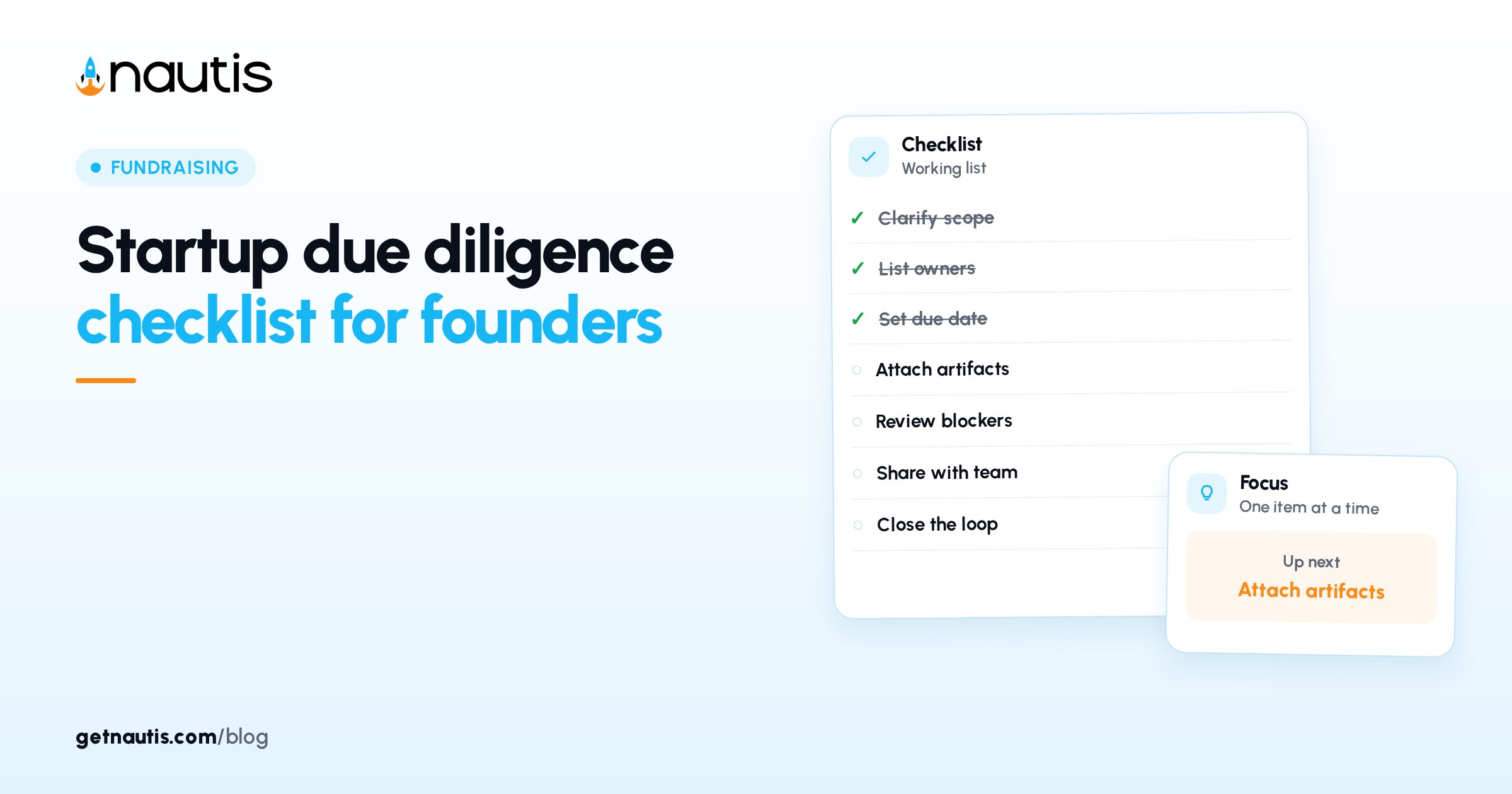
A startup due diligence checklist is the working list of documents, facts, and open questions you can defend when a serious investor starts digging. It is not a marketing folder. It is the map of what is true: ownership, money, contracts, people, product risk, and how you raise under an exemption pathway you actually understand.
This is general education for early founders preparing a seed or Series A process. It draws on public SEC small-business capital-raising resources as of October 2026, plus product help for readiness scoring and sharing docs. It is not legal, tax, or accounting advice. Counsel should review what you disclose and which offering pathway you use.
What a startup due diligence checklist is for
Diligence is how investors test whether the story in your deck matches the company's records. Your checklist should answer three jobs before the first partner request lands:
- What must be true and findable in writing
- Who owns each answer on your team
- What is still missing, stale, or redacted on purpose
If you only build the list after a term sheet conversation, you will invent file names under pressure and ship conflicting numbers. Build it while fundraising mode is still a calendar decision, not a fire drill.
Core categories founders should track
Category | Examples investors often ask for | Owner on your side |
|---|---|---|
Corporate | Charter, bylaws, board consents, good standing | CEO or counsel |
Ownership | Cap table, option plan, SAFEs or notes, side letters | CEO + counsel |
Financial | Actuals, bank balances, burn, model, tax filings status | Finance lead |
Commercial | Top contracts, pipeline proof, churn or retention notes | CEO or GTM lead |
People | Key employment or contractor agreements, IP assignment | CEO + counsel |
Product and tech | Architecture summary, security basics, major dependencies | CTO |
Legal and compliance | Litigation, licenses, privacy posture, offering pathway notes | Counsel |
Keep one row per item with status: ready, draft, missing, or not applicable. "Not applicable" needs a reason, not a shrug.
Corporate and ownership before the money talk deepens
Investors will reconcile who owns what. Export a current cap table, list every outstanding SAFE or convertible note with amount and key terms, and gather option plan documents. If two spreadsheets disagree, stop outreach until they match. Diligence hates surprise dilution more than it hates a thin early metric.
Board minutes and major consents belong on the list even when the company is small. Missing formalities are fixable; discovering them in a partner email is expensive.
Financial truth that matches the deck
Pick one source of cash and burn truth. Recent actuals, a simple runway view, and a model that uses the same definitions as the deck are enough for many early processes. If Startup Health or your books disagree with the pitch, the pitch loses. Date every export.
Do not paste "projected" revenue next to "actual" without labels. Partners read for traps. Your checklist should force a label on every number that leaves the company.
Contracts, customers, and proof
List the contracts that matter: top customers, critical vendors, and anything with exclusivity, most-favored pricing, or change-of-control drama. Redact personal data before sharing. Keep a private index of what was redacted so you can answer follow-ups without guessing.
Pipeline proof should match Fundraising CRM or sales CRM stages you actually use. Soft verbal interest is not a contract. Put verbal items in a notes column, not in committed revenue.
Keep customer names consistent across deck, CRM, and contract index. If a legal entity name differs from the brand name, put both on the checklist row once and reuse that pair everywhere.
People, IP, and product risk
Confirm IP assignment for founders and anyone who wrote core code. Flag contractors without clear assignment. Note key-person risk honestly. On product, prepare a short architecture and security summary you can stand behind; do not claim certifications you do not have.
If a dependency could stop the company (a single cloud account, a single vendor API), write it down. Diligence finds single points of failure whether you volunteer them or not.
Offering pathway sits beside the document list
SEC small-business capital-raising materials walk through funding options, exempt offerings, and building blocks for private raises. Your checklist should include a line for "which pathway counsel says we are using" and "what we may say publicly." A tidy data room does not replace that conversation. Treat pathway notes as internal until counsel says otherwise.
How to run the checklist during an active process
Assign one founder as diligence lead. Log every investor request the same day: who asked, what they asked, what you sent, and what remains open. Track nos and soft yeses so the pipeline stays honest while files fly.
Share staged access. Early conversations get overview docs. Deeper diligence gets contracts and full financials under clearer sharing rules. Do not dump payroll details into a link you sent for a first call.
When two investors ask the same question, reuse the approved answer. Inventing a second explanation mid-process is how stories fork.
Where Nautis helps without doing diligence for you
Nautis does not replace counsel or your auditor. It helps you see readiness and keep files and investor asks organized.
Investor Readiness scores whether pitch, data room, financials, traction, pipeline, team story, and round terms look ready for the round you claim, then ranks gaps into an action plan. It is read-only across other modules.
Data Rooms give you secure spaces with files, folders, sharing rules, and an activity log so you can share labeled packs instead of inbox attachments.
Set Shared Access so only the teammates who should edit the room can open it. When you upload a file that already exists in the same folder, choose keep both, replace, or skip instead of silently creating "final_v7". Use tags and Advanced Search by tag, type, or date when the pack grows past a screenful. The activity log shows who opened or downloaded what after you send an investor link, which is how you notice a stale deck still circulating.
Fundraising CRM keeps each investor as a deal inside a named round with notes and next steps so diligence requests do not live only in someone's head.
Cap Table tracks stakeholders and ownership scenarios you will need when partners reconcile paper.
Two checklist habits (examples)
Living list
Asha maintained a twenty-row checklist with owners and dates for six weeks before outreach. When a partner asked for contracts, she sent the redacted pack the same afternoon. Diligence stayed on the product conversation instead of on missing signatures.
Inbox archaeology
Ken promised "whatever you need" on a first call, then spent nine days hunting versions across email. Two partners received different burn figures. He paused new meetings, rebuilt one checklist with a single finance export, and restarted with matching numbers.
Neither scene predicts your round. They show why a startup due diligence checklist is an operating habit, not a PDF you design the night before.
Mistakes that make diligence louder
- Shipping a deck number that no export can reproduce
- Leaving SAFE amounts off the ownership list
- Sharing personal data in contracts without redaction
- Letting three co-founders answer the same question differently
- Treating "we will raise under some exemption" as a finished legal plan
- Uploading every private Slack export because someone said "everything"
- Closing the checklist after the first wire and ignoring post-close asks
If two appear together, pause new data room links for forty-eight hours and reconcile the source of truth.
After the first partner request
Expect follow-ups that were not on your original list. Add them as new rows instead of answering only in chat. Each new row needs an owner and a due date. If the same partner asks twice, your logging failed; fix the log before you send a third version of the file.
Keep a private "known issues" note for counsel: unsigned IP assignment, messy contractor history, or a customer concentration story. Surfacing issues with a plan beats discovery without context. Do not put that private note in the shared room.
Timing relative to fundraising mode
Build the checklist before you declare fundraising mode. During mode, update statuses weekly and freeze shared packs between major edits. After you stop raising, archive the room versions you sent so next round starts from history, not folklore.
Same-week build for a usable checklist
- Create one table with category, item, owner, status, and link
- Export cap table and list every convertible instrument
- Pull dated financial actuals that match the deck definitions
- Index top contracts and mark redaction needs
- Confirm IP assignment status for founders and core builders
- Write the offering-pathway conversation with counsel on the calendar
- Stage overview versus deep-dive packs in the data room
- Assign the diligence lead and a same-day logging rule for asks
A startup due diligence checklist earns its keep when every serious ask maps to a named owner and a dated file. Keep the story and the records identical, and let partners spend their time on judgment, not on hunting PDFs.
If an investor asks for something you do not have, say missing and give a date. Silence reads worse than a short gap with an owner.
Frequently asked questions
What belongs on a startup due diligence checklist?
Corporate records, ownership and convertibles, financial actuals and model, key contracts, people and IP assignments, product or security summaries, and a note on your offering pathway with counsel. Each row needs an owner and a status.
When should founders build the diligence checklist?
Before you declare fundraising mode. Building under a live partner request creates conflicting versions. Update weekly during the raise and freeze shared packs between major edits.
Is a data room the same as a diligence checklist?
No. The checklist is the work plan with owners and gaps. The data room is how you share labeled files with access rules. You need both: the list tells you what is missing; the room holds what is ready.
Does a tidy checklist replace securities counsel?
No. SEC small-business resources explain pathways at a high level, but your counsel should confirm what you may disclose and which exemption you rely on. The checklist only tracks that the conversation happened.
Sources
- SEC: Resources for Small Businesses (capital raising). Checked on October 31, 2026.
- Nautis Investor Readiness help. Checked on October 31, 2026.
- Nautis Data Rooms help. Checked on October 31, 2026.
Baltej Singh is a serial entrepreneur, technology leader, and Founder & CEO of Nautis and DemoVexa, with over 16 years of experience building software products, SaaS platforms, and startups. Previously the Co-Founder & CTO of SanchiConnect, he has worked extensively in the DeepTech startup ecosystem, connecting with 200+ venture capital firms and supporting a network of 4,000+ startups. Passionate about AI, automation, and entrepreneurship, he focuses on building innovative products that solve real-world problems and help businesses grow.