How to store founder facts with AI trust labels
 Baltej Singh8 min read
AI memory trust labels are how lasting company facts stay separated from guesses, expired notes, and personal preferences that are not policy. If an agent stores "we always discount 20 percent" without a source, next month's briefing can treat a rumor as a rule. This post shows how to store founder facts so Chief of Staff Memory stays something you can inspect, correct, and export. It sticks to documented Nautis behaviors in Liftoff Review, Memory, Approvals, and Learning Engine. It is operating guidance, not a claim that memory replaces judgment.
AI memory trust labels and verified memory
On the marketing site, Nautis describes corrections becoming memory with a trust label. In the product help, the concrete gate is verified memory: during Set up your Chief of Staff (Liftoff) (checked 31 Oct 2026), Review shows each detail with a source (Website, Deck, Online, or You). You edit with the pencil, tick team and products carefully, mark public profiles Yes or Not us, remove untrue lines under What your Chief of Staff will remember, then click Looks right. What you confirm becomes verified memory for your Chief of Staff.
That sequence is the first AI memory trust labels habit: nothing becomes durable company truth until a human accepts the source. Untick demo-page numbers. Mark Not us on search hits that are not your company. Verified memory is sticky by design; cleaning later is harder than cleaning once.
Fact classes to store on purpose
Help does not replace your judgment about what belongs in Memory. Use this operator table so teammates apply the same bar even when the UI only shows facts and commitments as a bucket.
Fact class | Store when | Required companion | Do not treat as |
|---|---|---|---|
Verified company truth | Source checked in Liftoff or a system of record | Source label or URL; Looks right or explicit correction | Marketing fluff from a demo page |
Working hypothesis | Team is testing it this quarter | Owner name + review date in the fact text | Permanent policy |
Time-bound metric | Number can drift (ARR, runway, headcount) | As-of date in the sentence | Evergreen truth |
Personal preference | Founder taste, not company rule | Marked as preference in the sentence | Default for the whole team |
Write the fact in one sentence. Include the source or as-of date in that sentence when the number can move. If the fact can move money, hiring, or investor messaging, do not leave it unlabeled in a chat thread that never reaches Memory.
Reject agent-suggested facts that arrive without a source you can open. If Chat invents a customer segment or a raise amount, correct Memory explicitly rather than arguing in the thread and moving on. The next Briefing will reuse whatever Memory still holds. AI memory trust labels only work if the human write-path is stricter than the model speak-path.
Where facts live in Chief of Staff
Open Chief of Staff (checked 31 Oct 2026), then Memory. Help describes Memory as company brief, narrative, facts and commitments you can inspect, correct, and export. Treat it as inspectable company knowledge, not a hidden prompt dump. Correct errors when you see them. Export when you need a backup before a major repositioning.
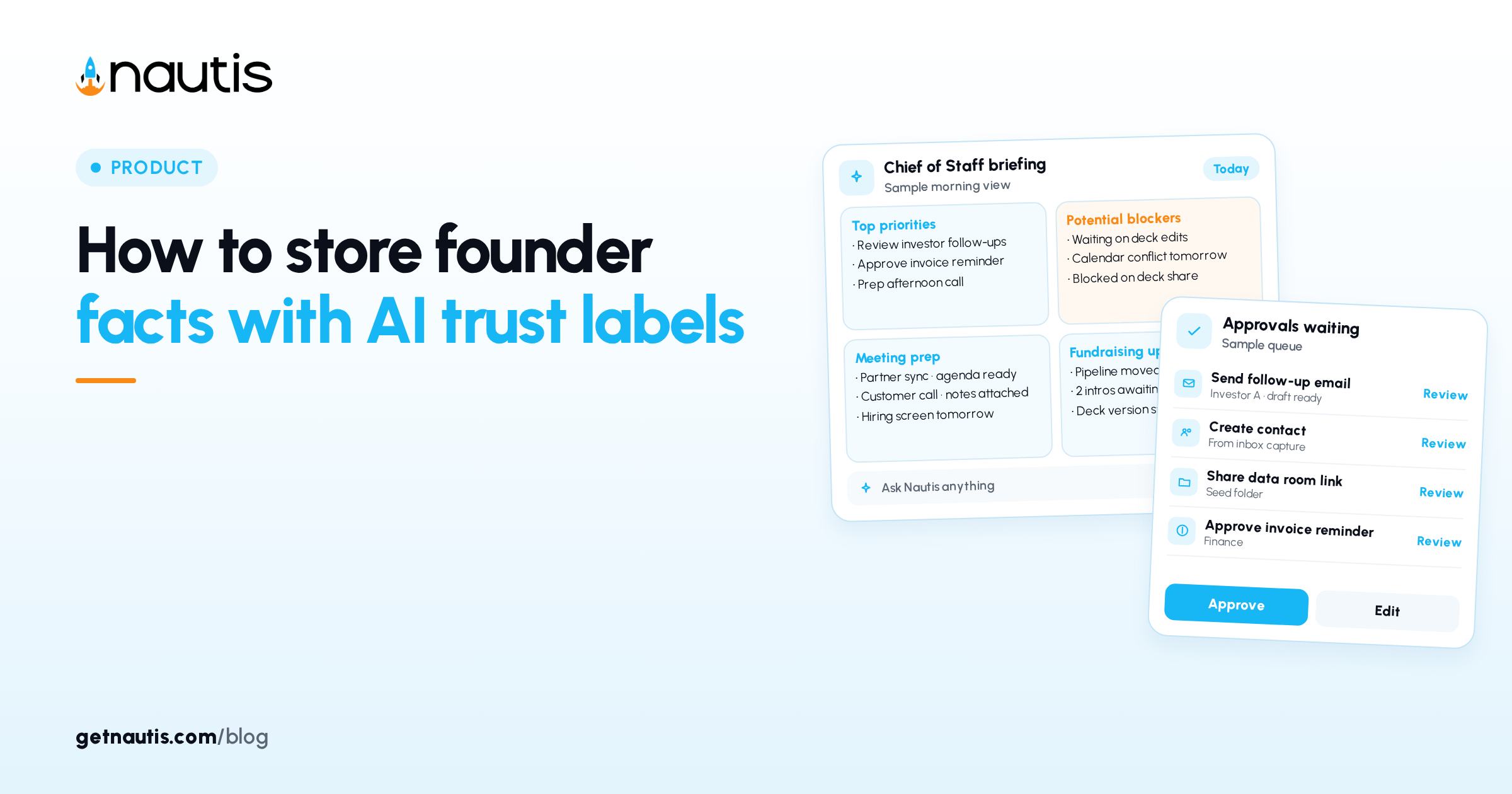
Chat and Briefing will reuse what Memory holds. Wrong facts produce wrong answers and misranked Priorities. When Briefing surfaces a stale claim, fix Memory the same day instead of arguing with the chat. Ask Commodore on a briefing item when you need context, but still correct the underlying fact if the source of truth moved. Briefing items group into Priorities, Blockers, Approvals, Pipeline, Today, and Runway. Done, snooze, and dismiss teach what matters; they do not fix a false fact underneath. If Runway is wrong because Memory still has last quarter's cash story, change Memory, then Refresh Briefing.
Owners and Admins can shape tomorrow's briefing with Priorities sliders (Revenue at risk, Runway & burn, Deals & fundraising, Team health, Marketing & brand, Everything else). Those weights amplify whatever Memory and live modules believe. Garbage facts get louder when you raise Deals & fundraising to Top of mind.
Liftoff Review as the first filter
Liftoff is the short owner-only setup: Your startup, Your tools, Review, Meet your Chief of Staff. Review is where AI memory trust labels become real. Each detail shows Website, Deck, Online, or You. Under Found online, Yes keeps a profile; Not us drops it. Under What your Chief of Staff will remember, delete lines that are not true. Looks right commits verified memory.
Nothing is ever sent or booked without your approval in that flow. Every email your Chief of Staff wants to send shows a preview you can edit first. Memory setup is not permission to auto-send.
If you closed Liftoff with Finish later, the dashboard card says Finish setting up your Chief of Staff. Continue until Looks right is done. Empty or half-reviewed memory makes Chief of Staff feel like a chatbot with better typography.
Illustrative weekly memory audit (composite only)
The routine below is a composite illustrative example, not a real company log.
Illustrative thirty-minute Monday audit: Open Memory. Export a copy. Scan facts and commitments for numbers without as-of dates. Correct one stale runway or ARR line. Open Approvals and clear or schedule every pending card so automation does not pile up unread. Skim AI Activity for Auto-ran and Approved rows that touched customer or investor channels. If Learning Engine proposed a source-linked recommendation, open the source record before you Accept.
Illustrative failure mode to avoid: saving Slack opinions into Memory as if they were verified memory, then wondering why Briefing argues with the deck. The fix is not a smarter model. The fix is Looks right discipline and same-day corrections.
Learning Engine is not a second rumor mill
Learning Engine (checked 31 Oct 2026) is institutional memory from finished work with real results. It proposes source-linked recommendations and, per help, never makes an unsourced claim. Browse events and recommendations with read permission; Update permission is needed to accept or reject recommendations and record realized outcomes. Everything stays scoped to your organization.
Use Learning Engine for lessons tied to records. Use Chief of Staff Memory for the brief, narrative, facts, and commitments the agents should reuse daily. Do not paste unsourced chat speculation into either place. AI memory trust labels fail when "someone said in standup" becomes a stored rule without a link. Accept a recommendation only after you open the linked record and agree the lesson still applies. Reject recommendations that cite finished work from a strategy you abandoned. Record realized outcomes when you have Update permission so the engine stays honest about what actually happened inside your organization, never someone else's.
Approvals and autonomy still sit beside memory
Clear Approvals the same day so automation does not pile up unread. Owners and Admins set Agent Autonomy to Ask every time or Run without asking; AI Copilot deletes stays Always asks. A correct Memory with reckless autonomy is still a risk. A gated autonomy with rotten Memory produces polite wrong answers. Fix both.
For a systems contrast between blank chat and governed company context, see AI chief of staff vs assistant. Keep Memory hygiene on the same weekly cadence as Approvals review so trust labels and pending cards do not rot on alternate weeks.
What to refuse to store
Refuse absolute policy language without a board or founder decision record. Refuse competitor gossip. Refuse fundraising amounts that are still soft circles. Refuse "always" and "never" discounts unless Pricing owns them in a dated note. Refuse personal health or interpersonal conflict details that do not belong in company Memory.
If Chat drafts a crisp sentence that fails those tests, edit the draft for a one-off email if you must, but do not promote it into facts and commitments. AI memory trust labels are as much about exclusion as about storage. The smallest honest Memory beats a large speculative one.
Team rules that keep labels honest
Name who may click Looks right and who may edit Memory facts. On many teams only the workspace owner finishes Liftoff, but later corrections need a written rule so two co-founders do not overwrite each other. Prefer one sentence facts. Prefer sources you can open in one click. Prefer deleting a bad fact over leaving a sarcastic correction that models will misread.
When traction moves, update Memory the same day you update the deck. Silent drift is how two drafts disagree in one afternoon. When a hypothesis dies, rewrite or remove it; do not hope Briefing forgets.
Keep a short shared note titled Memory owners: who finishes Liftoff Review, who may edit facts, and which metrics must carry as-of dates (ARR, runway months, headcount, open pipeline). Review that note when a new admin joins. New admins with Agent Autonomy access and stale Memory are a common incident pattern.
Export Memory before a major repositioning, a fundraise kickoff, or a brand rewrite. After the rewrite, re-open Memory and delete facts that describe the old story. Looks right at Liftoff time does not forever bless every line if the company changed.
AI memory trust labels, practiced this way, turn Remembers from a slogan into an audit trail: verified memory from Liftoff, inspectable facts in Memory, source-linked lessons in Learning Engine, and Approvals that still require a human before the outside world changes.
Frequently asked questions
What are AI memory trust labels in Nautis?
Marketing describes memory with a trust label. In product help, the concrete gate is verified memory after Liftoff Review: each detail shows a source, you fix errors, mark Not us on wrong profiles, and click Looks right. Memory then stays inspectable, correctable, and exportable.
Where do I edit company facts later?
Open Chief of Staff, then Memory. Help describes company brief, narrative, facts and commitments you can inspect, correct, and export. Fix stale numbers the same day traction or runway changes.
How does Learning Engine relate to Memory?
Learning Engine stores lessons from finished work as source-linked recommendations and does not make unsourced claims. Memory holds the daily brief and facts agents reuse. Keep unsourced standup opinions out of both.
Who should click Looks right?
Liftoff is for the workspace owner. Write a team rule for who may edit Memory afterward so co-founders do not overwrite facts without a source or as-of date.
Sources
- Nautis Set up your Chief of Staff (Liftoff). Checked on October 31, 2026.
- Nautis Chief of Staff. Checked on October 31, 2026.
- Nautis Learning Engine. Checked on October 31, 2026.
Baltej Singh is a serial entrepreneur, technology leader, and Founder & CEO of Nautis and DemoVexa, with over 16 years of experience building software products, SaaS platforms, and startups. Previously the Co-Founder & CTO of SanchiConnect, he has worked extensively in the DeepTech startup ecosystem, connecting with 200+ venture capital firms and supporting a network of 4,000+ startups. Passionate about AI, automation, and entrepreneurship, he focuses on building innovative products that solve real-world problems and help businesses grow.