How to audit your startup software subscriptions
 Baltej Singh9 min read
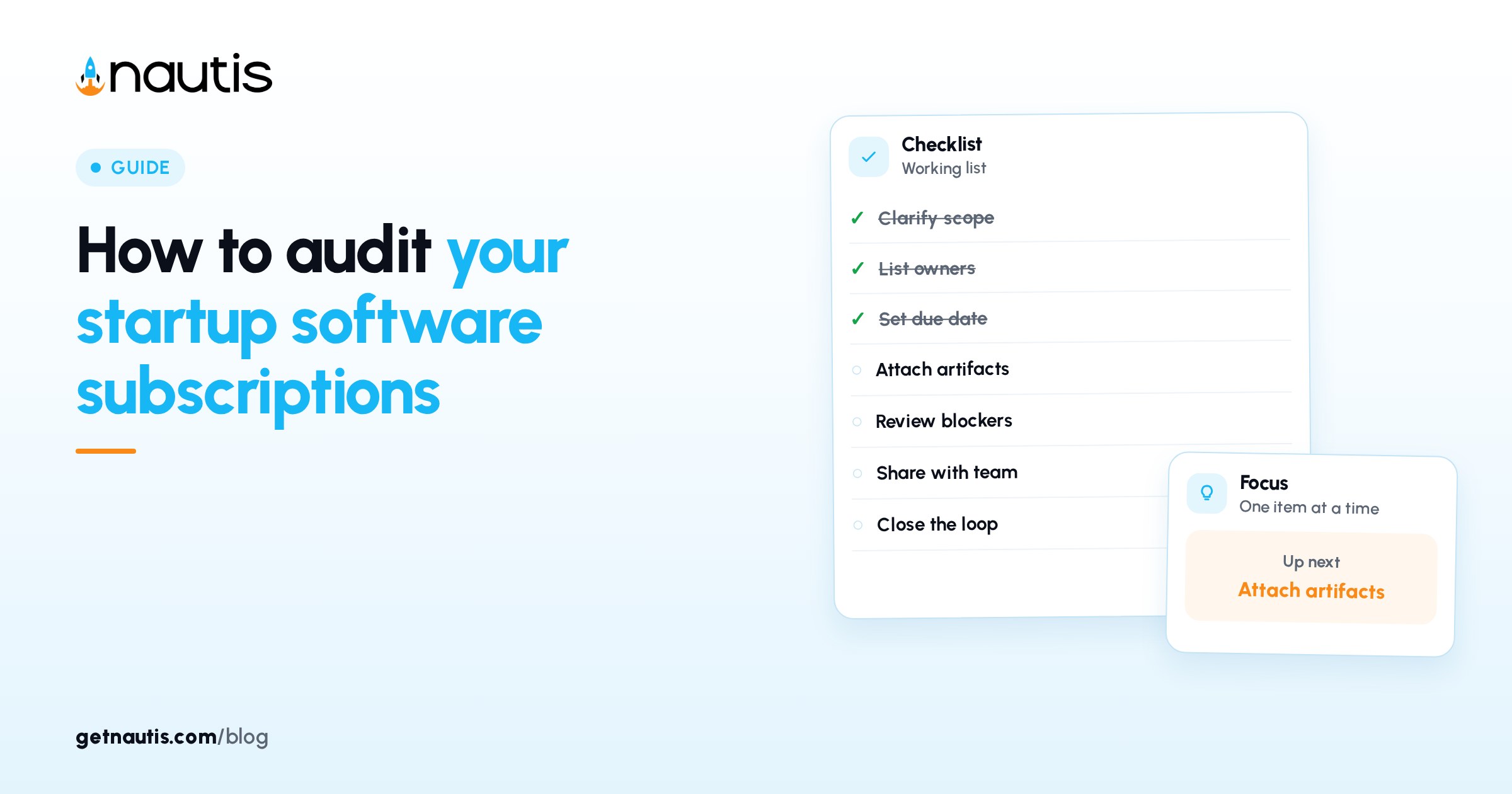
Recurring software charges quietly multiply after every hire wave, AI trial, and "just for this project" card swipe. How to audit your startup software subscriptions is a spend-and-usage pass: list what you pay for, who still uses it, when it renews, and whether to keep, downgrade, or discontinue - with dates.
This is not a browser cleanup day and not a redesign of which system owns each company object. It is a quarterly look at subscription money and evidence of use.
Why audit startup software subscriptions on a schedule
Card statements lag tribal knowledge. Someone cancels a project and the seat remains. An annual plan renews while the team has moved on. Without a dated inventory, finance argues from memory and founders argue from loyalty to logos.
YC's early-company advice favors focus over sprawl (Y Combinator Library, checked 1 Nov 2026). A subscription audit is that focus applied to recurring spend.
Run it about every ninety days, plus after fundraising or a sharp headcount change when new apps tend to appear.
Build a complete subscription inventory
Create a sheet with a row per recurring charge. Useful columns: product name, purpose in six words, monthly equivalent cost, seats or licenses, renewal date, last clear use, owner, disposition, due date.
Pull evidence from bank/card exports and invoice history. Include domains, plugins, AI add-ons, and agencies billed like software. Add your own Billing and plans seats and AI credits usage so Nautis is reviewed with the same skepticism as everything else.
Track the working table in Sheets. Store shared passwords and cancel codes in Credentials Vault so discontinuation does not depend on a single laptop.
Example numbers for illustration only: fourteen recurring products, five under an example $25/mo, three with no login in thirty days, two annual renewals inside three weeks. The inventory makes those facts visible before opinions start.
Read cost, seats, and renewals before opinions
Sort by monthly equivalent cost descending. Divide annual contracts by twelve. Highlight anything renewing inside thirty days.
For each row ask:
- Is there a named accountable person who will vouch for last month's value?
- Do paid seats exceed people who actually signed in?
- Would discontinuing before renewal save real cash without breaking a required workflow?
Dispositions that work:
- Retain when purpose and usage are clear and cost is acceptable
- Downgrade when seats, storage, or AI tiers exceed active use
- Discontinue when nobody can show recent value
Every Downgrade or Discontinue needs a due date in the sheet. A disposition absent a date is a wish. When you downgrade, note what you removed so the next quarter does not silently re-buy it.
Example illustration only: cutting four idle seats saves an example $80/mo only if onboarding does not re-invite them next week. Add a sheet note that re-invites need approval.
Judge usage without turning the meeting into a redesign
Usage evidence beats nostalgia. Ask for last-login proof, an export, or a weekly artifact the product produces. "We might need it later" becomes a review-by date inside ninety days, not an open Retain.
If two products claim the same purpose, flag the duplicate spend. You do not need to finish a full systems map in this meeting. You need to stop paying twice until a later consolidation pass. Sequence matters: score spend first; redesign systems with the systems consolidation playbook after the money decisions are dated.
Attention sinks still matter as cost context. A low-priced subscription that forces daily noise while outcomes stay flat is a candidate to discontinue even when the line item looks small. Count forced weekly logins and alert channels that nobody owns. Keep the discussion tied to spend and usage, not to a day-in-the-life browser story.
Hold a short decide meeting and execute the same week
Invite row holders, not the whole company. Walk cost-sorted rows. Speak Retain, Downgrade, or Discontinue with a due date. Type dispositions into Sheets during the meeting.
Rules that keep the hour honest:
- No Retain without a named human responsible for proving value
- Slipped due dates from last quarter come first on the agenda
- New purchases pause until dated Discontinue rows are cleared
- Timebox each row to about two minutes; if ownership is unclear, default to Discontinue with a fourteen-day due date while someone produces use evidence
Same week: discontinue in vendor admins, remove unused secrets from Credentials Vault, and apply seat downgrades before the next invoice. Publish the sheet where the team already reads weekly notes.
Ignore sunk-cost stories. Prior training does not erase ongoing spend. If legal or security blocks a discontinuation, log the blocker and a next checkpoint date instead of converting the row into an undated Retain.
Weight cost higher than anecdotes. Example weighting for illustration only: monthly equivalent cost 50%, seat waste 30%, renewal urgency 20%. A cheap product renewing tomorrow with zero seats used still deserves a Discontinue vote. Write the weights at the top of the sheet so the room does not invent a new scoring religion mid-argument.
Sample a working week before the meeting. Each owner pastes last-login or export proof for their top three spend rows. Live memory understates idle seats. Proof turns the conversation from brand preference into arithmetic.
Document purchase reason in a single line when known. Reasons that no longer match the six-word purpose are a smell. Example illustration only: bought for "board dashboards," now used as a single person's private habit. spend without a company job.
After the meeting, keep a ninety-day "do not rebuy" list naming the purpose that tempted the purchase and the substitute you will use. Without that list, the next demo recreates last quarter's charges under a new logo.
Do not optimize the sheet into a product. About ten columns is enough. Teams that add fifteen scoring dimensions never finish the hour. The audit succeeds when dispositions have dates, not when the spreadsheet wins an aesthetics contest.
When two products share a purpose, score them as a pair for duplicate spend. Independent rows hide the double charge. Example illustration only: CRM A medium cost, notes product B low cost; as a pair they fail because customer truth is split and you pay twice. Pair scoring changes the disposition talk and still avoid requiring a full architecture redesign in the same hour.
Rehearse a shorter thirty-minute mid-quarter pass if spend is climbing: only the top five cost rows and renewals inside thirty days. The full quarterly inventory remains the source of truth.
Separate "nice dashboard" from "required for close." Example illustration only: a reporting product that nobody opens during month-end close is optional spend even if the charts look polished in demos. Tie Retain votes to a workflow that already happens on the calendar.
Price increases deserve their own flag. If a renewal quote jumps more than an example 15% if it lacks matching usage growth, require a Retain re-justification in the sheet before auto-renew. Sticker shock is easier to act on thirty days early than on the invoice date.
Currency and seats sold in packs confuse monthly equivalent math. Normalize everything to a single currency and a monthly figure in the sheet. Mixed annual and monthly rows without normalization make the sort lie.
For AI credits billed on top of a seat, list the credit line as its own row when the amount is material. Bundling variable usage under a "platform" label hides the fastest-growing charge.
Founders sometimes exempt "engineering picks." Exempt nothing from the inventory. Engineering can still Retain after the row is scored; invisibility is the failure mode.
If two co-founders disagree on a Discontinue, still pick a due date for evidence. Open-ended disagreement is how idle licenses survive another quarter. Fourteen days of proof or the charge stops.
Map each retained line to a budget category finance already uses (G&A software, R&D software, GTM software). Category tags make the next board cash discussion faster and stop "misc SaaS" from becoming a junk drawer.
For prepaid annual deals, compute remaining prepaid months after a mid-term Discontinue. Sometimes the rational move is stop using the product and avoid expansion packs while the prepaid period burns down. Write that nuance in the disposition note so nobody mistakes "stop using" for "we forgot to cancel the contract."
Procurement email aliases deserve a check. Old aliases that still receive renewal notices are how zombie charges restart. Route renewals to a monitored alias listed on the sheet header.
If your accountant already categorizes software in the GL, reconcile the sheet totals to that GL software bucket once per audit. Mismatch larger than an example 10% means the inventory is incomplete. Fix the inventory before debating individual logos.
Close the loop and schedule the next audit
Export or snapshot the scored sheet after the meeting so history cannot be rewritten casually. Schedule the next subscription audit about ninety days out.
Optional mid-quarter thirty-minute pass: re-score only the top five cash rows and any renewal inside thirty days. The full quarterly inventory stays the source of truth.
Write a three-bullet note after discontinuations: what stopped, what to use instead, where secrets moved. Silence creates shadow workarounds that recreate spend under a new logo.
Bring last quarter's due dates into the room printed or filtered at the top of the sheet. Any Discontinue that slipped is the first agenda item. Habitual slippage is how subscription spend returns after a clean week.
Photograph or export the sheet after dispositions land. The artifact is a dated spend record, not a mood. Teams that skip the snapshot re-litigate the same logos next quarter.
If a product is annual-only and renews inside thirty days, treat renew as a forced choice: Retain with a named accountable person or Discontinue before the charge posts. Waiting until the charge clears turns the audit into archaeology.
FAQ
How often should I audit startup software subscriptions?
About every ninety days, plus after fundraising or a sharp headcount change when new recurring products tend to appear.
What should a software subscription audit include?
Every recurring charge you can find: SaaS, AI add-ons, domains, plugins, and software-like agency fees, with cost, seats, renewal date, owner, usage evidence, and a dated disposition.
Retain, downgrade, or discontinue: how do I choose?
Retain when purpose and recent use are clear. Downgrade when capacity exceeds active people. Discontinue when nobody can show last-month value, especially before a renewal.
Where do I track this in Nautis?
Use Sheets for the inventory, Credentials Vault for shared secrets, and Billing and plans when you review Nautis spend itself.
Frequently asked questions
How often should I audit startup software subscriptions?
About every ninety days, plus after fundraising or a sharp headcount change when new recurring products tend to appear.
What should a software subscription audit include?
Every recurring charge you can find, with cost, seats, renewal date, owner, usage evidence, and a dated disposition.
Retain, downgrade, or discontinue: how do I choose?
Retain when purpose and recent use are clear. Downgrade when capacity exceeds active people. Discontinue when nobody can show last-month value, especially before a renewal.
Where do I track this in Nautis?
Use Sheets for the inventory, Credentials Vault for shared secrets, and Billing and plans when you review Nautis spend itself.
Sources
- Y Combinator Library, Essential startup advice. Checked on November 1, 2026.
- Nautis, Tool Consolidation Playbook. Checked on November 1, 2026.
Baltej Singh is a serial entrepreneur, technology leader, and Founder & CEO of Nautis and DemoVexa, with over 16 years of experience building software products, SaaS platforms, and startups. Previously the Co-Founder & CTO of SanchiConnect, he has worked extensively in the DeepTech startup ecosystem, connecting with 200+ venture capital firms and supporting a network of 4,000+ startups. Passionate about AI, automation, and entrepreneurship, he focuses on building innovative products that solve real-world problems and help businesses grow.