Contractor vs employee checklist for startups
 Baltej Singh9 min read
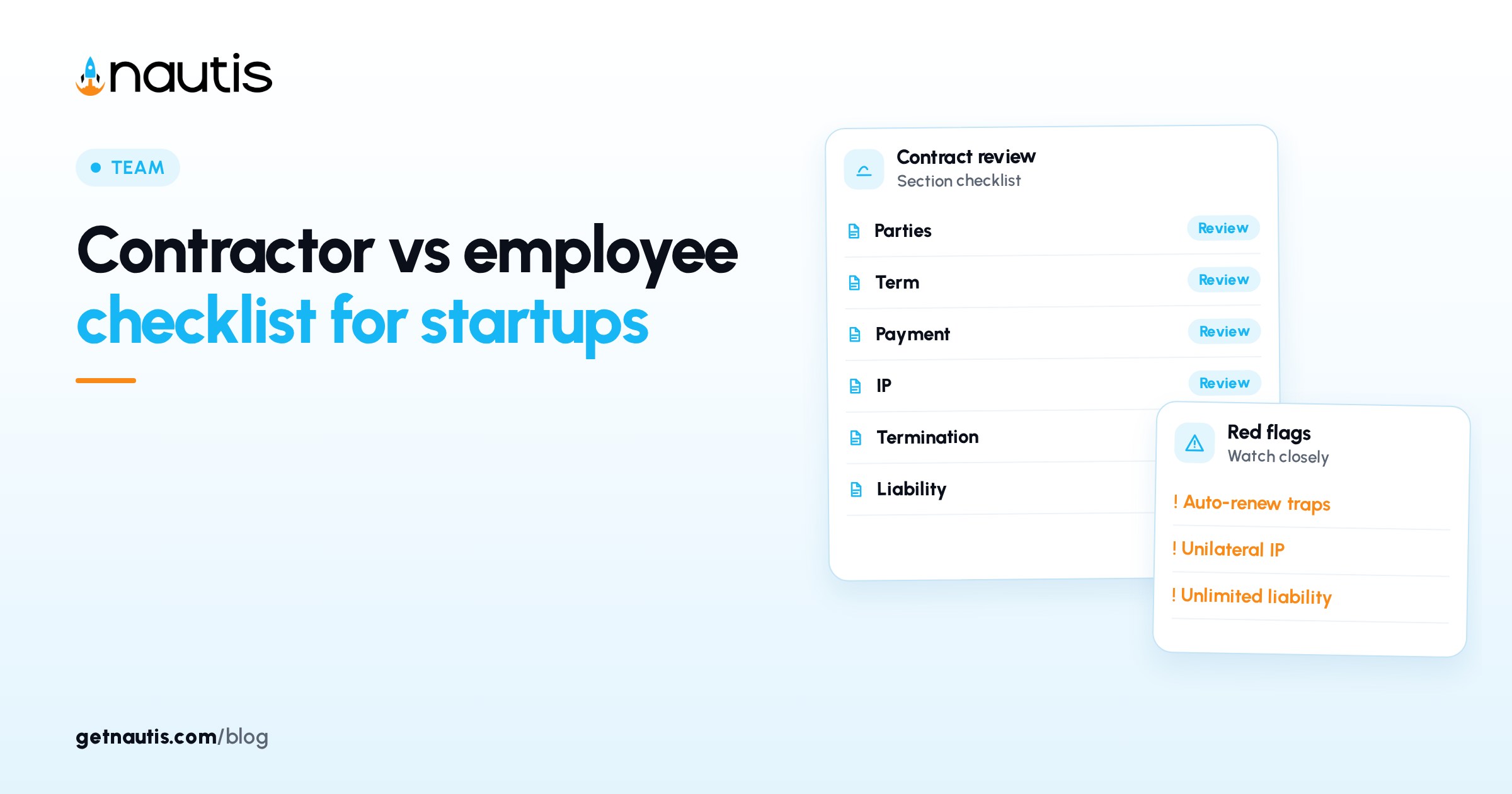
Contractor vs employee is the status call every early startup makes before the first signature. Get it wrong and you inherit tax, benefits, and control problems. Get it right and the paperwork matches how the work actually runs.
This checklist is for founders hiring in the United States. It is not legal or tax advice. Check classification, withholdings, and filings with a qualified attorney and a CPA or other tax professional who knows your facts. When the facts are mixed, pause hiring and, if needed, use IRS Form SS-8 rather than guessing from a Slack thread (IRS, About Form SS-8, checkedOn 2026-11-01).
Why contractor vs employee matters on day one
Employees generally require income tax withholding plus Social Security and Medicare taxes, the employer match, and unemployment tax. Independent contractors generally do not trigger those same withholdings on payments you make to them (IRS, Independent contractor or employee, checkedOn 2026-11-01).
Labeling someone a contractor does not settle status. The IRS looks at the substance of the relationship, including whether you have the right to control what is done and how it is done, even if the person works remotely or part time (IRS, Employee common-law employee, checkedOn 2026-11-01).
Illustrative miss (composite only): a "contractor" engineer on a six-month full-time Slack schedule, company laptop, and standups; paid on invoices; no W-2; later reclassified risk after a funding diligence pass.
Illustrative win (composite only): a specialist paid per delivered milestone, own tools, own hours within a deadline, written SOW, and a clear end date; employee headcount reserved for core product owners.
SBA guidance on hiring and managing employees stresses planning roles and compliance early, not after the person is already embedded (SBA, Hire and manage employees, checkedOn 2026-11-01).
Build the classification step into your hiring checklist before you debate salary. Status drives taxes, tools, management, and which agreement template you open.
What the IRS weighs when status is unclear
Facts fall into three common-law categories. No single factor decides the outcome. Document the factors you used (IRS, Independent contractor or employee, checkedOn 2026-11-01).
Category | Questions to answer in writing | Tips toward employee | Tips toward contractor |
|---|---|---|---|
Behavioral control | Who directs what work is done and how? | You set methods, hours, tools, and detailed process | They control methods; you buy a result or deliverable |
Financial control | Who pays expenses and provides tools? How is pay set? | You reimburse expenses, provide equipment, pay a wage or salary | They invest in their own tools, can profit or lose, invoice by project |
Type of relationship | Benefits, contracts, permanence, and how central the work is | Benefits, ongoing relationship, work is a key part of the business | Written project contract, finite engagement, work is not the core permanent role |
Illustrative write-up (composite only): one page listing the three categories for a design engagement; behavioral and financial lean contractor; relationship is a twelve-week brand project; file saved with the SOW.
If the picture stays unclear after you hire the same kind of worker repeatedly, Form SS-8 (Determination of Worker Status for Purposes of Federal Employment Taxes and Income Tax Withholding) lets the business or the worker ask the IRS for a determination. The IRS notes that a determination can take at least six months (IRS, Independent contractor or employee; IRS, About Form SS-8, checkedOn 2026-11-01).
Remote work does not create contractor status by itself. If you can control what will be done and how, common-law employee rules can still apply (IRS, Independent contractor or employee, checkedOn 2026-11-01).
Signals that point toward employee status
Under the IRS common-law categories, employee status gets more likely when you have the right to control what is done and how it is done, when you control business aspects of the job, and when the relationship looks like ongoing employment with benefits or key permanent work (IRS, Independent contractor or employee; IRS, Employee common-law employee, checkedOn 2026-11-01).
Behavioral signals that often point toward employee status include set hours on your calendar, managers assigning daily tasks and methods, and required use of your tools and processes. Financial signals include expense reimbursement, company-provided equipment, and wage or salary style pay rather than project invoices with a chance of profit or loss. Relationship signals include employee-type benefits, an open-ended engagement, and work that is a key aspect of the business (IRS, Independent contractor or employee, checkedOn 2026-11-01).
Paying on invoices alone does not outweigh those signals. A worker's preference for contractor status also does not decide the IRS analysis by itself.
Illustrative pattern (composite only): salespeople with territory quotas, mandatory CRM fields, set hours, and paid time-off language in an offer email. Those facts line up with employee status even if invoices are used.
If you need a short trial of fit, use a scoped paid project with real independence or an employment arrangement your counsel approves. Do not use contractor paperwork to describe a job you already manage day to day.
Equity talk, benefits talk, and open-ended "you are part of the team" language strengthen the relationship category toward employee. Keep true contractor language tied to deliverables, acceptance criteria, and end dates.
How to choose before you send paper
Write the role outcome first. If the person must follow your internal playbook all day and sit in your management chain, plan for employee status. If you need a bounded deliverable with their methods and tools, contractor status may fit.
Check budget for the true cost of an employee (taxes, tools, management time) versus a contractor rate that already prices risk and downtime.
Illustrative choice (composite only): core backend owner becomes a full-time employee offer; a three-week migration script is a contractor SOW with acceptance tests.
Do not mix statuses for the same work pattern. Relief from employment taxes in some cases requires consistent treatment and filing history; misclassification without a reasonable basis can leave you liable for employment taxes (IRS, Independent contractor or employee, checkedOn 2026-11-01). Treat consistency as a design constraint, not a slogan.
When in doubt, pause the start date. A week with counsel and a CPA or tax professional is cheaper than a reclassification scramble during diligence.
Share the three-category write-up with the hiring manager before the offer goes out. If they cannot defend the behavioral row, change the status or change how the work will be managed.
Put the role type where hiring actually happens
Once you choose, record it in the same system you use to hire so the label matches the pipeline.
In Nautis, open Jobs & Recruitment from Human Resources. On the jobs dashboard, create a posting and set employment type to Full time, Part time, Contract, Internship, or the matching option for the role. Fill Basic Information, Job Description, Number of Positions, Experience Level, location type, skills, and salary fields as needed. Publish when ready, or save to finish later. Candidates can apply from your public careers page without a Nautis account.
Illustrative job (composite only): title "Contract data migration specialist"; type Contract; deadline in three weeks; description lists deliverables and tools the contractor provides.
Move applications through your stages (including interview and offer). When someone accepts an employee offer and you mark them hired, Nautis can offer Convert to employee so their details go into HR Management. Keep true contractors on contract paperwork and payments that match contractor treatment; do not convert someone you still treat as an independent business.
Anyone with Jobs permissions can manage postings; read-only members can browse but cannot post roles or change candidate stages.
Use AI draft for the job description only after the status decision is fixed. A polished Contract posting that describes a full-time managed role creates evidence against you.
When counsel and paperwork must lead
Use written agreements that match the status you chose. Contractor packets usually need scope, deliverables, payment terms, IP assignment for work product, and confidentiality. Employee packets need the employment terms your counsel recommends for your state, plus tax and eligibility forms.
Federal common-law rules are only part of the picture. Other rules where your workers live or work may also apply. This guide does not map those rules. Ask a qualified attorney and a CPA or tax professional before you lock status, especially for multi-state teams.
Illustrative packet (composite only): contractor SOW plus IP and confidentiality exhibits; employee offer with start date, role, at-will language where applicable, and a first-week checklist owned by People ops.
If you already misclassified someone and want a path forward, the IRS Voluntary Classification Settlement Program (VCSP) is an optional way for eligible taxpayers to reclassify workers for future periods with partial relief from federal employment taxes. It has eligibility rules and uses Form 8952 (IRS, Independent contractor or employee, checkedOn 2026-11-01). Do not treat VCSP as a DIY substitute for advice from counsel and a tax professional.
Workers who believe they were misclassified may have their own filing options, including Form 8919 in some cases (IRS, Independent contractor or employee, checkedOn 2026-11-01). Your job as a founder is to classify carefully up front with professional advice so you are not arguing about history later.
Revisit status when the work changes
Status is not a forever sticker. A three-month contractor who becomes your only full-time support owner on your schedule needs a fresh determination. Expand the SOW without updating status and you recreate the illustrative miss above.
Set a calendar reminder at the contract midpoint and two weeks before renewal. Rerun the three-category table against how the person actually works, not how you hoped they would work.
If the person has no other clients, uses only your tools, and takes daily tasking, you are describing an employee in contractor clothing. Fix it on paper before the next invoice.
Illustrative revisit (composite only): midpoint review shows daily standups, company laptop, and no other clients; founders convert to an employee offer with a clean start date instead of renewing the SOW.
Measure success by whether a diligence folder can show the written factor analysis, the matching agreement, and the matching job type in Jobs & Recruitment. Silence in that folder is a risk signal.
Keep one owner for classification calls (often the CEO or a People lead) so Slack does not invent a new rule per hire.
Train interviewers not to promise benefits, titles, or hours that contradict the chosen status. Oral promises become facts in a dispute even when the PDF says contractor.
Broader product docs sit in the Help Center. Plan limits for hiring modules appear in-product; see pricing for plan context.
Frequently asked questions
What is the contractor vs employee test for US startups?
The IRS common-law focus is degree of control and independence across behavioral control, financial control, and type of relationship. Weigh all factors and document them; no single factor decides alone.
Does paying by invoice make someone a contractor?
No. Payment method is only one financial clue. Daily direction, company tools, and ongoing key work can still point to employee status.
What if we are still unsure?
Pause the start date, talk to counsel, and consider Form SS-8 for an IRS determination if the same pattern keeps recurring.
How should we record the choice in Nautis?
In Jobs & Recruitment, set employment type on the posting (for example Full time or Contract) so candidates and your team see the same status you intend to hire.
Sources
- IRS, Independent contractor (self-employed) or employee?. Checked on November 1, 2026.
- IRS, Employee (common-law employee). Checked on November 1, 2026.
- IRS, About Form SS-8. Checked on November 1, 2026.
- SBA, Hire and manage employees. Checked on November 1, 2026.
- Nautis Help Center, Jobs & Recruitment. Checked on November 1, 2026.
Baltej Singh is a serial entrepreneur, technology leader, and Founder & CEO of Nautis and DemoVexa, with over 16 years of experience building software products, SaaS platforms, and startups. Previously the Co-Founder & CTO of SanchiConnect, he has worked extensively in the DeepTech startup ecosystem, connecting with 200+ venture capital firms and supporting a network of 4,000+ startups. Passionate about AI, automation, and entrepreneurship, he focuses on building innovative products that solve real-world problems and help businesses grow.