A startup standup meeting format that stays short
 Baltej Singh9 min read
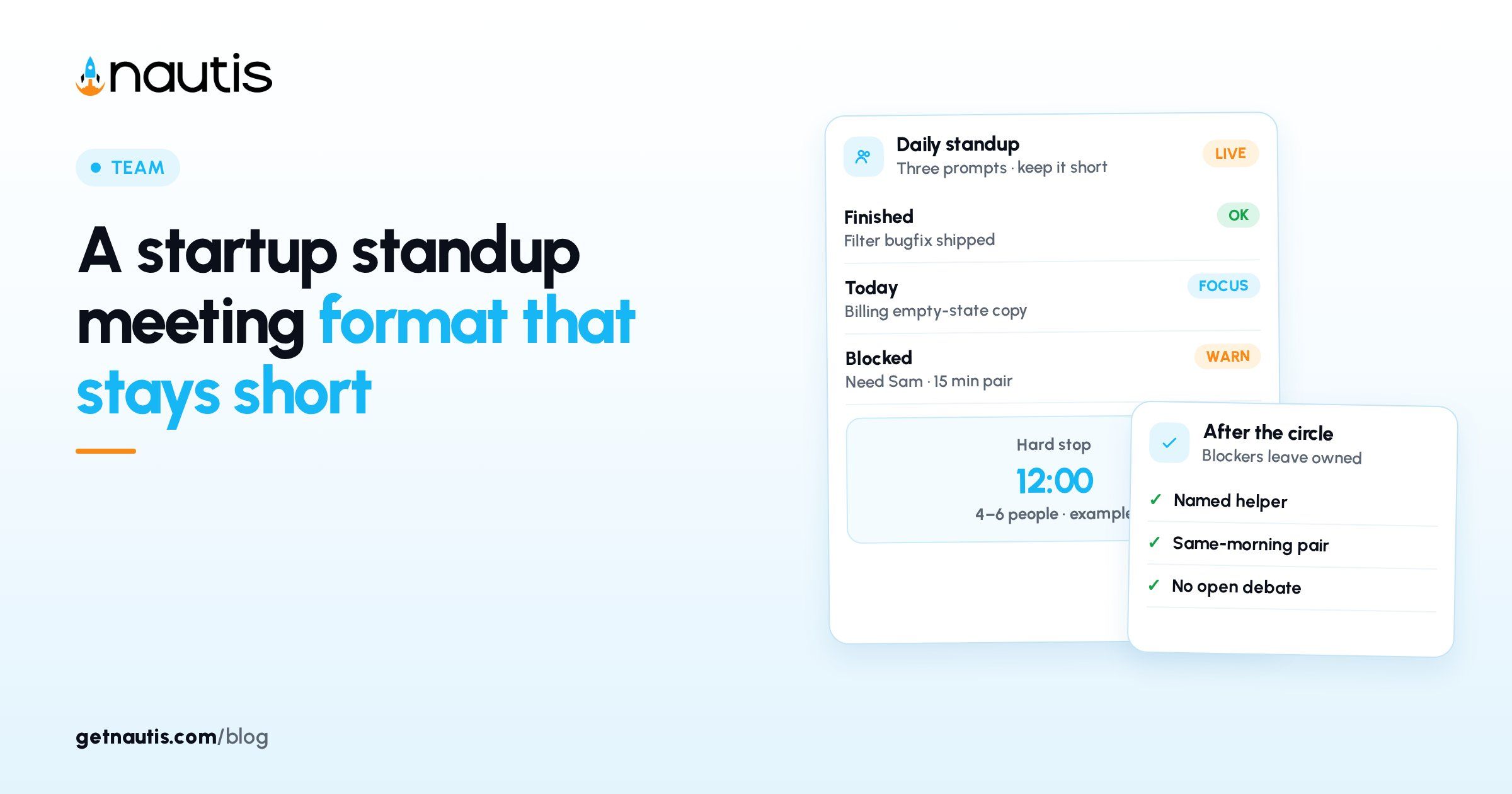
A startup standup meeting format that stays short is a fixed daily sync with three prompts, a visible clock, and a rule that problem-solving leaves the circle. Each person names one finished deliverable, one focus for today, and any snag that needs a helper. The call ends when the last person finishes, not when someone opens a design debate.
Early teams lose the habit when the circle becomes a second planning meeting. Write the rules once, put them in the invite, and refuse to expand the agenda because one day felt quiet. A short sync that surfaces stuck work is useful. A daily ceremony that restates hopes is waste.
This post gives you a working script you can run tomorrow. Use it even if you never open a product for meetings. Where Nautis appears, it is one place to put the invite, the format note, and the follow-up tasks.
Why early teams need a fixed standup script
Without a written script, every standup becomes a personality contest. The loudest person expands their update. The quiet person compresses real blockers into "I'm fine." Founders fill silence with roadmap talk. Fifteen minutes becomes thirty, and strong people start "protecting deep work" by skipping.
A fixed script protects the clock and the shy. It also makes the ritual transferable. When a founder is out, a teammate can still run the same prompts without inventing a new meeting culture that morning.
Y Combinator's essential startup advice library keeps pushing focus and talking to users over process theater. Treat the standup the same way: keep only the parts that change what people do before lunch. Drop slides, metrics dumps, and open discussion. Those belong in a weekly room or a pairing, not in the daily circle. For the weekly pattern, see how to run a weekly team meeting.
Case (example): Priya's five-person product team met at 9:40 for four weeks without a written format. Median length hit twenty-two minutes. After they pasted a three-prompt script into the invite and rotated a timekeeper, median length fell to eleven minutes across the next three weeks (example figures for illustration). The content of the work did not change. The contract did.
The three prompts that keep a startup standup meeting format honest
Atlassian's public standup guidance still centers on three questions: what you finished, what you will do next, and what is blocking you. GitLab's Scrum tutorial uses the same shape and adds a hard rule: if a topic needs more than a status update, postpone it and break out after the sync. Keep that skeleton. Do not invent a fourth prompt that invites storytelling.
Phrase the prompts so they force specifics:
- Finished: one deliverable a teammate could find without asking you (pull request, shipped change, closed ticket, completed call notes).
- Today: one primary focus, not a grocery list of intentions.
- Blocked: the snag plus the helper you need, or "none."
"Working on the dashboard" fails prompt two. "Ship the filter bugfix for the billing page" passes. "Waiting on design" fails prompt three. "Blocked on final copy for the empty state; need Sam for fifteen minutes after this" passes.
Walk in knowing your three lines. Atlassian notes that people who prepare keep energy high and everyone engaged. Unprepared people fill air with narrative while others wait. A sticky note or a filtered board view is enough prep. An essay is not.
If someone has nothing finished and nothing blocked, they still speak. Silence is data: either the work is invisible, or the person is stuck without naming it. Both need a light follow-up after the circle, not a public interrogation.
Time budgets by team size
Agree the length before the first person talks. Most early groups fit in eight to fifteen minutes. A visible countdown beats a polite hope that people will self-edit. Paste budgets into the recurring invite so new joiners do not learn the ritual by osmosis.
Headcount | Hard stop | Per-person budget | After-call rule |
|---|---|---|---|
2 to 3 | 8 minutes | About 90 seconds | Stay only if both must unblock |
4 to 6 | 12 minutes | 90 to 120 seconds | Side pairings after the sync |
7 to 9 | 15 minutes | 90 seconds, enforced | No open debate in the circle |
Split time zones | 12 to 15 minutes | Same budgets on video | Everyone joins solo on their laptop |
These budgets are example defaults, not industry benchmarks. Adjust once, write the new numbers down, and stop renegotiating them daily.
Start on time even if one person is late. Restarting for late arrivals teaches the group that the clock is optional. Hand the countdown to a non-founder for a full week so the ritual does not depend on one personality. Rotate that role.
When more than nine people share one daily goal, split into two syncs by workstream rather than stretching the original. One oversized circle is how the format collapses into a status theater nobody trusts.
What to park outside the circle
The standup is for shared awareness and named helpers. It is not for design reviews, hiring debates, pricing changes, or performance feedback. Say the parking lot out loud when someone starts a two-person rabbit hole. Schedule the follow-up immediately after adjournment instead of hijacking the remaining agenda.
Park these topics by default:
- Architecture choices that need a whiteboard
- Roadmap edits that change more than today's focus
- Customer escalations that need a thread with evidence
- Personal workload complaints that belong in a one-to-one
- Metrics deep dives that do not change today's plan
If a blocker needs the whole group, that is a signal that decision rights are fuzzy. Clarify who decides what outside the daily sync so the circle does not become the only place politics get resolved. Decision rights on small teams is the longer pattern for that.
Founders sometimes use standup as a personal briefing dump. Save personal triage for a private pass. Bring only the company-level asks. The room is not your inbox aloud.
Running the same standup on video and in writing
Colocated teams can stand in a circle. Distributed teams should treat every person as remote: each person joins from their own laptop so side conversations do not freeze out people on the call. Atlassian recommends that leveling rule for distributed ceremonies. Reference a shared board while people speak so updates point at work items, not vibes.
Written syncs fit thin overlap across time zones. Each person posts by a fixed local deadline. Helpers get an @name tag the same morning. A rotating scanner replies once with the open helper list. That scan replaces the live circle; it is not a second call.
GitLab documents an asynchronous option: a single standup issue or channel thread where people answer the three prompts in comments. Keep written posts tiny: three bullets, links to pull requests or docs, no essays. If a conversation is needed, book a pairing instead of dumping a memo into the thread.
Hybrid trap to avoid: five people in a conference room and three on a speakerphone. Remote voices lose body language and get talked over. If anyone is remote, everyone is remote for that fifteen minutes.
Colocated groups sometimes use a physical cue to start on time. Distributed groups get more from a five-minute calendar ping and a pinned format note. Pick the cheapest cue that starts the clock.
Turning blockers into owned tasks the same morning
A standup that ends without helpers is theater. Before anyone leaves, read the blocker list aloud. Each snag gets a named helper and a next step, even if the next step is "pair for ten minutes after this." Capture that list where the team already tracks work.
In Nautis, put follow-ups on Task boards with an assignee and a due date the same day. Keep the format contract itself in Notes so the prompts do not live only in someone's head. For the recurring invite, open Meetings, use New Meeting, set a short Duration, add Team Members as attendees, and paste the three prompts plus the hard stop into the Description. Use Availability Schedules and Event Types for external booking pages, not for this internal huddle.
If meeting notes tend to vanish into chat, turn the helper list into owned tasks before people stand up from their chairs, even when the notes are three lines on a whiteboard.
Cap post-sync pairings at fifteen minutes unless the two people explicitly extend. Pairings that always eat the next hour mean the daily circle is doing the wrong job, or the prompts are too vague to surface the real snag.
How often to revisit the format
Track two numbers for six weeks: median length, and share of snags that left with a helper the same day. If median length creeps past fifteen minutes, cut speaking budgets or the invite list. If helpers stay blank, the ritual is failing even when it ends on time.
Revisit the format every six weeks with two questions only: Did we finish on time? Did stuck work get helpers the same day? Change the clock, the roster, or the prompts. Do not add slides.
Stop the daily sync entirely when the team is two people who already sit next to each other and unblock in the hallway. Restart it when a third person joins, when remote work appears, or when the same snag surprises people two days in a row. Frequency is a tool, not a badge.
Pair the daily circle with a weekly review that handles outcomes and kill criteria. The standup is for today. The weekly pass is for whether the week still matches the plan.
A short startup standup meeting format is a contract with your calendar. Write the prompts, enforce the clock, name the helpers, and leave. Everything else can wait for a smaller room.
Frequently asked questions
How long should a startup standup meeting last?
Most early teams should hard-stop between eight and fifteen minutes. Two or three people often finish in about eight minutes. Groups of four to six usually need about twelve. Never let the circle become a planning meeting; move deep topics into a pairing after the sync.
What three questions should people answer in standup?
Say what you finished that a teammate can find without asking, what one focus you own today, and what is blocking you plus who can help. Keep each answer to about ninety seconds. If a topic needs more than a status update, break out after the call.
Should remote startups do live or written standups?
Use a live video sync when the team shares a workable overlap window. Use a written thread with a fixed local deadline when time zones are thin. In both cases keep the same three prompts and require named helpers the same morning.
How is a daily standup different from a weekly team meeting?
The daily standup is for shared awareness and same-day blockers. The weekly team meeting is for cross-team decisions, owners, and exit criteria. Do not dump weekly agenda items into the daily circle or the clock will fail.
Sources
- Atlassian, Standups for agile teams. Checked on November 6, 2026.
- GitLab Docs, Facilitate stand-ups, retrospectives, and velocity tracking. Checked on November 6, 2026.
- Nautis Help Center, Meetings. Checked on November 6, 2026.
- Nautis Help Center, Task Boards. Checked on November 6, 2026.
Baltej Singh is a serial entrepreneur, technology leader, and Founder & CEO of Nautis and DemoVexa, with over 16 years of experience building software products, SaaS platforms, and startups. Previously the Co-Founder & CTO of SanchiConnect, he has worked extensively in the DeepTech startup ecosystem, connecting with 200+ venture capital firms and supporting a network of 4,000+ startups. Passionate about AI, automation, and entrepreneurship, he focuses on building innovative products that solve real-world problems and help businesses grow.