How to offboard an employee at a small startup
 Baltej Singh9 min read
Knowing how to offboard an employee comes down to four jobs done in the right order: settle pay and benefits under your state's rules, move their knowledge to a named owner, remove their access on the last day, and keep a short written record. At a small startup one founder usually owns all four, so the work fits on a single checklist with a date next to every line.
Most early teams handle their first departure from memory. Someone remembers the laptop and the email account. Nobody remembers the domain registrar login on the engineer's personal phone, the customer who only replies to her, or the state rule on when the final paycheck is due. Those gaps show up weeks later, usually at a bad moment.
This guide follows one example departure from the day notice arrives to the week after the person leaves. The names and dates are invented for illustration.
How to offboard an employee when notice arrives
Picture a nine-person software startup. Sam, the second engineer, resigns on a Monday and offers two weeks of notice. Priya, the co-founder who handles operations, now owns the departure.
Her first hour sets the shape of the next two weeks. She does three things before anything else:
- Confirms the last working day in writing, by email, so the date is not in doubt later.
- Opens one offboarding document with a dated checklist, so tasks are not split across chat threads.
- Decides who will own each piece of Sam's work after he leaves, even if the answer is "Priya, for now."
The tone of that first reply matters too. A short note that thanks Sam, confirms the date, and says a plan for handover is coming keeps the next ten days cooperative. People who feel rushed out tend to share less of what they know.
If the departure is a termination rather than a resignation, the order changes. Access removal moves to the same hour as the conversation, and pay timing may be stricter, as the next sections explain.
The offboarding checklist by owner and day
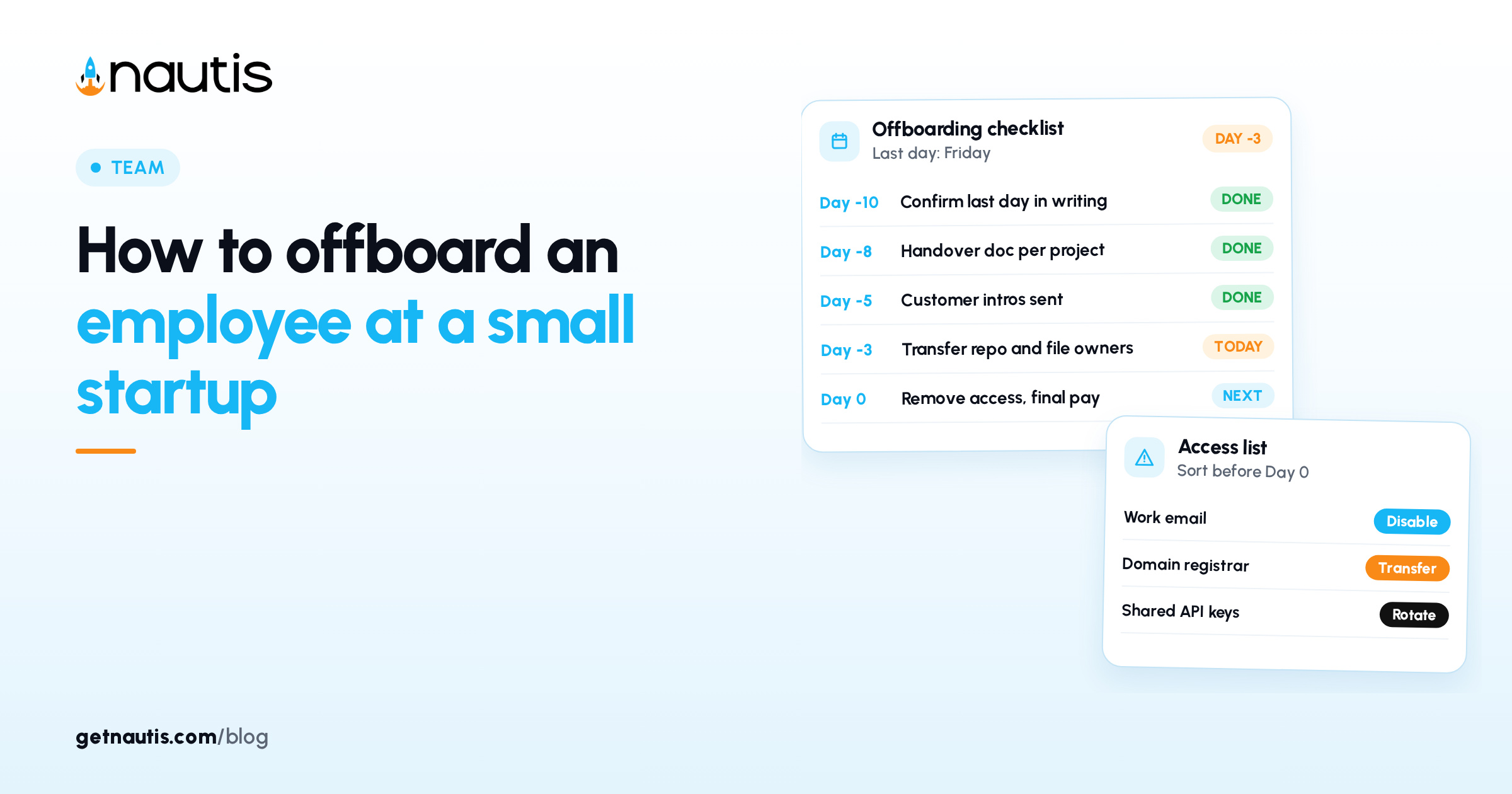
A checklist works when every line has an owner and a due date. The table below is the version Priya builds for Sam. The day numbers count backward from the last working day, so "Day -10" means ten working days before it.
When | Task | Owner | Done when |
|---|---|---|---|
Day -10 | Confirm last day in writing and tell the team | Priya | Email sent, team told in the weekly meeting |
Day -10 | List every system, account and shared secret Sam uses | Sam and Priya | List reviewed together |
Day -9 | Check final pay and benefit rules for Sam's state | Priya | Final pay date and amount written in the document |
Day -8 | Write the handover document for each open project | Sam | New owner has read it and asked questions |
Day -5 | Introduce new owners to customers and vendors Sam handles | Sam | Each contact has replied to the intro |
Day -3 | Transfer ownership of repositories, files and calendars | Sam | Files show the new owner |
Day -1 | Exit conversation | Priya | Notes saved in the record |
Day 0 | Remove access, collect equipment, run final pay | Priya | Access list fully checked off |
Day +7 | Rotate shared secrets and review what was missed | Priya | Rotation logged, checklist updated |
Two habits make this table useful. First, the access list on Day -10 is built with Sam, because he knows which tools he signed up for with a work card or a personal email. Second, the review on Day +7 turns every miss into a new line for the next person.
Pay, benefits and paperwork rules to check first
This section is general information, not legal advice. Employment rules vary by state, so confirm the details with an employment lawyer or a certified public accountant (CPA) before the last day.
The federal rule is simple and easy to misread. According to the U.S. Department of Labor, federal law does not require employers to give former employees their final paycheck immediately, but some states do. That means the deadline that matters is usually your state's, not a federal one.
California is a common example of a strict state. The California Division of Labor Standards Enforcement says an employee who is discharged must be paid all wages, including accrued vacation, immediately at the time of termination. An employee without a fixed-term contract who gives at least 72 hours of notice and quits on that day must be paid all wages, including accrued vacation, at the time of quitting.
Health coverage is the second check. The Department of Labor explains that the Consolidated Omnibus Budget Reconciliation Act (COBRA) generally applies to group health plans sponsored by employers with 20 or more employees in the prior year. It lets departing workers keep group coverage for a limited time, and they may be charged up to 102% of the plan's cost. COBRA also requires employers and plans to provide notice. A nine-person company may fall under the threshold, so ask your benefits provider or counsel what applies to your plan.
Before Day 0, Priya writes down these items:
- The final pay date required in Sam's state, and whether unused vacation must be paid out
- Any expense reimbursements still owed to Sam
- What happens to health coverage, and who sends the notice
- Equity details, such as vested shares and the exercise window in his option agreement
- Where his tax forms will be mailed after he leaves
If your time-off policy says whether unused days are paid out, check it now. Our guide to writing a simple paid time off (PTO) policy covers how to put that rule in writing, and the payout rule should match what your state requires.
Removing access without breaking the business
Access removal fails in two directions. Remove too little and a former employee can still read customer data months later. Remove too much, too fast, and you lose the only login to a production service.
The fix is to sort Sam's access list into three groups before Day 0:
- Accounts in his name that you can switch off: work email, chat, the code host, the support desk. Disable these at the end of the last day.
- Things he owns that the company needs: repositories, shared drives, calendar events, a domain registrar account, an app store listing. Transfer ownership first, then disable.
- Secrets he has seen: shared passwords, application programming interface (API) keys, database credentials. Change these after he leaves, even if you trust him, because you cannot know where copies were saved.
Two-factor codes are an easy miss. If a shared admin account sends its codes to Sam's personal phone, move the second factor to a company device before his last day, or nobody will be able to sign in.
A team password manager makes the third group much smaller, because people use shared logins without seeing them. If you do not have one yet, read why startups need a team password manager before the next departure.
Equipment comes last. Agree in writing how the laptop and any other devices come back, and who pays for shipping if Sam works remotely. Wipe the device only after you have confirmed nothing on it is the sole copy of company work.
Getting knowledge out before the last day
The handover document is where most of the value of a good offboarding sits. Sam knows why the billing service retries three times, which customer needs a call before any release, and which test fails on Fridays. None of that is written down.
Priya asks Sam for one short document per open area, each with the same four parts:
- What is in progress, with links to the work
- What is due in the next 30 days
- Who to ask outside the company, with contact details
- Known problems and the workaround for each
She also books two 45-minute screen-share sessions where Sam walks the new owner through the systems he built. Recording them, with Sam's agreement, gives the team something to replay later.
Customer and vendor relationships need a personal handoff. A short email from Sam introducing the new contact, sent before Day -5, gets replies while he is still around to answer questions. An email sent after he leaves often goes unanswered.
If your team has no habit of written procedures, a departure is a good time to start one. Turn the most useful parts of Sam's handover notes into step-by-step instructions that the next hire can follow without him.
What should you ask in an exit conversation?
Ask a few direct questions about the work, then listen. An exit conversation is the one moment a departing person has little reason to soften feedback, and a small team can act on what it hears.
Priya keeps it to 30 minutes and uses the same questions every time, so answers can be compared across departures:
- What made you start looking, or say yes to the new role?
- What slowed you down most in your work here?
- What would you change about how decisions get made?
- Is there anything you are worried will break after you leave?
- Would you be open to a call in a month if we have questions?
She writes notes during the call and saves them with the offboarding record. She does not argue with the answers or try to change Sam's mind.
For an involuntary departure, the conversation is different. Keep it short and factual, have the final pay and benefit details ready, and save feedback questions for a later, optional follow-up.
Keeping the offboarding record in Nautis
A short written record helps when a question comes up later about the final pay date, what equipment came back, or who now owns a customer.
In Nautis, the Employee Management guide says that when someone leaves, you should set their Exit date instead of deleting the record, so their history and reports stay accurate. The employee profile shows offboarding details alongside documents and compensation history.
Removing Sam from the workspace happens on the Members tab of your organization page. The help center says removing a member takes away access immediately, and anything they created, such as notes and contacts, stays in the organization.
For shared logins, the Credentials Vault controls who can see each credential through Shared Access. Its help page says a person loses access automatically when their account is removed from the organization, and suggests rotating the underlying secret as a precaution. That matches Priya's Day +7 step.
The checklist itself can live in Notes or on a task board, with each line assigned to its owner and due date. When the next person leaves, Priya copies the list, adds the lines Sam's departure taught her, and starts again on Day -10.
Frequently asked questions
How long should employee offboarding take at a startup?
For a resignation with two weeks of notice, plan the work across those ten working days and finish with a review one week after the last day. A termination compresses most steps into the same day, especially access removal and final pay. The review a week later still applies in both cases.
When is a final paycheck due after an employee leaves?
It depends on the state. The U.S. Department of Labor says federal law does not require an immediate final paycheck, but some states do. California, for example, requires immediate payment of all wages, including accrued vacation, when an employee is discharged.
Should I change shared passwords when an employee leaves?
Yes, change any shared password, key or credential the person could see, even if the departure is friendly. You cannot know where copies were saved. A team password manager reduces how many secrets people see in the first place.
What should an employee handover document include?
Include work in progress with links, anything due in the next 30 days, outside contacts with details, and known problems with their workarounds. Ask the new owner to read it and ask questions before the last day. Write one document per open area so each new owner gets only what they need.
Sources
- U.S. Department of Labor, Last Paycheck. Checked on November 11, 2026.
- U.S. Department of Labor, Continuation of Health Coverage (COBRA). Checked on November 11, 2026.
- California Department of Industrial Relations, Paydays, pay periods, and the final wages. Checked on November 11, 2026.
- Nautis Help Center, Employee Management. Checked on November 11, 2026.
- Nautis Help Center, Members, roles, and permissions. Checked on November 11, 2026.
- Nautis Help Center, Credentials Vault. Checked on November 11, 2026.
Baltej Singh is a serial entrepreneur, technology leader, and Founder & CEO of Nautis and DemoVexa, with over 16 years of experience building software products, SaaS platforms, and startups. Previously the Co-Founder & CTO of SanchiConnect, he has worked extensively in the DeepTech startup ecosystem, connecting with 200+ venture capital firms and supporting a network of 4,000+ startups. Passionate about AI, automation, and entrepreneurship, he focuses on building innovative products that solve real-world problems and help businesses grow.