An interview scorecard for startups that stays fair
 Baltej Singh8 min read
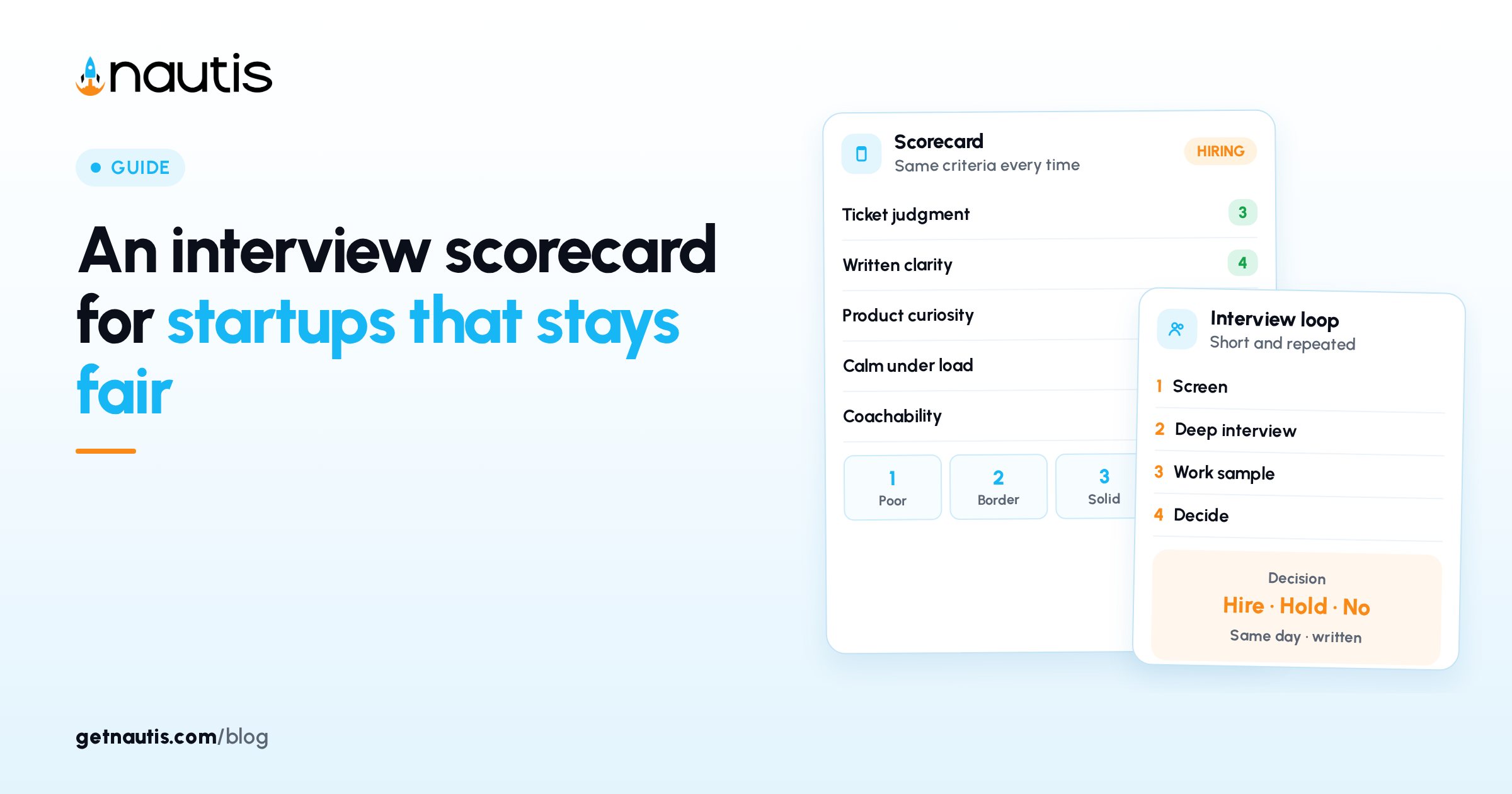
An interview scorecard for startups is a one-page hiring tool: the role outcomes, five to seven scored criteria, matching questions, and a shared 1 to 4 scale every interviewer uses on every finalist. You write it before the careers page goes live, run the same loop for each person, and decide from written notes rather than hallway vibes. Fairness here means same criteria, same prompts, and a paper trail you can still read in six months.
Unstructured chats reward charm, shared schools, and whoever interviewed last. Google's re:Work guide on structured interviewing, as of March 2026, frames the fix as vetted questions, detailed notes, standardized rubrics, and interviewer calibration. Separately, Equal Employment Opportunity Commission (EEOC) questions and answers on the Uniform Guidelines on Employee Selection Procedures state that those guidelines cover interviews and other selection steps used in hiring, not only written tests. Treat the scorecard as an operating habit, then check design and records with counsel for your jurisdictions. This post is not legal advice.
Where Nautis appears below, it is one place to publish the role, move candidates through Interview and Offer stages, capture interview notes, and convert a hire into Employee management. The method still works if you keep the scorecard in a shared doc.
What an interview scorecard for startups should capture
A finished scorecard answers four questions in writing:
- What outcomes does this seat own in the next ninety days?
- Which five to seven criteria predict those outcomes, stated as observable work?
- Which interview round owns each criterion, with the exact prompt and follow-ups?
- What overall bar means hire, hold, or no, including any hard disqualifiers?
If any of those four is blank, you are still interviewing on gut. Lock the blanks before you click Publish on the job. Pair hiring fairness with how you later run a fair performance review for a small team so the criteria you hire against are the ones you coach against.
Founder scenario (example): Mira needed a founding customer support lead for a five-person product. Her first three chats felt great and produced three different mental models of the role. She stopped the process, wrote a scorecard with criteria for ticket judgment, written clarity, product curiosity, calm under load, and coachability, then restarted with the same prompts. The fourth candidate scored mid on charm and high on the written work sample. That is what a scorecard is for.
Write criteria before you open the careers page
Criteria come from the work, not from a personality adjective list. Start from three to five outcomes with finish lines. Translate each outcome into one or two criteria you can hear in an answer or see in a work sample. Drop vague culture-fit lines that nobody can score the same way twice.
Illustrative outcomes for a support lead (composite only): cut first-response time under four business hours; ship two help articles customers actually used; own the Friday metrics note without a founder rewrite. Matching criteria might be prioritization under queue load, clear written explanation, and ownership of closed loops.
Before you post, decide employment type. A contractor loop is not the same paper trail as an employee loop. Walk contractor versus employee for startups with counsel when the seat could go either way, then set Job Type in Jobs and recruitment to match what you will actually offer.
In Jobs and recruitment, create the posting with Job Title, Job Description, Experience Level, Workplace Type, Required Skills, and compensation range (or hide the salary package if you must). Save as draft until the scorecard exists. Publishing first and inventing criteria mid-loop is how bias sneaks back in through "just one more vibe chat."
Build the scored criteria table
Use one table for the role. Every interviewer sees the same rows. Score each criterion on a fixed scale such as 1 (poor), 2 (borderline), 3 (solid), 4 (outstanding). Write a one-line anchor for what solid looks like so two founders do not invent private meanings.
Example scored criteria table for a founding support lead (illustrative only):
Criterion | Why it matters for the seat | Primary evidence | Solid (3) looks like | Round owner |
|---|---|---|---|---|
Ticket judgment | Wrong priority burns customers | Work sample or past tickets | Names urgency, tradeoff, and next step | Round 1 |
Written clarity | Support is mostly text | Email rewrite exercise | Customer can act without a call | Round 1 |
Product curiosity | Early support shapes the roadmap | Behavioral story | Asks why, not only how to reply | Round 2 |
Calm under load | Queues spike without warning | Hypothetical plus past example | Protects quality, escalates early | Round 2 |
Coachability | Tiny teams cannot hide friction | Feedback response in-loop | Adjusts without defensiveness | Round 2 |
Scheduling honesty | Coverage fails if calendars lie | Availability and tools talk | States constraints and backups | Round 1 |
Add a free row only when the craft truly needs it, such as on-call quality for an engineer. Do not invent dimensions you will not discuss. Google's re:Work materials stress role-related knowledge, problem solving, and leadership-style attributes with rubrics that show poor through outstanding answers. Keep your version short enough that a two-person panel can finish it.
Hard disqualifiers sit beside the table, not inside soft scores. Examples: cannot work the required overlap hours; refuses a lawful background check your counsel requires for the role; cannot complete a paid work sample you already described in the posting. Soft preference is not a disqualifier.
How should a short interview loop run?
A short loop for an early startup is usually three touches: screen, deep interview, and a work sample or reference check. Same order and same prompts for every finalist who reaches that stage. Changing the script for a "friend of the investor" candidate is how fairness dies.
Illustrative loop (composite only):
- Screen (twenty to thirty minutes): confirm outcomes interest, logistics, and one behavioral prompt from the table.
- Deep interview (forty-five to sixty minutes): remaining criteria with planned follow-ups; interviewer takes notes against the rubric, not a vibe summary.
- Work sample (sixty to ninety minutes, paid when the ask is real work): map to one or two criteria such as written clarity.
- Decision huddle (thirty minutes): compare scorecards, resolve gaps, write hire / hold / no with reasons.
Schedule interviews from the Interviews tab on the job in Jobs and recruitment when you use Nautis: date, time, panel, and round. After the conversation, record Feedback on the candidate card so the next interviewer is not guessing. Move stages on the board only when the scorecard for that stage is complete: Applied, Screening, Interview, Offer, Hired, or Rejected.
Ask behavioral prompts for past patterns ("Tell me about a time…") and hypothetical prompts for novel judgment ("Imagine the queue doubles by noon…"). Predetermine follow-ups so quiet candidates still get probed and talkative candidates stay on the criterion. Do not invent live questions that only one person hears.
Score, calibrate, then decide in writing
Interviewers score alone first. Then meet. Calibration means comparing evidence for the same criterion, not averaging personality. If one panelist scored written clarity a 4 and another a 2, read the notes and the work sample together until you share facts. Leave unresolved disagreement marked rather than papering it over with a compromise number nobody believes.
Write the decision the same day:
- Hire: which criteria cleared the bar, what offer shape you will send, and who owns the Convert to employee path.
- Hold: what missing evidence you still need and the date you will stop waiting.
- No: which criteria failed, who sends the reject note, and that the stage moves to Rejected.
Keep the filled scorecards. EEOC guidance on the Uniform Guidelines treats interviews as selection procedures within the broader hiring process; when processes create adverse impact, employers may need validity evidence or other justification under federal equal employment opportunity law. Even when you are small, dated notes beat reconstructed memory. Check retention and record rules with counsel rather than inventing a private archive policy in Slack.
When someone accepts and you move them to Hired, Nautis can offer Convert to employee so the person lands in Employee management with basics pre-filled. Complete Designation, Department, Employment type, Joining date, and Reporting manager so the seat you scored is the seat you onboard. Compensation revisions belong on the profile when pay is set, not only in an offer email thread.
Make the scorecard light enough to reuse
A scorecard that takes a day to fill will be abandoned by hire three. Cap criteria at seven. Cap deep interview length at sixty minutes. Reuse the table for the next similar seat and only edit rows that the work changed. Refresh questions when candidates start sharing answers with each other, which re:Work also flags as a maintenance chore.
Remote and hybrid candidates get the same criteria. What changes is evidence collection: shared docs, recorded work samples with consent, and timezone-honest slots. Do not lower the written bar for someone who interviews in person and raise it for someone who interviews on video.
Refuse these shortcuts:
- A final "culture coffee" with no scorecard that can overturn the panel.
- Different questions for referrals.
- Scoring after the offer is already emotional.
- Deleting notes because the hire "worked out" or the reject "felt awkward."
Fairness is repetition under the same rules. The interview scorecard for startups earns its keep when the fifth candidate faces the same bar as the first, and when next quarter's performance review can still point at the outcomes you hired for.
Frequently asked questions
What is an interview scorecard for startups?
It is a one-page hiring tool that lists role outcomes, scored criteria, matching interview prompts, and a shared rating scale. Every interviewer uses the same rows for every finalist. The goal is a written, comparable decision instead of gut feel.
How many criteria should a startup interview scorecard include?
Most early seats work with five to seven criteria tied to ninety-day outcomes. Fewer than that under-specifies the job. More than that slows the panel and invites unused rows. Add a craft-only row only when the work truly needs it.
Do structured interviews matter for a two-founder team?
Yes. Small teams still make selection decisions that shape culture and risk. Structured questions, rubrics, and notes reduce snap judgments and make later disputes reconstructible. Google's re:Work guidance on structured interviewing applies to organizations of any size.
Is an interview scorecard legal advice?
No. It is an operating habit for fairer hiring. Federal Equal Employment Opportunity Commission materials on the Uniform Guidelines on Employee Selection Procedures treat interviews as selection procedures. Check design, adverse-impact questions, and recordkeeping with counsel for your places of hire.
Sources
- Google re:Work, A guide to structured interviewing for better hiring practices. Checked on November 7, 2026.
- U.S. Equal Employment Opportunity Commission, Questions and Answers on the Uniform Guidelines on Employee Selection Procedures. Checked on November 7, 2026.
- Nautis Help Center, Jobs and recruitment. Checked on November 7, 2026.
- Nautis Help Center, Employee management. Checked on November 7, 2026.
Baltej Singh is a serial entrepreneur, technology leader, and Founder & CEO of Nautis and DemoVexa, with over 16 years of experience building software products, SaaS platforms, and startups. Previously the Co-Founder & CTO of SanchiConnect, he has worked extensively in the DeepTech startup ecosystem, connecting with 200+ venture capital firms and supporting a network of 4,000+ startups. Passionate about AI, automation, and entrepreneurship, he focuses on building innovative products that solve real-world problems and help businesses grow.