Startup tax calendar basics for US founders
 Baltej Singh8 min read
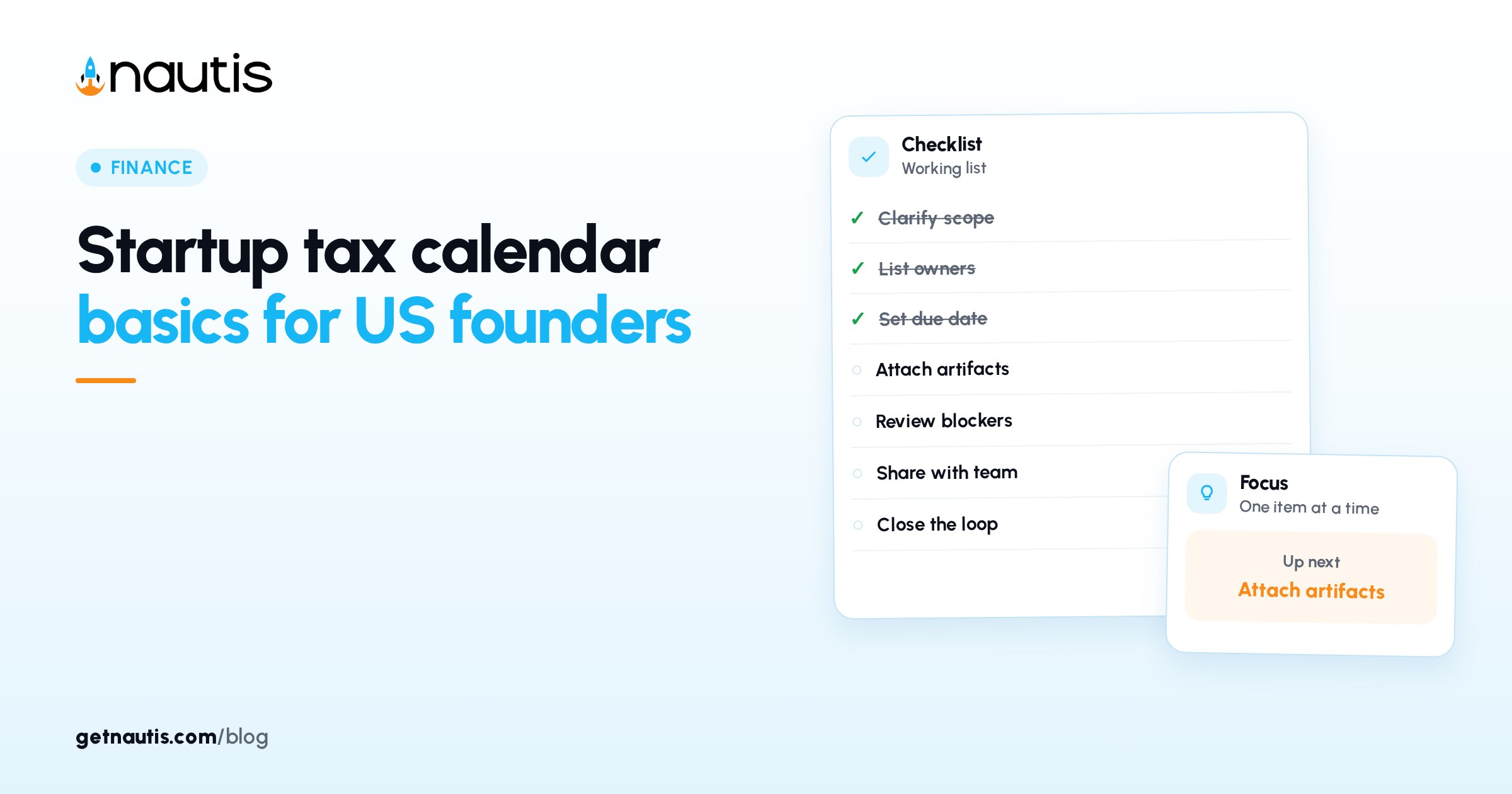
Startup tax calendar basics start with one shared board: every recurring federal obligation your company or founders must deposit, file, or send, plus the owner who proves it happened. The calendar is not a substitute for a CPA, payroll provider, or state registration. Entity type, employee headcount, contractor mix, and where you sell all change which rows apply. IRS Publication 509 publishes annual tax calendars; Form 1040-ES lists individual estimated-tax payment dates; the IRS employment-tax due-dates page covers Forms 941, 940, W-2, and many information returns. This is orientation for US founders, not tax advice. Confirm every date and form with your tax advisor before you pay or file.
Startup tax calendar basics the team can actually run
A useful calendar has four columns: cadence, obligation family, named owner, and proof. Cadence is how often the work repeats. Obligation family groups similar filings so the board stays short. The owner is a person, not "finance." Proof is the deposit confirmation, filed return, or accountant email you can find in under a minute.
Illustrative board seed (composite only): weekly receipt capture; monthly payroll deposit check; quarterly estimated-tax and Form 941 rows; annual W-2, 1099-NEC, and income-tax filing rows. Replace forms that do not apply to your entity.
Keep sales-tax and other state lanes on a separate tab. Nexus, registration, and state filing calendars deserve their own map; do not bury them inside the federal board or pretend one April date covers every state.
When cash is tight, founders sometimes skip calendar hygiene and only watch burn rate. Runway math still needs tax deposits on the same cash timeline, or the model lies about next month's balance.
Choose the entity lane before you lock dates
IRS business-structures guidance separates sole proprietorships, partnerships, corporations, and S corporations, among other forms. Your lane changes which estimated-tax rules, employment filings, and information returns sit on the board.
Illustrative lane notes (composite only): a single-member LLC taxed as a disregarded entity often pushes profit onto the owner's individual return and estimated payments; a C corporation has its own estimated-tax rhythm; an S corporation adds shareholder and payroll coordination your CPA must design. Do not copy a friend's calendar without matching entity elections.
Write the entity, EIN status, payroll provider, and CPA contact at the top of the board. If those four fields are blank, you are decorating dates, not operating a calendar.
When you change entity taxation mid-year, rebuild the board with the CPA instead of editing one row in isolation. Estimated-tax worksheets, payroll setup, and information-return lists can all shift together.
Build one cadence board from weekly to annual
Fill only the rows that apply. Weekend and holiday shifts follow IRS rules: when a due date falls on a Saturday, Sunday, or legal holiday, filing or payment is generally timely on the next business day. Always re-check the current Publication 509 and your advisor before you rely on a shifted date.
Cadence | Obligation family (illustrative) | Owner | Proof to keep |
|---|---|---|---|
Weekly | Receipt capture and expense categorization | Ops lead | Receipts attached in Expenses |
Monthly | Payroll tax deposit schedule check; book close export | Payroll admin + bookkeeper | Deposit confirmations; CSV export |
Quarterly | Individual or corporate estimated tax; Form 941 if you file quarterly | Founder + CPA | Payment confirmations; filed 941 |
Annual | Forms W-2/W-3, 1099-NEC where required, Form 940, income-tax returns | Payroll admin + CPA | SSA/IRS acceptances; filed returns |
Illustrative operating rule (composite only): every Friday, ops clears uncategorized expenses; the first Monday after month-end, payroll confirms deposit schedule status; fifteen days before each quarterly estimated date, the founder and CPA agree the payment amount.
The board is a reminder system. It does not calculate safe-harbor amounts, classify workers, or choose between Form 941 and Form 944. Those are advisor and payroll-provider jobs.
Put estimated taxes on the quarterly spine
Individuals, including many sole proprietors, partners, and S corporation shareholders, generally use Form 1040-ES when estimated tax applies. For calendar-year taxpayers, Form 1040-ES (2026) lists payment due dates of April 15, 2026; June 15, 2026; September 15, 2026; and January 15, 2027, with a noted exception if you file and pay the full 2026 balance by February 1, 2027 instead of the January payment. Corporations have their own estimated-tax due-date pattern described in Publication 509. Fiscal-year filers must shift months; do not assume December 31 year-end.
Illustrative founder habit (composite only): four calendar holds titled "ES payment decision," each two weeks before the IRS due date, with the CPA as optional attendee. The hold exists even in months when the expected payment is zero, so the team still verifies the math.
Underpayment penalties can apply period by period even if you are due a refund later. That is why startup tax calendar basics treat estimated payments as recurring operating events, not as an April surprise.
Record the payment method your advisor prefers (IRS Direct Pay, EFTPS, or another approved channel listed on IRS payments pages). Store confirmations where the owner of the board can find them without searching Slack.
If income is uneven, ask the CPA whether the annualized income installment method in Publication 505 belongs in your process. The calendar still shows the four due dates; only the amount calculation changes. Do not invent a fifth unofficial due date because a customer paid late.
Keep employment and information returns on separate clocks
If you pay employees, the IRS employment-tax due-dates page is mandatory reading for your payroll admin. Most employers file Form 941 each quarter by the last day of the month following the quarter (April 30, July 31, October 31, and January 31 for the fourth quarter), with a common extra ten calendar days to file when all taxes were deposited on time. Deposit schedules (monthly or semiweekly, plus the next-day rule for large accumulations) are separate from filing due dates and depend on lookback rules in Publication 15.
Annual January 31 clusters often include employee Forms W-2 (to employees and, with Form W-3, to the SSA), Form 940 for FUTA when required, and Form 1099-NEC to the IRS and to recipients when nonemployee compensation reporting applies. Other information returns may follow February or electronic March deadlines. Thresholds and e-file rules change; confirm the current instructions before you promise a contractor a date.
Illustrative split (composite only): payroll owns W-2 accuracy; ops owns contractor W-9 collection before the first payment; the CPA owns which 1099 series apply. The calendar only shows the handoffs.
Misclassifying a worker is not a calendar problem. If someone should be on payroll, adding a 1099 row will not fix it. Escalate classification questions to counsel and your CPA before the first payment.
Deposit timing is easy to confuse with filing timing. A semiweekly depositor may move cash many times per quarter and still file Form 941 only four times a year. Put both rhythms on the board so founders do not treat the 941 due date as the only payroll-tax event.
Leave state and sales-tax lanes on their own tab
Federal startup tax calendar basics do not replace state income, franchise, unemployment, or sales-and-use calendars. Those dates vary by state and by whether you have nexus, payroll, or marketplace rules in play. Keep a second tab titled by state, with registration IDs and filing frequency, maintained by whoever owns compliance.
On customer invoices, Nautis lets you set Tax Name and Tax Rate (%) on the summary. That field labels what you bill; it does not file a state return. Collection on Invoices still needs a matching state filing calendar outside the product.
Illustrative separation (composite only): federal board in one sheet; "CA payroll + sales" and "NY sales only" tabs beside it. Never merge them into a single April checklist.
Connect the calendar to the books you already keep
A calendar without evidence becomes theater. Use tools you already run so proof lands in one place.
In Expenses, categorize spend, attach receipts, and export CSV for the accountant on a monthly cadence that matches the board. Recurring expenses help you remember subscriptions; they do not pay the IRS.
On Invoices, keep Tax Name and Tax Rate honest for the jurisdictions you actually charge, then reconcile collections to your state tab.
In Financial Planner, Model Inputs include a place for Other Taxes beyond income tax, such as sales tax or payroll tax lines you want visible in projections. Put advisor-approved assumptions there so burn and runway scenarios include tax cash, then export Excel or PDF when the CPA wants the model. The planner does not file returns.
Illustrative month-end (composite only): day 2 export Expenses CSV; day 3 payroll confirms deposits; day 5 CPA reviews estimated-tax worksheet against Financial Planner Other Taxes lines; day 10 update the board's last-completed column.
Review the board every quarter with the CPA. Add rows when you hire, open a new state, elect a new entity status, or start paying contractors. Remove rows that no longer apply so the calendar stays short enough that founders still open it.
Startup tax calendar basics work when the next due date, the named owner, and the proof location are obvious to a new ops hire on day one. If any of those three are tribal knowledge, rewrite the row before the next quarter starts.
Frequently asked questions
Is one national tax calendar enough for a startup?
No. Federal due dates are only one lane. State income, unemployment, and sales-and-use calendars need their own tabs. Confirm every lane with your CPA.
Do estimated tax dates apply to every founder?
Not automatically. Form 1040-ES rules depend on how you owe tax and how much you expect to owe after withholding. Your tax advisor decides whether and how much to pay.
Is the Form 941 due date the same as my payroll tax deposit date?
Usually not. Filing due dates and deposit schedules are different. The IRS employment-tax due-dates page and Publication 15 explain both. Ask payroll to map your schedule.
Can Nautis file my taxes from the calendar?
No. Expenses, Invoices, and Financial Planner help you organize evidence and projections. Filing and deposits stay with you, your payroll provider, and your CPA.
Sources
- IRS Publication 509, Tax Calendars. Checked on October 31, 2026.
- IRS Form 1040-ES (2026). Checked on October 31, 2026.
- IRS: Employment tax due dates. Checked on October 31, 2026.
- IRS: Business structures. Checked on October 31, 2026.
- IRS: Make a payment. Checked on October 31, 2026.
Baltej Singh is a serial entrepreneur, technology leader, and Founder & CEO of Nautis and DemoVexa, with over 16 years of experience building software products, SaaS platforms, and startups. Previously the Co-Founder & CTO of SanchiConnect, he has worked extensively in the DeepTech startup ecosystem, connecting with 200+ venture capital firms and supporting a network of 4,000+ startups. Passionate about AI, automation, and entrepreneurship, he focuses on building innovative products that solve real-world problems and help businesses grow.