How to build a startup operating system
 Baltej Singh8 min read
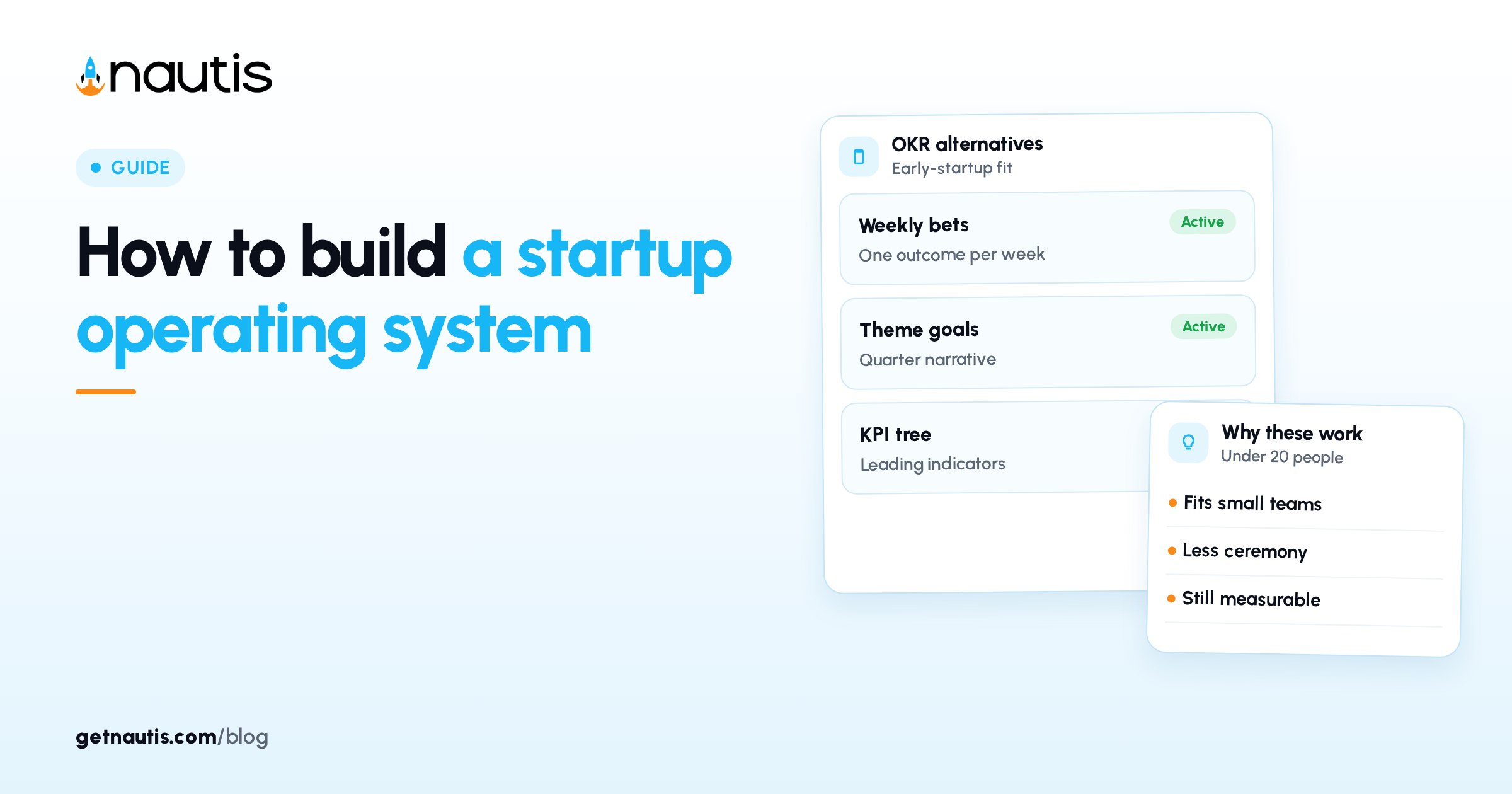
How to build a startup operating system starts with a boring definition: a small set of shared loops that keep truth, tasks, money, and decisions in places people trust. It is not a logo wall of apps. It is not a Notion museum. If a new hire cannot find the live deal, the open decision, and today's blockers without pinging you, you do not have an OS yet.
Y Combinator's essential startup advice keeps pushing founders back to writing product and talking to users. An operating system should protect that focus. It should cut fake work, not invent more dashboards. This guide shows a build order you can finish in a few weeks, with or without Nautis.
The four loops every early OS needs
Name the loops before you buy software. If a tool does not serve one of these, it is optional.
- Attention loop: what matters today, ranked, with owners
- Execution loop: tasks and projects with due dates and a definition of done
- Commercial loop: pipeline or fundraising deals with next steps
- Money and decision loop: cash/runway visibility plus a written record of choices
Miss one loop and the others lie. A perfect task board with no money view produces confident teams that run out of cash. A perfect CRM with no attention loop produces busy calendars and stale follow-ups.
Objects, owners, and systems of record
Write this table on a single page and treat edits as a company decision.
Object | System of record (pick one) | Owner | Review cadence | Forbidden second home |
|---|---|---|---|---|
Company priorities | One briefing or weekly note | Founder | Daily glance, weekly rewrite | Private founder brain dumps as truth |
Tasks and commitments | One board | Ops lead or founder | Daily move, weekly prune | Chat promises without cards |
Customers / deals | One CRM | Sales owner | Daily next steps, weekly forecast | Shadow spreadsheets for "just this week" |
Investors (if raising) | One fundraising board | Founder | Same-day notes, Monday ops | Inbox stars as the pipeline |
Cash and runway | Books + one published figure | Finance owner | Weekly reconcile, monthly board | Slide math that disagrees with the bank |
Decisions | Dated decision log | Founder | Weekly skim | "We decided on the call" with no write-up |
The OS is the discipline of one home per object. Tool consolidation helps, but ownership is the load-bearing wall. If you are drowning in SaaS sprawl first, fix that with the companion playbook on managing a startup without 15 tools.
A four-week build order
Do not install automation in week one. Habit first, agents second.
Week 1: truth map
- Inventory every place priorities, tasks, deals, and cash currently live
- Pick the system of record for each object in the table above
- Freeze edits in the losers (export-only) so the winners can catch up
- Publish the table in a channel everyone actually reads
Week 2: daily attention surface
Ship one morning page: blockers, pipeline or raise next steps, cash/runway, and anything waiting on approval. Humans can maintain it in a doc for seven days. The point is the sections, not the vendor.
If you want that page generated from workspace signals, Nautis Chief of Staff builds a daily Founder Briefing that ranks what changed, what is blocked, and what needs you today. Setup runs through Liftoff. A focused walkthrough of the habit lives in how to run a daily founder briefing.
Week 3: gates for irreversible moves
Write four rules on one page:
- External email that commits the company needs a human preview
- Money moves above a named threshold need a second pair of eyes
- Access grants and deletes need an owner and a log
- Stage changes on big deals need a dated note
In Nautis, those reviews sit in the Approval Center, and Owners or Admins set Agent Autonomy to Ask every time or Run without asking. Start External capabilities on Ask every time. AI Governance keeps a running record of what agents did so you can audit later.
Week 4: standing jobs only after the loops work
Automate chores that already have a human checklist: a morning summary, a weekly digest, a stale-deal nudge. In Nautis, Routines are standing orders for your AI agents; they run on a schedule or on workspace events, and anything a routine wants to change still follows your approval rules. Only Owners and Admins can add or edit them, and plan caps apply (5 on Launch, 10 on Voyage, 15 on Fleet).
If the human loop is broken, automation just emails the brokenness faster.
Meeting skeleton that makes the OS real
Software cannot replace the calendar contracts below. Keep them short.
Meeting | Length | Required inputs from the OS | Output that must land in the OS |
|---|---|---|---|
Daily standup or async check | 15 min | Open blockers from the attention loop | Updated owners and dates on the board |
Weekly ops | 45 min | Pipeline, cash/runway, overdue tasks | Three company priorities for next week |
Weekly raise review (if active) | 30 min | Investor board with next steps | Same-day notes debt cleared |
Monthly money review | 45 min | Reconciled burn and runway | Published figure everyone may quote |
Cancel any meeting that does not read from or write to the OS. Status theater is not a loop.
How to build a startup operating system you can defend in a board meeting
When an investor asks how you run the company, answer with loops and owners, not with a slide of logos.
Say which surface holds priorities, which board holds commitments, which CRM holds revenue truth, and which figure is the only runway number anyone may quote. Bring one screenshot or export per loop if you must. The story works when a board member could audit it without you narrating Slack archaeology.
If two co-founders disagree on a definition during that prep, fix the truth table the same day. Ambiguous systems of record become conflicting updates, which become diligence questions you did not need.
Definition of done: the whiteboard test
You are making real progress when all of these are true:
- A stranger can point to the live home for deals, tasks, cash, and decisions in under two minutes
- Yesterday's commitments are on a board with dates, not only in chat
- The morning attention surface is used before Slack archaeology
- Irreversible actions have a named gate
- One person owns each object in the truth table
Until then you have tools, not an OS.
Three build stories from the field (examples)
Two co-founders, twelve tools, no OS
Leah and Omar each keep a private task list and a shared spreadsheet for the board. Customer promises live in WhatsApp. After a missed enterprise follow-up, they spend week 1 of the build order only: one CRM, one board, one cash figure. Revenue does not jump in seven days. Embarrassment drops, which is the point.
OS without gates
A team has a clean briefing and still lets an AI draft send investor updates unreviewed. One wrong metric goes out. They add week 3 gates the hard way. The OS was incomplete without approvals.
Gates without attention
Another team requires approvals on everything but has no ranked morning page. Approvals pile up unread. They fix week 2 before adding more Routines. Volume of cards is not the same as clarity.
What Nautis contributes without owning the definition
Nautis calls itself an AI business operating system for startups: Chief of Staff for the attention loop, modules for CRM and fundraising boards, and Approval Center plus Agent Autonomy for gates. Plans are Launch, Voyage, and Fleet with a 14-day trial with no card on Launch; see the site pricing page for current amounts. None of that replaces your truth table. The product is useful after you decide what done means for each object.
Read the Chief of Staff help center for how the Briefing, Approvals, and autonomy settings work in product language. Keep competitor claims out of this build; your OS succeeds when your team trusts one scoreboard.
Role of backups and handoffs
An OS that only one founder can operate is a single point of failure wearing a productivity costume.
For every object in the truth table, name a backup who can update the system of record for two weeks. Practice once: the primary goes offline for a day and the backup runs morning attention plus weekly ops inputs. Write down what broke. Fix the permissions and the docs before you add more automation.
Handoffs also include contractors. If a contractor edits the CRM, they edit the system of record, not a parallel sheet. Parallel sheets recreate the problem you just paid to solve.
Anti-patterns that pretend to be progress
- Creating a second temporary CRM during a busy month
- Measuring OS maturity by number of integrations enabled
- Automating status emails nobody reads
- Letting chat be the only decision log
- Renaming a pile of docs as Operating System v3 without owners
- Skipping money from the daily attention surface because it feels uncomfortable
Install checklist you can finish in one afternoon
- Fill the objects table with real names
- Delete or freeze one duplicate home per object
- Stand up the four-section morning page
- Write the four irreversible-move gates
- Put weekly ops on the calendar with OS inputs listed in the invite
- Assign backup owners so vacation does not delete the OS
- Schedule a thirty-day review to kill unused surfaces
Build a startup operating system the way you would rebuild a kitchen: one prep surface, labeled drawers, and a rule that knives do not live in the couch. Fancy appliances come after people know where the cutting board is.
Frequently asked questions
What is a startup operating system in practice?
A small set of shared loops with named owners and one system of record for priorities, tasks, deals, cash, and decisions. It is a habit stack, not a pile of logos. If a new hire cannot find truth without pinging you, you do not have an OS yet.
Should we automate before the loops are stable?
No. Automate only chores that already have a human checklist. Broken loops automated become faster confusion. Standing jobs belong in week four of the build order, after truth, attention, and gates exist.
How does Nautis fit an operating system build?
Chief of Staff supplies the daily Founder Briefing for the attention loop. The Approval Center and Agent Autonomy encode gates. Routines can run standing jobs after approval rules are set. Your truth table still comes first.
How do we know the OS is working?
Use the whiteboard test and backup drill: a stranger finds the live homes in two minutes, and a backup can run morning attention for a day. Also check that weekly ops ends with written priorities in the system of record, not only in chat.
Sources
- YC essential startup advice. Checked on October 31, 2026.
- Chief of Staff help center. Checked on October 31, 2026.
- Set up your Chief of Staff (Liftoff). Checked on October 31, 2026.
Baltej Singh is a serial entrepreneur, technology leader, and Founder & CEO of Nautis and DemoVexa, with over 16 years of experience building software products, SaaS platforms, and startups. Previously the Co-Founder & CTO of SanchiConnect, he has worked extensively in the DeepTech startup ecosystem, connecting with 200+ venture capital firms and supporting a network of 4,000+ startups. Passionate about AI, automation, and entrepreneurship, he focuses on building innovative products that solve real-world problems and help businesses grow.