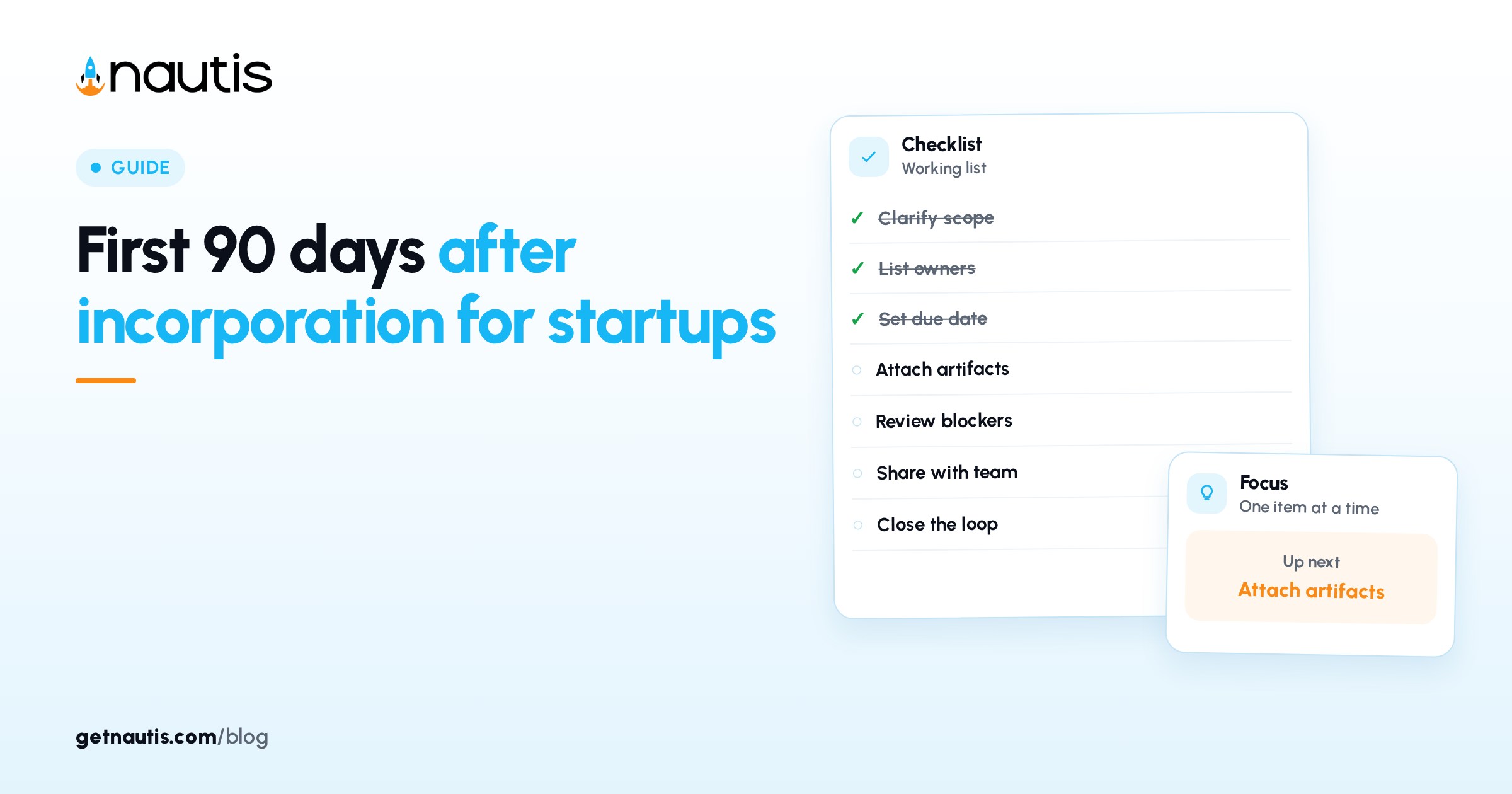
First 90 days after incorporation for startups
 Baltej Singh8 min read
This is not legal, tax, or accounting advice. Entity rules, filing deadlines, and elections change by jurisdiction and facts. Check every filing, tax election, and ownership instrument with a qualified attorney and CPA before you act. The links below are official reference pages checked on 1 Nov 2026; re-check them when you file.
The certificate is filed. The real work of the first 90 days after incorporation for startups is making the company operable: money moves through an operating account, ownership is written down where the team can see it, a light finance pulse exists, and a thin product path can teach you something.
This guide is organized by operating pillars, not by a marketing 30-60-90 clock. Keep counsel for legal instruments. Use Nautis modules named below for shared records.
First 90 days after incorporation: money rails and EIN
Open an operating account in the filed entity name as early as you can. Weeks of personal-card mix create cleanup that outlasts the quarter. Agree who can approve transfers so co-founders do not argue about every vendor payment.
Most US entities need an Employer Identification Number (EIN) for banking, payroll, and tax accounts. Apply through the IRS EIN process (IRS: Get an employer identification number, checked 1 Nov 2026). Keep the confirmation letter with formation PDFs in a shared folder banks and payroll providers can accept.
Collect formation documents into that same folder. You do not need a polished data room yet. You need a packet that opens accounts without a scavenger hunt.
Wire a company email domain before you invite contractors to systems. Accounts created on personal inboxes become migration chores later.
Ownership records: Cap Table and Section 83(b)
Start the ownership record even if the first split is only between founders. In Nautis, use Cap Table while memories are fresh. Incomplete early notes are how disputes begin; counsel still owns binding instruments.
Example for illustration only: two co-founders agree 50/50 subject to vesting they will paper with counsel. A Cap Table row exists in week one while long-form agreements are still drafting. Shared numbers first; signatures follow.
When restricted stock or other substantially nonvested property is transferred for services, some founders consider a Section 83(b) election. Under IRS rules, an 83(b) election generally must be filed no later than 30 days after the property transfer, and Form 15620 is an IRS form you can use for that election (IRS Form 15620 PDF; IRS update on Pub. 525 / Form 15620, both checked 1 Nov 2026). Whether you should elect, and how to file, is a CPA/counsel question. Missing the deadline usually cannot be fixed casually.
For equity promises to early helpers, write "promised, not issued" beside Cap Table notes until counsel papers the grant. Mixing promised and issued numbers invents folklore.
Share Cap Table view permissions with anyone who must approve fundraising or future offers later. Waiting until a raise to grant access creates last-minute chaos.
State annual reports, franchise tax, and BOI
State annual report and franchise-tax rules depend on where you formed and where you qualify to do business. Delaware domestic corporations, for example, file an annual report and pay franchise tax for the prior year on or before March 1 each year; late filing triggers stated penalties and interest on Delaware's site (Delaware Division of Corporations: Annual Report and Tax Information; Annual Report and Tax Instructions, checked 1 Nov 2026). Other states use different names, fees, and due dates. Put your state's due dates on a shared calendar and confirm them on the official secretary-of-state or tax site for your formation state - do not copy Delaware dates onto a non-Delaware entity.
Beneficial Ownership Information (BOI) reporting to FinCEN: as of FinCEN's final rule effective 14 Aug 2026, U.S. companies are exempt from BOI reporting requirements and are no longer required to file BOI reports (FinCEN BOI page; Treasury press release on the final rule, checked 1 Nov 2026). The March 2025 interim final rule had already removed domestic reporting-company obligations; the August 2026 final rule made that rollback permanent. Foreign entities registered to do business in the US may still have obligations - confirm on FinCEN's page if that describes you. Do not file BOI based on outdated 2024 blog posts.
Operating pulse and company identity
Record identity where people will look. In Nautis, create or edit Business Profile: Company Name and the required one-liner field, plus Basic Information you already know. From the sidebar open Profile & Company → Edit Business Profile. Skip polishing every optional section before banking and ownership are real.
If a registered agent or virtual mail address receives entity mail, name who opens that mail weekly. Missed letters create emergencies that feel like product work but are not.
Save a simple monthly pulse so cash is not only a feeling. On a fixed monthly cadence, record Cash Balance and an honest spend total in Startup Health under Finance. If recurring revenue is still zero, enter 0. The goal is a dated snapshot you can compare next cycle, not a full metrics curriculum.
Pick a bookkeeping path (accountant-led, bookkeeper, or categorized export you review monthly). Name a single human who closes the books for the cycle.
Thin product path without process sprawl
Ship a thin user path end to end. Protect a few calendar blocks for that path. Fancy internal portals can wait until someone outside the founding pair can complete the path without a screenshare.
Example illustration only: week six yields onboarding for five design partners, not a full billing suite. Learning beats surface area.
Instrument the path with three events only: start, activation moment, and return within seven days. Example for illustration only: five design partners start, three reach activation, one returns. Change one stuck step per week so learning stays attributable.
Time-box support for design partners to a daily window. Unbounded chat support collapses deep work and masquerades as progress. Parallelize lightweight agreements counsel recommends with scheduling those conversations so paper does not freeze shipping.
Weekly rhythm that stays light
Hold one weekly operating review with three topics only: balance versus last snapshot, what you learned from the user path, and the top open legal or finance item with counsel/CPA if needed.
YC favors concrete early execution over foggy ceremony (Y Combinator Library, checked 1 Nov 2026).
Habits that help:
- Change ownership or account signers the same week the agreement changes; write it into Cap Table or bank records immediately.
- No new recurring meeting type until the thin user path has real users or clear failure evidence.
- Counsel and CPA for instruments, elections, and filings; founders for operating cadence.
- State annual-report and franchise-tax due dates on a visible calendar after you confirm them on official sites.
Remote-first teams should agree where source links live: Business Profile for the public story, Cap Table for ownership, Startup Health for the monthly snapshot. At day 75, run a thirty-minute scavenger test: can a non-founder find those three without asking you?
If you take a friends-and-family check inside this window, still finish the basics. New cash does not replace a missing operating account, an unreadable Cap Table, or a missing monthly snapshot history.
At day 90, a teammate who did not incorporate the company should answer from systems of record: What was the last saved Cash Balance? Who owns what on a fully diluted basis? What one-liner sits on Business Profile? If any answer needs a private chat scroll, plumbing is unfinished.
Stalls to cut early
Personal cards for company spend. Stop early when possible.
Ownership only in one person's private file. Move to shared Cap Table.
Skipping the monthly snapshot because revenue is zero. Enter 0 for recurring revenue and keep the cash pulse.
Building internal portals before a user path. Invert the order.
Waiting for perfect legal drafts before recording agreed ownership percentages. Record the agreement, then paper it with counsel.
Following outdated BOI checklists that tell every domestic startup to file with FinCEN. Re-read FinCEN's BOI page (checked 1 Nov 2026).
Missing an 83(b) window because nobody calendared day 30. If counsel says an election applies, treat the IRS 30-day clock as hard (Form 15620, checked 1 Nov 2026).
FAQ
What matters most in the first 90 days after incorporation?
A live operating account, a shared ownership record, a monthly balance snapshot, and a thin user path - plus calendared official filings confirmed with counsel/CPA.
Is this legal or tax advice?
No. This is not legal, tax, or accounting advice. Confirm EIN, 83(b), state annual reports, franchise tax, BOI status, and equity paperwork with a qualified attorney and CPA.
Do US domestic startups still file FinCEN BOI reports?
FinCEN states that U.S. companies are exempt from BOI reporting under the final rule effective 14 Aug 2026 (FinCEN BOI, checked 1 Nov 2026). Confirm on that page for your entity type; foreign entities registered in the US may still have rules.
Where do I save a monthly balance snapshot in Nautis?
Open Finance → Startup Health and record Cash Balance (and related fields) so you have a dated comparison next cycle.
Frequently asked questions
What matters most in the first 90 days after incorporation?
A live operating account, a shared ownership record, a monthly balance snapshot, and a thin user path - plus calendared official filings confirmed with counsel and a CPA.
Is this legal or tax advice?
No. This is not legal, tax, or accounting advice. Confirm EIN, 83(b), state annual reports, franchise tax, BOI status, and equity paperwork with a qualified attorney and CPA.
Do US domestic startups still file FinCEN BOI reports?
FinCEN states that U.S. companies are exempt from BOI reporting under the final rule effective 14 Aug 2026. Confirm on FinCEN’s BOI page for your entity type; foreign entities registered in the US may still have rules.
Where do I save a monthly balance snapshot in Nautis?
Open Finance → Startup Health and record Cash Balance (and related fields) so you have a dated comparison next cycle.
Sources
- IRS, Get an employer identification number (EIN). Checked on November 1, 2026.
- IRS Form 15620, Section 83(b) Election (PDF). Checked on November 1, 2026.
- IRS, Update to Pub. 525 for Section 83(b) election / Form 15620. Checked on November 1, 2026.
- FinCEN, Beneficial Ownership Information Reporting. Checked on November 1, 2026.
- U.S. Treasury, FinCEN final rule ending BOI reporting for U.S. companies. Checked on November 1, 2026.
- Delaware Division of Corporations, Annual Report and Tax Information. Checked on November 1, 2026.
- Delaware Division of Corporations, Annual Report and Tax Instructions. Checked on November 1, 2026.
- Y Combinator Library, Essential startup advice. Checked on November 1, 2026.
Baltej Singh is a serial entrepreneur, technology leader, and Founder & CEO of Nautis and DemoVexa, with over 16 years of experience building software products, SaaS platforms, and startups. Previously the Co-Founder & CTO of SanchiConnect, he has worked extensively in the DeepTech startup ecosystem, connecting with 200+ venture capital firms and supporting a network of 4,000+ startups. Passionate about AI, automation, and entrepreneurship, he focuses on building innovative products that solve real-world problems and help businesses grow.