A founder-led sales playbook for the first 10 deals
 Baltej Singh8 min read
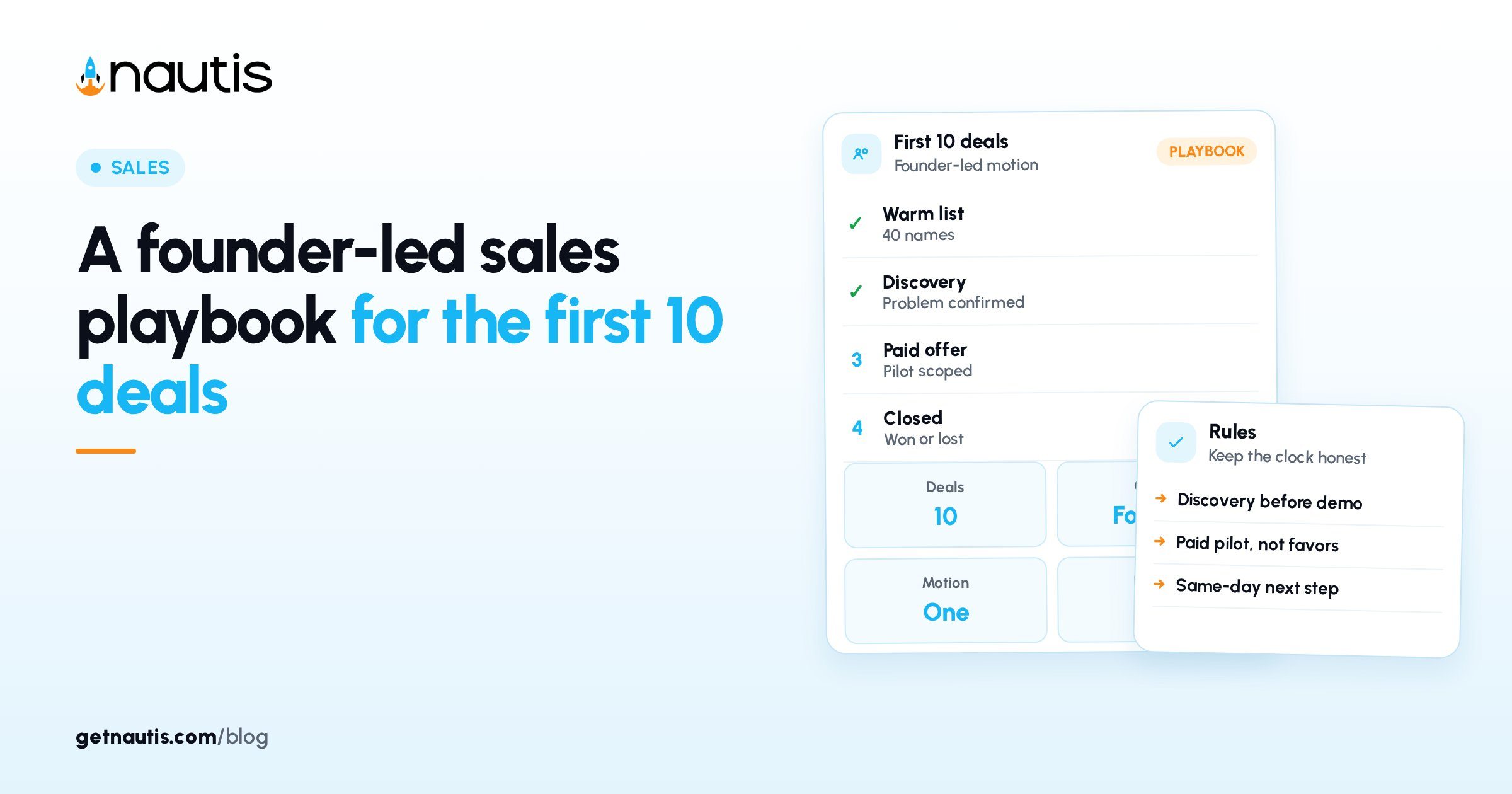
A founder-led sales playbook for the first 10 deals is a short written contract for how you find buyers, run discovery, price a paid next step, and keep learning in one pipeline. The founder owns every first conversation. The playbook exists so those conversations compound instead of resetting every Monday.
Most early teams skip the page and improvise. They open three channels, give away long unpaid projects, and call the fog "pipeline." Y Combinator's Startup School talk by Tom Blomfield on the sales playbook for founders pushes founders to leave vague design partnerships and move toward short, committed pilots that can become recurring revenue. Use that spirit. Write a playbook you can finish in one sitting.
This post is that playbook for the first ten closed or killed deals. Use it even if you never open a customer relationship management (CRM) tool. Where Nautis appears, it is one place to keep the pipeline stages and follow-ups together.
What a founder-led sales playbook is for
Founder-led sales means the person who built the product still runs the first calls. You are not hiring a quota-carrying rep to invent the motion. You are learning which buyer feels pain this week, which offer they will pay for, and which objections repeat.
The playbook is not a fifty-slide deck. It is one page that answers five questions:
- Who is the first buyer, named tightly enough that a stranger could spot them?
- Where do those people already spend time, so outreach matches their day?
- What three discovery questions force a next step or a clean no?
- What paid offer ends the free-forever trap?
- What evidence after ten deals would make you keep, narrow, or change the motion?
If any of those five is missing, you have vibes. Fix the page before you send another cold note.
Case (example): Anir owns a workflow tool for mid-market ops leads. Before he wrote a playbook he ran nine "friendly pilots" with no end date. After he locked one ideal customer profile (ICP) scene, a fourteen-day paid pilot at $1,500 (example figure), and a Monday review of open deals, he closed three paid starts in six weeks and killed four tire-kickers on purpose. Revenue was still small. Learning was not.
Build a forty-name list before you open tools
YC Visiting Partner Max Kolysh's Startup School advice on first customers is blunt: the first ten rarely come from a prospecting tool. They come from people who already trust you enough to take a bet. Start with former colleagues, classmates, and friends in the industry. Then ask for warm introductions from second-degree contacts. Cold outbound comes after that list is empty, not before.
Write forty names in a sheet with columns for company, role, warm path, last touch, and next ask. Forty is an example floor for a founder who can send personal notes in evenings. Adjust the number to the hours you can actually protect.
Prioritize by buying scene, not logo size. A smaller company with a live project beats a famous brand that will "circle back after Q4." Carol Luong's YC blog advice for technical founders also stresses researching triggers before outreach: hiring patterns, product launches, and other public signals that the pain is active now.
Do not spray the same paragraph to forty people. Personalize the first two lines with a specific observation, then state the problem you solve in one sentence, then ask for a short call. Spray-and-pray teaches the market to ignore you.
Run discovery before you demo
A demo that starts with slides wastes the only advantage a founder has: the ability to listen and change the offer the same week. Structure the first live call around the buyer's world.
Illustrative thirty-minute shape (example only):
- Minutes 0 to 5: confirm who else buys and what happens if nothing changes
- Minutes 5 to 18: current process, failed alternatives, and the last time the pain hurt
- Minutes 18 to 25: show only the wedge that matches what you heard
- Minutes 25 to 30: propose a dated next step or name the reason this is not a fit
Ask more than you talk. Luong summarizes research that strong conversations leave most of the airtime with the buyer. Take notes on objections in their words. Repeat the next step aloud before you hang up.
If the buyer cannot name a problem that costs time or money this quarter, do not invent urgency. Park them. Your first ten deals need people with a live project, not polite curiosity.
Stage map for the first ten deals
Keep stages few and exit criteria written. More columns do not create more revenue. They hide stuck work.
Stage | Exit when | Founder action same day |
|---|---|---|
Named lead | Warm path or personal opener drafted | Send or ask for the intro |
Discovery booked | Calendar hold with the real buyer | Prep three questions only |
Problem confirmed | Buyer names pain, alternative, and timing | Decide demo or disqualify |
Paid next step offered | Price, scope, and end date in writing | Send the one-page offer |
In pilot | Kickoff held; success metrics agreed | Daily check-ins while live |
Closed won or lost | Signature or a written no | Capture the learning note |
These stage names are examples. Match them to how you sell, then refuse to invent a seventh column because one deal felt special.
Tom Blomfield's YC talk warns that long unpaid design partnerships and endless free pilots create low engagement. Prefer a short paid pilot with success metrics, or a recurring contract with a clear opt-out, once you have enough product to deliver value fast. Time to first value matters more than feature count. Skip heavy integrations during a pilot if a spreadsheet import gets the buyer to a win sooner.
Price the pilot so it is cheap to say yes and expensive to ignore. Unlimited no-pay work trains tire-kickers. Label every figure you quote as your own offer, not a market benchmark.
Follow-up rules that force a yes or a no
Deals die in silence more often than in hard nos. Write follow-up rules before the first call so you do not negotiate with your own anxiety.
Example rules (illustrative only):
- Every live conversation ends with a dated next step on the calendar
- If a buyer goes quiet, send two short follow-ups over ten business days, then one breakup note that offers a clean close
- Never restart a dead thread with a new feature dump; ask whether the problem is still active
- Legal redlines that are not company-ending get accepted so the deal moves; fight only unlimited liability or intellectual property (IP) giveaways
- Scarcity is only honest capacity: if you can support two pilots this month, say so
Founders often fear naming price. Blomfield argues the opposite: ask early what solving the problem would be worth, and disqualify people who will never pay. A willingness-to-pay conversation in week one saves months of free work.
Visit in person when a deal is large enough to justify the trip. A lunch with the champion often beats another polished deck.
Keep learning in one commercial pipeline
Your first ten deals should leave a trail a future hire can read. Put every lead in one commercial pipeline with stages that match the table above. Record source, deal value, expected close date, and the objection that mattered.
In Nautis, open Leads CRM under Marketing. Create one pipeline for this motion (for example, "First ten B2B deals"), set Shared Access for anyone who must see it, and add leads as Individual or Company records with contacts, Deal Value, Priority, Expected Close Date, Source, and tags. Drag cards through stages as conversations move. Use Closed Won and Closed Lost so win rate is honest. Keep fundraising conversations in the separate Investor CRM so commercial learning stays clean.
If inbound starts to appear, route form fills into the same pipeline instead of a second spreadsheet. Custom forms for lead capture covers that intake path. For the wider ninety-day distribution plan around this motion, see how to build a 30-60-90 day go-to-market plan.
Review the board every Monday for thirty minutes. Counts only: new discovery calls, paid offers sent, pilots live, closed won, closed lost, and the top three objections. Chat threads are not a scoreboard.
When to keep selling yourself
Stay founder-led until the motion is boring. Boring means the same ICP, the same offer, and a repeatable path from discovery to paid next step. Hiring a salesperson before that usually produces expensive confusion: the new hire invents a second pitch while you still do not know which one works.
Signals you are ready to add help (examples, not thresholds):
- You can describe the buyer scene without adjectives
- Three or more paid starts came from the same offer shape
- Objections cluster into a short list you already answer the same way
- Your calendar still owns discovery, but research and scheduling can move to a contractor
Until then, protect founder hours for discovery and closing. Delegate research, list building, and note cleanup first. Do not delegate the first "will you pay?" conversation.
A founder-led sales playbook for the first 10 deals is finished when a teammate can open the page, open the pipeline, and run next week's calls without asking what "soon" means. If they cannot, the playbook is still a speech.
Frequently asked questions
What is a founder-led sales playbook?
It is a short written contract for how the founder finds buyers, runs discovery, prices a paid next step, and records learning for the first deals. It is not a fifty-slide methodology. The page should be clear enough that a teammate can run next week's calls without guessing.
How many deals should a founder close before hiring a salesperson?
Stay founder-led until the motion is repeatable: same buyer scene, same offer shape, and a short list of objections you already answer the same way. Hiring earlier usually creates a second pitch while you still do not know which one works. Use your own evidence, not a fixed industry number.
Should early B2B startups offer free pilots?
Long unpaid pilots often get low engagement. Prefer a short paid pilot with written success metrics, or move toward a recurring contract with a clear opt-out once you can deliver value quickly. Free work that never ends trains tire-kickers.
Where should founders track the first ten deals?
Use one commercial pipeline with few stages and honest Closed Won and Closed Lost exits. Record source, value, close date, and the objection that mattered. Keep fundraising conversations in a separate investor tracker so customer learning stays clean.
Sources
- Y Combinator Startup School, The Sales Playbook For Founders (Tom Blomfield). Checked on November 6, 2026.
- Y Combinator, Sales Advice for Technical Founders (Carol Luong). Checked on November 6, 2026.
- Nautis Help Center, Leads & Sales CRM. Checked on November 6, 2026.
Baltej Singh is a serial entrepreneur, technology leader, and Founder & CEO of Nautis and DemoVexa, with over 16 years of experience building software products, SaaS platforms, and startups. Previously the Co-Founder & CTO of SanchiConnect, he has worked extensively in the DeepTech startup ecosystem, connecting with 200+ venture capital firms and supporting a network of 4,000+ startups. Passionate about AI, automation, and entrepreneurship, he focuses on building innovative products that solve real-world problems and help businesses grow.