How to build a 30-60-90 day go-to-market plan
 Baltej Singh9 min read
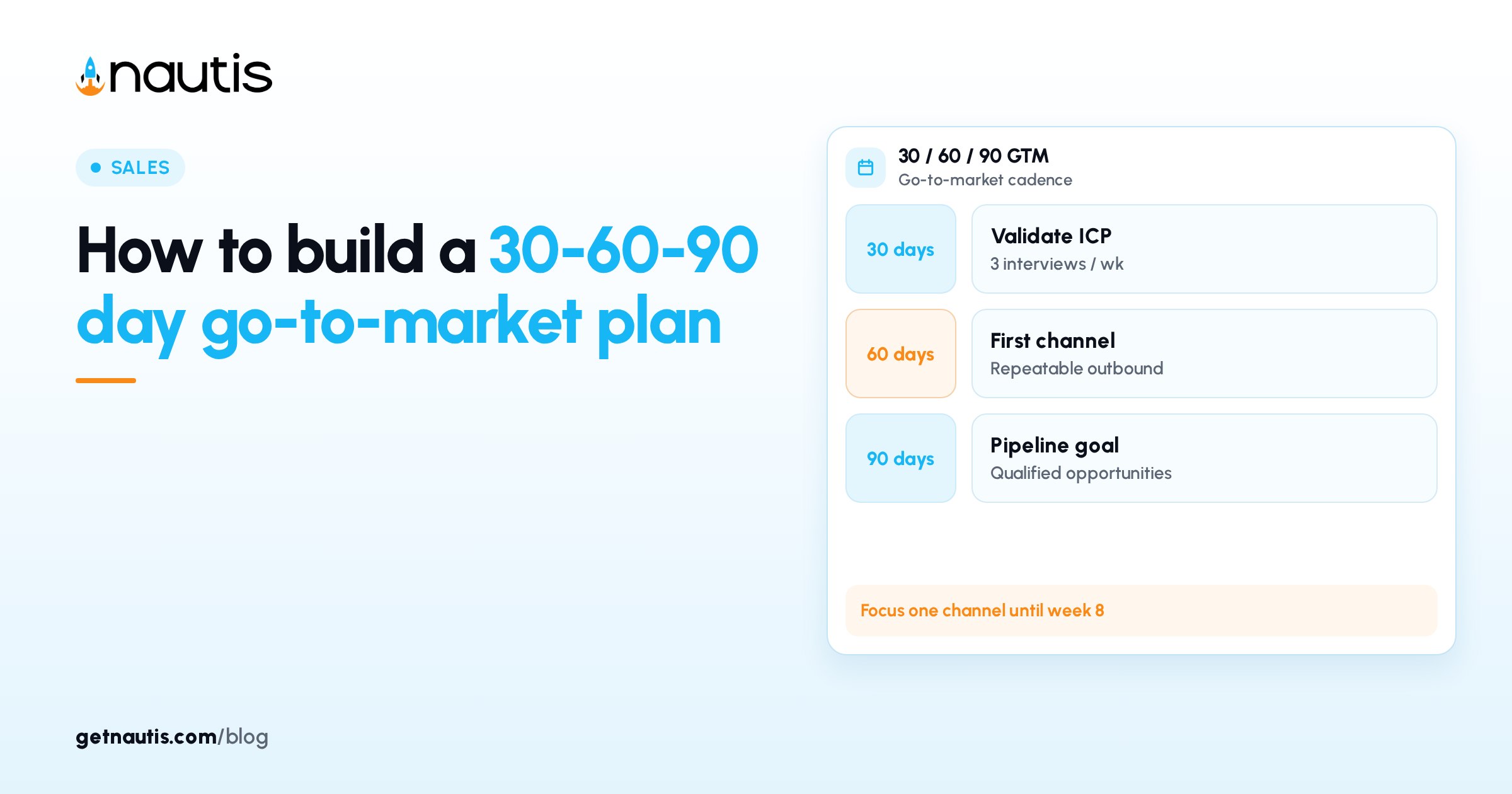
A 30-60-90 day go-to-market plan is a ninety-day sales and distribution contract with yourself. Days 1 to 30 prove one ideal customer. Days 31 to 60 push one channel hard enough to learn unit economics. Days 61 to 90 lock weekly metrics and kill criteria so the plan either compounds or gets rewritten on purpose.
Most early teams skip that contract. They open three channels, rewrite the homepage twice a week, and call the fog a strategy. Y Combinator's essential startup advice is blunt: launch, talk to users, and do things that do not scale before you build process theater. A short GTM plan turns that advice into a calendar.
This post is a working template. Use it even if you never open a GTM product. Where Nautis appears, it is one place to keep strategy, roadmap, tasks, experiments, and metrics together.
What a 30-60-90 day go-to-market plan is not
It is not a ninety-day promise of product-market fit. It is not a brand campaign calendar. It is not a pitch-deck market slide with TAM, SAM, and SOM stacked for theater.
A usable plan answers four questions in writing:
- Who will we sell to first, named tightly enough that a stranger could spot them?
- Which single primary channel will carry most of the learning?
- Which two or three metrics prove the channel is working?
- What evidence would make us stop, change ICP, or change channel?
If any of those four is missing, you have a vibes document. Fix it before day one.
Lock the inputs before the clock starts
Spend a half day on inputs. Do not start the thirty-day clock while ICP is still "SMBs that care about efficiency."
Write the ICP as a buying scene
Describe the person who feels the pain this week, the trigger that makes them look, the budget they control, and the alternative they use today. One ICP. Adjacent segments go in a parking lot note, not in week-one outreach.
Pick one north-star metric and two supporting ones
Examples of north stars early teams actually use: paid pilots started, weekly active workspaces, or qualified demos booked. Supporting metrics might be reply rate and time-to-first-value. Pick numbers you can pull without a data science hire.
Name the primary channel
Outbound founder email, partner intros, content that drives inbound demos, community presence, or a paid test. One primary. Secondary channels stay experimental with a budget cap and an end date.
Set cash boundaries
GTM burns money and attention. Pair this plan with a clear burn and runway habit so a "successful" campaign does not quietly erase months of cash. Keep the arithmetic honest with how to calculate startup burn rate and runway.
Days 1 to 30: prove the ICP
The first month is not for scale. It is for evidence that a defined buyer will take a next step.
Week-by-week shape
- Week 1: ship a thin offer (pilot, waitlist with a paid seat, or a scoped paid workshop). Talk to ten people in the ICP, not about your roadmap, about their last failed attempt to solve the problem.
- Week 2: run unscalable outreach. Personal notes, warm intros, sitting in the communities where buyers already complain. Record every objection in one sheet.
- Week 3: tighten messaging to the three objections that repeated. Kill feature promises that nobody asked for in those calls.
- Week 4: decide with evidence. Keep the ICP, narrow it, or replace it. Do not "also add" a second ICP because week four felt slow.
What proof looks like
Proof is not praise. Proof is a calendar hold, a pilot deposit, a signed order form, or a weekly usage pattern you can screenshot. Soft compliments without next steps are noise. YC's pocket guide puts it plainly: find a small group of customers who love the product rather than a large group who kind of like it.
Founder scenario (example)
Maya sells compliance workflow software to mid-market ops leads. In days 1 to 30 she books twelve ICP calls, lands two paid pilots at $2,000 each (example figures for illustration), and learns that "audit prep week" is the only trigger that creates urgency. She drops "always-on compliance" from the homepage hero. That is a successful month even though revenue is small.
Days 31 to 60: expand one channel
Month two is for depth in the channel that produced signal, not for collecting new logos on LinkedIn.
Double down rules
- Keep the same ICP definition unless month one killed it.
- Raise volume in the winning channel by a fixed factor you can staff (for example, 2x outreach volume or 2x demo slots), not by inventing a second motion.
- Instrument the funnel: touch, reply, meeting, pilot, close. If a stage cannot be counted, it is not a stage yet.
- Cap experiments. One messaging test and one offer test at a time. Parallel tests muddy the learning.
Unit economics light check
You do not need a full finance model. You do need cost per qualified meeting and a rough payback guess. If paid acquisition is the channel and cost per meeting climbs while close rate is flat, stop before the ad account becomes a vanity dashboard.
Founder scenario (example)
Raj's B2B tool got three design partners from founder-led outbound in month one. In month two he refuses conference booths and a podcast tour. He hires one contractor only to research accounts and keeps every first call himself. Reply rate falls from 18% to 11% when he switches from problem-led openers to feature-led ones (example rates). He switches back within a week. The channel still works; the copy was the variable.
Days 61 to 90: lock weekly metrics and kill criteria
Month three is where plans usually turn into slideware. Avoid that by forcing a weekly scoreboard and pre-agreed stops.
Weekly scoreboard
Every Monday, write five lines only:
- Primary metric this week vs target
- Funnel counts for the primary channel
- Cash spent on GTM this week
- Top three objections heard
- One decision: continue, cut, or change
Share that page with co-founders. Chat threads are not a scoreboard.
Kill criteria you write on day 61
Examples of clear kills (adjust to your motion; figures below are illustrations, not benchmarks):
- Fewer than eight qualified ICP meetings in a rolling four weeks after month-two volume increase
- Pilot-to-paid conversion under 20% across ten completed pilots
- Primary channel CAC (or time-cost equivalent) more than 2x the plan you wrote on day 31
- Retention at week four under a floor you set for the product category
If a kill trips, you change ICP, channel, or offer in writing within seven days. Hope is not a patch.
Phase comparison at a glance
Use this as a copy-paste skeleton. Replace the example targets with your own before day one.
Phase | Primary job | Example weekly focus | Example success signal | Default kill if missing |
|---|---|---|---|---|
Days 1-30 | Prove ICP | 8-12 ICP conversations | 2 paid pilots or equivalent commits | No next-step commits after 20 ICP talks |
Days 31-60 | Deepen one channel | 2x volume in the winning motion | Stable meeting-to-pilot rate | Rate collapses after volume rises |
Days 61-90 | Operationalize | Monday scoreboard + one test | Hit metric 3 of 4 weeks | Metric miss + no diagnosis in writing |
The numbers in the table are examples for a founder-led B2B motion. Consumer, marketplace, and enterprise motions need different floors. The shape stays the same: prove, deepen, operationalize.
How to staff the ninety days without a growth team
Early GTM fails when everyone owns it and nobody owns the weekly number.
- One owner for the plan (usually a founder)
- One owner for the CRM hygiene (can be the same person at the start)
- One standing 45-minute weekly review with a fixed agenda
- Contractors only for research, scheduling, or content drafts that the owner still edits
If you are drowning in tools while building the plan, subtract first. A thin stack beats a pile of dashboards; see how to manage a startup without using 15 different tools.
Turning the plan into tasks people finish
Strategy that never becomes dated tasks dies in Notion archaeology.
Break each phase into weekly tasks with a due date and a definition of done. Keep experiments separate from chores: "rewrite outbound opener and send 40 notes" is a task; "see if LinkedIn ads work" is an experiment with a hypothesis, metric, and end date.
In Nautis, the GTM Planner keeps strategy, a 30/60/90 roadmap, a kanban of tasks, experiments, and metrics inside one workspace. The Roadmap tab holds phase goals and weekly actions; Convert selected pushes chosen actions onto the Tasks board so you are not retyping them. The Builder can draft ICP, positioning, and a launch plan you then edit by hand. That does not replace the judgment above; it stops the plan from living in four documents.
If you prefer a simpler board, Task Boards can hold the same weekly work without the full GTM workspace.
Messaging and offer rules that save the plan
- Lead with the buyer's failed alternative, not your architecture.
- Price the pilot so it is cheap to say yes and expensive to ignore. Unlimited no-pay pilots train tire-kickers.
- Keep one case vignette updating weekly: problem, action, measurable result, with permission.
Common ways founders break the ninety-day GTM rhythm
- Starting day one with three ICPs "to keep options open."
- Declaring month one a success because inbound tire-kickers filled the calendar.
- Adding a second channel in week five because the first felt lonely.
- Measuring vanity traffic instead of meetings, pilots, and retention.
- Skipping kill criteria so nobody has permission to stop a failing motion.
- Letting the plan live only in a deck that nobody opens on Monday.
A one-sitting build checklist
Block three hours and leave with a dated document:
- ICP buying scene (one page)
- Primary channel and why
- North-star metric plus two supports
- Phase goals for 30, 60, and 90
- Weekly task list for the next two weeks only (detail the rest later)
- Kill criteria with owners
- Monday review invite on the calendar
Revisit the full plan at day 30 and day 60. Do not rewrite it daily.
Build a 30-60-90 day go-to-market plan that a new hire could execute from the page without asking what "soon" means. If they cannot, the plan is still a speech.
Frequently asked questions
How detailed should a 30-60-90 day go-to-market plan be on day one?
Write ICP, primary channel, metrics, phase goals, two weeks of tasks, and kill criteria. Detail later weeks only after month-one evidence. Daily rewrites usually mean the plan is anxiety, not strategy.
Can we run two channels in the first ninety days?
Keep one primary channel for learning. A second channel can exist only as a capped experiment with an end date. Splitting attention across two primaries usually slows proof of either.
What counts as proof in the first thirty days?
Calendar holds, pilot deposits, signed orders, or repeatable weekly usage. Soft praise without a next step is not proof. Narrow or replace the ICP if twenty conversations produce no commits.
Where does Nautis fit in this plan?
The GTM Planner holds strategy, a 30/60/90 roadmap, tasks, experiments, and metrics in one workspace. It does not invent ICP judgment or kill criteria for you. You can run the same rhythm in a simple task board if you prefer.
Sources
- YC essential startup advice. Checked on October 31, 2026.
- GTM Planner help center. Checked on October 31, 2026.
Baltej Singh is a serial entrepreneur, technology leader, and Founder & CEO of Nautis and DemoVexa, with over 16 years of experience building software products, SaaS platforms, and startups. Previously the Co-Founder & CTO of SanchiConnect, he has worked extensively in the DeepTech startup ecosystem, connecting with 200+ venture capital firms and supporting a network of 4,000+ startups. Passionate about AI, automation, and entrepreneurship, he focuses on building innovative products that solve real-world problems and help businesses grow.