How to prep investor meetings with AI context
 Baltej Singh8 min read
AI meeting prep for founders is not another daily briefing habit. The daily briefing ranks the company. Meeting prep builds a one-call packet: who you are talking to, what they already heard, what changed since last contact, and the single ask you will make in the room. This post shows how to pull that packet from Fundraising CRM, Chief of Staff context, and your calendar tools without pasting the whole company into a consumer chatbot. It is operator guidance. It is not legal advice, and it is not a promise that AI replaces judgment on the call.
AI meeting prep for founders versus the daily briefing
How to run a daily founder briefing from one page covers the morning list. Keep that ritual. For investor meetings, open the deal first. In Fundraising CRM (checked 31 Oct 2026), each deal keeps Notes, Meetings, comments, Files, and a full activity log. Read those before you open Chat. AI without the deal timeline invents a confident story that contradicts last week's email.
AI meeting prep for founders starts with stage honesty. If the deal is still Contacted, do not prep as if Term Sheet is inevitable. If Follow up today shows a Beacon draft, Approve & send only what you mean; Reject or Dismiss leftovers so prep is not fighting stale chase copy. Pipeline stages such as Lead, Contacted, Meeting, Term Sheet, Committed, and Passed (customizable later) only help if you believe them while you prep. Open the activity log and skim the last three touches in order. If the log shows a warm reply you forgot, your ask may already be obsolete. If the log shows silence after Docs out, prep should include a decision to chase, wait, or mark Lost rather than a cheerful product tour.
Build a one-page prep sheet
Block | Source in Nautis | What to write in one line |
|---|---|---|
Who and firm | Deal + stakeholder fields | Name, fund, last meeting date |
Stage and amount | Pipeline stage, Notes | Current stage; amount last discussed |
Instrument | Notes / Files | SAFE, note, or priced; cap or discount if disclosed |
Last promise you made | Notes / activity | Exact sentence you owe them |
Their last objection | Notes | One clause, not a novel |
Company change since then | Briefing / Memory | Metric or milestone with as-of date |
Single ask for this call | Your judgment | Intro, diligence open, or close next step |
Landmines | Cap Table / Files | Ownership or doc gaps you will not bluff |
Print or keep the sheet in Notes on the deal. If a block is empty, that is the prep finding: you are not ready to sound precise. Fill the block or shorten the ask. Empty objection and empty promise lines are the usual reason calls turn into vague tours.
Time box
Twenty-five minutes total: ten for CRM history, ten for Briefing and Cap Table spot-checks, five to sharpen the single ask. If CRM history alone takes twenty minutes because Notes are empty, the work is filing, not prompting. Do the filing before you ask any model to summarize air.
Pull context from Chief of Staff without dumping secrets into a blank chat
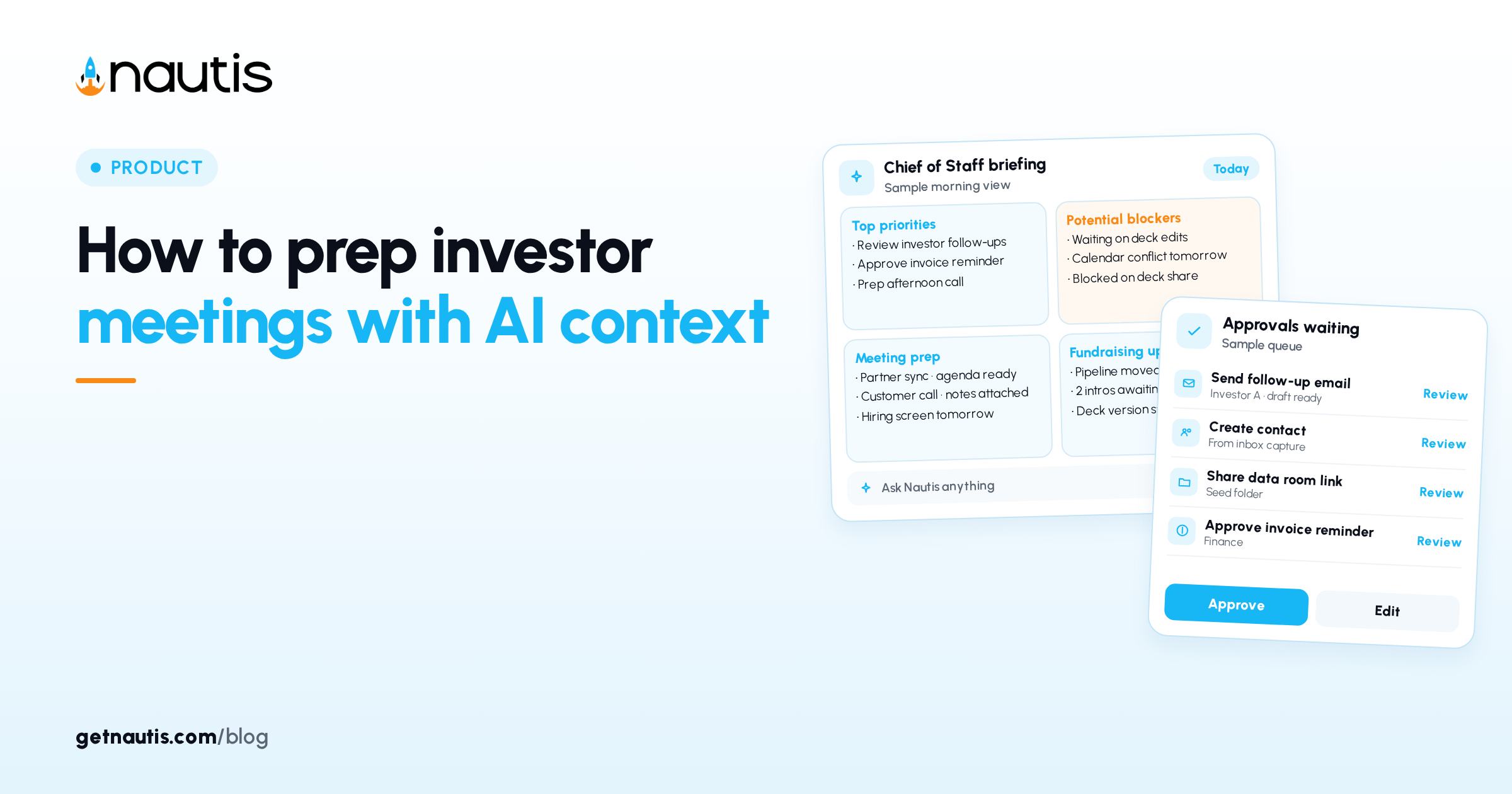
Open Chief of Staff (checked 31 Oct 2026). Use Briefing to see Priorities, Blockers, Approvals, Pipeline, Today, and Runway that might change what you say. For a deal-specific dig, Ask Commodore from a briefing item when you need context, or use Chat with a narrow question that names the firm and the open question. Do not paste cap table exports into a consumer model when Cap Table and Documents already hold the truth inside your workspace. When you use Chat, constrain it: three bullets on what changed for this firm since the last meeting, grounded in Briefing and Notes. Edit every sentence against Files. If the model invents a customer logo or a raise figure, correct Memory or reject the line. Prep is a filter, not a content farm.
Memory (company brief, narrative, facts and commitments) should already carry verified numbers. If Briefing cites a metric that feels wrong, correct Memory before the call rather than improvising. Approvals that are still Pending can be landmines: clear or schedule them so a routine does not send something mid-meeting. Owners and Admins set Agent Autonomy; your prep still includes glancing at Approval Center when External actions might fire during the hour.
Meetings module versus deal Meetings
Meetings (checked 31 Oct 2026) is booking links, availability schedules, and event types under Profile & Company. Deal-level Meetings inside Fundraising CRM are the relationship history on that investor. Use the booking tools to reduce scheduling friction; use the deal Meetings log to remember what was already said. Confusing the two is how founders re-ask questions they already answered on a prior call.
Liftoff can seed a booking link during Meet your Chief of Staff, but a link without a prep sheet still produces empty conversations. Scheduling success is not prep success.
Illustrative thirty-minute prep (composite only)
The sequence below is a composite illustrative example, not a real raise.
Illustrative prep: Founder opens the Seed round deal for a partner meeting tomorrow. Notes show last objection was pool size. Files hold the SAFE PDF. Stage is Meeting. They write the prep sheet: ask is confirm diligence list and timeline; company change is two design partners live as of this week; landmine is option pool slide still shows old percentage. Briefing shows a Blocker on a customer intro that matters to this firm; they Ask Commodore for a three-bullet update, then edit it against Notes. Last five minutes: one ask sentence rehearsed aloud. No new deck cosmetics.
Illustrative point: the AI step was narrow. The CRM and ledger did the heavy recall. A second illustrative habit: after two partner meetings in one week, compare prep sheets. If the company-change line is identical and vague both times, Memory and Briefing are not feeding you; fix the facts before the third call.
The last ten minutes before you join
Close tabs that are not the prep sheet, the deck, and the deal. Confirm Fundraise Target still matches what you will say about the raise size. Confirm you will not quote ownership without Cap Table Overview in reach. Confirm Follow up today has no half-approved draft that could send while you talk. Spend the last minutes on the single ask, not on polishing paragraph four of the narrative.
If the ask is unclear, the meeting will become a tour. Tours feel polite and produce no next step. AI meeting prep for founders fails when the model writes a beautiful agenda and you still do not know what yes looks like today. Write the yes condition in brackets on the prep sheet (for example: leave with diligence folder request or leave with intro to another partner). Put the no condition too: what you will not negotiate live (board seat, new instrument, off-sheet discount). Live renegotiation without Scenarios and counsel is how cap tables get messy after "great calls."
After the call: file before you celebrate
Same day, write three lines into deal Notes: what they said, what you promised, next date. Attach anything new under Files. Update stage only if reality changed. If you used Chat to draft a follow-up, edit it against Notes, then Approve & send from Follow up today if that is your path. Keep chase and close cadence on Raise HQ so prep and follow-up stay one system instead of a private doc that dies after the Zoom. If Beacon drafts a follow-up that ignores the three Note lines you just wrote, Reject it and Draft follow-up from the Notes truth. Approving a pretty draft that forgets the diligence list trains the wrong habit.
If the call surfaced a Memory error, correct Memory before the next briefing cycle. If it surfaced a Cap Table mismatch, fix Cap Table before the next ownership sentence leaves your mouth. If it surfaced a missing File, upload it before you ask them for anything else.
Same-day minimum
Three Note lines, stage update if needed, Files upload if needed. Skip the private "I will write it up tomorrow" promise. Tomorrow's Briefing will not remember the partner's exact objection unless you filed it.
Team rules so prep stays light
Name who owns prep sheets for partner-level meetings. Share the table template in a company Note. Ban consumer-chat pastes of customer names, unreleased metrics, or signed PDFs. Prefer Ask Commodore and deal context inside Nautis when the workspace already holds the files. Prefer silence over speculative answers when a prep block is empty.
Two founders on the same call should share one prep sheet, not two conflicting asks. Align the ask in writing five minutes before joining. If an associate joins, send them the same sheet. Different asks in the same Zoom are worse than a slightly imperfect ask everyone shares. AI meeting prep for founders works when context is assembled from systems of record, the ask is one sentence, and Notes capture the truth before the glow of the call fades. The model helps summarize. The packet decides whether the hour was real work.
Frequently asked questions
How is AI meeting prep different from the daily founder briefing?
The briefing ranks company-wide work. Meeting prep assembles a deal-specific packet: history, changes, landmines, and one ask for a single investor conversation.
Where should founders pull investor context in Nautis?
Start in Fundraising CRM on the deal (Notes, Meetings, Files, activity). Then use Chief of Staff Briefing or Ask Commodore for narrow updates. Keep booking links in the Meetings module separate from deal meeting history.
What belongs on the prep sheet?
Who and firm, stage and amount, instrument, last promise, last objection, company change with as-of date, the single ask, and landmines you will not bluff. Empty blocks mean you are not ready to sound precise.
Should I paste the deck into a consumer chatbot to prep?
Prefer workspace tools that already hold CRM and Cap Table truth. Avoid pasting signed PDFs, customer names, or unreleased metrics into consumer chats when Nautis already stores the files.
Sources
- Nautis Fundraising CRM. Checked on October 31, 2026.
- Nautis Chief of Staff. Checked on October 31, 2026.
- Nautis Meetings. Checked on October 31, 2026.
Baltej Singh is a serial entrepreneur, technology leader, and Founder & CEO of Nautis and DemoVexa, with over 16 years of experience building software products, SaaS platforms, and startups. Previously the Co-Founder & CTO of SanchiConnect, he has worked extensively in the DeepTech startup ecosystem, connecting with 200+ venture capital firms and supporting a network of 4,000+ startups. Passionate about AI, automation, and entrepreneurship, he focuses on building innovative products that solve real-world problems and help businesses grow.