How to ship something every week as a founder
 Baltej Singh8 min read
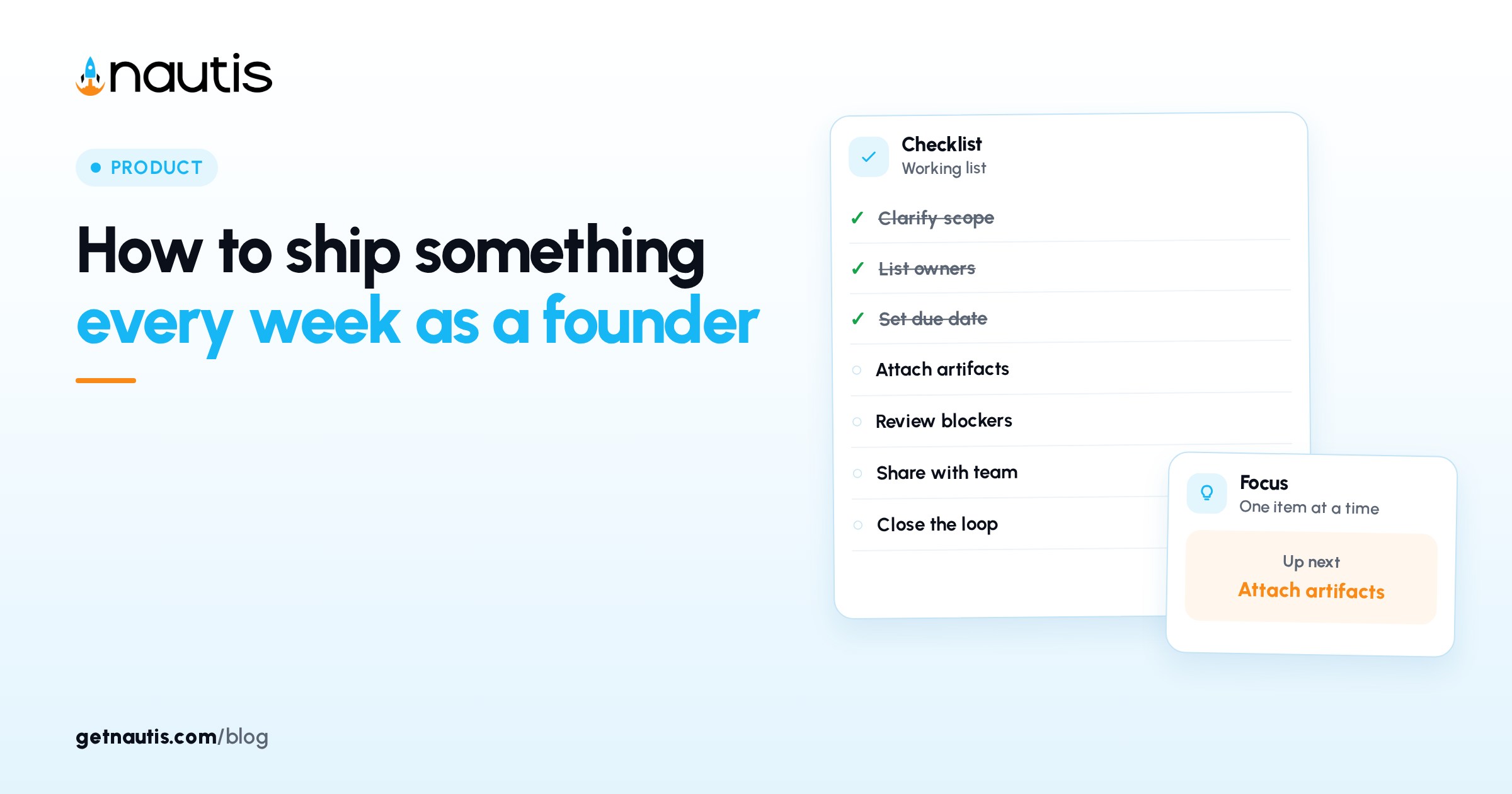
How to ship something every week as a founder is a release habit, not a status meeting. You put a user-visible change into the world on a fixed rhythm, write what changed, and watch one signal afterward. The point is external movement, not another calendar ceremony.
Y Combinator's (YC) essential startup advice keeps pushing focus and speed over process for its own sake (Y Combinator Library, checked 1 Nov 2026). Treat shipping as proof of focus: something left the building.
How to ship something every week as a founder without fake launches
The useful version is four moves: name the artifact, protect a release window, define Done as something a stranger can notice, and record a short learning after it is live. Skip hero launches. Prefer thin changes users can find without a tour from you.
It is not a weekly review of metrics. It is not a shutdown note. It is not a private branch labeled "almost done."
Illustrative pattern (composite only): a founder titles the change "Cut signup errors for new workspaces," blocks a two-hour release hold, ships a narrow fix, posts a three-line changelog, and names who will watch error rate for the next day.
If priorities already surface in a daily founder briefing, park the ship candidate there so meetings do not erase it. The briefing is intake; the ship is the output. Do not let the intake meeting become a substitute for the release.
Name the artifact before you touch the calendar
Write the ship title first. Verb plus object plus audience. Examples: "Cut signup errors for new workspaces", "Send the partner one-pager to the pilot list", "Publish the pricing FAQ customers already ask".
Refuse titles that begin with "work on" or "explore". Those are research holds, not releases.
Keep a short queue of candidate titles so you never start empty. Pull from support themes, objections you already heard on calls, and your own stuck workflow.
Share the title with anyone who can block you. Invisible ships get overwritten by meetings.
Add a non-goal line under the title: what you will not include this time. Scope creep is how release windows die.
When the title still feels fuzzy mid-cycle, shrink it. A thin ship that lands beats a wide ship that slips.
Protect a release window like payroll
Put a busy hold on the shared calendar for the release window. A couple of focused hours beat a vague "sometime later."
Team shape | Release window | Owner duties | Watch after |
|---|---|---|---|
Solo builder | Midweek afternoon block | Ship + changelog | Next business morning |
Founder + one builder | Review day before, ship day after | Founder accepts Done | 24 hours |
Tiny product trio | Dedicated ship block, short demo after | Rotating release captain | Light watch next day |
Decline new meetings that collide with the window unless revenue is on fire. Moving the window constantly trains the company to treat releases as optional.
Batch interruptions outside the hold. Chat that can wait usually can wait. If an interrupt is truly urgent, end the window early and reschedule rather than context-switch mid-release.
Remote founders should treat the hold as focus time with notifications off. The ritual fails when the calendar says busy but chat stays open.
When travel destroys the plan, ship a thinner artifact rather than skipping: a public status note, a fix to a help article users already hit, or a recorded demo sent to the pilot list. Continuity matters more than impressiveness.
If you must slip, slip once with a written reason and a new dated window in the same note. Silent slips kill the habit.
Define Done as something a stranger can notice
Done means a user, customer, or teammate outside your head can experience the change without a guided tour from you. Merged code with no release is not Done. A deck that never leaves the folder is not Done.
Write three checks before you call it shipped:
- Who can see it now with no ask to you?
- How do they find it (link, email, in-product)?
- What is the rollback or apology path if it breaks?
Keep the change small enough to reverse. Huge yearly launches are a different sport.
Post a short changelog where your users or teammates already look. Three lines beat a blog essay. Link the evidence (pull request, email, screenshot) for your own closeout note.
Template the changelog so you do not invent voice each time: what changed, who it helps, what to do next if something looks wrong. Consistency builds trust faster than clever copy.
For user-facing breaks, draft the apology line before you release. Founders who invent crisis copy under pressure usually overpromise.
Common anti-patterns to refuse: calling a staging-only change "live", bundling five ideas into one "ship", waiting for perfect analytics before any release, and renaming the window whenever mood shifts. Each pattern recreates silence with better excuses.
If you use feature flags, say whether the flag is on for real users in the Done checks. A dark flag with no audience is still a private branch.
Separate learning releases from vanity releases
A learning release changes a behavior you can observe: activation, reply rate, error rate, time-to-value. A vanity release only produces a nice screenshot.
Before you start, write the signal you expect within a short watch window. After ship, write worked, mixed, or failed with a single sentence of evidence.
Store that verdict where you keep experiments so the next title queue improves. In Nautis, finished experiments can become learning events in the Learning engine when you log a real result (Learning engine help). The module stores lessons; it does not ship the product for you.
Pair the watch signal with a single owner. "We will see what happens" is not a watch plan. Name who looks at the metric or inbox thread after ship and when they report back.
Skip vanity releases when cash or trust is tight. Users forgive small useful changes. They do not forgive radio silence followed by a giant surprising redesign.
Useful thin releases for quiet stretches include: clarifying empty states, fixing the top support confusion, removing a dead setting, or publishing the answer you already typed five times in chat. Thin is not the same as trivial when users feel it.
Customer-facing copy releases count. Clarifying an error message that confuses new signups can outperform a flashy screen nobody finds. Count it when users can see it absent your tour.
When a release needs a partner or customer to click something, send the ask the same day you go live. A changelog nobody receives is a diary entry.
Close the loop after it is live, then queue the next title
Answer four prompts in a single note:
- What shipped and where can someone see it?
- What signal will we watch, and until when?
- What did we learn that changes the next title in the queue?
- What blocked shipping, and who owns the unblock?
Send the note to anyone who depends on the product. Silence makes partners assume nothing moved.
If nothing shipped, write that plainly and name the blocker. Pretend ships poison the habit.
Founders raising at the same time can still keep the habit: ship to users, then mention the learning in investor updates without turning the cycle into deck work. Fundraising follow-ups have their own path in manage investor follow-ups; do not let that path cancel the release window.
Close the note with a draft of the next title even if it changes later. Empty queues recreate panic.
Keep these notes in the same folder so you can scan a month of releases quickly. Scattered notes hide streaks and hide slips.
Keep the release checklist short as the team grows
When you hire, keep a single company Done definition before you invent per-squad ceremonies. Multiple windows lacking a shared Done definition recreate silence.
Rotate the release captain so the founder is not the only person who knows how to ship. Document the Done checks where the team already tracks work, such as Task boards.
Retire steps nobody runs. Add a step only after the same miss happens twice (for example, shipping without a rollback owner).
Measure the habit with a pair of counts for a quarter: cycles with a real external ship, and median days from title to Done. If titles stall past the window often, your scopes are too wide.
Celebrate the boring streak. Ten plain releases in a row teach the company that movement is normal. Occasional hero launches cannot replace that baseline.
If you sell to businesses, remember that buyers notice changelogs and status pages. A quiet product looks abandoned even when the team is busy internally. External proof is part of the habit, not a marketing side quest.
How to ship something every week as a founder compounds when the outside world sees movement on a rhythm you can sustain across quiet weeks and loud ones. Name the artifact. Protect the window. Define Done. Write the learning. Repeat the loop without waiting for inspiration.
When in doubt, shrink the scope and keep the date. A smaller external change teaches more than a larger internal almost.
Frequently asked questions
How do you ship something every week as a founder?
Name a user-visible artifact early, protect a release window, define Done so a stranger can find the change, then write a short learning note after it is live.
Is this the same as a weekly review?
No. A weekly review inspects numbers and decisions. Shipping puts an external change into the world. Keep the release habit separate from review meetings.
Does every ship need to be product code?
No. Help articles, pricing FAQs, partner notes, and recorded demos count when the audience can find them without you. Private branches do not count.
What if fundraising fills the calendar?
Ship a thinner artifact rather than skipping. Investor follow-ups have their own track and should not cancel the release window every cycle.
Sources
- Y Combinator Library, Essential startup advice. Checked on November 1, 2026.
Baltej Singh is a serial entrepreneur, technology leader, and Founder & CEO of Nautis and DemoVexa, with over 16 years of experience building software products, SaaS platforms, and startups. Previously the Co-Founder & CTO of SanchiConnect, he has worked extensively in the DeepTech startup ecosystem, connecting with 200+ venture capital firms and supporting a network of 4,000+ startups. Passionate about AI, automation, and entrepreneurship, he focuses on building innovative products that solve real-world problems and help businesses grow.