Cash flow vs profit for early startups
 Baltej Singh8 min read
Cash flow vs profit startup confusion usually shows up as a calm dashboard and an empty payroll account in the same week. This post opens on that failure, walks the mistakes that cause it, and keeps one illustrative company in view the whole way. It is operating guidance for early teams. It is not accounting, tax, or audit advice.
The week profit looked fine and cash did not
Illustrative company: Mira Labs (composite only, not a real customer). In March they closed three annual contracts on paper for $90,000 of booked revenue. The P&L screenshot in the partner update looked green. Bank cash on the Friday before payroll was $41,000. Two invoices were still Net-45. One customer paid a deposit; two had not paid anything. Contractors billed weekly. The founder had been quoting "we are profitable this month" in Slack.
Nothing in that story is exotic. Cash flow vs profit startup mixups happen when recognition, collection, and burn language share one optimistic sentence. Mira's mistake was not signing the deals. It was treating accrual-shaped profit as permission to spend cash that had not arrived.
Hold Mira in mind. Every section below returns to their Friday number before it generalizes.
How the week started, still illustrative: Monday standup used "profitable March" as a morale line. Tuesday the AE celebrated the third signature. Wednesday finance exported a P&L PDF for the update. Thursday cards cleared. Friday the bank balance refused to match the story. The gap was always collection timing. The language made it look like a mystery.
Mistake: saying profitable when you mean invoices exist
Profit on an accrual view can rise when you deliver or when you book the contract, depending on your policy. Cash rises when money clears the bank. Those clocks disagree on purpose.
For Mira, $90,000 of annual contracts did not put $90,000 in the bank in March. An illustrative split: $15,000 deposit cleared, $75,000 still receivable. If someone divides "profit" by monthly burn and calls it runway, they invent months that the bank cannot fund.
Fix in language first. Say "booked" or "recognized" when you mean the P&L. Say "collected" when you mean the bank. Say "outstanding invoices" when you mean promises. Cash flow vs profit startup literacy is mostly refusing to reuse the word profitable for all three.
Write the three words on the top of the weekly doc so new hires inherit the split. Mira's Slack culture punished anyone who sounded cautious, which is how the wrong synonym spread. Reward the person who asks "collected or booked" in the meeting. That question is cheaper than a payroll scramble.
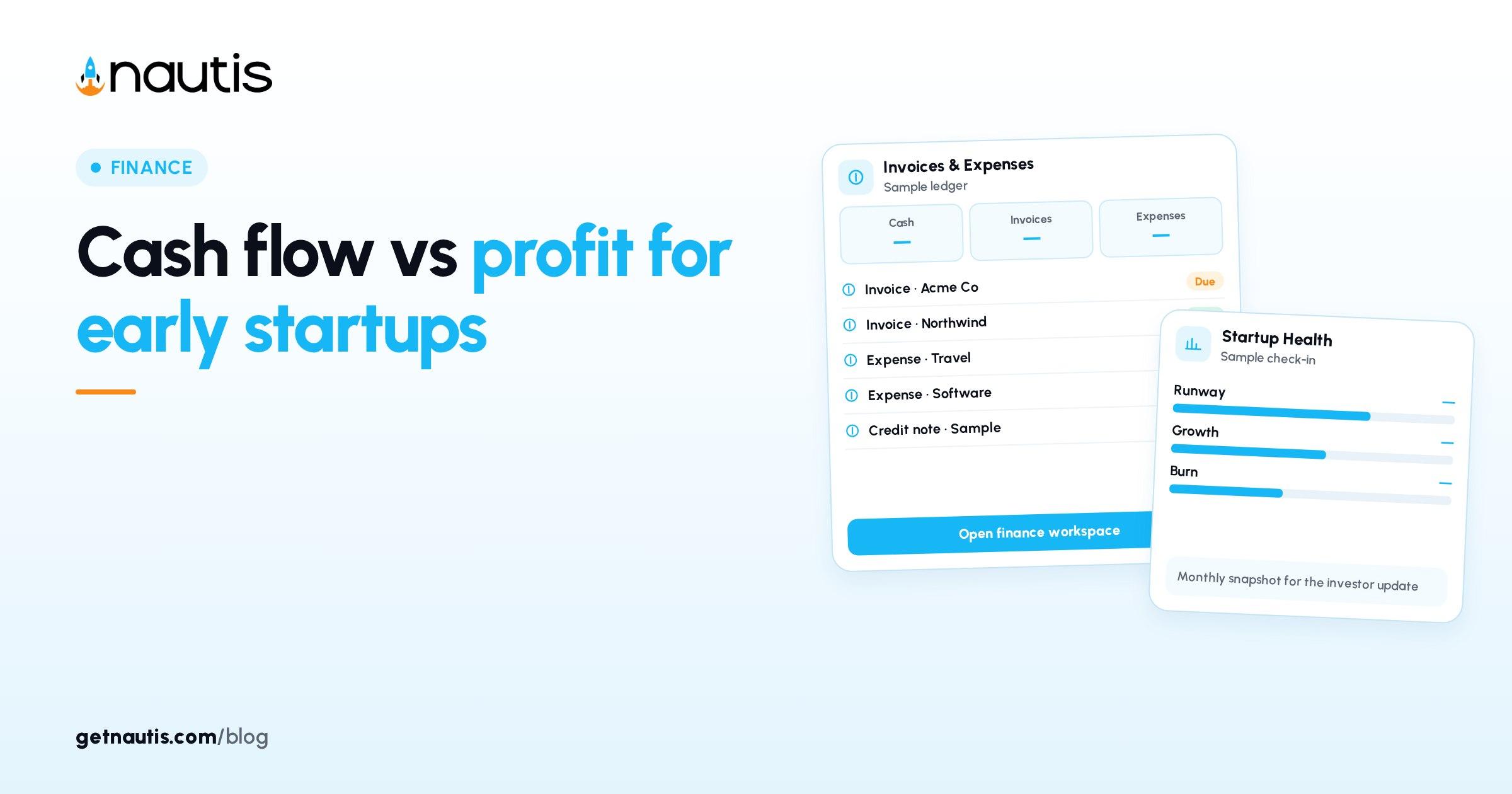
In Nautis, customer billing lives in Invoices (checked 31 Oct 2026): create PDFs, send email, track who has paid, record partial payments, and use credit notes when you refund or reverse. That module is for billing customers. It is not your Nautis subscription billing under organization settings. Mira's founder should have opened invoice payment status before the Slack claim, not the revenue total alone.
Mistake: feeding burn with the wrong profit story
Burn and runway answers need cash, not vibes. Gross burn is cash out. Net burn is cash out minus cash in for the period. Runway is cash divided by the burn definition you named. The dedicated walkthrough is How to calculate startup burn rate and runway. The cash flow vs profit startup failure is dragging accrual profit into that sentence.
Mira's illustrative burn that Friday: about $38,000 cash out in the last thirty days, about $12,000 cash in (the deposit plus a small monthly). Net burn near $26,000. Cash $41,000. Runway on net burn is under two months, not the "we are profitable" calm the P&L suggested. If they had used booked revenue as cash in, net burn would look tiny and runway would look comfortable. That comfort is fictional.
Verified habit: once a month, enter Cash Balance, Monthly MRR (recurring only; skip one-off sales), and Monthly Burn (total spend minus revenue; enter 0 if cash-flow positive) in Startup Health (checked 31 Oct 2026). Nautis turns those three inputs into runway, growth, burn-trend metrics, alerts, and an investor snapshot. Mira should have typed bank cash and true burn there before the partner update, then explained any gap between booked revenue and collected cash in the snapshot narrative instead of hiding it.
Mistake: letting expenses and payroll run on P&L confidence
Spend is paid in cash even when the month "made money" on paper. Contractors, card bills, and payroll do not accept a screenshot of booked ARR.
Mira's illustrative Friday list: $22,000 payroll Monday, $6,000 contractor batch Wednesday, $4,000 SaaS and ads already settled. Receivables of $75,000 do not move those dates. The founder cut marketing in panic after payroll cleared, which was later than a cash forecast would have forced the cut.
Log actual spend where it belongs. Expenses (checked 31 Oct 2026) is where you record business expenses, attach receipts, sort by category, and watch spend against budgets. Recurring subscriptions and approval chains exist so card spend is not a surprise. Mira needed the expense export beside the invoice aging list, not a single profitable badge.
Rule that would have saved the week: no new non-customer spend while collected cash covers fewer than two payroll cycles, regardless of P&L. Write the rule with a number. Mood-based freezes arrive after the bounce risk.
Illustrative application for Mira: two payroll cycles at $22,000 means $44,000 cash reserved before discretionary spend. At $41,000 on Friday they were already inside the reserve. The annual-deal celebration should have triggered the freeze on Tuesday, not the apology on Friday. Put the reserve math in the same note as the invoice aging list so sales wins do not auto-approve spend.
Mistake: one chart that pretends the clocks match
Founders often paste a green P&L bar next to a runway claim and hope the reader blends them. Diligence readers separate them. So should you.
Use a scannable split every Monday. Mira's illustrative four lines that Friday should have been:
Line | Figure | Definition in force |
|---|---|---|
Cash in bank | $41,000 | Cleared balance, not booked revenue |
Gross burn (30d) | $38,000 | Cash out only |
Net burn (30d) | $26,000 | Cash out minus cash in |
Runway at net burn | ~1.6 months | Cash / net burn; receivables excluded |
Beside that table, keep a second tiny list: invoices outstanding by age, and profit or loss for the month on your stated policy. Two lists. One table for cash. Never one blended "health" number that mixes profit with runway.
When someone asks "are we profitable," answer with the P&L list. When someone asks "how long can we operate," answer with the cash table. Cash flow vs profit startup clarity is the refusal to answer both with the same adjective.
Practice the fork out loud once with the team. Mira's illustrative board observer asked a single blended question; the founder gave a single blended answer. Split the reply anyway. Observers learn fast when you show two columns. They lose trust when one adjective has to carry cash and accrual at once.
If you maintain a longer model, keep profit and cash flow as separate outputs. Do not let a single dashboard tile titled "momentum" overwrite the bank. Alerts in Startup Health that flag runway under six months or burn jumping versus last month are cash alerts. Treat them as cash alerts even when last month's P&L was flattering.
Cash flow vs profit startup questions after the scare
Is positive profit the same as positive cash flow?
No. Profit follows your recognition rules. Cash flow follows the bank. Mira was illustratively "up" on booked annual contracts and still weeks from covering payroll with cleared funds.
Can I include outstanding invoices in runway?
Not as cash. You may show a second scenario labeled collections if paid by date X, with probabilities you can defend. Do not fold unpaid invoices into the primary runway denominator or numerator without labeling the fiction.
What should we put in the weekly update?
Four cash lines (cash, gross burn, net burn, runway), plus booked versus collected for the month, plus the largest unpaid invoice age. Mira's partner update failed because it led with profit and buried collection risk.
Does MRR equal cash collected?
No. Startup Health asks for Monthly MRR as recurring revenue and Monthly Burn as spend minus revenue for the check-in math. Still reconcile MRR to what actually cleared. Annual prepay can spike cash while MRR stays smooth. Monthly invoices can keep MRR tidy while cash lags.
When do we revisit the rule set?
When payment terms change, when you start annual billing, when payroll steps up, or when a customer concentration crosses a third of booked revenue. Mira should have revisited the day the first Net-45 annual deals landed, not the Friday before payroll.
What if accrual profit and cash disagree for months?
Expect that during annual billing ramps, hardware lead times, or heavy prepaid contracts. Report both without forcing them to converge in rhetoric. Schedule collection work like product work: owners, dates, escalation. Mira's illustrative miss was celebrating booking velocity while nobody owned days-sales-outstanding.
Cash flow vs profit startup discipline is a speaking habit backed by two artifacts: invoice and expense truth for the clocks, and a cash table that never borrows the word profitable. Keep Mira's Friday as the caution. Booked green is not cleared green. Cleared green is what pays people.
Frequently asked questions
Is positive profit the same as positive cash flow?
No. Profit follows recognition rules. Cash flow follows the bank. Annual bookings can look green on a P&L while payroll still depends on unpaid invoices.
Can outstanding invoices count toward runway?
Not as cash in the primary runway figure. You may show a separate collections scenario with dates and honest probabilities.
What belongs in the weekly cash update?
Cash in bank, gross burn, net burn, runway at the named burn definition, plus booked versus collected and the oldest large unpaid invoice.
Does MRR mean cash collected?
No. MRR is recurring revenue. Always reconcile it to what cleared, especially with annual prepay or Net-45 terms.
Sources
- Nautis Startup Health help. Checked on October 31, 2026.
- Nautis Invoices help. Checked on October 31, 2026.
- Nautis Expenses help. Checked on October 31, 2026.
- How to calculate startup burn rate and runway. Checked on October 31, 2026.
Baltej Singh is a serial entrepreneur, technology leader, and Founder & CEO of Nautis and DemoVexa, with over 16 years of experience building software products, SaaS platforms, and startups. Previously the Co-Founder & CTO of SanchiConnect, he has worked extensively in the DeepTech startup ecosystem, connecting with 200+ venture capital firms and supporting a network of 4,000+ startups. Passionate about AI, automation, and entrepreneurship, he focuses on building innovative products that solve real-world problems and help businesses grow.