What to put on a use of proceeds slide
 Baltej Singh8 min read
What to put on a use of proceeds slide is not a design question. It is a honesty check: does the money story in the deck match the ask in your CRM, the files in your data room, and the plan your team can execute. Investors read this slide to see whether you know where cash goes month by month. Mystery buckets fail that test. This post is an operator guide for founders building a seed or early round deck. It is not legal, tax, or accounting advice. Ask counsel and your accountant before you publish numbers externally.
Use of proceeds slide: the only jobs it has
The slide has three jobs. First, show categories that add up to the raise amount. Second, tie each category to a milestone an outsider can verify later. Third, match The Ask & Round Terms you already claim elsewhere. If the deck says $2.0M and Raise HQ Fundraise Target says $1.5M, fix the mismatch before the next meeting.
A use of proceeds slide is not a second financial model. It is a one-page map. Detail lives in Financial Planner scenarios, offer letters, and vendor quotes. The slide only has to be directionally true and arithmetically clean. Founders who paste the entire model onto a slide teach investors to negotiate line items instead of the plan. Founders who show only vibes teach investors to assume the cash has no owner. Aim for the middle: few bars, named milestones, matching totals.
Line items that belong (and buckets that do not)
Put this on the slide | Typical seed meaning | Leave this off or rename it |
|---|---|---|
Product and engineering | Hires, contractors, core build | "R&D" with no headcount |
Go-to-market | Sales or marketing seats, launch spend | "Growth" with no channel |
Customer success or ops | Support that keeps revenue | "Ops" as a junk drawer |
Runway buffer | Explicit months of cash after plan | "Contingency" at 40% with no story |
Infrastructure | Cloud, security, tooling tied to scale | "Other" as the largest bar |
One-time setup | Legal, audit, or migration if material | Tiny fees that clutter the chart |
If a bar cannot survive the question "what hire or vendor is that," it is not ready for the slide. Merge micro-lines. Split vanity megabars. Your use of proceeds slide should be readable on a phone screenshot.
Build the slide in six passes
- Lock the ask amount and instrument in one internal note shared with co-founders.
- List hires and major vendors with rough monthly cost and start month.
- Roll those into five or fewer categories that sum exactly to the ask (or to ask plus a labeled buffer that still totals the ask).
- Write one milestone under each category (ship date, pipeline target, runway months).
- Paste the same ask into Fundraising CRM Fundraise Target (checked 31 Oct 2026) so Raised math stays honest.
- Store the PDF in Data Rooms with the deck version date in the filename.
Skip pass 5 and you will contradict yourself on a partner call. Skip pass 6 and diligence starts in email attachments. Creating a data room needs verified email and the matching create permission; each room has its own files, folders, sharing rules, and activity log. Use that structure so the proceeds PDF is not a orphan file in Downloads.
Illustrative bad slide vs cleaner slide (composites only)
The examples below are composite illustrative examples, not real decks.
Illustrative bad version: Four bars labeled Growth, Product, Ops, and Other. Other is 35%. No hire counts. No months of runway. Ask on the title slide is $2.5M; use of proceeds totals $2.1M. Notes say "we will fine-tune with whoever leads."
Illustrative cleaner version: Bars for Engineering (two senior IC hires plus contractor budget), GTM (one AE, one marketer, launch spend), Customer ops (one seat), Infrastructure (cloud and security), and Runway (explicit six months after the hire plan). Total equals the $2.0M Fundraise Target. Each bar has a one-line milestone. The same PDF sits in the data room folder for the active round.
The illustrative lesson is arithmetic plus specificity, not prettier colors. Walk the cleaner version with your eng and GTM leads before any investor sees it. If they cannot point to their own seats on the bars, you are still in the bad version.
Keep readiness, CRM, and the deck in the same story
Investor Readiness (checked 31 Oct 2026) scores fundraising fundamentals including The Ask & Round Terms and Data Room. If Overview still says Not yet because round terms or the data room are empty, a polished use of proceeds slide will not invent a Ready to raise verdict. Fill the ask, instrument, and files first.
When the round moves, update the slide the same day you change Fundraise Target. Old PDFs in investor inboxes will linger; your live data room version and your spoken ask must still match. If you cut the raise mid-process, republish the slide and note the version in CRM Notes for deals still open.
Cap Table does not replace use of proceeds, but ownership promises and hire plans collide when you sell more of the company than the plan can staff. Glance at Cap Table Overview for issued, authorized, and fully diluted totals before you present a hiring-heavy proceeds mix that assumes capital you have not structured.
For instrument context when the ask is SAFE-heavy, see SAFE note explained for startups. Keep spoken proceeds promises identical in every partner update so you are not negotiating three different maps at once.
Numbers investors push on
Expect questions on burn after the hire wave, time to the named milestones, and what you cut if the round closes light. Answer with a short sentence under the chart or in speaker notes, not with a new mystery bar. If half the raise is runway, say how many months and what triggers the next raise conversation.
Percentages should be round enough to remember (for example 40 / 25 / 15 / 10 / 10) unless a precise vendor quote forces otherwise. False precision on a seed use of proceeds slide reads like theater. True precision on payroll dates belongs in the model, not in the bar labels.
Currency stays consistent with Fundraise Target. Do not show USD bars and speak EUR on the call. If you raise in one currency and spend in another, say that in one clause and keep the slide in the raise currency.
Pressure-test the plan with a light-close case: if you take 70% of the ask, which bar shrinks first. Write that answer before the meeting. Founders who improvise cuts live often cut the milestone that made the raise make sense.
When to refresh the slide
Refresh when the ask changes, when a lead hire slips a quarter, when you drop a product bet, or when counsel changes instrument economics enough to alter cash timing. Do not refresh weekly for cosmetic reasons. Do send a short milestone update when a proceeds category lands, instead of waiting for a perfect quarterly narrative.
Version the filename: use-of-proceeds-YYYY-MM.pdf. Put the same date in the data room by uploading a new file rather than silently replacing without a team note. Partners who saw v1 should hear that v2 exists before the next meeting.
If Financial Planner scenarios disagree with the slide by more than a rounding error, stop sending the deck. Reconcile burn and runway in the planner, then redraw the bars. The slide follows the model; the model does not follow a pretty chart.
Chart layout that survives a partner screen share
Keep one chart, not three. Horizontal bars with category labels and percent or dollar labels beat a pie that hides the smallest slice. Put the total ask in the title or subtitle so nobody does mental math against a buried footer. If you show dollars and percents, make sure they agree after rounding.
Speaker notes carry hire counts and start months. The visible slide stays sparse. During the meeting, narrate in category order from largest to smallest unless runway is the strategic punch line, in which case say so up front. Never invent a new category live because a partner asked about international expansion. Park the idea in Notes and, if it becomes real, ship a v2 slide.
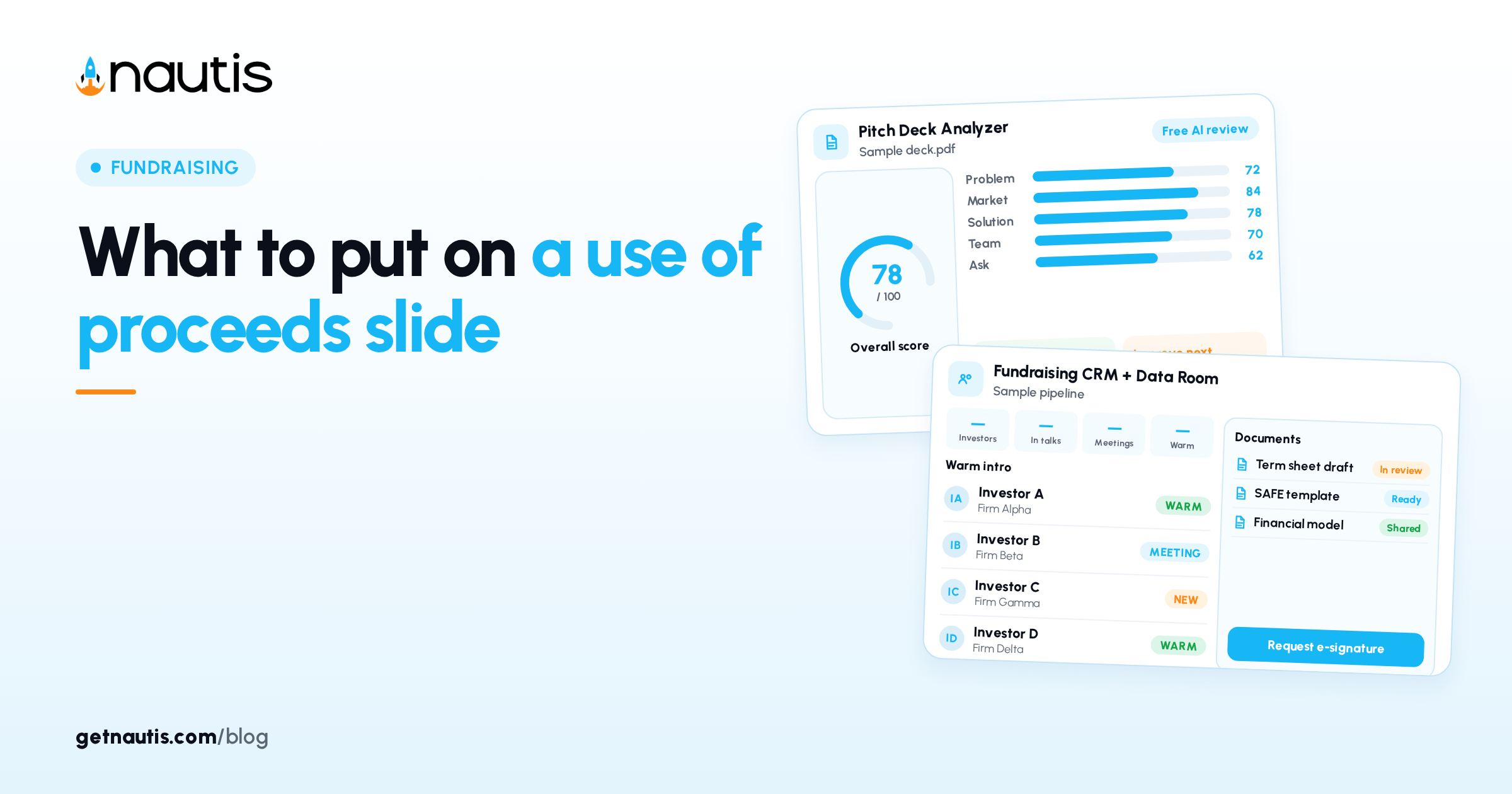
If you use Pitch Deck Analyzer or any scoring tool later, remember that a clean use of proceeds slide still fails if Fundraise Target and the data room copy disagree. Tools catch structure; they do not catch split-brain asks across systems.
Close the loop inside the company
Walk engineering and GTM leads through the bars before investors see them. If they cannot recognize their own hiring plan, the slide is fiction. Align the use of proceeds slide with the offer pipeline and the Financial Planner scenario you treat as base case. Then lock the spoken script: one sentence per bar, total equals ask, milestones dated.
Assign one founder as owner of the PDF version. That person updates Fundraise Target, data room file, and speaker script together. Split ownership is how ask amounts drift across channels. Rehearse the three-sentence open: here is the ask, here is how the bars add up, here is the first milestone money buys. If you cannot say those three lines without looking at the slide, simplify the bars again.
Done this way, the slide stops being a design chore and becomes a control surface for the raise. Mystery buckets disappear. The ask stops drifting. Diligence questions start from your map instead of from confusion. What to put on a use of proceeds slide, in the end, is whatever you can defend with hires, vendors, milestones, and matching CRM math.
Frequently asked questions
What should be on a use of proceeds slide?
Five or fewer categories that add up to the raise, each with a milestone, usually spanning product or engineering, go-to-market, ops or success, infrastructure, and an explicit runway buffer. Drop junk-drawer labels like Other when they hide the real plan.
How do I keep the slide aligned with Nautis?
Set the same amount in Fundraising CRM Fundraise Target, keep The Ask & Round Terms complete in Investor Readiness, and store the dated PDF in Data Rooms. Update all three the same day the ask changes.
Should use of proceeds match the financial model exactly?
Directionally yes. The slide is a map, not the full Financial Planner scenario. If planner burn and the bars disagree by more than rounding, stop sending the deck until you reconcile.
How often should I update the slide?
When the ask, critical hires, or major product bets change, or when instrument timing shifts cash needs. Avoid cosmetic weekly redraws; do send milestone updates when a proceeds category lands.
Sources
- Nautis Fundraising CRM. Checked on October 31, 2026.
- Nautis Investor Readiness. Checked on October 31, 2026.
- Nautis Data Rooms. Checked on October 31, 2026.
- Nautis Financial Planner. Checked on October 31, 2026.
Baltej Singh is a serial entrepreneur, technology leader, and Founder & CEO of Nautis and DemoVexa, with over 16 years of experience building software products, SaaS platforms, and startups. Previously the Co-Founder & CTO of SanchiConnect, he has worked extensively in the DeepTech startup ecosystem, connecting with 200+ venture capital firms and supporting a network of 4,000+ startups. Passionate about AI, automation, and entrepreneurship, he focuses on building innovative products that solve real-world problems and help businesses grow.