Annual vs monthly billing for an early SaaS company
 Baltej Singh9 min read
Annual vs monthly billing is a trade between cash now and flexibility for the buyer. Annual plans bring a year of cash in on day one and remove eleven chances to cancel, while monthly plans lower the bar to say yes and give you faster pricing feedback. Most early software as a service (SaaS) companies should offer monthly by default, add an annual option with a modest discount once a few customers have stayed past their third month, and never spend prepaid cash as if it were already earned.
That answer hides a few decisions that are easy to get wrong. How big should the discount be? Which buyers should you steer toward annual? What happens to your runway math when a customer pays twelve months up front and then asks for a refund in month four? This guide walks through each one with a worked example you can copy into your own spreadsheet.
Annual vs monthly billing: the short answer by stage
The right default depends less on your product and more on how much you already know about retention.
Your situation | Default to offer | Why |
|---|---|---|
First 10 paying customers, pricing still moving | Monthly only | You will change the price soon, and annual contracts lock in a number you may regret |
Customers staying past month three, price stable for a quarter | Monthly plus an annual option | You have enough proof to ask for commitment without guessing |
Selling to teams with a procurement step | Annual as the main offer, monthly on request | Finance teams often prefer one invoice and one approval a year |
Product used in seasonal bursts | Monthly | Annual buyers in seasonal markets ask for refunds after the busy months end |
Two signs you are not ready for annual yet. You still rewrite the pricing page every few weeks, or you cannot say why the last three customers who left actually left. In both cases an annual plan freezes something that is not finished. If your plan cards and trial terms are still in flux, sort those first using what to include on an early SaaS pricing page.
What changes in your bank account
The clearest way to compare the two is to model one month of new customers and follow the cash for a year. The figures below are an example, not a benchmark.
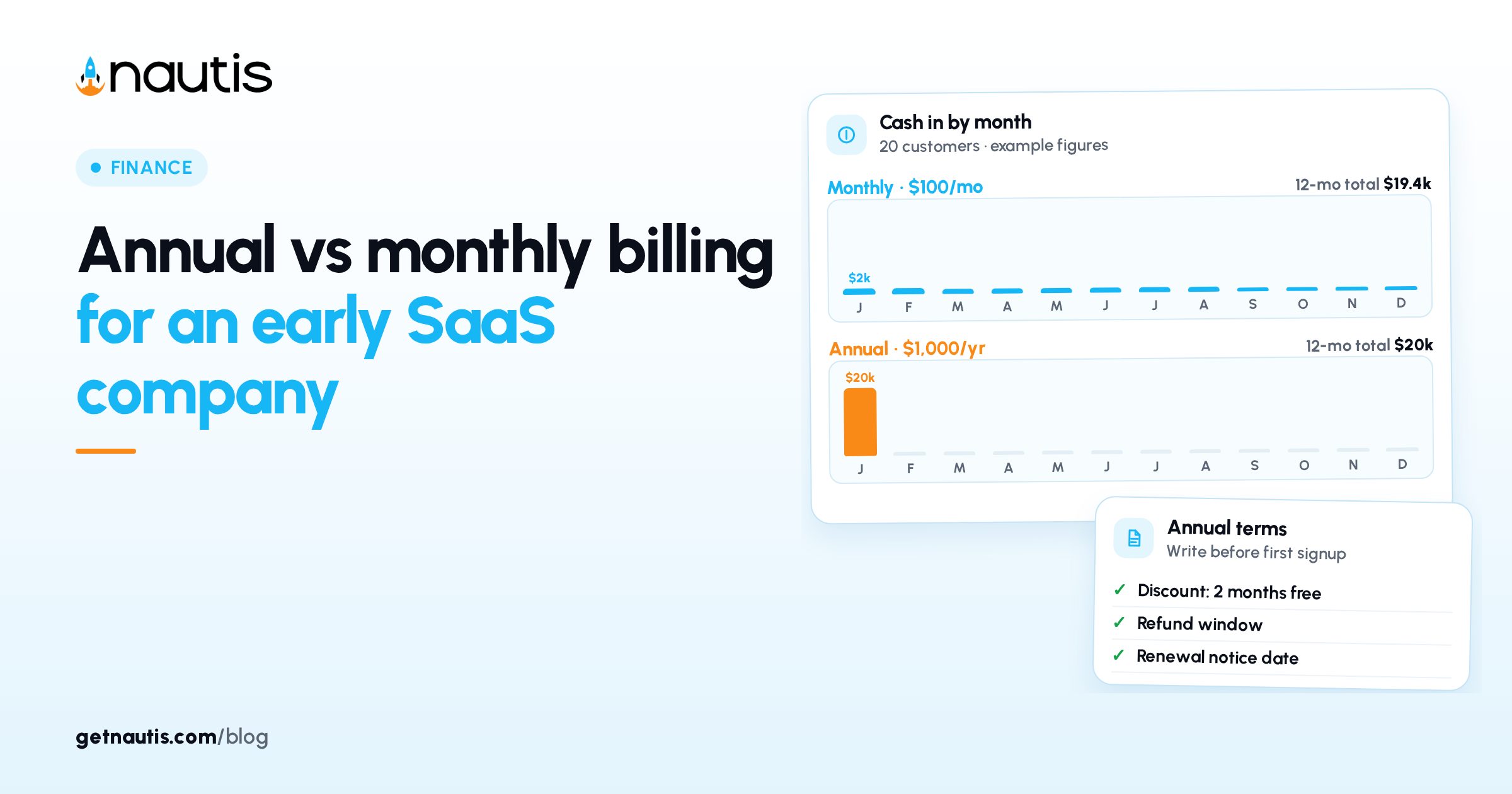
Priya runs a scheduling tool for small physical therapy clinics. She signs 20 new clinics in January. The list price is $100 a month. Her annual option is $1,000 a year, framed as "two months free." Assume 4% of monthly customers cancel each month (an example rate, chosen to keep the arithmetic simple).
Example scenario | Cash in January | Cash by end of June | Cash by end of December | Clinics still paying in December |
|---|---|---|---|---|
All 20 on monthly | $2,000 | about $10,860 | about $19,365 | about 13 |
All 20 on annual | $20,000 | $20,000 | $20,000 | 20 (renewal decision due in January) |
6 annual, 14 monthly | $7,400 | about $13,600 | about $19,555 | about 15 |
A few things stand out once the numbers are on a page.
- Over twelve months, the totals land close together. The annual discount roughly cancels out the churn the monthly plan would have suffered at a 4% rate.
- The timing is completely different. Annual puts ten times more cash in Priya's account in January, which matters if she is trying to hire before she raises.
- The retention picture is murkier with annual. Twenty clinics "still paying" in December says nothing about how many will renew. She will not find out until the following January.
Change the churn assumption and the comparison moves. At a lower monthly churn rate, monthly billing collects more over the year than the discounted annual plan. At a higher rate, annual wins on total cash too. Run your own rate, not the example one.
How big should the annual discount be?
Pick a discount you can explain in one sentence and afford if every customer takes it.
"Two months free" works out to about 16.7% off the monthly price. A flat 20% off is also common and easy to read. Anything much larger starts to look like the monthly price was inflated, and it trains buyers to wait for a deal.
Before you settle on a number, check three things:
- Margin after the discount. If your gross margin is thin, a 20% annual discount can push some accounts below the cost to serve them. Work out the per-customer numbers with unit economics for SaaS before you print a price.
- What you lose if everyone switches. Model the case where every current monthly customer moves to annual on the same day. If that would leave you short of cash in month eight, the discount is too deep.
- Whether the discount is the real reason people choose annual. Some buyers want annual for one invoice a year, not the savings. Ask the next five who pick it.
Which customers should you push toward annual?
Annual suits buyers who already know they will use the product all year. Pushing it on everyone creates refund requests and awkward renewal calls.
Good candidates:
- Customers past their third month whose usage has held steady or grown.
- Teams that told you budget is set yearly and that monthly card charges cause expense report pain.
- Buyers who asked about annual pricing on their own.
Poor candidates:
- Anyone still in their first few weeks of setup.
- Customers whose usage dropped in the last month.
- Buyers who negotiated hard on the monthly price and are likely to keep negotiating.
A simple rule many founders use: offer annual at signup as an option, then make a direct ask around the end of month three to customers who are clearly active. That ask lands better because it follows proof, and it gives you a natural moment to check in on how the account is going.
What annual prepayment does to your books and runway
Annual cash arrives up front, but under generally accepted accounting principles (GAAP) in the United States the revenue does not. The Financial Accounting Standards Board (FASB) revenue standard, Topic 606, says a company recognizes revenue when or as it transfers the promised service to the customer. For a subscription delivered across twelve months, that usually means recognizing it month by month. The unearned part sits on the balance sheet as a contract liability, often called deferred revenue.
In practice that creates two traps for an early team.
- Spending the cash as if it were earned. Priya's $20,000 in January is a promise to serve 20 clinics for a year. If she spends it on a hire in February and three clinics ask for prorated refunds in May, she has to find that money elsewhere.
- Overstating growth. Reporting $20,000 of January revenue makes the next month look like a collapse. Report monthly recurring revenue (MRR), which counts an annual plan as one twelfth per month, so the trend reads honestly.
When you calculate runway, keep a separate line for prepaid cash you may still owe back under your refund terms. The method in how to calculate startup burn rate and runway still applies. Just do not let a big annual month hide a rising burn.
This section is general information, not accounting, tax or legal advice. How deferred revenue is treated for taxes can differ from book accounting, so check the treatment for your company with a certified public accountant (CPA).
Renewal notices, refunds and cancellation terms to write down
Annual plans raise questions monthly plans rarely do. Write the answers into your terms before the first annual customer signs.
Term to decide | Questions to answer |
|---|---|
Refunds | Full refund within a set window? Prorated after that? No refund after a certain point? |
Upgrades mid-term | Do you charge the difference for the rest of the term, or start a new annual term? |
Downgrades mid-term | Allowed now, or only at renewal? |
Renewal price | Same price, or the current list price at renewal? How much notice do you give? |
Cancellation | How does a customer turn off auto-renewal, and by when? |
If any of your customers are individuals buying for personal use, renewal rules get stricter. California's Automatic Renewal Law, for example, defines a consumer as an individual buying for personal, family or household purposes. For an automatic renewal with an initial term of one year or longer, it requires a notice at least 15 days and not more than 45 days before the renewal. It also requires an annual reminder for annual automatic renewal agreements and an online way to cancel when the customer signed up online. Other states have their own rules, and business-to-business (B2B) contracts can be covered by different terms.
This is not legal advice. Have a lawyer review your renewal and refund terms for the states and countries where you sell.
How to offer both without confusing buyers
Once the terms are written, the rollout itself is small.
- Show both prices on the pricing page with the monthly price as the anchor and the annual price as "per month, billed yearly," plus the yearly total so nobody is surprised.
- Put the refund and renewal terms one click away from checkout.
- Set a calendar reminder for every annual renewal date, well inside any notice window you have promised.
- Track MRR and cash separately each month so the two stories do not blur.
If you bill customers by invoice rather than card, recurring invoices handle the schedule. In Nautis, Invoices lets you set up a recurring invoice with a weekly, monthly, quarterly or yearly frequency, and it generates each new invoice on its cycle. Payment is collected outside Nautis through your bank or payment provider, and you record it with Record Payment so the status updates. Nautis does not send overdue reminders automatically, so plan to send renewal and late-payment follow-ups yourself.
To test the decision before you commit, the Financial Planner lets you set a billing frequency on each revenue item. You can copy a projection, change the mix of monthly and annual customers in the copy, and use Compare to view the two side by side. That is a quick way to see whether the cash timing of annual plans changes how long your runway lasts.
Start with Priya's table, swap in your price, discount and churn rate, and decide from your own numbers.
Frequently asked questions
Should a new SaaS startup offer annual billing?
Usually not on day one. Start with monthly billing while your price is still changing, then add an annual option once customers stay past their third month and your price has held steady for a quarter. Annual contracts lock in a number, so wait until you trust it.
What is a normal discount for paying annually?
Two common framings are two months free, which is about 16.7% off, and a flat 20% off. Pick a number you can afford if every customer switches and that you can explain in one sentence. Much deeper discounts can make the monthly price look inflated.
Is annual prepayment revenue when the customer pays?
Under the FASB revenue standard, Topic 606, revenue is recognized when or as the service is delivered. For a twelve-month subscription that usually means month by month, with the unearned part held as a contract liability, often called deferred revenue. Confirm your own treatment, including taxes, with a CPA.
Do I have to send renewal reminders for annual plans?
It depends on who your customers are and where they are. California's Automatic Renewal Law, for example, requires a notice 15 to 45 days before renewal for consumer plans with a term of one year or longer. Ask a lawyer which rules apply to your contracts.
Sources
- FASB, Accounting Standards Update 2014-09, Revenue from Contracts with Customers (Topic 606). Checked on November 3, 2026.
- California Legislative Information, Business and Professions Code sections 17600 to 17606 (Automatic Purchase Renewals). Checked on November 3, 2026.
- Nautis Help Center, Invoices. Checked on November 3, 2026.
- Nautis Help Center, Financial Planner. Checked on November 3, 2026.
Baltej Singh is a serial entrepreneur, technology leader, and Founder & CEO of Nautis and DemoVexa, with over 16 years of experience building software products, SaaS platforms, and startups. Previously the Co-Founder & CTO of SanchiConnect, he has worked extensively in the DeepTech startup ecosystem, connecting with 200+ venture capital firms and supporting a network of 4,000+ startups. Passionate about AI, automation, and entrepreneurship, he focuses on building innovative products that solve real-world problems and help businesses grow.