How to run a weekly review for founders
 Baltej Singh8 min read
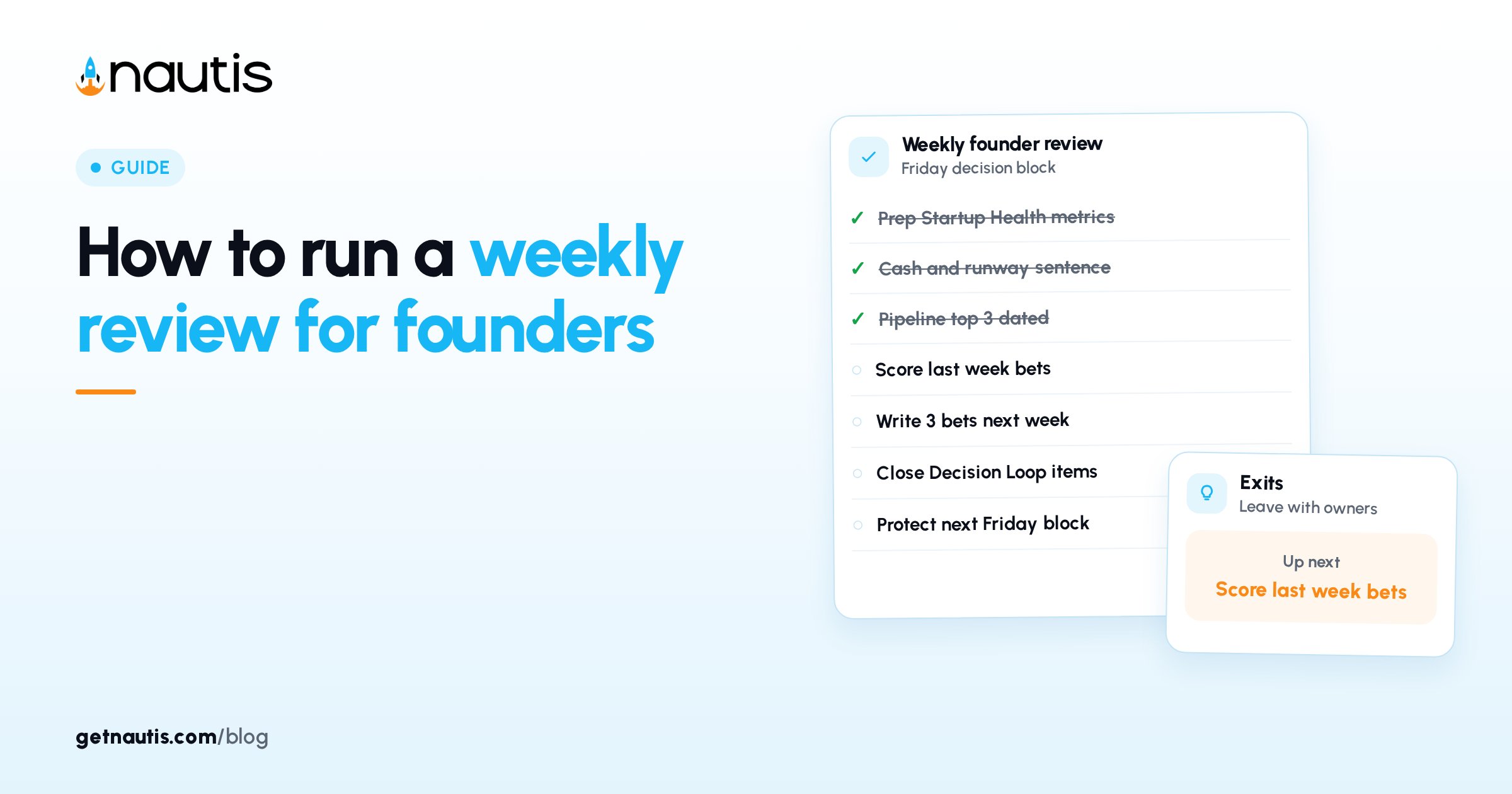
A weekly review for founders is a fixed block that turns the week into decisions: cash and runway from the last Startup Health check-in, pipeline truth, three bets, and open decisions with owners. It is not a status theater meeting and it is not inbox triage.
Keep the review under sixty minutes. Prep numbers before the hour so the live block is for choices, not archaeology.
Founders who skip prep usually "extend" the block and still leave without owners. Cap the live hour; if prep is late, shrink the agenda instead of stealing the next meeting.
Why a weekly review for founders needs a written agenda
Without a written agenda, founders fill the hour with whatever Slack pinged loudest. A short agenda with named artifacts keeps the review honest: each section has a source page and an exit (decide, schedule, or park).
Illustrative miss (composite only): Friday "sync" with no agenda; forty minutes of product chat; cash never opened; a hiring decision slips into Monday panic.
Illustrative win (composite only): same Friday block; agenda with five sections; last Startup Health metrics printed; three bets scored; two Decision Loop items closed or dated.
YC's essential startup advice stresses focus and talking to users over process theater. Treat the weekly review the same way: fewer sections, clearer owners, faster loops. If a section never changes a decision, delete it.
Write the agenda in the same doc every week. Version hopping across Notion, Docs, and slides is how artifacts go stale before Friday.
Share the doc link in the calendar invite. Guests should open artifacts themselves rather than waiting for a screen share that hides the system of record.
Prep the numbers before the live block
Open Startup Health under Finance when you need the latest monthly check-in. Use Update Data only when you are recording or correcting a monthly check-in, not as a weekly ritual. Startup Health captures Cash Balance, Monthly MRR, and Monthly Burn, then shows Runway and trend badges. It is a monthly check-in, not a weekly form. For the weekly review, pull the latest saved month and note what changed since last Friday in one line each for cash, MRR, burn, and runway.
If create or update permission is missing, you can still read metrics with read access when the module is on your plan. Do not invent a mid-week fake check-in; wait for month end or edit the real monthly record when numbers were wrong.
When the alerts strip on Startup Health flags runway under six months, negative MRR growth, or rising burn, bring that alert into the cash section first. Dismissing the strip in-product only clears the session UI; it does not clear the underlying trend.
Illustrative prep (composite only): ten minutes Thursday; copy runway and MRR growth badges into the review doc; flag one alert that still matters.
If Analytics charts in Startup Health show burn rising while MRR is flat, bring the chart into cash section as evidence, then name one spend cut or revenue bet. Charts without a decision waste the hour.
Pair cash with one pipeline view and one hiring or delivery list you already trust. The weekly review for founders fails when every section opens a different spreadsheet tab with conflicting totals.
If Monthly MRR in Startup Health includes only recurring revenue, do not "fix" the weekly narrative with one-off services cash. Say what is recurring versus one-off in the cash section so pipeline optimism does not hide burn.
Run the hour with section exits
Use this table as the operating contract. Each row is a section, not a speech.
Section | Artifact to open | Exit before you leave the section |
|---|---|---|
Cash and runway | Latest Startup Health dashboard (Cash, MRR, Burn, Runway) | One sentence on trend; one action if runway or burn alerts matter |
Pipeline | CRM or board you treat as system of record | Top three deals: next step and owner dated |
Delivery bets | Three written bets from last week | Keep, cut, or rewrite; no silent carries |
Decisions | Decision Loop or decision log entries waiting | Approve, reject, or set a decision date |
People and capacity | Hiring or contractor list | One capacity call: hire, pause, or reassign |
Illustrative hour (composite only): 0-10 cash; 10-25 pipeline; 25-40 bets; 40-50 decisions; 50-60 people; parking lot captured in notes.
Parking lot items get a date or they die. An undated parking lot is how the next review inherits unresolved noise.
Time-box ruthlessly. If pipeline needs thirty minutes, cut delivery bets to a scored list and finish decisions next morning rather than skipping cash.
Bring screenshots only when the live system is down. Prefer opening the real Startup Health dashboard and the real CRM so edits happen in the system of record during or right after the block.
Score last week's bets before you add new ones
Start from the three bets you wrote last week. Each gets a plain verdict: hit, miss, or learning. A pattern of misses means estimates or focus are off, not that you need a longer agenda.
Write at most three bets for the coming week. Each bet needs an owner and a Friday proof (number, ship, or customer conversation). Bets without proof language become wish lists.
Illustrative bets (composite only): last week two hits, one miss on outbound; next week one product bet, one sales bet, one hiring screen bet; miss triggers a narrower ICP test, not a fourth bet.
Refuse vanity bets such as "be more strategic." If you cannot describe the Friday proof in one line, the bet is not ready for the list.
Keep the bet list in the same doc every week so trends are visible. Do not migrate bets into a new tool mid-quarter.
When a bet depends on a customer call, schedule that call before Friday or rewrite the bet. Carrying "talk to five users" without calendar holds is how misses accumulate.
Close decisions with Decision Loop, not chat memory
Open Decision Loop for decisions that should survive the week. Chat threads forget owners. A decision entry with status and next date beats a thumbs-up emoji.
For reversible calls, decide in the review. For irreversible calls (pricing floors, equity grants, major hires), schedule the deeper block and name the prep owner before you leave the section.
Illustrative decision (composite only): pause a channel spend (reversible) decided same hour; equity refresh (irreversible) parked with counsel date and Decision Loop owner.
Record the decision text in the Loop the same day. Waiting until "things calm down" is how oral decisions fork into three remembered versions.
If Decision Loop is empty, write two decisions from the week that already happened so the log catches up. Empty logs make next week's review guesswork.
Name a backup facilitator when one founder is traveling. The agenda and artifacts stay the same so the block does not vanish.
End with owners, then protect the calendar block
End by reading actions aloud: owner, artifact, date. Put the next weekly review for founders on the calendar as a recurring block and decline conflicts that are not customer or safety emergencies.
Chief of Staff Briefing can surface blockers and runway signals on other mornings (Chief of Staff), but the weekly review stays a human agenda with exits. Do not replace the Friday block with an unread briefing badge.
Illustrative close (composite only): five actions in the doc; calendar holds next Friday 16:00; Slack status points to the doc link.
If more than seven actions appear, you ran a backlog grooming session. Move execution detail to owners offline and keep the review list short enough to reread Monday morning.
Keep the review founder-owned even as the team grows
When a five-person team appears, the weekly review for founders still belongs to the founders for cash, bets, and irreversible decisions. Functional leads can join pipeline or delivery sections, then leave. A full-company status hour is a different meeting with a different agenda.
Illustrative growth (composite only): CEO and CTO stay for all sections; head of sales joins pipeline only; eng lead joins delivery bets for fifteen minutes; people section stays founders-only until a manager seat exists.
Publish the guest rules once. Ambiguous invites recreate the all-hands energy you were trying to avoid.
If you already run a weekly team meeting, do not duplicate demos inside the founder review. Point to the team meeting notes for narrative and keep this block for money, bets, and decisions.
Startup Health Investor Snapshot work belongs after a monthly check-in, not as a weekly slide build. Use the latest dashboard numbers in the review; polish snapshots when you actually send an update.
Protect prep time on the calendar the day before. A review without prep becomes a scavenger hunt and trains the team that artifacts do not matter.
If travel kills Friday, move the block earlier the same week rather than stacking two reviews later. Double sessions create rubber-stamp decisions.
Recheck the agenda quarterly. Cut any section whose artifact nobody opened for a month. Add a section only when a repeated miss traces to a missing artifact, not to a desire for more ceremony. Ship the same agenda template for four weeks before you redesign it. Early churn of the agenda hides whether the habit works.
Broader ops context sits in the Help Center.
are the Startup Health and Decision Loop help articles checked on 2026-11-01; YC essential advice is linked for the focus framing only.
Frequently asked questions
How is a weekly review for founders different from a weekly team meeting?
The founder review decides cash, bets, and hard calls. A team meeting shares status and demos. Keep demos out of the founder block and point to team notes instead.
Should we update Startup Health every week?
No. Startup Health is a monthly check-in for Cash Balance, Monthly MRR, and Monthly Burn. In the weekly review, read the latest month and discuss trends; save new check-ins for month end unless you are correcting a bad record.
How many bets belong in the review?
Three is enough. Each needs an owner and a Friday proof. More bets usually means weaker focus, not better coverage.
What if Decision Loop is empty?
Log two real decisions from the past week so the record catches up. Then use the Decisions section to close or date open items instead of relying on chat memory.
Sources
- Nautis Help Center, Startup Health. Checked on November 1, 2026.
- Nautis Help Center, Decision Loop. Checked on November 1, 2026.
- Nautis Help Center, Chief of Staff. Checked on November 1, 2026.
- Y Combinator, Essential startup advice. Checked on November 1, 2026.
Baltej Singh is a serial entrepreneur, technology leader, and Founder & CEO of Nautis and DemoVexa, with over 16 years of experience building software products, SaaS platforms, and startups. Previously the Co-Founder & CTO of SanchiConnect, he has worked extensively in the DeepTech startup ecosystem, connecting with 200+ venture capital firms and supporting a network of 4,000+ startups. Passionate about AI, automation, and entrepreneurship, he focuses on building innovative products that solve real-world problems and help businesses grow.