Four AI jobs for founders: ops, raise, revenue, finance
 Baltej Singh8 min read
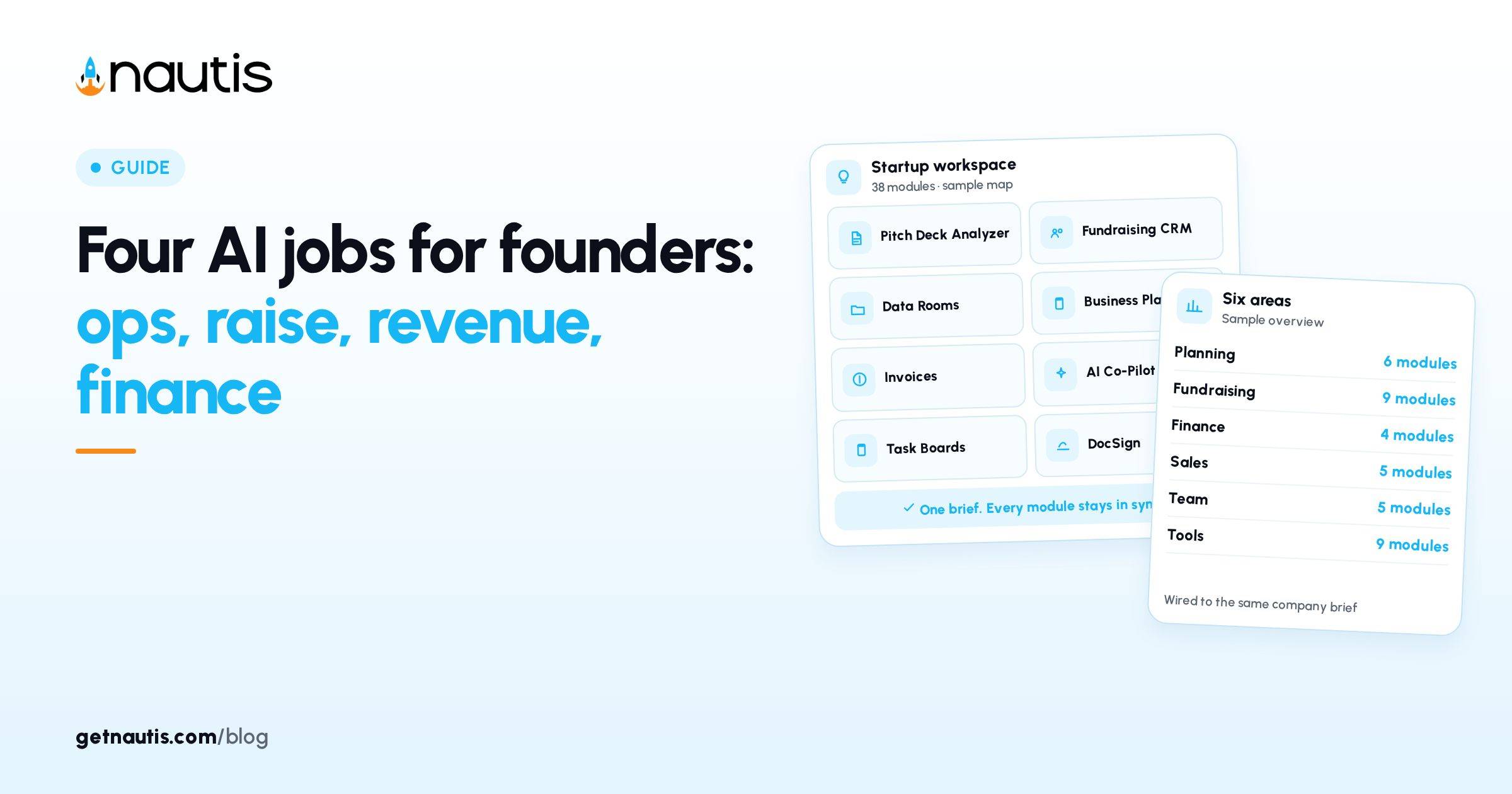
Four AI jobs for founders means four lanes of standing work (ops, raise, revenue, finance), each with an owner, an artifact, and an approval posture. It is not four chat personalities and not a vendor bake-off. In Nautis, lanes ride on Routines, Approvals, and the modules that hold the truth for that work. Operating guidance only, not legal advice.
Four AI jobs for founders as lanes
A lane is a recurring job family you are willing to schedule. Ops keeps the company coordinated. Raise keeps investor materials and follow-ups current. Revenue keeps pipeline and customer follow-through visible. Finance keeps cash, spend, and plan numbers honest.
Illustrative split (composite only): one founder owns raise and revenue lanes; the other owns ops and finance. Each lane has a single artifact updated on a fixed cadence. Shared ownership of every lane recreates inbox chaos with better vocabulary.
Write the four lane names on a Note before you add routines. If a request does not fit a lane, it waits for a human meeting instead of becoming a fifth vague standing job.
Lane names stay stable even when tools change. Renaming revenue to growth every month breaks the matrix and makes Approvals harder to audit. Pick plain words your team already uses in standups.
Assignment matrix before you schedule anything
Lane | Primary artifact | Default approval posture | Catalog starting point | Human still owns |
|---|---|---|---|---|
Ops | Weekly operating Note or briefing read | Ask-first on external sends | Briefings / Operations catalog cards | Final prioritization and people decisions |
Raise | Investor update draft or deal follow-up list | Ask-first on anything investor-facing | Fundraising catalog cards | Narrative, ask amount, and send |
Revenue | Pipeline exceptions list | Ask-first on customer email | Sales catalog cards | Pricing, discounts, and promises |
Finance | Cash and spend check Note | Ask-first on money language | Finance catalog cards | Bank moves, payroll, and model sign-off |
Only organization Owners and Admins can add, edit, run, pause, resume, or remove a routine. Plans cap how many routines you can keep. Suggested for you at the top of Routines picks jobs for your stage; each card shows category, schedule or Triggered, a Read-only label if it changes nothing, and estimated cost. Prefer Read-only cards while a lane is new.
Built-in routines you customize start counting toward plan limits once changed or paused, so edit with intent. Try it once on a card when you need a smoke test; writes still follow approval rules and use credits.
Illustrative first week (composite only): ops gets a weekday briefing routine; finance gets a Monday digests-style read of spend categories; raise and revenue stay human-drafted with one read-only prep routine each. No customs yet.
Week two should not double the count. If Explore shows you near the routine cap, remove an unread digest before you add a raise-lane helper. Credits spent on ignored summaries are not lane coverage.
Ops and raise lanes in practice
Ops
Ops AI work prepares coordination: meeting prep, internal digests, task tidy drafts. Keep irreversible writes on ask-first. The artifact is a Note or briefing the owner actually opens. If the digest goes unread twice, pause the routine instead of adding another.
Ops is the lane most likely to spawn overlapping digests. Before you add a second ops routine, name which artifact dies. Two unread summaries are worse than none because they train the team to ignore AI Activity.
Illustrative ops move (composite only): a Triggered meeting-prep routine drafts three bullets into a Note; the founder edits two lines before the call; no email leaves without approval.
Raise
Raise AI work prepares fundraising hygiene: draft update sections, remind follow-ups, assemble context for a meeting. Investor-facing sends stay ask-first. Do not let a routine invent valuation language. The artifact is a dated update draft or a follow-up list tied to real conversations.
Keep raise-lane outputs inside Notes or drafts until a human sends. Forwardable investor email is still a human send, even if the routine assembled metrics. Log the send decision in Approvals when the channel requires it.
Illustrative raise move (composite only): a weekly routine drafts lowlights and metrics placeholders from workspace data; the founder rewrites the ask paragraph by hand before anyone sees it.
For what an AI chief of staff is for, see What is an AI chief of staff. For asks that must wait on you, see AI that asks before acting.
Revenue and finance lanes in practice
Revenue
Revenue AI work surfaces exceptions: stale stages, missing next steps, draft follow-ups. Customer promises and discounts stay human. The artifact is a short exceptions list, not a full CRM takeover narrative.
Revenue routines should not auto-move stages that change commission or customer promises. If a catalog job can write CRM fields, keep those writes on ask-first until stage names are stable and someone reads AI Activity weekly.
Illustrative revenue move (composite only): a catalog sales routine flags deals with no next step in fourteen days; the founder sends two emails manually after editing tone.
Finance
Finance AI work supports Cash Balance discipline, expense capture, and plan reads. In Expenses, prefer Scan a Bill or Add Expense the same day so the finance lane is not a weekend sorting job. In Startup Health, enter Cash Balance from month-end business cash, Monthly MRR as recurring only, and Monthly Burn as spend minus revenue (or 0 if cashflow positive). In Financial Planner, treat Revenue Items and Model Inputs as the signed assumptions; clones are for Compare, not for silent edits to the live base.
Finance-lane digests can point at Dashboard burn and runway, but they do not replace entering Cash Balance on the monthly check-in. A summary that cites last month cash while the bank moved yesterday is worse than a blank Note.
Illustrative finance move (composite only): a Monday routine reminds the owner to clear uncategorized expenses and to skim runway; Record Payment and bank transfers stay human.
For runway definitions, see How to calculate startup burn rate and runway.
Guardrails that keep lanes from merging
- One routine maps to one lane on the matrix Note.
- External sends and deletes stay on ask-first until a separate Autonomy review.
- Customs wait until a lane has clean catalog history for several quiet runs.
- Credits and plan caps are shared; a noisy raise routine can crowd out finance. Pause before you add.
When chat offers to "just handle ops and revenue today," return to the matrix. Four AI jobs for founders collapses when one freeform thread tries to wear every lane's approval rules at once.
Put the matrix link in the team channel topic or the Chief of Staff Note pinned for the week. New contractors who suggest standing jobs must name a lane first. No lane, no routine.
Illustrative merge catch (composite only): a custom asked to "grow pipeline and update investors." It was rejected; two catalog jobs replaced it, one sales, one fundraising, each with its own artifact.
Review customs in the same Monday meeting as the matrix. A custom without a lane tag on the Note is treated as unowned and paused. That single rule prevents side-door automation more effectively than another policy document.
Monday lane review
Twenty minutes, same agenda every week. This is the close of the practice, not a museum of failure stories.
Minute | Check | Pass looks like |
|---|---|---|
0-5 | Open Routines run history and AI Activity | No surprise external actions |
5-10 | Confirm each lane artifact was touched | Four dated artifacts or an explicit pause |
10-15 | Clear leftover Approvals | Queue empty or paused routines that caused them |
15-20 | Keep, pause, or remove one job max | Matrix Note updated |
If a lane has no owner this week, pause its routines instead of letting summaries pile up. Reassign on the matrix before you invent a custom to paper over missing ownership.
Record the pass or fail for each lane in one line on the Note: artifact touched, approvals clear, routine kept or paused. Four lines beat a long retrospective. After three green Mondays, you may consider one custom in the quietest lane only, still with an owner, artifact, and stop rule.
Four AI jobs for founders is working when each lane has a boring artifact, a known approval posture, and a catalog job you would defend to a co-founder in one sentence. Add headcount or widen Autonomy only after those sentences stay true for several Mondays.
If raise and revenue share one founder, alternate deep work blocks rather than merging the lanes into one GTM brain routine. The matrix is there to protect attention, not to multiply agents.
Handoff cards when a human joins a lane
When you finally hire into a lane, hand the person three things on day one: the matrix row, the last four Monday review lines, and the routine list for that lane only. Their first job is to run the Monday checks, not to redesign Autonomy.
Illustrative handoff (composite only): a new ops coordinator receives the ops row, two active catalog routines, and instructions that customer email stays ask-first. They do not inherit raise-lane drafts by accident.
If the hire is part-time, keep Owners and Admins as the only people who can add routines until they have completed two Monday reviews without surprise AI Activity rows. Four AI jobs for founders stays intact when a new human strengthens one lane instead of remixing all four on arrival.
Frequently asked questions
What are the four AI jobs for founders in this article?
Ops, raise, revenue, and finance lanes. Each needs an owner, an artifact, and an approval posture before you add routines.
Who can add routines for a lane?
Only organization Owners and Admins can add, edit, run, pause, resume, or remove routines. Plans cap how many you can keep.
Should one routine cover two lanes?
No. One routine maps to one lane on the matrix. Split customs that mix investor updates with pipeline growth.
When can we add a custom routine?
After several quiet Monday reviews in that lane, with an owner, artifact, and stop rule. Catalog first.
Sources
- Nautis Routines help. Checked on October 31, 2026.
- Nautis Expenses help. Checked on October 31, 2026.
- Nautis Startup Health help. Checked on October 31, 2026.
- Nautis Financial Planner help. Checked on October 31, 2026.
- What is an AI chief of staff. Checked on October 31, 2026.
Baltej Singh is a serial entrepreneur, technology leader, and Founder & CEO of Nautis and DemoVexa, with over 16 years of experience building software products, SaaS platforms, and startups. Previously the Co-Founder & CTO of SanchiConnect, he has worked extensively in the DeepTech startup ecosystem, connecting with 200+ venture capital firms and supporting a network of 4,000+ startups. Passionate about AI, automation, and entrepreneurship, he focuses on building innovative products that solve real-world problems and help businesses grow.