What gross margin means for product startups
 Baltej Singh8 min read
Gross margin for startups is the share of revenue left after the direct cost of delivering what you sold. In plain terms: revenue minus cost of goods sold (COGS), divided by revenue. Nautis does not ship a module named Gross Margin. Financial Planner lets you enter Cost of goods sold per unit on Revenue Items, then shows COGS, gross profit, and gross margin among the P&L and dashboard metrics once assumptions are in. You still decide what belongs in COGS versus operating expense. This is operating guidance. It is not accounting advice.
Write the recipe before the percentage
Gross margin for startups goes wrong when teams argue about a percentage with no shared recipe. Write three lines first:
- Revenue definition: what counts as product or service sales in the period.
- COGS definition: costs that rise when you deliver one more unit or active account.
- Everything else: operating expense, even if it feels product-ish.
Illustrative Driftcoil card (composite only): "Revenue = recognized subscription and usage fees. COGS = hosting, payment processing, third-party APIs billed per customer usage, and outsourced onboarding hours tied to new logos. Sales salaries and brand ads stay below the line."
Post the card above any chart. Without it, gross margin for startups becomes a vibes metric. Name a follow-up owner for disputed lines. Review the boundary card every Monday before you expand scope further. Keep the first draft of the card short. Done weekly beats redesigned quarterly in a panic.
Boundary scorecard: above the line or below
Use the same questions for every disputed cost. If you answer yes to the delivery test, it is a COGS candidate. If you answer yes only to "we need this to grow," it is usually opex.
Cost (illustrative) | Delivery test | Default line | Notes |
|---|---|---|---|
Cloud hosting for the product | Scales with usage or seats | COGS | Split shared infra with a simple rule |
Payment processing fees | Charged per collection | COGS | Follow the processor invoice |
Customer success salaries | Mostly retention and expansion | Opex | Move only hours that onboard delivery if you must |
Outsourced implementation | Required to stand the customer up | COGS | Contractors tied to go-live |
Paid acquisition | Buys logos, not delivery | Opex | Never in COGS for margin theater |
Core engineering salaries | Builds the product, not per-unit delivery | Opex | Common SaaS default |
Third-party AI API metered by customer jobs | Burns when customers run jobs | COGS | Meter from the vendor bill |
Illustrative fight (composite only): Driftcoil wanted engineering in COGS to look enterprise hardware-like. That failed the delivery test. They kept engineering in opex and documented why. Gross margin for startups that stuffs payroll into COGS to impress a deck will unwind in diligence.
Keep paid ads out of COGS even when growth is the company story. Acquisition cost belongs with CAC conversations, not in the gross margin recipe. Mixing them double-counts pressure and confuses diligence readers who expect delivery-based COGS.
Build the number from parts you can audit
For a period:
- Sum revenue under your card.
- Sum COGS under your card.
- Gross profit = revenue - COGS.
- Gross margin % = gross profit / revenue.
Illustrative month (composite only): revenue 80,000; hosting 9,000; processors 2,400; metered APIs 3,600; implementation contractors 5,000; COGS total 20,000; gross profit 60,000; gross margin 75%.
When a cost is mixed (one engineer partly on paid professional services), split with a written rule such as timesheet percentage, then freeze that rule for the quarter. Silent weekly re-splits destroy comparability.
If two founders disagree on a borderline cost, write both arguments in a Note and default to opex until the Monday owner decides. Paralysis keeps last month's percentage fake-stable. A dated decision keeps gross margin for startups comparable.
Put the recipe into Financial Planner without reinventing the model
In Financial Planner, Revenue Items take unit price, billing frequency, forecasted units, and Cost of goods sold per unit if applicable. The revenue total flows into the profit and loss automatically. Model Inputs hold Operating Expenses such as salaries, rent, software, and marketing. The P&L read includes COGS, gross profit, operating expenses, EBITDA, taxes, and net profit. The dashboard surfaces gross margin among key metrics once inputs are stable.
Map your card into those fields. Put delivery-tied unit costs in Cost of goods sold per unit. Put salaries and growth spend in Operating Expenses. Gross margin for startups in the planner is only as honest as that mapping.
Do not use Expenses Policy Rules to redefine margin. Policy Rules warn or block spend violations. Classification for margin lives in your card and in planner inputs.
Revisit Cost of goods sold per unit whenever unit mix shifts (new SKU, new metered API). Stale per-unit COGS silently drifts the dashboard while the recipe prose still looks current.
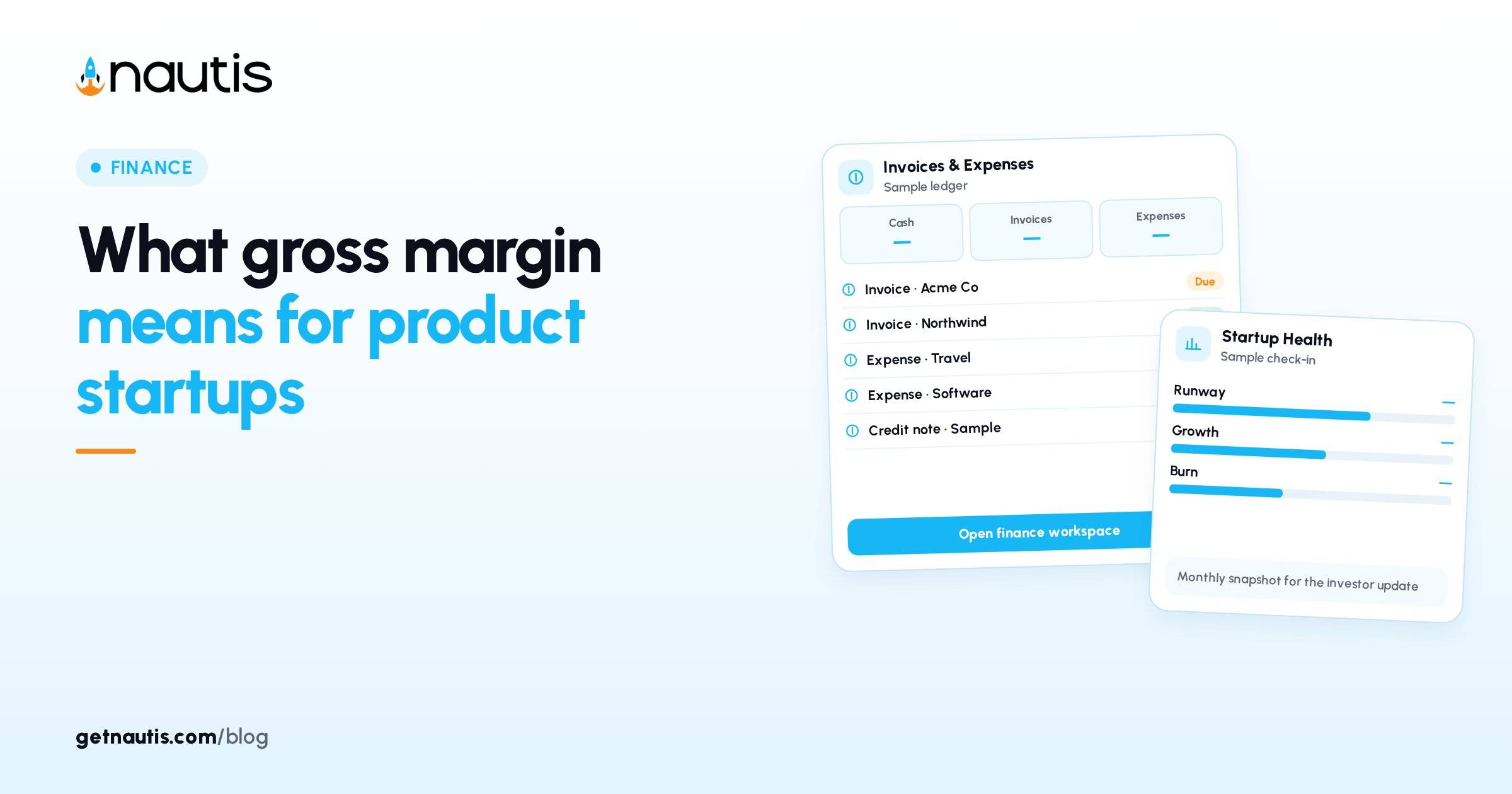
For company pulse on cash, MRR, and burn, use Startup Health check-ins as context beside the margin card. Do not ask Startup Health to compute gross margin; it is built around cash, recurring revenue, and burn. For burn and runway labels, see How to calculate startup burn rate and runway. When you compare planning tools more broadly, see Best startup financial planning tools for founders.
Illustrative six-week boundary cleanup
Illustrative Driftcoil (composite only): Week 1: write the recipe card; list every vendor over 500 a month. Week 2: sort each vendor with the scorecard; park debates in a Note, not in the live percentage. Week 3: enter COGS per unit and opex lines in Financial Planner; generate P&L. Week 4: compare planner gross margin to the sheet built from bank and invoices; fix mismatches. Week 5: freeze the card; train sales not to quote margin from memory. Week 6: Monday review becomes exceptions only (new vendor, new SKU).
They refused to change the card the same week they changed pricing. Price tests belong with commercial experiments. Margin classification belongs with the recipe.
Hardware, services, and mixed SKUs
Hardware-heavy: materials, inbound freight, and warranty reserves usually sit in COGS. Factory overhead follows your accountant's rule; write that rule on the card.
Services-heavy: delivery labor and subcontractors for scoped implementations often sit in COGS; bench time between projects often sits in opex. Gross margin for startups in agencies collapses when bench cost hides in COGS forever.
Mixed SaaS plus services: keep two margin views or a clear allocation. Blending unlimited onboarding labor into software COGS will punish the product margin when sales gives away setup.
Illustrative mix (composite only): Driftcoil sells software at 78% gross margin and paid migrations at 35%. They report both. A blended 70% without disclosure hid an unprofitable services line for a quarter.
When you add a SKU, add a scorecard row the same week. Do not wait for quarter close.
Worked classification clinic (illustrative)
Illustrative clinic for Driftcoil (composite only). Ten costs on the whiteboard; two founders score silently, then compare.
- AWS host for production: both COGS.
- AWS host for staging and CI: both opex.
- Stripe fees: both COGS.
- HubSpot seats: both opex.
- Contractor writing migration scripts per customer: both COGS.
- Contractor redesigning the marketing homepage: both opex.
- On-call stipend for engineers: both opex.
- Third-party SMS used when customers trigger alerts: both COGS.
- Office internet: both opex.
- Bulk purchase of laptops: both opex (capitalize or expense per accountant; still not COGS).
Agreement on nine of ten is good enough to freeze. The disputed shared database cluster gets a split rule: 70% COGS, 30% opex, reviewed quarterly. Gross margin for startups becomes teachable when the clinic is written down. Run the clinic when vendors change a lot, not when someone dislikes last month's percentage.
What gross margin for startups does not answer
Gross margin for startups does not tell you if cash will last. It does not replace burn or runway. It does not equal contribution profit after sales commissions unless your card says so. It does not fix a bad price by itself.
Illustrative misuse (composite only): founder saw 80% gross margin and hired two account executives the same week cash runway was five months. Margin was fine. Cash was not. Keep runway on its own check.
When diligence asks, show the recipe card, the period math, and the planner P&L line. If you exclude something unusual, label it. Hidden exclusions read as fiction.
Illustrative diligence packet (composite only): one-page recipe card, trailing three months of revenue and COGS tables, Financial Planner P&L export, and a sentence on any exclusion.
Keep the Monday exception pass short
Owner opens the card. Any new vendor or SKU gets a scorecard row. If the delivery test is unclear, default to opex until proven otherwise. Defaulting to COGS to protect a target percentage is the failure mode.
Illustrative exception (composite only): a new translation API bills per character generated for customers. Delivery test passes. Add to COGS. A redesign agency invoice for the marketing site fails the test. Opex.
Publish the recipe card beside the Financial Planner export your board sees. When numbers disagree, debug mapping first: wrong Cost of goods sold per unit, revenue items that include one-off services, or opex lines that still hold metered delivery vendors.
Gross margin for startups is finished when two teammates independently classify the same ten costs the same way, and when Financial Planner COGS per unit matches that card. The percentage is the output. The boundary is the work.
Frequently asked questions
Does Nautis have a Gross Margin module?
No. Financial Planner accepts Cost of goods sold per unit and shows COGS, gross profit, and gross margin metrics from your assumptions. You define what belongs in COGS.
Should engineering salaries sit in COGS?
For most SaaS products, core engineering is operating expense. Put costs in COGS when they scale with delivering another unit or active account.
How often should we revisit the recipe?
Review exceptions weekly with a named owner. Freeze the core card for the quarter unless the business model changes.
Is high gross margin enough to hire?
No. Check cash and runway separately. Strong margin with short runway is still a cash problem.
Sources
- Nautis Financial Planner help. Checked on October 31, 2026.
- How to calculate startup burn rate and runway. Checked on October 31, 2026.
- Best startup financial planning tools for founders. Checked on October 31, 2026.
Baltej Singh is a serial entrepreneur, technology leader, and Founder & CEO of Nautis and DemoVexa, with over 16 years of experience building software products, SaaS platforms, and startups. Previously the Co-Founder & CTO of SanchiConnect, he has worked extensively in the DeepTech startup ecosystem, connecting with 200+ venture capital firms and supporting a network of 4,000+ startups. Passionate about AI, automation, and entrepreneurship, he focuses on building innovative products that solve real-world problems and help businesses grow.