How to build a simple startup budget
 Baltej Singh8 min read
Startup budget template basics are how small teams keep cash decisions boring: categories with owners, budgets you can compare to actuals, and a Monday readout that fits on four lines. This is not a second course in burn-rate formulas. For calculation definitions and worked math, use How to calculate startup burn rate and runway. This post is the template and operating rhythm: what to put in the sheet, what to put in Nautis, and what to refuse to track until the basics run. It is operator guidance, not accounting or tax advice. Ask your accountant before you treat any template as a filing system.
Startup budget template basics: what the one-pager must hold
A simple startup budget answers five questions every week. How much cash is in the bank. What is leaving this month by category. Who owns each category. What changed since last week. How many months of runway you believe under two scenarios you already named. If your "budget" is a 40-tab model nobody opens, you do not have a template. You have a museum.
Keep the first version on one page with a named owner and a review date. Stop expanding until two people can run the Monday readout without you. Startup budget template basics fail when only the founder can find the password-protected spreadsheet.
Category map with owners (the real template)
Category | Typical contents | Owner | Budget habit |
|---|---|---|---|
Payroll and contractors | Salaries, benefits load, regular contractors | CEO or COO | Monthly budget; lock hires to a date |
Product and infrastructure | Cloud, tools, security | Eng lead | Monthly; flag spikes before they hit |
Go-to-market | Ads, events, agencies | GTM lead | Monthly or campaign period |
Customer success / ops | Support tools, logistics | Ops lead | Monthly |
General admin | Legal, accounting, insurance, rent | Founder or finance owner | Quarterly where spend is lumpy |
Contingency buffer | Named reserve, not "misc" | Founder | Review monthly; spend only with a note |
Refuse a junk drawer larger than a thin contingency line. If "Other" is your biggest bar, you do not have startup budget template basics. You have opacity. Merge micro-lines. Split vanity megabars that hide two owners. Write the owner Slack handle or email next to each category on the one-pager. Ownership that lives only in your head fails the first week you travel.
What stays out of v1
Do not model fifteen revenue SKUs before you can list payroll by person. Do not build international tax tabs before Expenses categories exist. Do not duplicate Cap Table ownership math inside the budget. Point ownership questions to Cap Table; keep the budget about cash timing and category spend.
Wire the template into Nautis Finance
Expenses budgets versus the planner
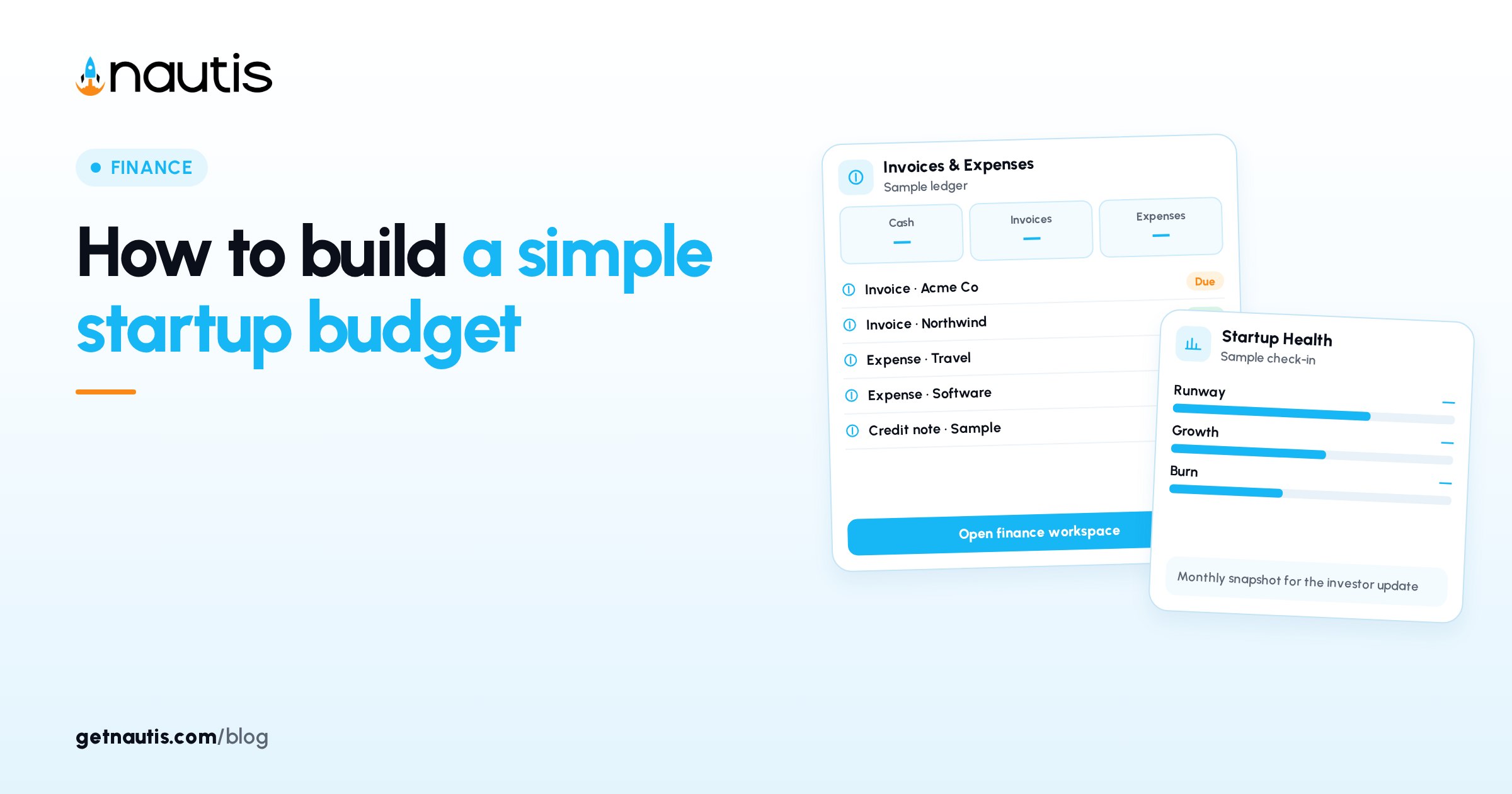
In Expenses (checked 31 Oct 2026), open Budgets, Create Budget, pick a Category (or all categories), a Period (monthly, quarterly, annual), and an Amount. The Budgets page shows budget vs actual with progress bars and alerts when you are over budget. Log spend with Add Expense (manual or receipt scan), attach receipts, and use recurring expenses for subscriptions so the actuals are not a month-end surprise. Approval Rules and Policy Rules need admin permission; use them when cards need gates, not as a substitute for category owners.
Financial Planner (checked 31 Oct 2026) builds multi-year projections: revenue, costs, P&L, balance sheet, cash flow, with a dashboard that includes burn rate and runway. Export to Excel or PDF when you share a longer view. Use Planner for scenarios and board packs. Use the one-page budget plus Expenses budgets for weekly control. Mixing those jobs produces either a model nobody updates or a weekly sheet that pretends to be a full forecast.
Startup Health as the monthly pulse
Startup Health (checked 31 Oct 2026) is a monthly check-in for cash, recurring revenue, and burn in under a minute. Nautis turns those into runway, growth, and burn-trend metrics, charts, alerts, and an investor snapshot. Read access can view; create or update permission is needed to add a check-in. Put the check-in on the calendar the same week as your budget review so the three numbers do not drift from the category sheet. If Startup Health alerts fire on burn trend while your one-pager still says "fine," believe the alert until category actuals explain it. Silence the alert only after the sheet and the check-in agree.
The Monday four-line readout
Report cash, gross burn, net burn, and two runway scenarios in four scannable lines. Recheck it on a fixed weekly cadence. Name the scenarios once (for example base case and hiring-pause) and keep those names stable so the board does not hear a new fantasy each month. Link each line to Expenses actuals or Startup Health so the readout is not oral tradition. When the burn-rate guide's formulas and your readout disagree, fix inputs before you rewrite the narrative.
Owners speak only to their category variance: over budget, under budget, or on track, with one clause why. If every owner narrates strategy, the meeting becomes a second all-hands. Startup budget template basics keep the meeting short because the sheet already held the argument.
Bring one decision per overrun: cut, delay, or explicitly raise the category budget with a date. "We will watch it" is not a decision. Record the decision under the category owner Notes so next Monday does not relitigate the same spike. If Approvals in Expenses are pending for large cards, clear them before you trust budget vs actual bars; pending spend is still spend when it clears. Cash timing still matters inside a simple template. Mark large legal or insurance bills in the month they leave the bank, not the month you felt the stress. Align category budgets with that timing so progress bars mean something.
Two-person drill
Once a month, the backup operator runs Monday alone: Refresh Expenses budgets, read Startup Health latest check-in, write the four lines, and ping category owners only for red bars. If they cannot finish in twenty minutes, the template is still too personal or the categories are still too many. Cut categories before you add automation.
Illustrative first month (composite only)
The month below is a composite illustrative example, not a real company ledger.
Illustrative week 1: Founder creates six categories with owners, Create Budget monthly amounts in Expenses, and a one-page sheet that mirrors those categories. Recurring subscriptions land as recurring expenses. Illustrative week 2: GTM overruns events; progress bar alerts; owner cuts a contractor week instead of silently expanding "Other." Illustrative week 3: Startup Health check-in records cash, recurring revenue, and burn; runway chart matches the Monday readout within rounding. Illustrative week 4: Financial Planner scenario tests a hire wave; the weekly template stays six categories; the planner holds the multi-year view.
Illustrative point: the template stayed small while the systems of record absorbed detail. The burn-and-runway primer still owns the formula explanations; this page owns the operating skeleton. A second illustrative habit: when a founder wants a seventh category for "brand," they must name an owner and a monthly amount first. No owner, no category.
Rules that keep the template honest
Name one budget owner for the company and one owner per category. Freeze category names for a quarter unless spend structure truly changed. When Fundraise Target or a use-of-proceeds story changes, update category budgets the same week so investor narrative and internal spend do not diverge. When a hire is verbal only, do not pretend payroll is already in the budget; add a dated line under a hiring scenario instead of corrupting base case. Same rule for verbal agency retainers and "we will probably renew" SaaS. Recurring expenses in Nautis should match contracts you would defend to an auditor, not hopes.
Do not claim runway precision your bank balance cannot support. Do not report net burn while forgetting known contractor invoices sitting in email. Do not let Approval Rules become theater while category owners never look at Budgets progress bars.
Revisit the one-pager when headcount jumps, when you open a new GTM channel, or when cash drops below a threshold you wrote in advance. Otherwise resist redesign. Startup budget template basics compound through repetition, not through prettier tabs. Teach the second operator the Create Budget path and the Monday four lines in one sitting. If only you can interpret the progress bars, the template is still a personal notebook. Export Financial Planner when investors want a multi-year view; do not paste that export into the weekly sheet and call it simplicity.
When to open the longer model
Open Financial Planner when you need hiring ramps, revenue ramps, or loan schedules across years. Keep assumptions dated. Export Excel or PDF for sharing. Then return to the one-pager for the next Monday. The planner is allowed to be rich. The weekly template is not allowed to become the planner.
Build the simple budget, attach it to Expenses budgets and a Startup Health cadence, keep Financial Planner for longer scenarios, and send readers to the burn-rate guide when they need the math spelled out. Four lines on Monday beat a model that only opens before board meetings.
Frequently asked questions
What belongs in a simple startup budget template?
A short list of spend categories with owners, monthly or period budgets, and a weekly readout of cash, burn, and two runway scenarios. Keep v1 on one page before you add complexity.
How does this differ from a burn-rate article?
Burn-rate posts teach formulas for gross burn, net burn, and runway. This post is the operating template: categories, Expenses budgets, Startup Health cadence, and Monday reporting. Link the burn guide for the math.
Where do I set budgets in Nautis?
In Expenses, open Budgets, Create Budget, choose category or all categories, period, and amount. Progress bars compare budget vs actual. Use Financial Planner when you need full multi-year statements.
How often should founders review the budget?
Weekly four-line cash and burn readout, monthly Startup Health check-in, and a deeper Planner pass when hiring or fundraising assumptions change. Redesign categories only when the business structure changes.
Sources
- Nautis Expenses. Checked on October 31, 2026.
- Nautis Financial Planner. Checked on October 31, 2026.
- Nautis Startup Health. Checked on October 31, 2026.
Baltej Singh is a serial entrepreneur, technology leader, and Founder & CEO of Nautis and DemoVexa, with over 16 years of experience building software products, SaaS platforms, and startups. Previously the Co-Founder & CTO of SanchiConnect, he has worked extensively in the DeepTech startup ecosystem, connecting with 200+ venture capital firms and supporting a network of 4,000+ startups. Passionate about AI, automation, and entrepreneurship, he focuses on building innovative products that solve real-world problems and help businesses grow.