How to design a B2B referral program
 Baltej Singh9 min read
Referral program for B2B works when three things are written before the first ask: what the referrer gets, what the new buyer must do to count, and how the invite is sent. Programs fail when rewards are vague, when any signup pays out, or when people have to invent the pitch. Write the rules on one page. Then ask a happy customer to try them.
Referral program for B2B starts with a qualifying rule
Decide what "qualified referral" means before you mention money or credit.
Rule piece | Write this | Weak version |
|---|---|---|
Who can refer | Paying accounts in good standing | Anyone with a link |
Who counts as new | New company, not a seat on an existing account | Any email domain |
Qualifying event | First paid invoice, or trial activated + paid | Clicked pricing once |
Window | Credit within 30 days of qualify | "Sometime later" |
Exclusions | Agencies referring themselves, your employees | No exclusions listed |
Example qualifying event for a seed-stage SaaS: "New workspace on a paid plan after a clean trial, not a second workspace for an existing customer." Put that sentence in the program note and in the invite email.
If sales already runs informal intros, fold those into the same rule so you do not pay twice for the same logo under different names.
YC's essential startup advice keeps pushing clear offers and real user conversations. A referral ask is another offer. Ambiguity here creates awkward follow-ups with your best customers.
Choose a reward both sides understand
Pick one reward shape and explain it in one sentence.
Shape | When it fits | Watch-out |
|---|---|---|
Account credit | Your product has clear monthly value | Credit that never expires and stacks forever |
Cash / gift | Buyers cannot use more of your product | Tax and payout ops you are not ready to run |
Extra months | Annual or monthly plans are simple | Complicated plan math mid-contract |
Dual-sided credit | You want the new buyer motivated too | Paying for tire-kickers who never activate |
Write the cap: maximum referrals per quarter, maximum credit per referrer, and whether partners are excluded. Caps feel unfriendly until the first surprise invoice from a power referrer.
Do not invent a points economy. B2B teams already have enough systems. Credit or months is enough for an early referral program for B2B.
Fraud and awkward edge cases
Write three refusals into the one-pager so you are not inventing policy under pressure.
Situation | Default answer |
|---|---|
Referrer points to a sister brand they own | Does not qualify; say so up front |
Referral closes then churns in 14 days | Pay only after the qualify event you wrote; if that was first invoice, keep it unless fraud |
Two customers claim the same intro | First logged Source = Referral row wins; tell both the rule |
Referrer wants a custom cash deal | Decline or update the public rules for everyone |
Fraud is rarer than confusion. Most pain is unclear ownership of the intro. Timestamped CRM rows beat memory.
If you operate across countries, note whether credits are the only reward you will support at first. Cross-border cash adds tax and banking work that early teams underestimate.
Make the invite path boring and short
The referrer should not write a novel. Give them a short blurb and a tracked link.
Piece | Content |
|---|---|
Blurb | 2-3 sentences in the customer's voice |
Link | Unique or UTM-tagged URL to your conversion path |
What to send | Email or LinkedIn note template |
What you send after | Thank-you + status when the referral qualifies |
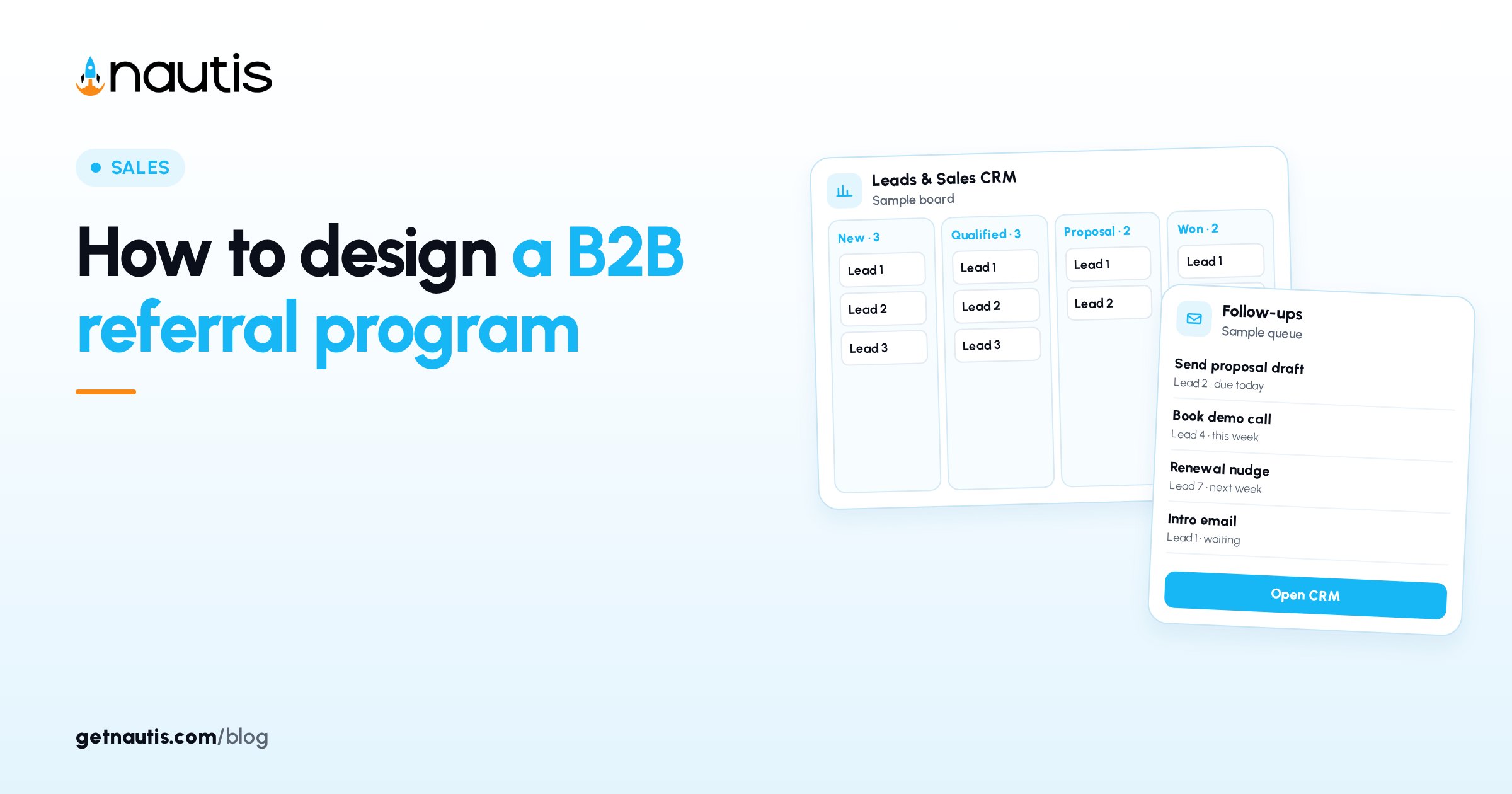
Store the blurb and rules in Notes. Track each referred company in Leads & Sales CRM with Source set to Referral and the referring company named. If you need a small intake form for the referrer to submit a name, keep fields to company, contact, and optional context in Custom forms.
UTM or unique links matter because handshake intros otherwise look identical to cold inbound. Without a tag, finance cannot see which reward is owed and marketing cannot see whether referred pipeline converts differently.
Write the attribution window next to the qualifying event. Example: credit only if the referred company starts a workspace within thirty days of the invite click. Late arrivals can still buy; they simply fall outside the referral reward.
If the invite blurb recommends your product, the reward is a material connection. Ask referrers to disclose it clearly in the message (for example, that they receive credit if a peer becomes a customer). The FTC's Endorsement Guides FAQ states that when an endorser has been paid or given something of value to tout a product, that connection should be disclosed clearly and conspicuously (FTC's Endorsement Guides: What People Are Asking). As of November 2026 that FAQ remains the plain-language place to start. Keep the program about qualified customer intros; do not pay for fake reviews.
Keep Sheets as the payout log: referrer, new account, qualify date, reward, paid date. CRM alone rarely proves finance what to credit.
Ask at the right moment
Ask after value, not after the first login.
Good moments:
- After they thank you for a concrete result
- After they expand seats or renew
- After they say they would recommend you without prompting
Bad moments: during pricing disputes, during an outage, or in the same email as a hard upsell.
Use a single sentence ask: "If a peer is fighting the same problem, we credit a month when they become a paying customer under our written rules. Want the short blurb and link?" Attach the one-pager. Do not negotiate a custom reward on the call unless you update the written rules for everyone.
Run payouts on a fixed cadence
Pick a weekly or monthly hour to clear qualified referrals. Surprises destroy trust.
Cadence step | Owner |
|---|---|
Confirm qualify event hit | Sales or founder |
Confirm exclusions | Founder |
Issue credit or send reward | Finance or founder |
Mark paid in the sheet | Same owner |
Thank the referrer with status | Same owner |
If a referral stalls in trial, send one status note to the referrer with facts, not blame. Then stop pinging them about it.
What not to launch yet
Skip these until the simple loop works.
Skip | Why |
|---|---|
Public marketplace of rewards | You will debug edge cases in public |
Multi-tier partner portals | Ops cost dwarfs early volume |
Auto-pay without a human check | Fraud and self-referrals sneak in |
Different rewards per segment | You cannot explain the program in one breath |
Ship one rule set to ten happy accounts. Count how many invites go out and how many qualify in thirty days. Then adjust the reward or the qualifying event, not both at once.
Measure the loop without vanity
Weekly, count four numbers only:
- Asks sent (founder-initiated referral asks)
- Invites customers actually sent
- Qualified referrals
- Rewards paid
Ignore click counts on the link until invites are flowing. A high click rate with zero qualifies usually means the landing path is wrong or the blurb oversold.
Review the blurb when three referred conversations start with "I thought you did X." Fix the sentence; do not raise the reward to compensate for a confusing pitch.
Connect referral outcomes to the same pipeline stages you already trust. A referred lead that never reaches a first meeting is a process issue, not a reward issue.
A two-week start
Week 1: write the qualifying rule, reward sentence, exclusions, and blurb. Build the sheet columns. Tag the deal Source as Referral in Leads & Sales CRM.
Test the one-pager on a teammate who was not in the drafting meeting. If they cannot restate the qualifying event and the reward in one breath, shorten the page. Complexity is the main reason B2B referral programs stall.
Keep legal review light but real: one pass on the reward language and exclusions. This post is operational, not legal advice; if you offer cash in multiple countries, talk to counsel before you promise payouts.
Week 2: ask five customers who already said something positive. Send the one-pager. Log every invite. Run one payout review even if zero qualified yet, so the muscle exists.
Referral program for B2B stays small on purpose. Clear rules, a short invite, and paid credits on time beat a flashy portal nobody trusts.
When a referral becomes a customer, close the loop with both sides in writing: thank the referrer, confirm the reward date, and tell the new account who introduced them if that is appropriate. Silent success makes people stop referring.
Train anyone who touches onboarding to ask "How did you hear about us?" with Referral as an explicit Source option. Otherwise informal intros never hit the sheet and you will underpay the people who helped you.
Referral program for B2B is a trust product. Slow, clear, and paid on time beats clever.
Publish the rules where referrers can find them without asking you: a short help article or a note linked from the thank-you email after they start paying. Hidden rules feel like a trap even when the reward is fair.
If channel partners already earn commission, keep them on the partner agreement rather than mixing them into the customer referral sheet. Two motions with one budget become arguments.
Quarterly, read the four counts with one question: are we under-asking happy accounts, or over-paying noisy intros? Adjust asks or exclusions before you touch the reward size.
Name the program owner in the one-pager. When credits stall, referrers need one human to ping, not a shared inbox that never replies.
If finance needs a longer hold before credits post, publish that hold in the rules. Silent delays feel like broken promises even when the account eventually gets paid.
Decline to run the program through personal DMs only. If the blurb and link are not findable in a shared note, the motion dies when one founder goes on vacation.
Re-read the one-pager every quarter with finance present so credits, caps, and exclusions still match how you actually pay.
Frequently asked questions
What makes a referral program for B2B work early?
A written qualifying rule, a reward both sides understand, and a short invite path. Vague promises and unpaid credits kill trust with your best accounts.
What should count as a qualified referral?
Usually a new company that hits a paid event you define, inside an attribution window, with exclusions for self-referrals and employees. Write the event in one sentence.
Should we pay cash or account credit?
Credit or extra months is simpler for most early teams. Cash adds payout and tax work. Dual-sided credit can help if the new buyer also needs a nudge.
Do referrers need to disclose the reward?
If their message recommends your product and they receive something of value, the FTC Endorsement Guides FAQ says that material connection should be disclosed clearly and conspicuously. Put a disclosure line in the blurb template.
Sources
- YC's essential startup advice. Checked on November 1, 2026.
- FTC's Endorsement Guides: What People Are Asking. Checked on November 1, 2026.
Baltej Singh is a serial entrepreneur, technology leader, and Founder & CEO of Nautis and DemoVexa, with over 16 years of experience building software products, SaaS platforms, and startups. Previously the Co-Founder & CTO of SanchiConnect, he has worked extensively in the DeepTech startup ecosystem, connecting with 200+ venture capital firms and supporting a network of 4,000+ startups. Passionate about AI, automation, and entrepreneurship, he focuses on building innovative products that solve real-world problems and help businesses grow.